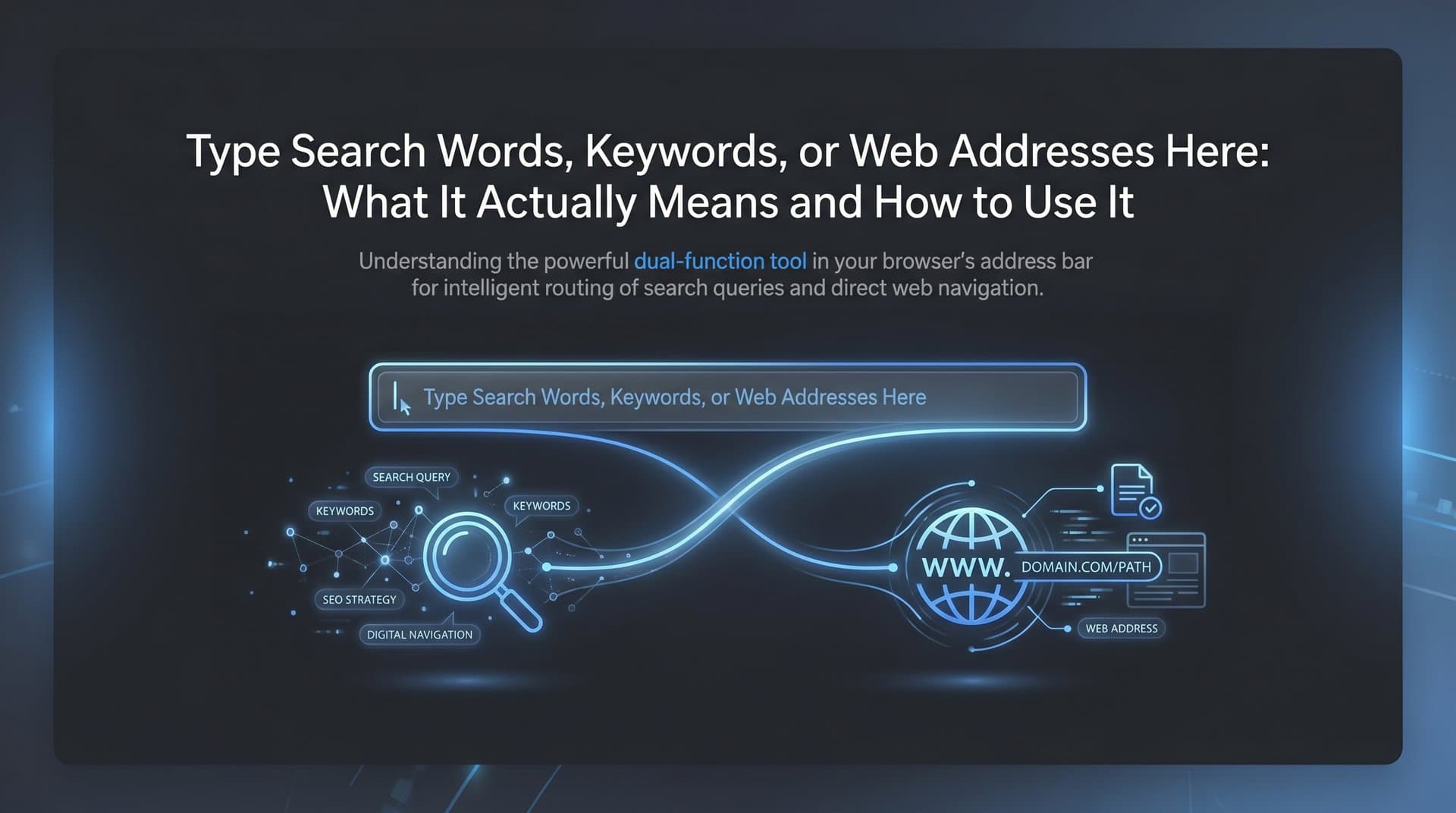
You've seen it thousands of times. You click on your browser, the cursor blinks in that long rectangular bar at the top of the screen, and the gray placeholder text reads: type search words, keywords, or web addresses here. Most people glance past it without a second thought and start typing. But that unassuming line of text is actually a window into one of the most consequential pieces of infrastructure in modern digital life.
That single prompt is doing something remarkable. It's telling you that you can type a destination (a URL, a web address) or a question (a keyword, a search phrase), and the browser will figure out what you mean and take you somewhere useful. Two completely different behaviors, one input field, zero friction. For everyday users, it's invisible convenience. For marketers and SEO professionals, it's a map of how people begin every digital journey.
Understanding what happens behind this prompt, how browsers route your input, how search engines interpret your intent, and how AI platforms are now reshaping the entire discovery layer, gives you a meaningful strategic edge. Whether you're building a content strategy, running keyword research, or trying to make sure your brand surfaces in AI-generated answers, it all starts here, at the browser bar. This guide breaks down the mechanics, the marketing implications, and what you need to do about it in a world where search is rapidly evolving.
The Omnibox Revolution: Why Your Address Bar Does Double Duty
It wasn't always this way. In the early days of web browsers, the address bar and the search bar were two separate things. You typed a URL in one place and a search query in another. They served different purposes, and the browser made no attempt to blur that line.
That changed in 2008 when Google launched Chrome with what it called the "omnibox," a single unified input field that could handle both web addresses and search queries. The name was deliberate: one box to rule them all. Firefox, Edge, Safari, and virtually every other major browser eventually followed suit, and the separation between "navigation" and "search" effectively disappeared from the user experience. For a deeper look at how this unified experience works, see our guide on search or type web address behavior.
But the omnibox isn't just a cosmetic change. It contains real logic. When you type something in the address bar, the browser evaluates your input and makes a routing decision. If it looks like a URL, with a recognizable domain structure, a protocol like "https://", or a known top-level domain, the browser navigates directly. If it looks like a search query, a phrase, a question, a string of words without a clear URL structure, the browser hands it off to your default search engine. And in ambiguous cases, like typing "amazon" or "apple," the browser uses a mix of your browsing history, autocomplete data, and heuristics to decide what you probably meant.
For marketers, this routing logic is not a technical footnote. It's the beginning of user intent. The moment someone places their cursor in that bar and starts typing, they are signaling something: what they want, how they think about it, and how they expect to find it. That signal is the raw material of keyword strategy.
Think about what it means that billions of people use this single interface as their entry point to the web. The phrases they type, the brand names they search, the questions they ask, all of it flows through the omnibox and into search engines where it becomes data. Search volume, keyword trends, autocomplete suggestions: these are all downstream products of the behavior that starts when someone types into the address bar.
Understanding the omnibox also helps explain why branded search matters so much. When a user types your brand name directly into the address bar, they might be navigating to your site or searching for it. Either way, that's a strong signal of brand awareness and intent. It's the kind of behavior that SEO professionals and brand strategists work hard to cultivate, and it all starts with that simple, familiar prompt.
URLs, Keywords, and Search Queries: Knowing the Difference
The browser prompt says "type search words, keywords, or web addresses here," and each of those three things is genuinely distinct. Getting clear on the differences helps you think more precisely about how people find content online, and how to create content that meets them where they are.
A web address (URL) is a direct navigational instruction. When you type "https://www.nytimes.com" or even just "nytimes.com," you're telling the browser exactly where to go. There's no ambiguity, no interpretation needed. The user already knows the destination. This is navigational intent in its purest form. Our article on Google search link to URL explores how search engines handle these direct navigation patterns.
A keyword is a topic signal. It's a word or short phrase that represents a subject area. "Running shoes," "project management software," "tax preparation" are keywords. They're the building blocks of SEO strategy because they represent what people care about, not necessarily what they're searching for right now. Keywords are the categories; search queries are the actual behavior.
A search query is what someone actually types when they want to find something. It's natural language, often longer and more specific than a keyword. "Best running shoes for flat feet under $100" is a search query. It contains keywords, but it also contains context, intent, and specificity that a bare keyword doesn't capture.
The ambiguous cases are where things get interesting. When someone types "amazon" into the address bar, are they navigating to amazon.com or searching for information about the Amazon rainforest? The browser uses context clues: your history, the default search engine's interpretation, and autocomplete patterns. For branded terms, this ambiguity is actually a competitive consideration. If your brand name is also a common word, you face a disambiguation challenge that affects how often you capture direct navigational traffic.
Autocomplete and search suggestions add another layer. As you type, the browser and search engine surface predicted completions based on what millions of other users have searched for. These suggestions are a real-time window into collective search behavior. They show you not just what people search for, but how they phrase it, which is invaluable for content strategy.
Your default search engine setting also shapes everything. A user with Google as their default will have their ambiguous queries routed to Google's results and interpreted through Google's algorithms. A user with Bing or DuckDuckGo will get different results, different autocomplete suggestions, and potentially different brand visibility. For marketers, this is a reminder that "search" is not a monolithic channel. Understanding the various Google search types helps you appreciate the diversity of query interpretation.
How Search Intent Begins in the Browser Bar
Search intent is one of the most important concepts in modern SEO, and it begins the moment someone starts typing. The four commonly recognized types of search intent are navigational, informational, transactional, and commercial investigation, and each one manifests differently in the address bar. For a comprehensive breakdown, our guide on what is search intent in SEO covers each type in detail.
Navigational intent is when someone types a brand name, a partial URL, or a known destination. "YouTube," "Sight AI," "Gmail login" are all navigational queries. The user knows where they want to go; they're just using the browser bar as a shortcut. For brands, navigational search volume is a proxy for brand awareness and loyalty. If people are typing your name directly, they already know you exist and want to find you specifically.
Informational intent is the most common type. The user wants to learn something. "How does the omnibox work," "what is GEO in SEO," "type search words keywords or web addresses here explained" are all informational queries. This is where content marketing lives. Blog posts, explainers, guides, and how-to articles are built to serve informational intent.
Transactional intent signals readiness to act. "Buy running shoes online," "sign up for SEO software," "download keyword research tool" indicate a user who is ready to convert. These queries are high-value for paid search and conversion-focused landing pages.
Commercial investigation sits between informational and transactional. The user is researching before making a decision. "Best AI visibility tools 2026," "Sight AI vs. competitors," "top keyword research platforms" are commercial investigation queries. These users are evaluating options, and well-crafted comparison content or detailed product pages serve them best.
Why does this matter for browser behavior specifically? Because the intent type shapes not just what someone types, but how they type it. Navigational queries tend to be short and brand-specific. Informational queries are often phrased as questions or multi-word phrases. Transactional queries include action words. Recognizing these patterns in your keyword data helps you build content that aligns with where users actually are in their journey, not just where you hope they are.
Navigational queries deserve special attention from a brand strategy perspective. When users type your brand name into the address bar, that's a signal of brand strength. It means your brand has enough recognition that people seek it out directly rather than discovering you through a generic search. Building that kind of navigational demand is one of the goals of brand-building content and AI visibility work, because a brand that gets mentioned frequently across AI platforms and search results is a brand that people eventually start typing directly.
Keyword Research Starts with How People Search
Keyword research is often treated as a technical exercise: pull data from a tool, sort by volume and difficulty, pick your targets. But the most effective keyword strategy starts with a more human question: what do people actually type when they want what I offer? Our deep dive into what is keyword research in SEO explores this foundational question.
The phrases flowing through the omnibox every day are the raw material of SEO and GEO strategy. They represent real demand, real language, and real intent. The goal of keyword research is to decode that behavior and create content that matches it precisely.
Long-tail queries are particularly valuable here. These are longer, more specific search phrases that tend to have lower individual search volume but higher intent and lower competition. "How to track brand mentions in ChatGPT" is more specific than "brand tracking," and the person typing it is much further along in their understanding and closer to taking action. Building content around long-tail queries lets you serve users who know exactly what they need, and those users convert more reliably. Learning how to find low competition keywords is essential for uncovering these high-value opportunities.
Question-based searches are another rich vein. When people type questions into the address bar, they're essentially writing your content brief for you. "What does type search words keywords or web addresses here mean?" is a question that signals a specific informational need. An article that directly answers that question, in the language the user used, is highly likely to rank for it and satisfy the user who finds it.
Branded terms deserve their own research track. Understanding what variations of your brand name people search for, including misspellings, partial names, and brand-plus-modifier combinations, helps you protect your branded search territory and identify gaps where competitors might be capturing traffic that should be yours.
Search volume and competition data help you prioritize. Not every keyword you could target is worth targeting. A keyword with high volume but overwhelming competition from established players may yield less return than a lower-volume term where you can realistically rank in the top positions. The goal is to find the intersection of relevance, intent alignment, and competitive opportunity.
From Browser Bar to AI Search: The New Discovery Layer
Here's where the landscape gets genuinely interesting, and where the stakes for marketers have risen significantly. For decades, the journey from browser bar to answer looked like this: user types query, search engine returns a list of links, user clicks a link. The browser bar was the on-ramp to a highway of blue links.
That model is being fundamentally disrupted. AI-powered search platforms including ChatGPT, Perplexity, Google's AI Overviews, and others are increasingly synthesizing answers rather than simply listing sources. When someone types a question into these platforms, or into a search engine that now incorporates AI-generated responses, they often get a direct answer assembled from multiple sources, with links appearing as citations rather than primary destinations. If your site isn't appearing in these results, our article on AI search engines missing my website explains why and what to do about it.
This changes the game for brand visibility in a profound way. Ranking on page one of Google is still valuable, but it's no longer sufficient on its own. If an AI model synthesizes an answer about your industry and doesn't mention your brand, you've effectively been excluded from that discovery moment, even if you rank well in traditional search. The question is no longer just "do I rank?" but "does AI mention me?"
This is where Generative Engine Optimization, or GEO, enters the picture. GEO is the practice of optimizing your content and brand presence so that AI models include you in their generated responses. It complements traditional SEO rather than replacing it. The fundamentals overlap: authoritative content, clear expertise signals, well-structured information. But GEO adds new dimensions, including how often your brand is cited across the web, how AI models perceive your authority on specific topics, and whether your content is structured in ways that AI systems can easily parse and reference. Understanding the key AI search engine ranking factors is critical for building this new dimension of visibility.
The practical implication is that your content strategy needs to serve two masters simultaneously. Traditional search engines reward keyword relevance, backlink authority, and technical optimization. AI platforms reward comprehensive, accurate, well-cited content that clearly establishes topical expertise. The good news is that truly excellent content tends to perform well on both dimensions. The challenge is ensuring you have visibility into how AI models are actually representing your brand, so you can identify gaps and act on them.
Platforms like Sight AI exist precisely for this reason: to give marketers visibility into how their brand appears across AI models like ChatGPT, Claude, and Perplexity, tracking mentions, sentiment, and the specific prompts that surface brand references. Without that visibility, you're optimizing blind in a channel that's rapidly becoming a primary discovery layer.
Optimizing for Every Type of Search Input
Understanding the theory is one thing. Putting it into practice means auditing your current presence and building a strategy that covers the full spectrum of how people search, from typing your URL directly to asking an AI a question that your brand should answer.
Direct URL and navigational traffic: Make sure your site is technically sound for users who type your domain directly. Fast load times, clear site structure, and a homepage that immediately communicates your value proposition are essential. If users are navigating to you by name, don't lose them to a slow or confusing experience.
Branded keyword searches: Audit what appears when someone searches your brand name. Do you own the top results? Are there competitor ads appearing above your organic listing? Is your brand knowledge panel accurate and complete? Branded search is often the highest-converting traffic you'll receive, and it deserves active management. A solid SEO keywords strategy should always include a branded search component.
Long-tail informational queries: Map your content to the specific questions your audience types. Use keyword research tools to identify question-based queries in your niche, then create content that answers them directly and thoroughly. This is where blog posts, explainers, and how-to guides earn their keep.
AI visibility auditing: Regularly check how AI platforms respond to prompts related to your industry, products, and brand. Are you being mentioned? Are the mentions accurate and positive? What competitors are being cited instead of you? This kind of audit reveals content gaps that traditional SEO tools won't surface. Dedicated AI search optimization tools can automate much of this monitoring process.
Content indexing: Even the best content is invisible if it isn't indexed. Ensure your new content is being discovered quickly by search engines using tools that support IndexNow integration and automated sitemap updates. Speed of indexing matters in competitive niches where freshness is a ranking signal.
GEO-optimized content creation: Structure your content so it's easy for AI models to parse and cite. Clear headings, direct answers to specific questions, well-cited facts, and comprehensive topic coverage all contribute to AI citability. Think of each piece of content as a potential source that an AI might reference when synthesizing an answer.
The through-line across all of these actions is alignment: making sure that however someone searches, whether they type your URL, search your brand name, ask a long-tail question, or prompt an AI, your brand is there with a relevant, accurate, and compelling response.
The Bottom Line
That simple placeholder text, type search words, keywords, or web addresses here, is easy to overlook. It's been part of the browser experience for so long that it fades into the background. But it represents something significant: the starting point of every digital journey, the moment before intent becomes action.
For marketers and SEO professionals, understanding what happens behind that prompt is a genuine strategic advantage. It means knowing the difference between a URL, a keyword, and a search query. It means recognizing the four types of search intent and building content that serves each one. It means understanding that keyword research is really about decoding human behavior, the actual phrases people type when they want something.
And increasingly, it means looking beyond the browser bar entirely. As AI-powered search platforms become a primary discovery layer, the question of where your brand appears has expanded. It's not just about ranking in search results. It's about being cited in AI-generated answers, being recognized by the models that millions of people now turn to for information and recommendations.
The fundamentals haven't changed: know how people search, create content that matches their intent, and make sure your brand is visible wherever answers are delivered. What has changed is the number of places where those answers now appear.
Start tracking your AI visibility today and see exactly where your brand appears across top AI platforms. Stop guessing how models like ChatGPT and Claude talk about your brand, and start using that visibility to uncover content opportunities, close the gaps, and build an organic presence that works across every type of search.