
Finding low-competition keywords isn't some dark art; it's a straightforward, repeatable process. It really comes down to this: identify long-tail phrases with low Keyword Difficulty scores, manually eyeball the search results for weak spots (like forums or super outdated content), and listen in on community discussions for user-generated gold.
This strategy is all about securing quick wins and building momentum before you even think about tackling the big, highly competitive terms.
The Hidden Advantage of Low Competition Keywords

Forget the frustrating chase for high-volume keywords everyone else is fighting over. The traditional SEO playbook often sends new sites down a long, winding road of hard work with very little to show for it. There's a smarter way.
Instead of trying to push through the main gate of a crowded stadium, you're finding a side door. The focus shifts to low-hanging fruit: keywords that are less crowded but hyper-relevant to a specific slice of your audience. This isn't about avoiding competition—it's about being strategic and picking your battles. These keywords are the foundational building blocks that deliver real results, and they do it much faster.
If you want to go deeper on this, there’s a great guide on how to find low-competition keywords that covers some excellent ground.
Building Momentum with Targeted Traffic
The real magic of this strategy is its ability to build topical authority and momentum from the ground up. When you successfully rank for a cluster of related, low-competition terms, you send a powerful signal to Google that your site is a credible source on that subject. This initial traction makes it so much easier to rank for more competitive keywords down the line.
The goal isn't just traffic; it's targeted traffic. Low-competition keywords often capture users with a very specific intent, meaning they are further along in their journey and more likely to convert.
This approach works so well because it mirrors how people actually search. We've seen that long-tail keywords—those specific, multi-word phrases that are naturally lower in competition—drive a staggering 70% of all search traffic.
Think about it. Someone searching for "best running shoes" is browsing. Someone searching for "best trail running shoes for flat feet under $100" is ready to buy. That's why these detailed queries often have conversion rates 2.5 times higher than generic head terms.
Best of all, you're not waiting years to see results. Pages targeting these keywords can realistically hit top rankings in just 3-6 months. If you're curious about the mechanics behind this, we break it down further in our article about understanding organic search keywords.
Why This Strategy Works
The logic is simple: you're meeting far less resistance. While your competitors are busy dumping resources into an all-out war for broad, high-volume terms, you're quietly capturing valuable, high-intent traffic from the edges.
This method pays off in several key ways:
- Faster Rankings: Get on the first page in months, not years. It's a huge morale booster and proves your strategy is working.
- Higher Conversion Rates: You're attracting users with specific problems who are actively looking for a solution.
- Building Topical Authority: Every piece you rank establishes more credibility with search engines, helping all your content perform better over time.
- Sustainable Growth: This creates a compounding effect. Each small win builds on the last, creating a rock-solid foundation for long-term SEO success.
Building Your Keyword Research Toolkit
Before you can start uncovering those hidden gem keywords, you need to arm yourself with the right gear. Having the right software doesn't just make the process faster; it gives you the hard data you need to make smart decisions.
Think of it less like a shopping list and more like building a specialized workshop. Each tool has a specific and critical function, from generating those first seed ideas all the way to deep competitive analysis. It’s not about the brand name on the tool, but what it lets you do.
Core Tools for Keyword Analysis
The foundation of any serious keyword research effort is a solid SEO platform. These tools are what let you sift through thousands of potential keywords to zero in on the handful that are actually worth your time.
My go-to recommendation here is a comprehensive tool like Semrush. It’s an industry standard for a reason, offering a massive keyword database and metrics I trust. But if you're working with a tighter budget, alternatives like LowFruits are fantastic. They are specifically designed to find low-competition keywords and can deliver incredible results without the hefty price tag.
No matter what you choose, here are the non-negotiables:
- Keyword Difficulty (KD) Filters: This is your most important feature. The ability to filter out high-KD keywords instantly cuts through 90% of the noise.
- Search Volume Metrics: You have to know if a keyword has enough interest to be worth chasing. This is essential.
- SERP Overview: A snapshot of the current top-ranking pages is crucial for a quick manual check without having to leave the tool.
Here’s a perfect example of how you can use these filters to immediately narrow down a massive list into something manageable.
This view shows just how powerful it is to apply filters for Keyword Difficulty and volume. You can instantly isolate keywords that fit the low-competition profile you’re looking for.
Your Starting Filter Configuration
To avoid drowning in a sea of data, you need to start with a clear set of filters. This simple setup will give you a list of keywords that you actually have a realistic shot at ranking for.
A great starting point is to set your filters to a Keyword Difficulty (KD) of less than 30 and a monthly search volume of over 100. This combination strikes the perfect balance between achievability and traffic potential.
This isn't a hard and fast rule, but it’s a strategic baseline. It cuts out the hyper-competitive terms while making sure there's enough search interest to make your content effort worthwhile. Semrush's KD metric is great here, as a score under 30% usually signals an easier path to the top. From my experience, a well-optimized page for a keyword with a KD below 20 can get great visibility with way less effort.
For more on this, check out the great discussion on using KD for low-competition keywords at Traffic Think Tank.
Budget-Friendly and Manual Methods
You don't always need an expensive subscription to get going. While paid tools absolutely speed things up, there are plenty of free and budget-friendly options to gather initial ideas and do some basic analysis. Understanding what to look for in SEO tools will help you pick the right mix for your needs and budget.
Consider adding these to your arsenal:
- Google Keyword Planner: It’s built for ads, but it's still a solid source for seed keywords and getting a feel for search volume.
- Google Search Itself: Autocomplete, "People Also Ask," and "Related Searches" are pure gold. These are long-tail keyword ideas coming straight from the source.
- Community Forums: Sites like Reddit and Quora are where your audience lives. They’re invaluable for finding the exact language and questions people are actually using.
My Repeatable Workflow for Uncovering Hidden Gem Keywords
Theory and tools only get you so far. The real magic in finding low-competition keywords comes from building a repeatable workflow—one that blends hard data with a bit of human intuition.
It’s all about knowing where to look for those initial sparks of inspiration and then having a solid process to figure out if they're duds or diamonds. This is where we get our hands dirty.
The whole process boils down to a simple loop: generate ideas, analyze the data, and then filter ruthlessly for the real opportunities.
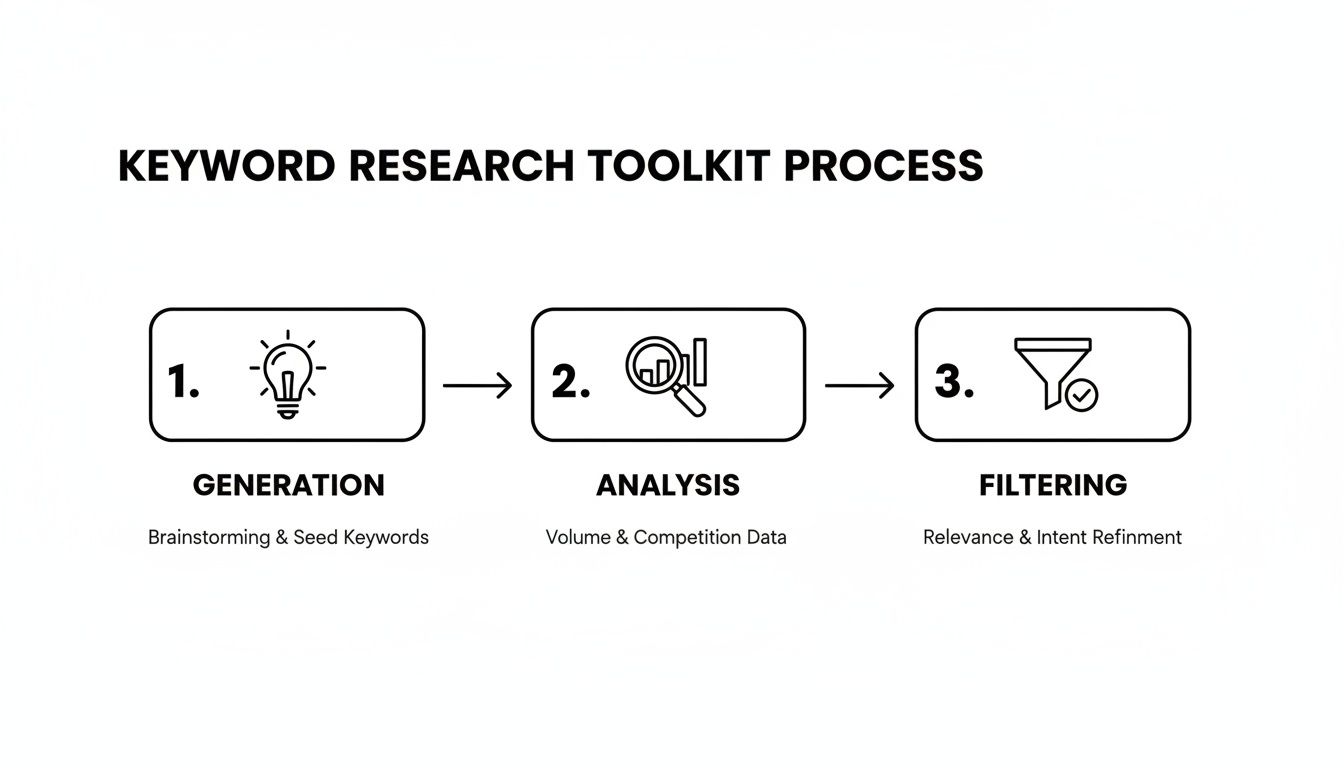
This cycle ensures you're not just pulling random keywords out of a hat. You're systematically uncovering phrases that tap into real user needs and give you a clear path to ranking.
Generate Seed Keywords from Untapped Sources
The best keywords rarely pop up when you're staring at a blank search bar in an SEO tool. They come from the real world—from the actual words your audience is using. Your first job is to put on your detective hat and gather these raw, authentic "seed" keywords.
Most people start and stop their research inside a tool. You can get a massive head start by looking where others don't.
- Mine Customer Pain Points: What questions do your customers actually ask on sales calls? What problems are they describing in support tickets? This stuff is gold. A query like "how to integrate X with Y without a developer" is a high-intent, low-competition keyword just waiting for you.
- Reverse-Engineer Competitor Content: Take a look at your direct competitors, especially newer sites that are ranking surprisingly well. What long-tail topics are they hitting in their blog posts? Don't just glance at their target keyword; read their H2s and H3s for the supporting questions they're answering.
- Become a Forum Lurker: Seriously, spend some time on Reddit, Quora, and niche industry forums. Search for your core topics and see what people are asking. The titles of these threads are often perfectly phrased, long-tail keywords. People are literally telling you what they need to know, in their own words.
These initial seeds give you a much stronger foundation to build on. If you want to go even deeper on creative sourcing, our guide on https://www.trysight.ai/blog/where-to-find-blog-content-ideas has a ton of other unconventional methods.
Expand and Filter with Your Toolkit
Once you have a handful of strong seed keywords, it’s time to head back to your favorite keyword research tool. Plug each seed keyword in and let the tool work its magic, using the "related keywords" or "keyword ideas" feature to expand your list.
This is how you turn your initial 5-10 ideas into hundreds or even thousands of possibilities.
Now, it’s time to clean up the list. Apply the filters we talked about earlier: set a maximum Keyword Difficulty (KD) of 30 and a minimum monthly search volume of 50-100. This instantly gets rid of the impossibly hard terms and the ones with almost no search traffic.
Your goal here isn't to find the perfect keyword just yet. It's to create a manageable, high-potential shortlist of 20-30 candidates that you can investigate by hand.
The Crucial Step: Manual SERP Analysis
This is, without a doubt, the most important part of the entire process. A low KD score is an invitation, not a guarantee. You have to manually analyze the search engine results page (SERP) for every keyword on your shortlist to see what the real competition looks like.
This is where you learn to trust your gut more than the tool's metrics.
Open an incognito browser window and search for each keyword one by one. As you scan the top 10 results, you're hunting for signs of weakness.
Telltale Signs of a Weak SERP:
- Forum Results: If a Reddit or Quora thread is hanging out on page one, that’s a massive green light. Google is basically telling you it couldn't find a better, more authoritative piece of content.
- Low-Authority Sites: Are other small blogs or new websites with a low Domain Rating (DR) showing up? If they can rank, you absolutely can.
- Outdated Articles: Check the publication dates. If the top results are from 2020 or earlier, the topic is ripe for a fresh, more current take.
- User-Generated Content: Pages from sites like Pinterest or community forums signal a serious lack of dedicated, high-quality content on the subject.
- Mismatched Search Intent: Does the SERP show a bunch of product pages when your keyword is clearly informational (or vice versa)? This confusion is your opportunity to create content that perfectly matches what the user actually wants.
When you find a keyword that has a low KD score and two or more of these weak spots on the SERP, you’ve likely struck gold. This is an opportunity you can chase with confidence.
Of course, once you’ve found these gems, you have to execute. Applying strong SEO copywriting best practices is what turns your hard-won keyword into a page-one ranking. This is how you turn solid research into real results.
Alright, you’ve done the heavy lifting—brainstorming, digging through competitor sites, and manually stalking the SERPs. You should have a pretty hefty list of potential keywords by now.
But a long list is just data; it's not a plan. This is the crucial point where we turn that raw potential into an actionable content strategy that actually gets results.
Prioritization is what separates the SEO campaigns that take off from the ones that just spin their wheels. If you don't have a system for deciding what to tackle first, it's way too easy to get distracted by shiny, high-volume keywords that you have no chance of ranking for anytime soon. We need a logical way to score and rank these opportunities to get the quick wins that build momentum.
Creating a Simple Scoring Matrix
Instead of just going with your gut, let's build a simple scoring system. This isn't about some overly complex algorithm; it’s a practical way to give each keyword a numerical value based on what actually matters. By scoring each term across a few key criteria, the best opportunities will naturally float to the top.
All you need is a simple spreadsheet with columns for each factor you want to measure. This scoring matrix will become your single source of truth for your entire content plan.
Here are the essential ingredients for your scoring system:
- Search Volume: Higher is often better, but we’re hunting for the sweet spot, not just vanity metrics.
- Keyword Difficulty (KD): The lower, the better. No exceptions.
- Search Intent Alignment: How well does this keyword actually connect to what you sell or do?
- Content Opportunity: Based on your manual analysis, how weak is the current competition?
Evaluating every keyword against these metrics pulls you out of the guessing game and into a data-informed process. This is especially powerful when you're sifting through hundreds of lower-volume keywords.
Believe it or not, a staggering 94.74% of keywords worldwide get 10 or fewer monthly searches. That just goes to show how many untapped, low-hanging fruit opportunities are out there. A scoring system helps you find the gold in that massive pool.
For example, you could score volume on a 1-5 scale and difficulty inversely from 1-5. A keyword with 300 monthly searches (Volume Score: 4) and a super-low KD (Difficulty Score: 5) would hit a 9/10, making it a much higher priority than a keyword with thousands of searches that you'll be stuck trying to rank on page five for months.
Building Your Prioritization Table
Now, let's turn this idea into a practical tool. You can build this in Google Sheets, Excel, whatever you prefer. The goal is to create a clear, sortable list that tells you exactly what to write next.
The objective isn't to find the 'perfect' keyword. It's to find the best available opportunity for your site right now. A good keyword you can rank for in three months is infinitely more valuable than a great keyword you might rank for in two years.
Here’s a simple template to get you started. The scores from 1-5 are a bit subjective, but the key is to be consistent as you work through your entire list.
Keyword Prioritization Scoring Matrix
This table gives you a practical framework for scoring and ranking your potential keywords. By assigning points based on key metrics, you can easily identify which topics to prioritize for your content calendar.
| Keyword | Search Volume | KD Score | Relevance Score (1-5) | Content Opportunity (1-5) | Total Priority Score |
|---|---|---|---|---|---|
| Example Keyword A | 250 | 15 (5 pts) | 5 | 4 | 14 |
| Example Keyword B | 900 | 28 (3 pts) | 5 | 2 | 10 |
| Example Keyword C | 80 | 8 (5 pts) | 2 | 5 | 12 |
Let's quickly break down how you'd assign these scores:
- KD Score: Flip the script on difficulty. A very low KD (0-15) gets a 5. A tougher one (25-30) might only get a 1 or 2.
- Relevance Score: How perfectly does this term align with your business? A keyword directly tied to your product or service is an easy 5. A broader, top-of-funnel topic might be a 2 or 3.
- Content Opportunity: This score comes directly from your manual SERP analysis. If you spotted multiple weak points like forums or outdated content, give it a 5. If the SERP is solid but you know you can do better, maybe a 3.
- Total Priority Score: Just add up the points from the KD, Relevance, and Opportunity columns.
After you've scored all your keywords, sort the list by the "Total Priority Score" column from highest to lowest. And just like that, you have a prioritized content roadmap.
The keywords at the top are your golden tickets—they offer the best blend of low competition, high relevance, and a clear shot at ranking. This systematic approach ensures your team is always focused on creating content with the highest potential impact, helping you build that crucial SEO momentum much faster. Of course, once you start publishing, you'll need to know how to track keyword rankings to measure your success.
Common Mistakes to Avoid in Keyword Research
Even the sharpest keyword strategy can fall flat because of a few common, yet critical, mistakes. Knowing these pitfalls is just as important as knowing the right steps to take. It’s all about learning from the hard-won lessons of others so you can sidestep the traps that sabotage great research.

The road to finding low-competition keywords is paved with misleading signals and easy assumptions. If you can steer clear of these frequent missteps, your efforts will translate into real traffic and rankings, not just wasted hours on content that never sees the light of day.
Blindly Trusting Tool Metrics
The single biggest mistake I see is taking tool metrics as gospel. A low Keyword Difficulty (KD) score can feel like a siren's call, luring you toward a keyword that seems like a guaranteed win. But that number almost never tells the whole story.
I’ve seen keywords with a KD of 15 where the SERP is an impenetrable fortress of massive, household-name brands. The ranking pages might not have a ton of backlinks (hence the low KD), but the sheer domain authority and brand power of sites like Forbes, Wikipedia, or a major industry leader make them nearly impossible to dislodge.
This is exactly why manual SERP analysis is non-negotiable. You have to look past the numbers and see the real-world competition. Is the SERP filled with giants, or are there actual weak spots like forum threads and outdated articles?
A low KD score is an invitation to investigate, not a guarantee of success. Your eyes are the final, and most important, filter.
Mismatching Content to Search Intent
Another classic blunder is creating the wrong type of content for a keyword. You might find a fantastic low-competition term and pour your soul into a 2,000-word masterpiece, only to watch it languish on page four. Why? Because Google knows people searching that term don't want an article—they want product pages.
Take a query like "waterproof hiking boots for women." This is overwhelmingly commercial. Searchers want to see grids of boots they can compare and buy right now. A blog post titled "The Ultimate Guide to Waterproof Hiking Boots" is almost guaranteed to fail because it completely misunderstands what the user is trying to do.
Before you write a single word, Google the keyword yourself. Look at the format of the top-ranking results.
- Informational Intent: You'll see blog posts, guides, and "how-to" articles.
- Commercial Intent: The results will be packed with product category pages, review roundups, and e-commerce sites.
- Navigational Intent: The top result is almost always the official website for a specific brand.
Creating content that doesn't align with the dominant intent is like trying to fit a square peg in a round hole. It simply won't work.
Falling into the Cannibalization Trap
As your site gets bigger, it's dangerously easy to create multiple articles that compete against each other for the same keyword. This is keyword cannibalization, and it sends confusing signals to Google. When you have two pages targeting "best budget coffee maker," Google doesn't know which one to rank. The result? It often ranks neither of them well.
This usually happens by accident when you're creating content on closely related topics. For instance, you might end up with separate posts for:
- "best coffee makers under $50"
- "top affordable coffee machines"
- "cheap coffee maker reviews"
To a search engine, these all target the same fundamental need. A much better approach is to consolidate these into one powerful, comprehensive guide that targets all the variations. Regularly audit your existing content to find and merge pages that are fighting each other for SERP visibility. This simple act of house-cleaning can often give your primary page a significant ranking boost.
FAQs About Low-Competition Keywords
As you start digging for these keyword gems, a few questions always pop up. It’s one thing to know the theory, but it's another to handle the real-world situations that will inevitably come your way. Let's run through some of the most common "what-ifs" I hear all the time.
How Long Does It Take to Rank for a Low-Competition Keyword?
Realistically, for a new or growing site, you can expect to see movement onto the first page within 3 to 6 months. There's no magic number, but that's a massive advantage compared to the 12+ months you might be waiting for a high-competition term.
Your timeline will definitely hinge on the quality of your content, your site's overall health, and just how weak the competition really is. But the big takeaway is this: these keywords give you a real shot at gaining traction fast. Seeing those early wins is a huge motivator. For a deeper dive into the mechanics, our guide on how to get organic traffic has you covered.
What Is a Good Monthly Search Volume to Target?
For most niches, the sweet spot is somewhere between 50 and 500 monthly searches. This range is big enough to drive valuable, targeted traffic but small enough to fly under the radar of the big players chasing massive volume.
Don't get caught up in vanity metrics. Seriously. Ranking #1 for ten different keywords that each get 100 searches a month is way more achievable—and valuable—than being stuck on page three for a single term with 10,000 searches. The goal here is to build up a collection of targeted traffic streams.
Can I Find These Keywords for Free?
Absolutely, but you'll have to trade money for time and a bit of detective work. If you know where to look, you can definitely unearth some great low-competition keywords without spending a dime.
Here are a few free methods that actually work:
- Google's Built-In Tools: Use Google Autocomplete, the "People Also Ask" boxes, and the "Related Searches" at the bottom of the SERP. These are long-tail ideas coming straight from the source.
- Community Goldmines: Forums like Reddit and Quora are fantastic. Search your core topics and just read the thread titles. They're often perfectly phrased, long-tail keywords that represent what real people are asking.
- Manual Competition Check: To get a rough idea of competition, use the
allintitle:"your keyword"search operator in Google. If you see a low number of results—under 500 is a good sign—it often points to weaker competition.
Free methods are great for brainstorming, but paid tools are built to speed up the data analysis. They save you a ton of time.
Should I Avoid a Keyword if Big Brands Are on the SERP?
Not necessarily. This is where you have to put on your analyst hat and really look at the SERP. If the entire first page is dominated by household names like Forbes or Amazon with perfectly optimized articles, then yeah, you should probably find another hill to climb.
But the real opportunity is in a mixed SERP. If you see one or two big brands sprinkled in with weaker sites, forum results, or outdated articles, that's your opening. You don't have to beat everyone. You just need to find one weak link and provide a much better answer than they do to sneak onto the first page.
Ready to stop the manual busywork and put your content strategy on autopilot? IndexPilot turns your keyword list into compounding organic traffic by handling everything from research and writing to optimization and publishing. Discover how our AI agents can build your SEO growth engine.