An effective SEO keywords strategy isn't just about chasing high-volume terms. It’s a detailed plan for understanding what your audience actually wants, mapping those needs to your business goals, and creating content that cements your topical authority. The whole point is to attract not just any traffic, but the right traffic—the kind that converts.
Building Your Strategic Foundation
A winning SEO keywords strategy never starts in a keyword research tool. It starts with a dead-simple understanding of your business objectives and the audience you're trying to help.
If you skip this step, you risk creating a mountain of content that generates meaningless traffic. We’ve all seen it: clicks that never, ever translate into customers. The real goal is to build a framework where every single keyword you target serves a clear purpose in your customer's journey.
This is the core of modern SEO. We've moved past hunting for individual keywords and shifted our focus to building topical authority. That means covering a subject so completely that Google has no choice but to see your site as the go-to expert. If you're new to this, a simple guide on what is SEO and how it works can provide the essential groundwork for these more advanced strategies.
From Business Goals to Keyword Concepts
First things first: connect your big-picture business goals to tangible content themes. Are you trying to boost free trial sign-ups for your SaaS product? Or maybe drive sales for a specific e-commerce category? Your answers here will directly shape the keywords you go after.
- Define Your Audience: Who are you really trying to reach? What keeps them up at night? Figure out their pain points, challenges, and goals. Even simple personas can keep your thinking sharp.
- Identify Core Topics: Brainstorm the main subject areas where your expertise and your audience's needs collide. Think of these as your content pillars.
- Map the Search Journey: Put yourself in their shoes. What do they search for when they're just becoming aware of a problem (informational queries)? What about when they're comparing solutions (navigational/commercial)? And finally, when they're ready to buy (transactional terms)?
This process helps you build out a semantic keyword universe—a structured web of related terms and ideas that truly reflect your niche. For a deeper look at this, check out our guide on building an SEO content strategy that ties directly into this foundational work.
A keyword strategy built on business goals ensures your SEO efforts contribute directly to the bottom line. It transforms SEO from a marketing task into a core driver of business growth.
The diagram below shows how this foundational process works, moving from high-level goals down to specific content pillars.
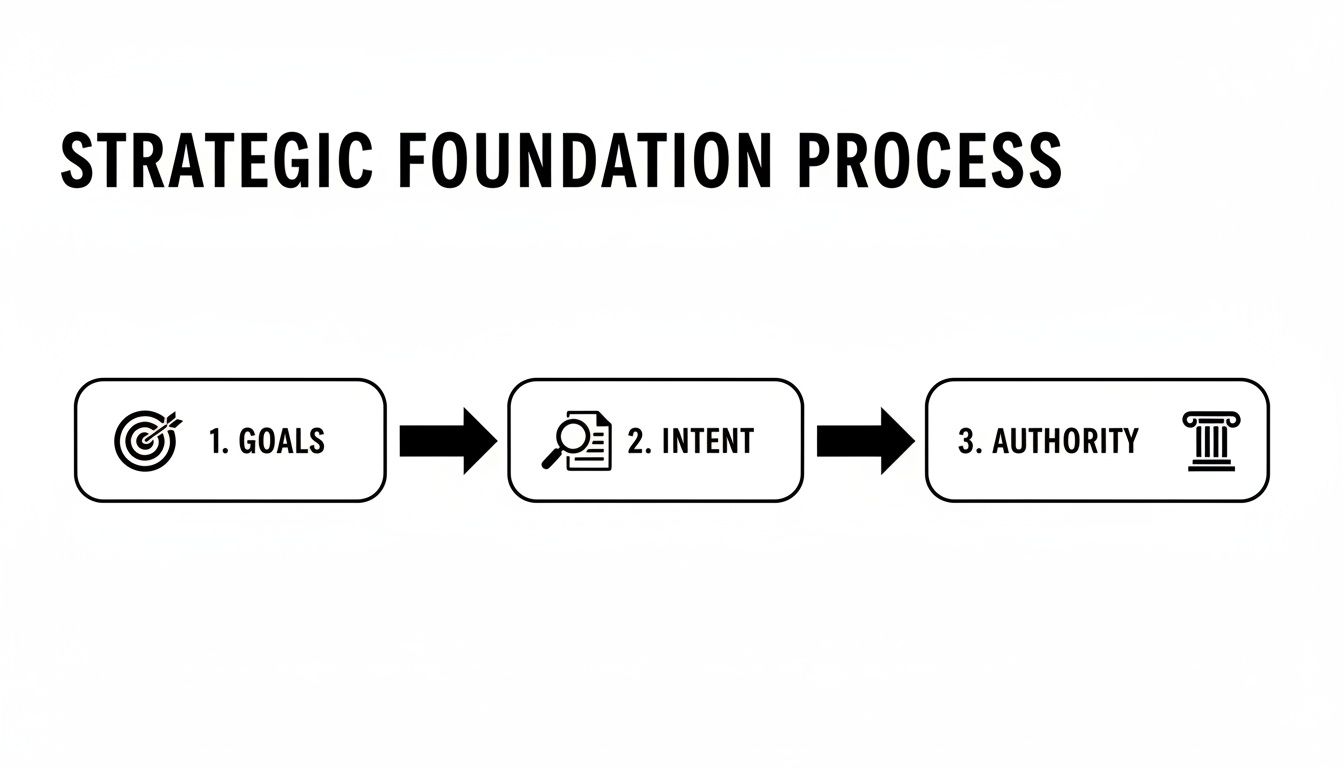
This flow visualizes how tangible business objectives inform your understanding of user intent, which in turn guides the content you create to build lasting topical authority.
Mastering Keyword Research and Intent Analysis

Alright, with our strategic foundation set, it’s time to get our hands dirty and find the actual phrases your audience is using. This isn't just about pulling a list of terms from a tool. It's about getting inside your customers' heads and decoding the why behind every single search they make. That empathy is the bedrock of any keyword strategy that actually works.
The first step is to build out a "seed list" of potential keywords, but don't just jump into the usual tools. The best, most authentic ideas often come from listening in on real conversations.
- Competitor Analysis: Start by looking at what your direct and indirect competitors are ranking for. Tools like Ahrefs or Semrush are great for this, showing you their top-performing pages and the keywords driving that traffic. It gives you an immediate baseline of what’s working in your space.
- Community Mining: This one's a goldmine. Dive into forums like Reddit, Quora, and niche industry groups. Pay close attention to the exact language people use when they're describing their problems or asking for help. It’s raw, unfiltered keyword insight.
- AI-Powered Discovery: To really speed things up, platforms like Sight AI can analyze thousands of data points to surface content gaps and keyword opportunities you’d likely miss with manual research alone.
This initial list is just the raw material. The real magic happens when you start analyzing user intent.
Decoding the Four Types of User Intent
Honestly, if you get one thing right, let it be this. Understanding intent is completely non-negotiable. Every single search query falls into one of four main categories, and if your content doesn't perfectly match what the user is trying to do, even a #1 ranking is worthless.
Below is a simple framework I use to classify keywords. It helps connect the dots between what someone types into Google and the kind of content we need to create to satisfy their goal.
Keyword Intent Analysis Framework
| Intent Type | User Goal | Example Keywords | Ideal Content Type | Funnel Stage |
|---|---|---|---|---|
| Informational | To find an answer or learn something. | "what is a topic cluster," "how to improve email open rates" | Blog Posts, "How-To" Guides, Infographics | Top of Funnel |
| Navigational | To find a specific website or page. | "Sight AI blog," "Ahrefs keyword explorer login" | Homepage, Branded Pages, Login Portals | N/A |
| Commercial | To research and compare options before buying. | "best SEO rank tracking tools," "Sight AI vs Semrush" | Comparison Articles, Reviews, Case Studies | Middle of Funnel |
| Transactional | To complete an action, like buying or signing up. | "buy project management software," "Sight AI free trial" | Product Pages, Pricing Pages, Demo Forms | Bottom of Funnel |
Thinking about keywords this way helps you map everything to a specific stage in the buyer's journey. You're not just creating content; you're building a path that guides a user from their first question to their final purchase.
By understanding these distinct intent types, you create a seamless experience that guides users from initial awareness all the way to conversion. It’s about meeting them exactly where they are.
Prioritizing High-Value Long-Tail Keywords
It's always tempting to go after those high-volume "head" terms like "SEO" or "marketing." But the real strategic wins? They're found in long-tail keywords. These are the longer, more specific phrases—usually three or more words—that reveal crystal-clear intent.
Sure, long-tail keywords have lower search volume individually, but they are far less competitive and convert at a much higher rate. In fact, long-tail keywords deliver conversion rates around 2.5× higher than their short-tail counterparts. This is because a staggering 91.8% of all search queries are long-tail.
Think about it: someone searching with more specific language is much further along in their decision-making process. The data backs this up, showing that these specific queries have a 3-5% higher click-through rate because users are more engaged and ready to act. You can find more stats like this over at Keyword.com.
It’s the difference between someone searching for "shoes" (just browsing) versus someone searching for "men's waterproof trail running shoes size 11" (ready to buy). Your job is to create the content that precisely meets that very specific need.
We cover this in more detail in our complete guide to keyword research for organic SEO, but the bottom line is this: by focusing on these high-intent, lower-competition phrases, you can start winning valuable traffic much, much faster.
Build Topical Authority with Content Clusters
So, you've got a massive list of keywords. That's a good start, but let's be honest—without a clear structure, it's just a bunch of noise in a spreadsheet. If you really want to dominate your niche and show Google you're an expert, you need to organize your keywords and content strategically.
This is where the topic cluster model shines. It’s a framework that shifts your focus from targeting disconnected, individual keywords to building a powerful network of interconnected content. It's how you become the go-to resource on a subject.
Think of it like building your own little library or knowledge hub. You start with a big, comprehensive piece at the center—the pillar page—and then create multiple, more detailed articles that branch off from it, exploring specific subtopics.
Pillar Pages vs. Cluster Content
The model is built on two core components that work together to create a seamless user experience and a killer internal linking structure.
Pillar Pages: This is the heart of your cluster. It's a long-form, all-encompassing guide that gives a broad overview of your main topic. A classic example would be something like, "The Ultimate Guide to Project Management Software." It touches on all the key aspects of the topic without getting lost in the weeds on any single one.
Cluster Content: These are the spokes of your content wheel. Each piece is a deep dive into a specific, long-tail keyword related to your pillar topic. Following our example, cluster content could be articles like, "Best Project Management Tools for Small Teams," "How to Create a Project Timeline," or "Agile vs. Waterfall Project Management."
Every piece of cluster content links back up to the main pillar page. In turn, the pillar page links out to all its supporting articles. This creates a dense, logical web of internal links that funnels authority to your most important pages and makes it incredibly easy for users to navigate your site.
We get into the nitty-gritty of this in our deep dive on what is keyword clustering and its strategic perks.
When you organize your content this way, you’re not just writing articles; you're building a library. This structure makes it incredibly easy for both search engines and users to understand the depth of your expertise on a given subject.
Mapping Keywords to Your Content Architecture
Now for the fun part: mapping your keyword research to this framework. Kick things off by identifying the core business topics you want to own. These high-level subjects are destined to become your pillar pages.
From there, start grouping your related long-tail and semantic keywords into logical sub-themes. Each of these sub-themes becomes the foundation for a piece of cluster content. Depending on how broad the topic is, a single pillar page might have anywhere from 10 to 30 cluster articles supporting it.
Let's say your pillar is "email marketing." Your clusters might look something like this:
- Email deliverability best practices
- How to write compelling email subject lines
- Choosing the best email marketing platform
- Segmentation strategies for e-commerce
- A/B testing email campaigns
This structured approach gives every keyword a specific home and a clear purpose in your content plan. It stops you from creating redundant content and helps you build a powerful, interconnected asset over time.
This dashboard from Sight AI shows how you can track topics where you’ve already established visibility, which is a great way to find new cluster opportunities.
A visual like this quickly pinpoints which themes are performing well and, more importantly, where you have content gaps. This allows you to strategically build out new clusters and strengthen your authority.
Platforms like Sight AI can seriously speed this whole process up. Instead of spending hours manually sifting through thousands of keywords, AI-powered tools can automatically group them into semantically related clusters based on search intent. This not only saves a ton of time but also uncovers relationships between keywords a human might miss, leading to a much more robust SEO strategy.
Turning Your Strategy into High-Ranking Content

Alright, you've done the heavy lifting and now have a structured plan built around topic clusters. So, what's next? This is where the magic happens—where your SEO keyword strategy transforms from a spreadsheet into actual content that climbs the rankings and brings in real business.
The mission is simple: create articles that are not just optimized but genuinely helpful and engaging. Forget the old days of keyword stuffing. Modern on-page SEO is all about naturally weaving your primary keyword and its variations into a story that clicks with your audience and satisfies their intent.
And of course, staying on top of algorithm changes is non-negotiable, especially when you're navigating Google's Helpful Content Update. The golden rule remains: create content for people, not just for search engine crawlers.
On-Page SEO Essentials Checklist
Before you even think about hitting that "publish" button, every article needs a quick but critical on-page SEO check. This isn't just about ticking boxes; it's about sending crystal-clear signals to search engines about what your page is about and why it deserves a top spot.
A well-structured article is simply easier for both people and search bots to understand. It starts with a few foundational elements that, frankly, too many marketers overlook in the rush to get content out the door.
Here’s what you absolutely can't skip:
- Compelling Title Tag: This is your first impression in the search results. It needs to include your primary keyword (ideally near the front) and be written to practically beg for a click. Think high CTR.
- Engaging Meta Description: While it's not a direct ranking factor, your meta description is your sales pitch in the SERPs. Keep it concise (around 155 characters), pop your keyword in there, and add a compelling call-to-action.
- Logical Header Structure: Every page needs one—and only one—H1 tag for the main title, featuring your primary keyword. From there, break up the content with H2s and H3s that include your secondary keywords and related terms.
- Optimized Image Alt Text: Don't neglect your images. Every single one needs descriptive alt text. It’s a huge win for accessibility and gives search engines another clue about your page’s topic.
- Strategic Internal Linking: This is key. Link from your new cluster content back to your main pillar page. Just as important, find opportunities to link to other relevant articles within the same topic cluster to spread that link equity around your site.
The Financial Impact of Strategic Content
Executing a keyword strategy isn't just a marketing task; it's a direct investment in business growth with a surprisingly clear financial return. When companies truly commit to producing high-quality, targeted content consistently, the results can be massive. We're talking an average ROI of 748% for a comprehensive strategy, a figure that completely overshadows the 16% ROI from more basic content efforts.
In fact, 49% of marketers credit organic search for providing the highest ROI among all marketing channels. It's solid proof that a meticulous on-page SEO process pays off in a big way.
This just goes to show that the time you put into optimizing every single piece of content translates directly into measurable financial gains. It solidifies SEO's role as a primary revenue driver, not just a cost center.
Streamlining Content Creation with AI
Let's be real: creating top-tier, optimized content consistently and at scale is a huge challenge. This is exactly where AI assistants and solid content briefs become your secret weapons. A great brief is the blueprint for your article, making sure your writers know the target keyword, user intent, necessary subtopics, and where to place internal links.
AI tools like Sight AI can put this entire workflow on hyperdrive. In just a few minutes, they can analyze what's already ranking at the top and generate a data-driven outline for you, complete with suggested headers and questions to answer. This ensures your article is comprehensive right from the get-go. From that point, AI can help you draft sections, polish the final copy, and make sure your keywords are integrated naturally.
By pairing a solid SEO content brief template with smart AI assistance, you build a repeatable system for cranking out content that hits all the right notes for both quality and optimization. It's how you execute your strategy faster and more effectively.
Tracking Performance and Refining Your Approach
Launching your SEO keyword strategy is a huge milestone, but honestly, it’s only the halfway point. A strategy that isn’t measured is just a collection of assumptions. The real growth comes from creating a continuous feedback loop where you track what’s working, ditch what isn’t, and double down on your wins.
This is where you shift from execution to refinement. The goal isn't just to pump out more content; it's to make smart, data-driven decisions that actually move the needle.
Pinpointing Your Key Performance Indicators
To measure success, you first need to define what it looks like. While vanity metrics like impressions might feel good, they don't pay the bills. You need to focus on the KPIs that tie directly back to business outcomes.
Here are the metrics I always keep a close eye on when evaluating a keyword strategy:
- Organic Traffic Growth: Is your overall non-paid traffic climbing month-over-month and year-over-year? This is your top-level health check.
- Keyword Rankings: Are your target pages actually moving up the SERPs for their primary and secondary keywords? You're looking for consistent upward momentum here.
- Click-Through Rate (CTR): What percentage of people who see your page in the search results click on it? A low CTR is often a red flag that your title tags and meta descriptions need a refresh.
- Conversions from Organic Search: This is the bottom line. How many people coming from organic search are completing a goal, like signing up for a trial or buying a product?
Monitoring these in tools like Google Analytics and Google Search Console is non-negotiable. But for a more granular view, specialized platforms are essential for effective SEO rank tracking and seeing how you stack up against the competition.
A great strategy is dynamic. It adapts to performance data, algorithm updates, and shifts in user behavior. If you set it and forget it, you're guaranteeing it will become outdated.
To keep everything organized, it helps to track these metrics in a centralized place. Here’s a simple breakdown of what matters most.
Essential SEO Keyword Strategy KPIs
| Metric | What It Measures | Why It's Important | Primary Tools |
|---|---|---|---|
| Organic Traffic | The total number of visitors arriving from non-paid search results. | The primary indicator of overall SEO health and brand visibility. | Google Analytics, Adobe Analytics |
| Keyword Rankings | The position of your pages in SERPs for specific target keywords. | Directly shows progress and visibility for your most important terms. | Sight AI, Ahrefs, Semrush |
| Click-Through Rate (CTR) | The percentage of impressions that result in a click to your website. | Indicates how compelling your SERP snippet (title/meta) is to users. | Google Search Console |
| Organic Conversions | The number of goal completions (e.g., sales, sign-ups) from organic visitors. | The ultimate measure of SEO ROI, connecting traffic to business value. | Google Analytics, HubSpot |
| Bounce Rate | The percentage of visitors who leave after viewing only one page. | Can signal a mismatch between user intent and your content's value. | Google Analytics |
Tracking these KPIs consistently will give you a clear picture of what’s working and where you need to adjust your focus.
Conducting Regular Content Audits
Let's be real: not every piece of content you publish will be a home run. That's why a regular content audit—I recommend doing one quarterly—is your chance to systematically review performance and find opportunities. This is how you spot underperforming pages that are ripe for a refresh.
Look for pages with declining traffic, tanking keyword rankings, or low engagement. Once you've got your list, you can decide what to do next.
- Refresh and Update: Can you add new information, update some stats, or drop in more internal links to breathe new life into an old post? This is often the easiest win.
- Consolidate and Redirect: Do you have multiple articles nibbling at the same topic? Combine them into one powerhouse piece. This can seriously improve rankings and the user experience.
- Prune and Remove: Is the content hopelessly outdated and irrelevant? Sometimes, the best move is to just delete it and redirect the URL to a more relevant page.
This continuous refinement is crucial. Brand-associated keyword searches are a powerful trend, and they directly influence how search engines see your authority. For example, businesses with strong keyword ranks typically rank 1.5 spots higher than their competitors. Since 70% of all clicks go to the first five organic results, those small gains from a content refresh can be incredibly valuable. This data, highlighted in emerging SEO trends on marketermilk.com, just reinforces the idea that you can't just create content—you have to actively manage its performance over time.
Common Questions About SEO Keyword Strategy

Even with the best roadmap in hand, some questions always come up when you start putting a keyword strategy into action. It's totally normal to get stuck on the little details that can make or break your success.
Let's clear the air. This section tackles the most common questions we get, with direct, no-fluff answers to help you move forward with confidence.
How Many Keywords Should I Target Per Page?
This is a classic question, but thinking about a magic number of keywords is a bit of an outdated approach. It's much more effective to think in terms of a "keyword cloud" or a thematic group for each page you create.
Every piece of content should have one primary keyword. This is your north star, the main topic. It should feel natural in your title tag, your H1 heading, and somewhere in the first 100 words. Simple.
From there, you'll want to weave in 3-5 secondary keywords throughout the rest of the page. These aren't just random words; they're closely related long-tail variations or semantic phrases that add critical context and depth for both users and search engines.
- Pillar Pages: A massive, comprehensive pillar page might naturally rank for dozens of long-tail variations because its whole purpose is to be the ultimate guide on a broad topic.
- Cluster Content: A more focused blog post (like the one you're reading now) will perform best with one primary keyword and a handful of those supporting, semantic variations.
The goal isn't to check a box or hit a quota. The real goal is to create a piece of content so thorough that it completely satisfies what the user was looking for, maybe even answering follow-up questions they hadn't thought of yet.
How Long Until an SEO Keywords Strategy Shows Results?
Ah, the million-dollar question. The honest-to-goodness answer is: it depends. How quickly you see real results from your SEO strategy hinges on a few key things.
Factors like your website's current authority, how competitive your keywords are, and how consistently you're publishing high-quality content all play a huge role. A brand-new website will always have a steeper hill to climb than an established domain with years of great content under its belt.
But to give you a rough idea, here’s a general timeline:
- 3 to 6 Months: You should start to see the first glimmers of hope. Think more impressions in Google Search Console and some rankings climbing for your less competitive, long-tail keywords.
- 6 to 12 Months: This is typically when the magic starts to happen. You should see a real, tangible impact on your organic traffic and maybe even leads, especially for the more important keywords you're targeting.
Consistency is the engine of any successful SEO strategy. Publishing a few articles and then stopping is a recipe for failure. Sustained, regular publication of high-quality, optimized content is what builds momentum and authority over time.
What Is the Difference Between SEO and PPC Keywords?
While they both revolve around keywords, the way you use them in SEO versus PPC (Pay-Per-Click) is fundamentally different. Getting this distinction right is crucial for a well-rounded marketing plan.
SEO keywords are all about the long game. You use them to optimize your website and content to earn organic (unpaid) rankings. The goal is to build sustainable, long-term traffic by being the most valuable and relevant result for a search query. The research is deep, focusing on user intent and creating comprehensive resources.
PPC keywords, used in platforms like Google Ads, are about immediate results. You're bidding on keywords to have your ad show up right at the top, right now. The goal is instant traffic and conversions, so the research is laser-focused on commercial intent since every single click costs you money.
The smartest approach? Let them work together. You can use a small PPC budget to test how well a new keyword converts before you invest the significant time and resources it takes to rank for it organically.
How Can AI Tools Improve My Keyword Strategy?
AI tools have become a massive force multiplier in modern SEO, supercharging just about every step of building a keyword strategy. They chew through tedious tasks and surface data-driven insights that would be almost impossible to find by hand.
You can feel AI's impact across the entire workflow:
- Research: AI can analyze thousands of competitor pages in minutes, revealing their entire keyword playbook and spotting high-value content gaps for you to attack.
- Clustering: Forget spending days in a spreadsheet. Advanced algorithms can instantly group thousands of keywords into tight, semantically-related topic clusters.
- Content Creation: AI can generate incredibly detailed, SEO-optimized outlines and even solid first drafts based on your target keywords and an analysis of what's already ranking.
- Performance Monitoring: The game has changed. AI platforms can now track your visibility not just in Google, but in the answers of AI chatbots, revealing entirely new threats and opportunities for your brand.
At the end of the day, AI helps you execute a smarter, more effective keyword strategy much faster and at a much larger scale. It’s a serious competitive advantage.
Ready to turn AI visibility insights into high-ranking content and measurable growth? Sight AI monitors how AI models talk about your brand and surfaces the exact content gaps you need to fill. Our AI-powered platform helps you research, outline, and produce SEO-optimized articles at scale, so you can dominate search and AI chat.
Discover your content opportunities at https://www.trysight.ai.