Keyword research is all about figuring out the exact words and phrases real people are typing into search engines. It's like learning your customer's language so you can speak directly to their needs. This isn't just a task; it's the absolute foundation of any smart SEO strategy.
What Is Keyword Research and Why It Matters
Imagine you've invented the world's best fishing rod, but you show up at a market where everyone is shouting for "casting sticks." You have the perfect product, but because you're not using their language, you're completely invisible.
That's exactly what happens when you skip keyword research. You're just guessing what your audience wants instead of knowing for sure.
At its core, keyword research closes the gap between what your business offers and what your potential customers are looking for. It turns your content strategy from a shot in the dark into a precise plan built to attract the right kind of traffic. When you get this right, you can:
- Create content that solves actual problems and answers specific questions.
- Line up your business goals with what your audience truly needs.
- Pull in qualified traffic from people actively searching for your solutions.
- Spot untapped opportunities and get a leg up on the competition.
The Foundation of a Strong SEO Strategy
Good keyword research is way more than just grabbing a list of terms and stuffing them into your articles. A solid strategy involves digging into key metrics to figure out which keywords are actually valuable for your business. For a deeper dive, this guide on What is Keyword Research in SEO is a great place to start.
The screenshot below from a keyword tool shows you exactly what this looks like in practice.

This data doesn't just tell us what people search for; it shows us how tough it might be to rank for those terms and how many people are looking each month. Understanding these details is the key to finding the right organic search keywords to build your strategy around.
How Keyword Research Drives Your Entire SEO Strategy
Trying to build a house without a blueprint is a recipe for disaster. You could have the best materials and the most skilled crew on the planet, but without a plan, you'd end up with a mess—a structure that's unstable and completely misses the point.
Keyword research is that blueprint for your entire SEO strategy. It provides the essential structure and direction for everything you do.
Without it, you’re just guessing. You might write a brilliant article, design a beautiful webpage, or launch an expensive ad campaign, but if none of it aligns with what your audience is actually searching for, your efforts will be wasted. It’s the difference between shouting into an empty room and having a meaningful conversation with potential customers already looking for you.
Keyword research transforms your SEO from a game of chance into a data-driven science. It ensures that every piece of content you create, every page you optimize, and every link you build serves a clear purpose—to connect with a real audience and achieve specific business goals.
This foundational process touches every single aspect of your online presence. It tells you what content to create, how to structure your website, and even which technical SEO fixes to tackle first.
Connecting Research to SEO Actions
Good keyword research gives your marketing team a clear roadmap. The insights you uncover will directly shape several key areas, making sure all your efforts work together to improve organic traffic and spark real growth.
- Content Creation: It reveals the exact topics, questions, and pain points your audience has. This is your green light to create blog posts, guides, and videos that directly answer their needs, positioning your brand as a helpful authority.
- On-Page SEO: Keyword data tells you how to optimize your titles, meta descriptions, and headers. It helps you speak the same language as your audience on your most important pages, which is a huge relevance signal to search engines.
- Technical SEO: When you know your most valuable keywords, you know which pages are most important. This helps you prioritize your site architecture, ensuring your money-making pages are easy for search engine crawlers to find, index, and understand.
Ultimately, keyword research isn't just about finding search terms; it's about understanding people. This means digging into search intent—the "why" behind every query. For example, data shows that a whopping 52.65% of Google searches are informational, while only a small fraction are ready-to-buy transactional queries. Knowing this helps you create the right content for the right person at the right time. You can learn more by checking out these other search intent and SEO statistics.
Understanding Search Intent to Attract the Right Visitors
Imagine two coffee shops on the same street. One has free Wi-Fi and quiet corners, perfect for remote workers who linger for hours over a single latte. The other is all about quick service and grab-and-go pastries, catering to busy commuters. Both get customers, but only one gets the right customers for its business model.
That’s the power of understanding intent.
In the world of SEO, search intent is the "why" behind every single keyword someone types into Google. It's the user's ultimate goal. Just getting traffic isn't the finish line; you need to attract visitors whose goals actually line up with what your content delivers. Nailing this is the secret to creating pages that don't just rank, but actually convert.
Google’s entire algorithm is a machine built to satisfy user intent. It constantly analyzes search behavior to figure out if someone is looking for information, trying to find a specific website, comparing products, or is ready to pull out their credit card. Pages that perfectly match this intent get rewarded with higher rankings because they deliver a better experience. Simple as that.
The Four Main Types of Search Intent
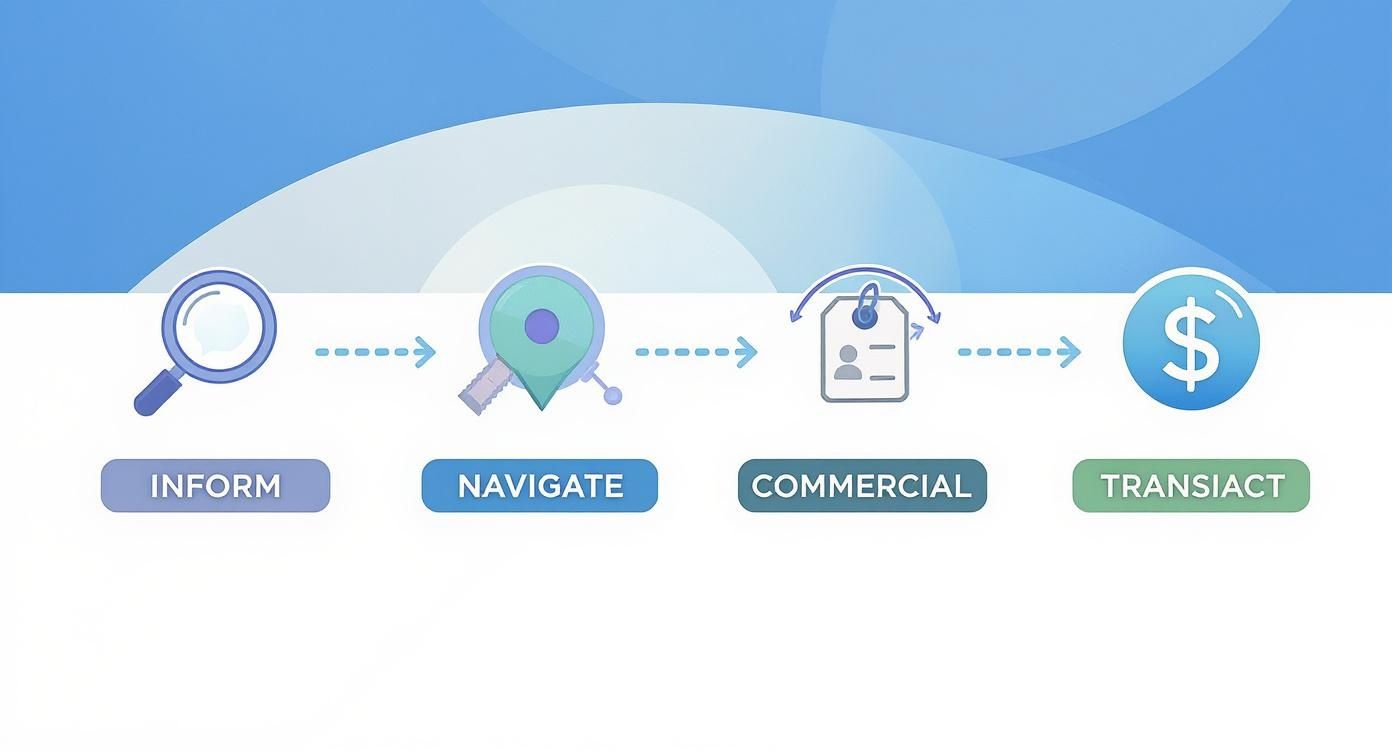
To really master keyword research, you have to learn how to decode the four main types of search intent. Each one signals a different stage in a user's journey and demands a completely different kind of content to satisfy it.
Informational Intent: The user just wants to learn something. Their queries often look like "how to," "what is," or "why does." A search for "how to bake sourdough bread," for instance, is purely informational. This person isn't ready to buy a thing; they’re deep in the learning phase. The best content for them is a detailed blog post, a step-by-step guide, or a how-to video. You can get more insights on where to find blog content ideas in our dedicated article.
Navigational Intent: Here, the user is just trying to get to a specific website or page. They already know the brand and are using the search engine as a shortcut. Keywords like "YouTube," "IndexPilot login," or "Twitter" are classic examples. The only way to satisfy this intent is to be the website they’re looking for.
By aligning your content with search intent, you’re not just optimizing for a search engine; you’re optimizing for human behavior. You’re meeting users exactly where they are in their journey, building trust and guiding them toward a solution.
Commercial Intent: This user is in the research phase right before making a purchase. They’re busy comparing options, digging through reviews, and hunting for the best solution. Keywords for this stage often include terms like "best," "review," "vs," or "comparison." A search for "best stand mixer for bread" shows someone is seriously evaluating their options and getting very close to a buying decision.
Transactional Intent: This is it—the user is ready to take action. They want to buy, sign up, or download something right now. These are easily the most valuable keywords for driving direct business results. They often include trigger words like "buy," "price," "discount," or "sale." A query like "buy sourdough starter kit online" signals a crystal-clear intent to purchase immediately.
Let's break this down a bit more to see how these intent types guide your content strategy.
Decoding the Four Types of Search Intent
Understanding these categories is the first step, but seeing them side-by-side helps clarify the kind of content you need to create for each.
| Intent Type | User Goal | Example Keyword | Best Content Format |
|---|---|---|---|
| Informational | To find an answer or learn something new. | "how to fix a leaky faucet" | Blog posts, how-to guides, video tutorials, infographics. |
| Navigational | To reach a specific website or brand. | "Facebook login" | Your homepage, login page, or a specific brand page. |
| Commercial | To research and compare products or services. | "best running shoes for flat feet" | Comparison articles, product reviews, listicles, "vs." posts. |
| Transactional | To complete a purchase or take a specific action. | "buy iPhone 15 pro max" | Product pages, pricing pages, sales landing pages. |
As you can see, a user looking for a "how-to" guide won't be satisfied with a product page, and someone ready to "buy now" doesn't want a long-winded article. Matching your content format to the user's intent is non-negotiable for SEO success.
Interestingly, while over 80% of search queries in the U.S. are just 1-3 words long, separate data shows that 56% of buyers use queries with 3 or more words. This highlights that purchasing behavior often involves more specific, intent-driven phrases. You can explore more fascinating SEO statistics to see just how much user behavior shapes modern strategy.
A Practical Guide to Performing Keyword Research
Alright, you've got the theory down. Now, let's roll up our sleeves and get practical. This isn't some dark art reserved for SEO wizards; it's a straightforward process anyone can master. Think of this as your step-by-step blueprint for figuring out the exact words and phrases your customers are typing into Google.
The whole thing starts with a single idea and blossoms into a full-blown content strategy. We'll walk through the entire journey together—from jotting down initial thoughts to digging up hidden gems with powerful tools, making sense of the metrics, and finally, building a smart content plan that actually gets results.
Stage 1: Brainstorm Your Seed Keywords
Every keyword research project starts with seed keywords. These are the big, foundational terms that describe what you're all about. Think of them like the roots of a tree—they’re not the finished product, but everything else grows from them.
To get started, put yourself in your customer's shoes. How would they talk about what you offer? What problems are you solving for them? Try to come up with five to ten main topics that are directly related to your business.
For a company that sells hiking gear, the seed keywords would look something like this:
- hiking boots
- backpacking tents
- waterproof jackets
- trail running shoes
These simple terms are your launchpad. They form the core of what we'll build on in the next step.
Stage 2: Expand Your Keyword List
Now that you have your seed keywords, it's time to branch out and find more specific, long-tail variations. This is where the real magic happens, where you uncover the detailed questions and phrases that show someone is serious about finding a solution. Guesswork won't get you far here—you need the right tools for the job.
Keyword research tools let you plug in your seed keywords and will spit back hundreds, sometimes thousands, of related ideas. Plenty of great free options can get you started, but paid platforms will give you much deeper data. If you want to see what's out there, this guide on the top SEO tools is a great place to start.
This word cloud shows just how many related terms can spring from a few simple seed keywords. It’s a perfect visual for how a handful of core ideas can explode into a universe of content topics.
See how that works? You start broad and let the tools help you discover all the different ways people search for related concepts.
Stage 3: Analyze and Prioritize Your Keywords
By now, you probably have a giant spreadsheet filled with potential keywords. The next challenge is to cut through the noise and find the real opportunities. This means looking at a few key metrics to decide which terms are actually worth your time and effort.
You're looking for a sweet spot between three crucial things:
- Search Volume: How many people are searching for this phrase every month? More is usually better, but it's not the whole story.
- Keyword Difficulty: How tough will it be to crack the first page of Google for this term? You want to find terms you can realistically rank for, especially if your site is newer.
- Relevance and Intent: Does this keyword actually line up with your business? And what is the searcher really looking for? This is, by far, the most important factor.
The goal isn't just to chase keywords with massive search volume. The real win is finding relevant terms with decent volume and achievable difficulty that perfectly match what your ideal customer needs.
Understanding what a searcher wants to do—whether they're just gathering information, looking for a specific website, comparing products, or are ready to pull out their credit card—is the key to picking the right keywords to target.
Stage 4: Organize Keywords into Topic Clusters
The final step is to bring some order to the chaos. Instead of thinking about each keyword as a separate target, it's time to group related terms into topic clusters. This is a much smarter, more modern way to approach SEO.
Here’s how it works: you create one big, comprehensive "pillar" page on a broad topic. Then, you create several smaller "cluster" pages that dive deep into related subtopics, and you link all of them back to the pillar.
For example, your pillar page could be "The Ultimate Guide to Backpacking Tents." Your cluster content would then target more specific, long-tail keywords like "best 2-person backpacking tent" or "how to waterproof a tent." This structure tells search engines that you're an expert on the entire subject, which helps you rank for a whole range of related terms.
Decoding Keyword Metrics and Modern SEO tools
So, you’ve done the brainstorming and have a nice, long list of keywords. The next step is where the real strategy begins: making sense of all the data that comes with them.
Think of keyword metrics as the vital signs for any search term. They tell you everything you need to know—how popular it is, how tough the competition is, and whether the people searching for it are actually looking to buy something. This is what separates a good SEO plan from a great one.
Ignoring these numbers is like trying to drive across the country without a map. Sure, you might get there eventually, but you’ll probably waste a lot of time and gas on dead-end roads. Understanding these metrics helps you sidestep the classic mistake of chasing a keyword with huge search volume that you have zero chance of ranking for.
Understanding Core Keyword Metrics
To really analyze your keyword list, you need to get comfortable with three core metrics. Together, they paint a complete picture of a keyword's potential and how much muscle you’ll need to put behind it to get to the top.
Search Volume: This is simply the average number of times people search for a keyword each month. It’s a great measure of demand, but don't let big numbers fool you—a term with 10,000 monthly searches is worthless if it has nothing to do with what you offer.
Keyword Difficulty (KD): Usually scored from 0-100, this metric gives you an idea of how hard it will be to crack the first page of Google. A lower score means less competition, making it a perfect target if your website is still new or building authority.
Cost Per Click (CPC): This one comes from the advertising world and shows what people are willing to pay for a single click on an ad for that keyword. Even if you aren't running ads, a high CPC is a massive clue. It screams that the keyword has strong commercial intent, meaning the traffic it brings is incredibly valuable.
Smart keyword selection is all about finding the right balance. A keyword with decent search volume, low difficulty, and a solid CPC is often the sweet spot—that "goldilocks" opportunity that drives targeted traffic and actually grows your business.
Once you’ve chosen your targets, it’s crucial to know how to track keyword rankings to see if your hard work is paying off.
The Rise of AI in Keyword Research
Keyword analysis is getting a major upgrade, and it’s all thanks to artificial intelligence. Modern SEO isn’t just about pulling data anymore; it’s about predictive, strategic thinking, and AI is leading the charge.
AI doesn't just find keywords; it uncovers entire content ecosystems. It helps you see the relationships between topics, predict what users will search for next, and build authority in your niche more effectively than ever before.
While the core metrics of search volume, difficulty, and CPC are still central, AI is changing how we use them. In fact, a whopping 86% of SEO experts are already using AI tools in their workflow, with many relying on them to generate optimized meta titles and descriptions from the get-go.
To find and analyze these opportunities efficiently, more and more pros are turning to specialized AI keyword research tools. This trend makes it clear that AI is becoming fundamental to creating SEO-ready content right from the start.
Turning a Keyword List Into a Real Content Strategy
A spreadsheet overflowing with keywords isn't a strategy—it's just raw material. The final, and most crucial, step in mastering keyword research is turning all that data into a cohesive plan of action that Google will actually reward. This is where you transform isolated search terms into a powerful, interconnected web of content.

By far, the most effective way to pull this off is with the topic cluster model. Instead of chasing keywords one by one, you group related terms around a central, comprehensive "pillar" article. This main pillar page covers a broad topic, while smaller "cluster" articles dive deep into specific subtopics, all linking back to the central hub.
Build Your Topical Authority
This structure does way more than just keep your content organized. It screams expertise to Google. When you create this spiderweb of interlinked articles all focused on one core subject, you’re building topical authority. Search engines see that you’ve covered a topic from every possible angle, which makes you a far more credible and comprehensive resource in their eyes.
Think of it this way: a pillar page on a "Beginner's Guide to Digital Photography" could be supported by cluster content like:
- "best budget cameras for beginners"
- "understanding the exposure triangle"
- "how to edit photos in lightroom"
Each piece targets its own long-tail keyword but also strengthens your overall authority on digital photography. This is a world away from outdated practices like keyword stuffing. In fact, top-ranking pages today often have a 50% lower keyword density than just a few years ago, which proves Google cares more about quality and relevance. You can discover more insights about modern on-page SEO to see just how much the game has changed.
Keyword research isn't a one-and-done task you can just check off a list. It's a continuous cycle of discovery, creation, monitoring, and tweaking that keeps your content strategy sharp and effective for the long haul.
It's a Never-Ending Cycle of Growth
Honestly, your keyword research should never really be "finished." As you publish content, you have to keep a close eye on its performance, figure out what's hitting the mark, and spot new opportunities. Dive into your analytics to see which terms are actually driving traffic and which pages are just collecting dust.
This ongoing analysis feeds right back into the discovery phase. It lets you refine your strategy, breathe new life into old content with fresh insights, and jump on emerging trends in your niche. When you treat keyword research as a living, breathing part of your SEO, you create a sustainable engine for organic growth that just keeps getting better year after year.
Common Questions About Keyword Research Answered
Once you get the hang of keyword research, a bunch of practical questions always seem to pop up. It's one thing to understand the theory, but putting it into practice is where the real learning happens. Let's tackle some of those common head-scratchers so you can feel more confident in your SEO process.
How Often Should I Do Keyword Research?
This is probably the most common question I hear. The simple answer? It’s not a one-and-done task. SEO is a continuous cycle, so you can't just set it and forget it.
A good rhythm is to do a deep dive into your keywords every quarter. Beyond that, you should be doing quick checks for new content ideas whenever they come up. This keeps your strategy fresh and in sync with what people are actually searching for right now.
Long-Tail vs. Short-Tail Keywords
It's easy to get tangled up in the jargon here, but the difference is pretty straightforward. Short-tail keywords are broad, like "running shoes." They get a ton of search volume, but they're also incredibly competitive and don't tell you much about what the searcher wants.
Long-tail keywords are the opposite. They’re super specific phrases like "best trail running shoes for flat feet." While they have lower search volume, they are an absolute goldmine for targeted traffic because they reveal exactly what the user is looking for. Someone searching that long-tail phrase is much closer to buying, which means higher conversion rates for you.
Targeting long-tail keywords is like having a direct conversation with a highly qualified lead. You skip the noise and connect with an audience that knows exactly what they're looking for.
Where Should a Beginner Start?
Feeling overwhelmed? You don't need to jump into expensive subscriptions right away. Start with the free tools that are already at your fingertips. Google's own search results are a great place to begin—just look at the "People also ask" section for instant insights. Google Trends is another powerhouse for understanding what your audience is curious about over time.
How Many Keywords Should I Target on One Page?
This is a big one. In the old days, people would cram as many keywords as possible onto a page. That's a huge mistake now. Modern SEO is all about focus and relevance.
Stick to one primary keyword and a small handful of closely related secondary terms for each page. This approach helps you create a focused, high-quality page that actually answers the user's question. Search engines penalize "keyword stuffing," so your goal should always be to write naturally for humans, not to repeat keywords for bots.
Ready to turn your keyword strategy into compounding organic traffic? IndexPilot uses trainable AI Agents to automate the entire SEO workflow, from research and writing to optimization and publishing. Schedule a demo and see how it works.