Most marketers have a mental model of Google search that looks something like this: someone types a few words into a search bar, a list of blue links appears, and the user clicks through. That's the whole game, right? Optimize for text queries, rank on page one, collect traffic.
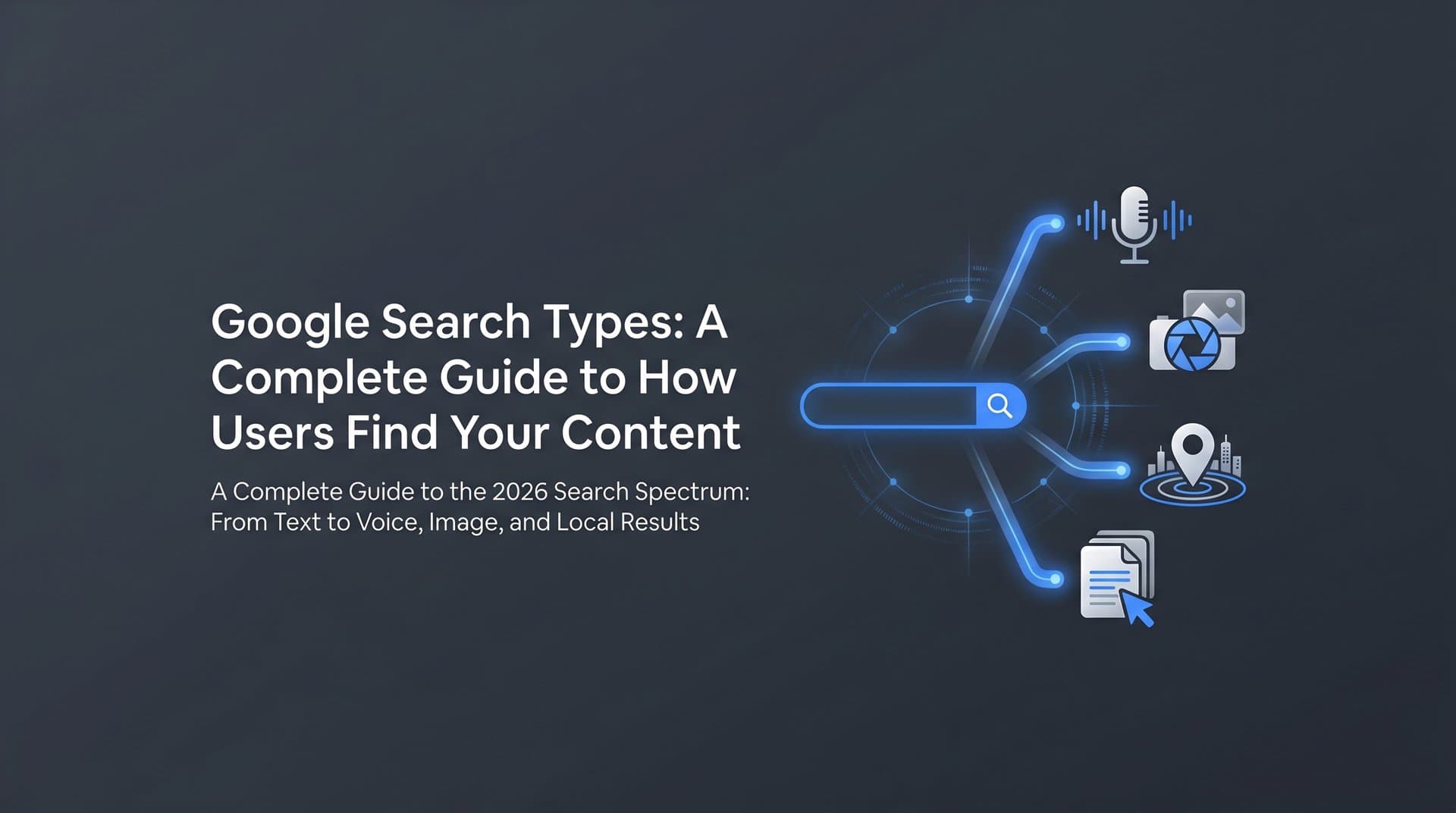
The reality in 2026 is considerably more interesting. Google processes a wide variety of distinct search types, each with its own interface, ranking signals, and user behavior patterns. Someone searching for a product might never see a traditional blue link. A user looking for a local restaurant is interacting with a completely different SERP ecosystem than someone researching a technical topic. A voice query on a smart speaker is structurally different from anything typed into a desktop browser.
Understanding these different search types isn't just a nice-to-have piece of SEO trivia. It's the difference between capturing a fraction of your potential organic traffic and building a genuinely comprehensive visibility strategy. Each search type represents a distinct channel where your content can surface, your brand can earn recognition, and your audience can find you before they ever visit a competitor.
This guide breaks down every major Google search type, explains how each one works, and provides concrete optimization strategies for each. By the end, you'll have a clear picture of where your content currently appears, where it's missing, and how to close those gaps. You'll also understand why the conversation around search types now extends beyond Google entirely, into the AI platforms that are reshaping how people discover information.
The Intent Layer Beneath Every Google Query
Before diving into individual search types, it helps to understand the framework Google uses to interpret every query: search intent. Google's algorithms don't just match keywords to content. They try to understand why someone is searching and then serve the SERP format most likely to satisfy that need.
The four foundational intent categories are informational, navigational, transactional, and commercial investigation. Each one tends to trigger different SERP features and, by extension, different search types. For a deeper dive into how these categories shape your optimization approach, our guide on search intent in SEO covers the topic comprehensively.
Informational intent covers queries where the user wants to learn something. "How does compound interest work?" or "symptoms of vitamin D deficiency" are classic examples. Google often responds with Featured Snippets, Knowledge Panels, or People Also Ask boxes. For content creators, this is the territory of blog posts, explainer articles, and educational videos.
Navigational intent means the user already knows where they want to go and is using Google to get there quickly. "Spotify login" or "New York Times" are navigational queries. The user isn't looking for alternatives, so competing here requires owning your brand name and ensuring your site architecture is clean and indexed correctly.
Transactional intent signals that the user is ready to take action, whether that's making a purchase, signing up for a service, or downloading something. These queries trigger Shopping carousels, product listings, and app install prompts. This is where ecommerce and SaaS brands need strong product schema and Merchant Center integration.
Commercial investigation intent sits between informational and transactional. The user is evaluating options before committing. "Best CRM for small business" or "Notion vs Asana" are good examples. These queries often surface comparison articles, review sites, and listicles.
Why does this matter for search types? Because Google doesn't serve a one-size-fits-all SERP. A transactional query might return a Shopping carousel at the top with almost no traditional blue links visible. A local intent query triggers the Local Pack. A visual query might surface Google Image Search results prominently. The intent signals which search type ecosystem Google activates, and your content needs to be formatted and structured to appear in the right one.
The practical implication for content strategy is straightforward: before you create a piece of content, identify the dominant intent behind the queries you're targeting, then reverse-engineer the SERP format Google actually serves for those queries. If the top results for your target keyword are all video content, publishing a text-only article puts you at a structural disadvantage. Matching your content format to the search type your audience actually uses is one of the highest-leverage moves in modern SEO.
Text, Voice, and Conversational Search: Three Ways Users Ask Questions
Text search is the baseline. Users type a query, Google returns results. But even within text search, query structure varies enormously. Short-tail queries like "running shoes" carry very different intent signals than long-tail queries like "best running shoes for flat feet under $100." Both are text searches, but they require different optimization approaches and often surface different SERP features.
Voice search changes the equation in meaningful ways. When people speak a query rather than type it, the phrasing becomes more natural and conversational. Instead of typing "weather New York," someone speaking to a smart speaker might say "What's the weather going to be like in New York this weekend?" Voice queries tend to be longer, question-based, and phrased the way people actually talk.
For SEO, this means optimizing for voice requires thinking beyond traditional keyword targeting. Content that answers specific questions clearly and concisely tends to perform well in voice search because Google often reads Featured Snippet content aloud in response to voice queries. Structuring content with clear question-and-answer formatting, using natural language, and targeting long-tail conversational phrases all contribute to voice search visibility. Our guide on conversational search optimization tactics covers these techniques in detail.
Then there's the newest layer: conversational and AI-powered search. Google's AI Overviews (previously known as SGE) represent a fundamental shift in how search results are presented. Instead of a list of links, users see an AI-generated summary at the top of the SERP that synthesizes information from multiple sources. The underlying links are still there, but the user experience is now mediated by an AI layer.
This creates a new optimization challenge. Getting cited as a source in an AI Overview requires producing content that is authoritative, well-structured, and clearly answers the question being asked. Factors like E-E-A-T (Experience, Expertise, Authoritativeness, Trustworthiness) become even more important because Google's AI is selecting which sources to synthesize and cite.
The three search modes also differ in where they happen. Text search is predominantly desktop and mobile browser-based. Voice search happens through smart speakers, phone assistants, and in-car systems. Conversational AI search is increasingly happening outside of Google entirely, on platforms like ChatGPT, Claude, and Perplexity, which we'll address specifically in a later section.
For content teams, the takeaway is to write for humans first, structure for machines second. Content that clearly answers questions in plain language, uses logical heading structures, and covers a topic with genuine depth tends to perform across all three query modes. The keyword research process should include conversational phrases and question-based queries alongside traditional short and medium-tail terms.
Visual and Video Search: The Traffic You're Probably Missing
Here's a search type that many content marketers underinvest in: visual search. Google Image Search has been around for years, but the introduction of Google Lens transformed visual search into something genuinely powerful. Users can now point their phone camera at a product, a landmark, a piece of text, or virtually anything else and receive relevant search results based on what they're seeing.
For brands, this means images are no longer just decorative elements on a webpage. They're indexable, discoverable assets that can drive traffic independently of the text content surrounding them. A product photo that appears in Google Image Search results can bring a user directly to your product page. An infographic can surface for informational queries. A diagram can appear when someone searches for a concept you've visualized.
Optimizing for image and visual search involves several concrete practices. Descriptive, keyword-relevant alt text is the foundation. File names matter too: "blue-running-shoes-womens.jpg" is more useful to Google than "IMG_4821.jpg." Image structured data (specifically ImageObject schema) helps Google understand the context of your images. File size optimization ensures images load quickly, which affects both user experience and crawl efficiency.
Google Lens optimization is closely tied to product schema for ecommerce brands. When a user points Lens at a product and Google can match it to a structured product listing, the experience becomes shoppable. This is a significant opportunity for brands selling physical products.
Video search is equally important and closely tied to YouTube, which Google owns. Video content surfaces in universal search results, often above traditional blue links for queries where Google determines video is the most useful format. Tutorials, product demonstrations, how-to content, and reviews tend to trigger video results.
Optimizing video for search requires attention to several factors. Video titles and descriptions should include target keywords naturally. Transcripts improve accessibility and give Google more text to index. Chapters (timestamps) help Google understand video structure and can surface specific segments in search results. Thumbnail quality affects click-through rate, which influences ranking signals. VideoObject schema markup helps Google categorize and display your video content correctly in search results.
The broader principle here is that every content format you publish is potentially discoverable through a different search type. A single comprehensive guide can generate traffic through text search, image search (via its diagrams and screenshots), and video search (if you produce an accompanying video). Building this multi-format thinking into your content production process multiplies the surface area where your brand can appear. Understanding how to improve organic search ranking across these formats is essential to capturing this overlooked traffic.
Local, Shopping, and News: Three Specialized Search Ecosystems
Some search types operate as largely self-contained ecosystems with their own ranking factors and optimization requirements. Local, Shopping, and News search are the three most significant examples.
Local Search is triggered when Google detects geographic intent in a query, either explicitly ("coffee shops near me") or implicitly ("plumber" searched from a mobile device). The Local Pack, that cluster of three business listings that appears above organic results, is prime real estate for businesses with physical locations or service areas.
Ranking in the Local Pack depends primarily on three factors: relevance (does your business match what the user is searching for?), distance (how close is your business to the user?), and prominence (how well-known and reviewed is your business?). Optimizing your Google Business Profile is the most direct lever. Accurate business information, consistent NAP (Name, Address, Phone) data across all directories, a steady stream of genuine reviews, and regular posts and updates all contribute to local search visibility. Local citations, which are mentions of your business on other websites and directories, reinforce prominence signals.
Shopping Search is the territory of ecommerce. Product listing ads and free product listings appear in Shopping carousels for transactional queries. Appearing here requires a Google Merchant Center account with a product feed that includes accurate, complete product data. Product schema markup on your website reinforces this data and helps Google surface your products in rich result formats.
For ecommerce brands, Shopping search is often where the highest-intent traffic lives. A user who has searched "buy women's trail running shoes size 8" is much closer to a purchase than someone reading a general blog post about running. Ensuring your product feed data is accurate, your prices are competitive, and your product pages are well-optimized is foundational to Shopping search performance. Conducting thorough SEO competitive research helps you understand how rivals are capturing this high-value traffic.
News Search and Google Discover serve a different audience: publishers, content creators, and brands that produce timely, topical content. Google News surfaces recent, relevant articles for current events and trending topics. Discover pushes content proactively to users based on their interests, without them needing to search at all.
Earning placement in News search requires meeting Google's technical requirements for news publishers, establishing topical authority in your subject area, and maintaining a consistent publishing cadence. Discover placement is influenced by content quality, engagement signals, and how well your content aligns with the established interests of users Google is serving. Both channels reward brands that invest in genuine expertise and consistent content production rather than sporadic publishing.
Building a Multi-Search-Type Content Strategy
Understanding individual search types is useful. Building a strategy that deliberately optimizes across multiple search types simultaneously is where the real competitive advantage lives.
Start with an audit. For the primary queries your business wants to rank for, search them yourself and analyze what Google actually returns. Is the top of the SERP dominated by a Local Pack? Shopping carousels? Video results? Featured Snippets? AI Overviews? This tells you which search types Google considers most relevant for your target queries and therefore which formats your content needs to match. You can check your position in Google search as a starting point for this analysis.
Next, look at your existing content inventory. For each major piece of content, ask: which search types could this realistically appear in? A well-written product guide might currently rank in text search but has no accompanying images with proper alt text, no video version, and no structured data. Adding those elements doesn't require rewriting the content. It requires extending it into additional search type formats.
The framework for creating content that spans multiple search types looks like this:
Start with depth: Create a comprehensive piece of content that genuinely answers the question or solves the problem better than existing results. Depth is the foundation that makes all other optimization worthwhile.
Add visual assets: Include original images, diagrams, or infographics with descriptive alt text and proper file naming. This creates an entry point for image search traffic.
Structure for Featured Snippets: Use clear question-and-answer formatting, concise definitions, and numbered steps where appropriate. This serves both traditional Featured Snippets and AI Overview citations.
Implement structured data: Add the appropriate schema markup (Article, HowTo, FAQ, Product, VideoObject, etc.) to help Google understand and categorize your content for specialized SERP features.
Ensure fast indexing: Technical SEO fundamentals matter across all search types. Submitting sitemaps, using IndexNow for rapid URL discovery, and maintaining clean site architecture ensures your content is actually crawled and indexed before opportunities pass. Understanding search engine indexing optimization can meaningfully accelerate how quickly new content enters search results.
The goal is to treat each piece of content as a multi-format asset rather than a single-channel artifact. One well-produced guide, properly optimized, can simultaneously appear in text search, image search, video search (with an accompanying video), and potentially in AI Overviews or Featured Snippets. That's multiple traffic streams from a single content investment.
AI Visibility: The Search Type That Bypasses Google Entirely
There's a conversation happening in the search industry that goes beyond optimizing for Google's various search types. A growing number of users now conduct searches, research products, and discover brands through AI platforms like ChatGPT, Claude, and Perplexity rather than through Google at all. These platforms function as a new category of search interface, one where users ask questions in natural language and receive synthesized answers rather than a list of links.
This creates a visibility challenge that traditional SEO doesn't fully address. Your brand could rank on page one of Google for dozens of keywords and still be completely absent from the answers these AI platforms provide. Conversely, a competitor with strong topical authority and well-structured content might be regularly cited by AI models as a recommended resource, capturing brand awareness and consideration from users who never open a search engine. Learning how to optimize for AI search engines is becoming essential for brands that want to stay visible.
This is the domain of GEO: Generative Engine Optimization. Where SEO focuses on ranking in search engine results pages, GEO focuses on ensuring AI platforms mention, recommend, and accurately represent your brand when answering relevant queries. The optimization principles overlap in meaningful ways: authoritative, well-structured, accurate content performs better in both contexts. But GEO adds specific considerations around how AI models process and cite information, how your brand is described across the web, and what sentiment AI platforms associate with your brand when they do mention it.
Tracking AI visibility requires different tools than traditional rank tracking. You need to know which AI platforms mention your brand, in what context, with what sentiment, and in response to which types of prompts. This kind of monitoring is what platforms like Sight AI are built for: tracking brand mentions across AI models like ChatGPT, Claude, and Perplexity, surfacing an AI Visibility Score, and identifying content opportunities to improve how AI platforms represent your brand. Understanding the AI search engine ranking factors that drive these citations is key to improving your presence.
For marketers and founders thinking about comprehensive search visibility in 2026, the question is no longer just "where do we rank on Google?" It's "where does our brand appear across every surface where our audience looks for answers?" That includes all of Google's search types and the growing ecosystem of AI-powered search interfaces beyond Google.
Your Complete Search Visibility Roadmap
The core insight from this guide is straightforward: Google search is not a single channel. It's a collection of distinct search types, each with its own ranking signals, content formats, and user behaviors. Text, voice, visual, video, local, shopping, and news search all represent separate opportunities to capture organic traffic, and most brands are only seriously competing in one or two of them.
The brands that will build durable organic visibility are those that treat search comprehensively. They audit which search types their target queries actually trigger. They create content in formats that match those search types. They implement the technical infrastructure, structured data, fast indexing, clean architecture, that ensures their content is discoverable across all search surfaces. And they extend their visibility strategy beyond Google to include the AI platforms where a growing share of their audience now searches.
This isn't about doing everything at once. It's about systematically expanding your search presence one channel at a time, starting with the search types most relevant to your audience and industry.
The next step is an honest audit of where your brand currently appears and where it doesn't. Look at your target queries across text, image, video, and local search. Check whether your products appear in Shopping results. Assess whether your content earns Featured Snippets or AI Overview citations. Then extend that audit to the AI platforms your audience uses.
Start tracking your AI visibility today and see exactly where your brand appears across top AI platforms. Stop guessing how AI models like ChatGPT and Claude describe your brand, and get the visibility data you need to optimize for every search surface where your audience is looking.