Search intent is simply the "why" behind a search. It’s the real goal a person has when they type something into Google, going way beyond the literal words they use. Getting this right is the absolute core of modern SEO.
Why Search Intent Is The Heartbeat Of Modern SEO

Think of Google as the world's smartest librarian. A rookie librarian might just point you to the right aisle. But a truly great one listens to what you're really trying to solve. They hear "history of Rome" but understand you're a tourist looking for a quick guide, not an academic needing a dense, scholarly journal.
That's exactly how Google thinks now. It's moved past simply matching keywords. Thanks to sophisticated AI like BERT and MUM, Google has an almost human-like ability to understand the context and purpose driving a search.
The Shift From Keywords To User Satisfaction
This is a massive change from the old days of SEO. Keyword stuffing is dead. Today, your ranking is a direct reflection of how well your content solves the user's problem. If you miss the mark on their intent, your page simply won't rank—no matter how many keywords or backlinks you have.
This focus on the user is why what is search intent in SEO is such a hot topic. It’s the single most important factor that dictates:
- What you create: Should this be a blog post, a product page, or a video tutorial?
- How you format it: Is a simple how-to guide, a detailed listicle, or a side-by-side comparison table the best fit?
- The angle you take: Are you writing for a total beginner, a seasoned expert, or someone with their credit card out?
Understanding The Intent Distribution
Search intent breaks down into a few key categories, and the numbers tell a clear story. Research from Rank Math shows that a staggering 70% of Google searches are informational—people just looking for answers. Commercial investigation, where users are comparing options, makes up 22%. Navigational queries (finding a specific website) are 7%, and direct transactional searches (ready to buy) are just 1%.
To make this crystal clear, here’s a quick breakdown of the main intent types.
The Four Core Types Of Search Intent At A Glance
| Intent Type | The User's Goal ('The Why') | Example Keyword |
|---|---|---|
| Informational | To find information or learn something. | "how to tie a tie" |
| Navigational | To find a specific website or page. | "twitter login" |
| Commercial | To research products/services before buying. | "best running shoes for flat feet" |
| Transactional | To complete a specific action, like a purchase. | "buy nike air max 270" |
This table shows just how different a user's mindset can be, even when the keywords seem related. Grasping these differences is the first step toward creating content that actually works.
The single biggest mistake in SEO is creating content that perfectly answers a question nobody is asking, or answers the wrong question for the right keyword. Aligning with search intent ensures your valuable content actually connects with the right audience at the right time.
Mastering search intent isn't optional anymore. When you align your content with what users are truly looking for, you stop trying to "trick" Google and start helping people. And that's exactly what Google wants to reward. Learning to diagnose and match user intent is a cornerstone of effective content SEO best practices that drive real, sustainable growth.
Decoding The Four Primary Types Of Search Intent
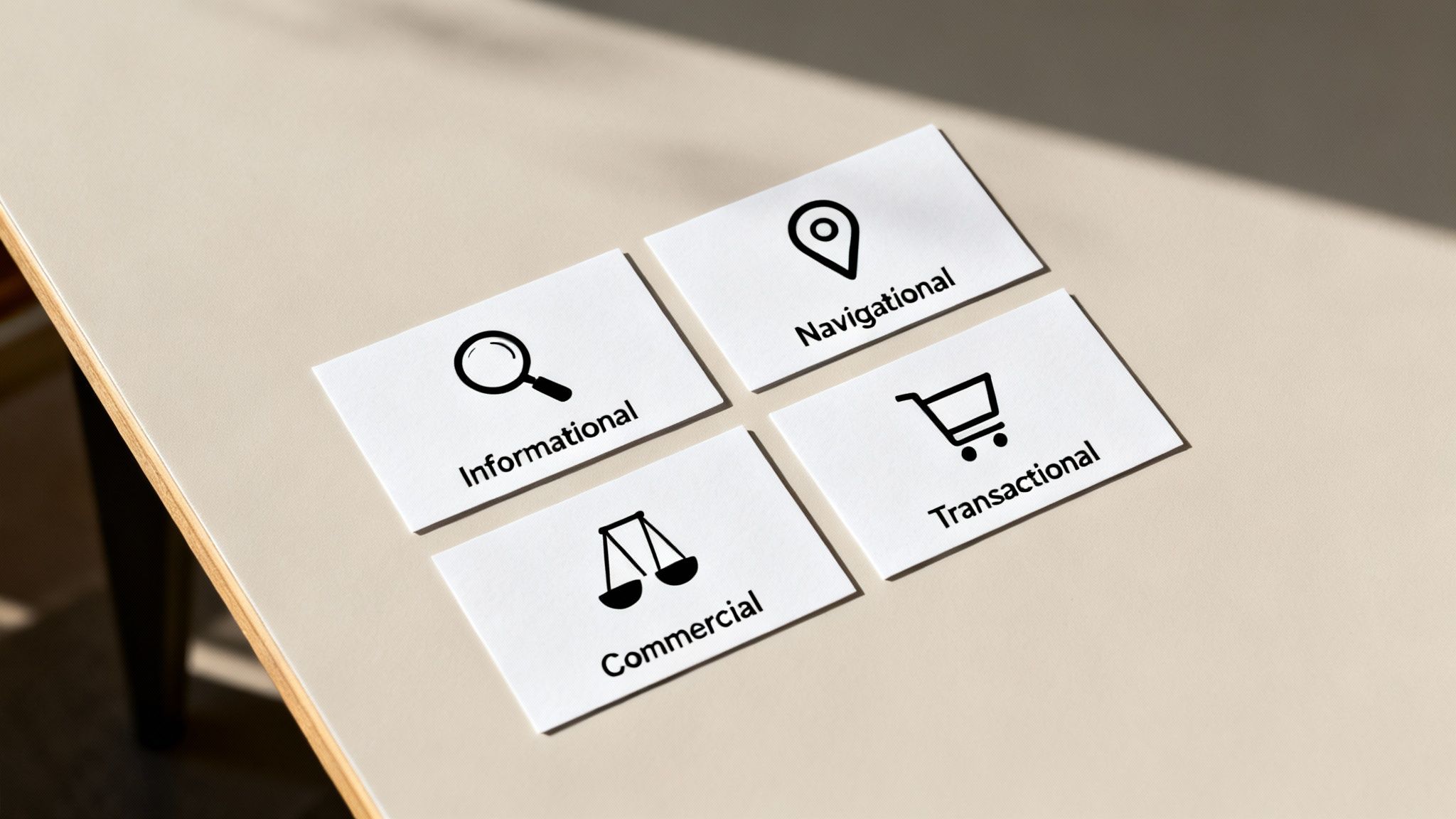
To really get what is search intent in SEO, you have to put yourself in the searcher's shoes. Every single time someone types something into Google, that query is a little window into what they need, right now. Once you start decoding those goals, you can stop just chasing keywords and start creating content that actually helps people.
The user's journey is rarely a straight line from A to B, but their searches almost always fall into one of four main categories. Don't think of them as rigid labels—they're more like different mindsets or stages in a decision. Let's break down each one and see how Google brilliantly tailors its results to match.
Informational Intent: I Need To Learn Something
This is the big one. Informational intent accounts for the vast majority of all searches. When someone has informational intent, they’re in learning mode. They want answers, how-to guides, facts, or explanations. They aren't looking to buy anything just yet; their only goal is to find information.
You'll often spot these queries by the question words they start with:
- Who: "who invented the telephone"
- What: "what are the symptoms of dehydration"
- How: "how to change a tire"
- Why: "why is the sky blue"
They might also tack on words like "guide," "tutorial," "tips," or "ideas."
Take a look at the results for "how to change a tire." Google knows that person needs a step-by-step process, and fast. The SERP is packed with how-to articles, blog posts with numbered lists, and video tutorials. You won't see a single product page trying to sell you tires because that would completely miss the point of the search.
Navigational Intent: I Need To Go Somewhere Specific
Navigational intent is as straightforward as it gets. The user already knows exactly where they want to go online and is just using Google as a quick shortcut to get there. They're looking for a specific website, a certain page on that site, or maybe a social media profile.
These searches almost always include a brand, product, or website name.
- "twitter login"
- "youtube"
- "bank of america"
For a search like "twitter login," the user's goal is crystal clear. They want to log into their Twitter account, period. Google gets this and puts the official login page right at the top. Trying to rank a blog post titled "10 Tips for a Better Twitter Profile" for this query would be a complete waste of time because it doesn't solve the user's direct, navigational need.
Search engines reward pages that provide the most direct and satisfying answer to the user's query. A perfect match between your content and the user's intent is the fastest path to the top of the search results.
This is true for all intent types, but it's blindingly obvious with navigational and informational searches. Nailing this is the key to a smart content strategy and choosing the right organic search keywords.
Commercial Intent: I Need To Research And Compare
Commercial intent is that crucial middle ground between learning something and buying something. The searcher has identified a problem or a need and is now actively researching their options. They're comparing products, checking out reviews, and looking for recommendations to make a smart decision. They aren't quite ready to pull out their credit card, but they're getting very close.
Keywords with commercial intent often have modifiers that signal this investigation phase:
- Best: "best noise cancelling headphones"
- Review: "iphone 15 pro review"
- Vs: "airpods pro vs sony wf-1000xm5"
- Comparison: "electric car comparison"
Think about the search for "best noise cancelling headphones." That person wants expert opinions and side-by-side breakdowns. The SERP reflects this perfectly, serving up listicles from trusted tech sites, in-depth review articles, and detailed comparison tables. Google knows the user is in evaluation mode and gives them content designed to help them weigh their options.
Transactional Intent: I Am Ready To Act
This is it—the final stage of the journey. The user has done their homework and is now ready to take action. Usually, that action is a purchase, but it could also be signing up for a newsletter, downloading an app, or booking a flight. For businesses, transactional intent is pure gold because it captures people at the exact moment of conversion.
Transactional keywords are super specific and often include action-oriented words:
- Buy: "buy macbook pro"
- Coupon: "dominos coupon code"
- For sale: "used honda civic for sale"
- Near me: "pizza delivery near me"
When someone types "buy macbook pro," they practically have their wallet out. They don't want a review or a history lesson on Apple. Google’s results page for this is heavily commercial, dominated by shopping ads, direct links to product pages on Apple.com and major retailers, and local store availability. The entire page is engineered to make a purchase as easy as possible.
Getting a handle on these four types of search intent is fundamental. When you can diagnose the "why" behind a keyword, you can create the exact content Google wants to rank and that users are dying to find. That's how you turn SEO from a guessing game into a predictable engine for growth.
How To Identify Search Intent Like A Pro
Knowing the types of search intent is one thing. Actually diagnosing it for any given keyword? That's where the real skill comes in.
When you move from theory to practice, you stop guessing what users want and start giving them exactly what they’re looking for. This is the shift that turns basic keyword research into a powerful, strategic analysis that drives real results.
Fortunately, you don’t need a crystal ball to figure it out. You just need to learn how to read the clues that users—and Google itself—leave behind. There are two killer ways to do this: analyzing the query itself and, more importantly, decoding the story Google tells you on the search results page.
Method 1: Analyze The Keyword Modifiers
The quickest way to get a read on intent is to look at the specific words a user tacks onto their main search term. These keyword modifiers are like little signposts pointing directly to their goal, giving you instant context about where they are in their journey.
Think of these modifiers as your cheat codes to understanding intent:
- Informational Modifiers: Words like "how to," "what is," "guide," "tutorial," "ideas," and "tips" are dead giveaways. A user searching for "how to fix a leaky faucet" is clearly in learning mode.
- Commercial Modifiers: When you see "best," "review," "vs," "comparison," or "top," the user is sizing up their options. They’re deep in evaluation mode for a query like "best noise cancelling headphones."
- Transactional Modifiers: Terms like "buy," "price," "discount," "coupon," or "for sale" scream "ready to buy." A search for "buy Macbook Pro" leaves absolutely no room for doubt.
- Local Modifiers: Adding "near me" or a specific city like "pizza Brooklyn" signals local intent. This is a powerful, high-conversion segment you can't afford to ignore.
And speaking of local intent, its importance is massive. Roughly 46% of all Google searches have local intent, which is a huge audience looking for solutions right around the corner. The data gets even better when you look at what they do next: 28% of those local searches lead to a purchase within a single day. That highlights just how valuable this traffic is for businesses with a physical presence.
Method 2: Read The SERP Like A Story
While keyword modifiers are a great starting point, the ultimate source of truth for search intent is the SERP itself. Google has poured billions into figuring out what people want, and the results page is a direct reflection of what it’s learned.
By simply searching for your keyword and seeing what ranks, you get to see what Google has already decided is the most satisfying answer for that query.
Think of the SERP as Google's final answer to the search intent test. The types of pages and features it displays are your cheat sheet for creating content that will rank.
When you analyze the SERP, don't just glance at the top 10 blue links. You need to look for patterns in the content formats and the special features—known as SERP features. These are the strongest clues you can possibly get.
Decode Critical SERP Features
Here’s what to look for and what it’s telling you:
- Featured Snippets: That answer box sitting at the very top? It signals strong informational intent, usually for "what is" or "how-to" questions. Google knows a quick, direct answer is the best experience here.
- "People Also Ask" Boxes: These dropdowns are a goldmine of related informational queries. They show you the secondary questions your audience is asking, helping you build out more comprehensive content.
- Shopping Ads & Product Grids: If the page is plastered with product listings and images, the intent is overwhelmingly transactional or commercial. People want to see products and prices, not read a 5,000-word article.
- Image & Video Packs: A carousel of images or videos means visual content is the best way to satisfy intent for that query. This is super common for things like recipes, travel destinations, or visual tutorials.
- Local Pack (Map Pack): The map with three local business listings is the clearest signal of local intent you can get. For these keywords, a perfectly optimized Google Business Profile is far more valuable than a blog post.
By combining a close look at the query with a thorough SERP analysis, you can develop a precise understanding of what your user needs. This knowledge is the bedrock of creating content that resonates with both people and search engines.
To truly master this, you need to weave these principles into a comprehensive guide to keyword research to build a complete strategy. And once your content is out there, you’ll need a solid way to see if it's working by learning how to track keyword rankings effectively.
Matching Your Content To The User's Goal
Knowing the different types of search intent is one thing. But the real magic happens when you turn that knowledge into a concrete content strategy. This is where you shift from analysis to action, building pages that don't just exist to fill a URL but actually solve a user's problem at the exact moment they have it.
Creating the right content format isn't a gut feeling or a personal preference; it's a strategic decision. You have to ask yourself: what does the user need right now? A person with informational intent is looking for a teacher. Someone with transactional intent needs a cashier. Your content has to play the right role.
This is all about decoding what a user wants and then delivering it perfectly. We do this in two main ways: by looking at the query itself and by analyzing what Google already rewards on the search results page.
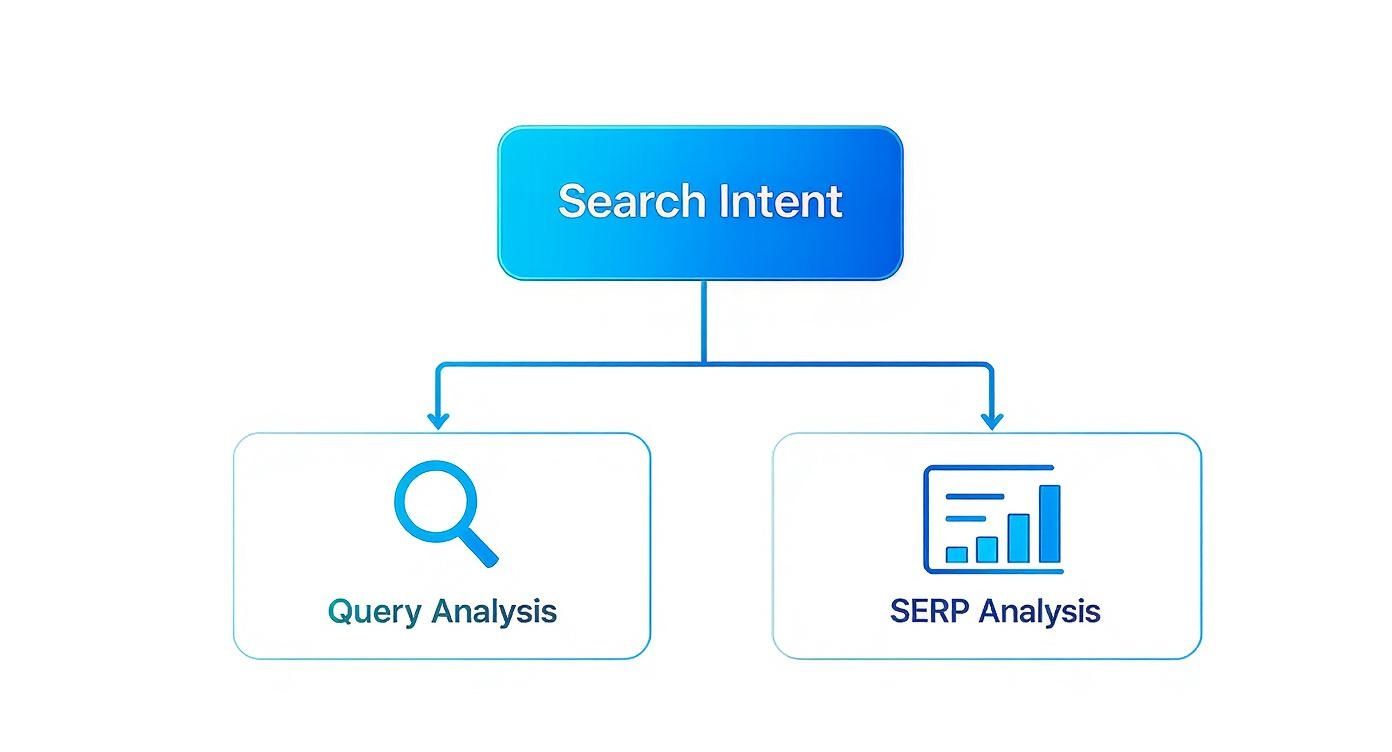
Think of query and SERP analysis as your compasses. They point you directly toward creating content that clicks with the user's goal.
Building For Informational Intent
When someone wants to learn something, your content has to be the best damn teacher on the block. They're looking for clear, comprehensive, and trustworthy answers. Your job is to package that information in a way that's incredibly easy to digest and apply. This is your prime opportunity to build trust and show off your expertise.
For these searches, the winning formats are almost always educational:
- In-depth Blog Posts & Guides: The bread and butter for "how to" or "what is" questions. Think detailed, step-by-step instructions or deep-dive explanations.
- Listicles: Perfect for "best ways to..." or "top tips for..." searches. A simple numbered or bulleted list is scannable and user-friendly.
- Tutorial Videos: For visual learners or complex processes, a video can explain something in two minutes that would take 2,000 words of text.
- Infographics: Great for breaking down complex data, stats, or processes into a shareable, visually engaging format.
Your call-to-action (CTA) here isn't "Buy Now." That would be like a teacher ending a lecture by trying to sell you a car. Instead, encourage more learning with CTAs like "Download the free checklist" or "Subscribe for more tips."
Crafting Content For Commercial Intent
When a user is in the investigation phase, your content needs to become the ultimate shopping assistant. These people are actively comparing options, digging for reviews, and trying to make a smart decision. Your goal is to give them every last detail they need to feel confident.
To capture this audience, you need content that makes it easy to compare and builds confidence:
- Detailed Product Reviews: Go way beyond the spec sheet. Talk about real-world use cases, the good, the bad, and the ugly. Honesty is your best friend here.
- Comparison Tables: A side-by-side table comparing features, pricing, and benefits is pure gold for a user weighing their options.
- Buying Guides: Help users navigate a tricky purchase with a guide like "How to Choose the Right Laptop" or "What to Look for in a Project Management Tool."
The CTAs should guide them to the next logical step in their research, like "Compare Models" or "See Pricing Details." This is also where sharp SEO copywriting best practices can make a huge difference in nudging them in the right direction.
Optimizing For Transactional Intent
Okay, the user is ready to pull the trigger. Your job now is simple: get out of their way. Transactional intent demands pages that are fast, clear, and relentlessly optimized for conversion. Every single element on the page should be laser-focused on removing friction and making the final action a no-brainer.
For transactional queries, the user has already made their decision. Your job is not to convince them anymore—it’s to facilitate the transaction smoothly and efficiently.
The most effective formats are direct and action-oriented:
- Product Pages: These need high-quality images, crystal-clear pricing, a can't-miss "Add to Cart" button, and plenty of customer reviews.
- Service & Pricing Pages: Clearly outline what's included, present transparent pricing tiers, and make it stupidly simple to sign up or get a quote.
- Booking or Sign-Up Forms: Keep them short and mobile-friendly. Only ask for what's absolutely essential.
Here, the CTAs need to be direct and unambiguous. Use strong, action-packed language like "Buy Now," "Get Started Today," or "Book Your Appointment." There should be zero doubt about what happens when they click that button.
To make this crystal clear, I've put together a matrix that maps the right content formats, on-page elements, and CTAs to each type of search intent. Think of this as your cheat sheet for building pages that Google and your users will love.
Content Format And Search Intent Alignment Matrix
| Search Intent | Best Content Formats | Key On-Page Elements | Effective Call-to-Action (CTA) |
|---|---|---|---|
| Informational | Blog Posts, Guides, Listicles, How-To Articles, Videos, Infographics | Step-by-step instructions, clear headings (H2s, H3s), bullet points, helpful images/diagrams, embedded videos. | "Download our free guide," "Subscribe to our newsletter," "Read the next article," "Watch the tutorial." |
| Navigational | Homepage, About Us Page, Contact Page, Login Portal, Specific Product Pages | Clear branding, intuitive navigation menu, prominent brand name, easy-to-find contact info or login fields. | "Log In," "Explore Our Site," "Contact Us." The main goal is to facilitate navigation, not drive an action. |
| Commercial | Product Reviews, Comparison Pages, "Best Of" Listicles, Buying Guides, Case Studies | Comparison tables, feature lists, pros and cons, user reviews/testimonials, clear pricing information, spec sheets. | "Compare Features," "See Pricing," "View Demo," "Read the full review," "Download the case study." |
| Transactional | Product Pages, Service Pages, Pricing Pages, Sign-Up/Booking Forms, Category Pages | High-quality product images, clear pricing, "Add to Cart" button, security badges, customer reviews, simple forms. | "Buy Now," "Add to Cart," "Sign Up Today," "Get Started," "Book Your Appointment." Direct and action-oriented. |
Use this table as a starting point whenever you're planning a new piece of content. By consciously aligning your format and CTAs with the user's underlying goal, you're not just doing good SEO—you're creating a better, more helpful experience for your audience. That's a win-win that always pays off.
Advanced On-Page Optimization For Intent
Nailing the right content format is a huge step, but honestly, it’s only half the battle. If you really want to dominate the search results, you have to send crystal-clear signals to both people and search engines that your page is the perfect match for their goal. This is where you roll up your sleeves and get into advanced on-page optimization.
Think of it this way: your content format is the type of store you built—a library for informational content, a showroom for commercial comparisons. Now, you need to design the perfect storefront sign and interior layout. The goal is to draw people in and guide them exactly where they need to go. Every single element on the page has to be meticulously crafted to speak the user's language.
To pull this off, you have to master effective on-page optimization strategies. It’s non-negotiable for signaling relevance to Google while delivering exactly what your visitors expect.
Crafting Intent-Driven Title Tags And Meta Descriptions
Your title tag and meta description are your digital billboard on the SERP. They're the first impression anyone gets of your page, and they have to scream, "I have the answer you're looking for!" This isn't the time for cute or clever headlines; clarity is king.
You can signal intent directly with the language you choose:
- Informational Intent: Use powerful words like "Complete Guide," "How To," or "Step-by-Step Tutorial." Adding the current year (like "2025 Guide") signals freshness and tells users your info is up-to-date.
- Commercial Intent: Sprinkle in words like "Best," "Top 10," "Review," or "Comparison." These are magnets for people who are actively weighing their options.
- Transactional Intent: Be direct and get straight to the point. Use phrases like "Shop Now," "Buy Online," or "Get a Free Quote," and highlight perks like "Free Shipping."
This one small tweak can send your click-through rate through the roof because you’re confirming the user’s goal before they even click.
Structuring Your Page With Intentional Headings
Once someone lands on your page, your headings (H2s and H3s) become their roadmap. Let’s be real—nobody wants to read a giant wall of text. It's an instant turn-off. Well-structured headings let people scan your content and find the exact tidbit of info they need in seconds. That speed directly impacts their satisfaction.
For an informational article, structure your headings to answer the main question first, then tackle all the logical follow-up questions. The "People Also Ask" box on Google is a goldmine for these. This approach shows Google you’ve built a truly comprehensive resource.
For commercial pages, your headings should highlight key features, benefits, and comparisons. They need to answer common objections before the user even thinks of them, guiding them smoothly through their decision.
Your on-page elements—from the title tag to the final call-to-action—should work in harmony to create a seamless journey that aligns perfectly with the user's original goal. Mismatched signals create friction and lead to bounces.
Designing Calls-To-Action That Match The Mindset
Your call-to-action (CTA) is the final piece of this intent puzzle. A CTA that clashes with the user's mindset at that moment is just plain jarring and won't work. The language has to match where they are in their journey.
Look at these examples:
- Informational Mindset: The user is here to learn, not to buy. Your CTA should offer more value and encourage them to stick around.
- Good: "Download the Free Checklist," "Watch the Video Tutorial," "Subscribe for More SEO Tips."
- Bad: "Buy Now."
- Transactional Mindset: This person is ready to pull the trigger. Your CTA needs to be direct, clear, and action-focused.
- Good: "Add to Cart," "Get Started Today," "Book Your Demo."
- Bad: "Learn More."
Finally, use your internal links to guide people to the next logical step. If they just finished reading a guide on "what is search intent," a natural next move would be to explore more advanced techniques. That's your chance to link them to a deeper resource, like our complete guide on SEO content optimization, keeping them engaged and moving through your site.
Of course. Here is the rewritten section, crafted to sound like an experienced human expert and match the provided style examples.
Your Burning Questions About Search Intent, Answered
Once you start looking at your SEO strategy through the lens of search intent, a lot of new questions pop up. These are the tricky, "gray area" questions that separate the pros from the beginners. Getting a handle on these nuances is what turns a good SEO plan into a great one.
Think of this section as your personal cheat sheet for navigating the complexities of what users really want.
Can a Single Keyword Have More Than One Search Intent?
Yes, and it happens all the time. This is what we call mixed intent, and it’s a crucial concept to wrap your head around. A single query can serve several different masters.
Let's take a classic example: "New York pizza." Someone typing this into Google could be after a few different things:
- Informational: They want to learn about the history of New York-style pizza.
- Commercial: They're looking for a "best of" list to see which pizzerias are top-rated.
- Navigational/Local: They already have a place in mind and need directions to Joe's Pizza.
- Transactional: They're hungry right now and want to find "pizza delivery near me" to order.
When you run into mixed intent, your first move is to check the SERP. Google is a master at handling this ambiguity and will often serve up a blended page of results—maybe a map pack, a listicle, and a Wikipedia article—to cover its bases. Your job is to spot the dominant intent and build content for that, or create a powerhouse page that skillfully addresses the top two or three.
How Do I Optimize for Search Intent If I Already Have Content?
Great question. This is where the real work begins. Start with a content audit, but focus specifically on your most valuable pages. For each page, grab its main target keyword and pop it into an incognito browser window.
Now, put on your detective hat and analyze the current SERP. What is Google rewarding today? Is there a glaring mismatch? Maybe you have a short, punchy blog post, but Google is now showing massive, in-depth guides for that keyword.
If your content format doesn't look like what's already on page one, you've got an intent mismatch. This isn't just an opportunity for a tune-up; it's a critical signal that you need to overhaul your page to stay competitive.
This is a "content renovation" project. It means rewriting, restructuring, and reformatting that page to align with what today's searchers (and Google) clearly want. You might need to expand a thin article into a comprehensive guide, add a comparison table, or switch up your calls-to-action.
How Often Does the Search Intent for a Keyword Change?
Search intent isn't set in stone. It can shift and evolve based on new trends, technology, or even major world events. The intent behind "AI writing tools," for example, has undergone a massive transformation in just a couple of years. It went from being almost purely informational to now being intensely commercial and transactional.
While the intent for evergreen queries like "how to boil an egg" probably isn't going anywhere, it's smart to periodically review the SERPs for your money-making keywords. A quarterly check-in is a good rhythm, especially if you're in a fast-moving industry. This simple habit ensures your content stays fresh and relevant, preventing that slow, painful slide down the rankings.
Is Search Intent More Important Than Backlinks?
Let's use an analogy. Think of building a house. Search intent is the foundation. Backlinks are the walls and roof. You absolutely need both to have a solid, lasting structure, but you can't build a strong house on a cracked foundation. It just won't work.
You could have a mountain of high-quality backlinks pointing to your page, but if that page completely misses the mark on what the user actually needs, it will always be an uphill battle to rank. In many cases, a page that perfectly nails search intent can outrank a competitor that has more backlinks but a weaker alignment.
So, what’s the right way to think about it? Prioritize intent first. Get the foundation right. Once you have a piece of content that perfectly satisfies the user's goal, every backlink you build becomes a powerful amplifier, cementing your page's authority and pushing it to the top.
Ready to stop guessing and start creating content that perfectly matches search intent every time? IndexPilot uses trainable AI Agents to handle your entire SEO workflow, from keyword discovery and content strategy to writing and optimization. Publish at scale, accelerate your indexing, and turn SEO into a reliable growth engine. Transform your SEO with IndexPilot today.