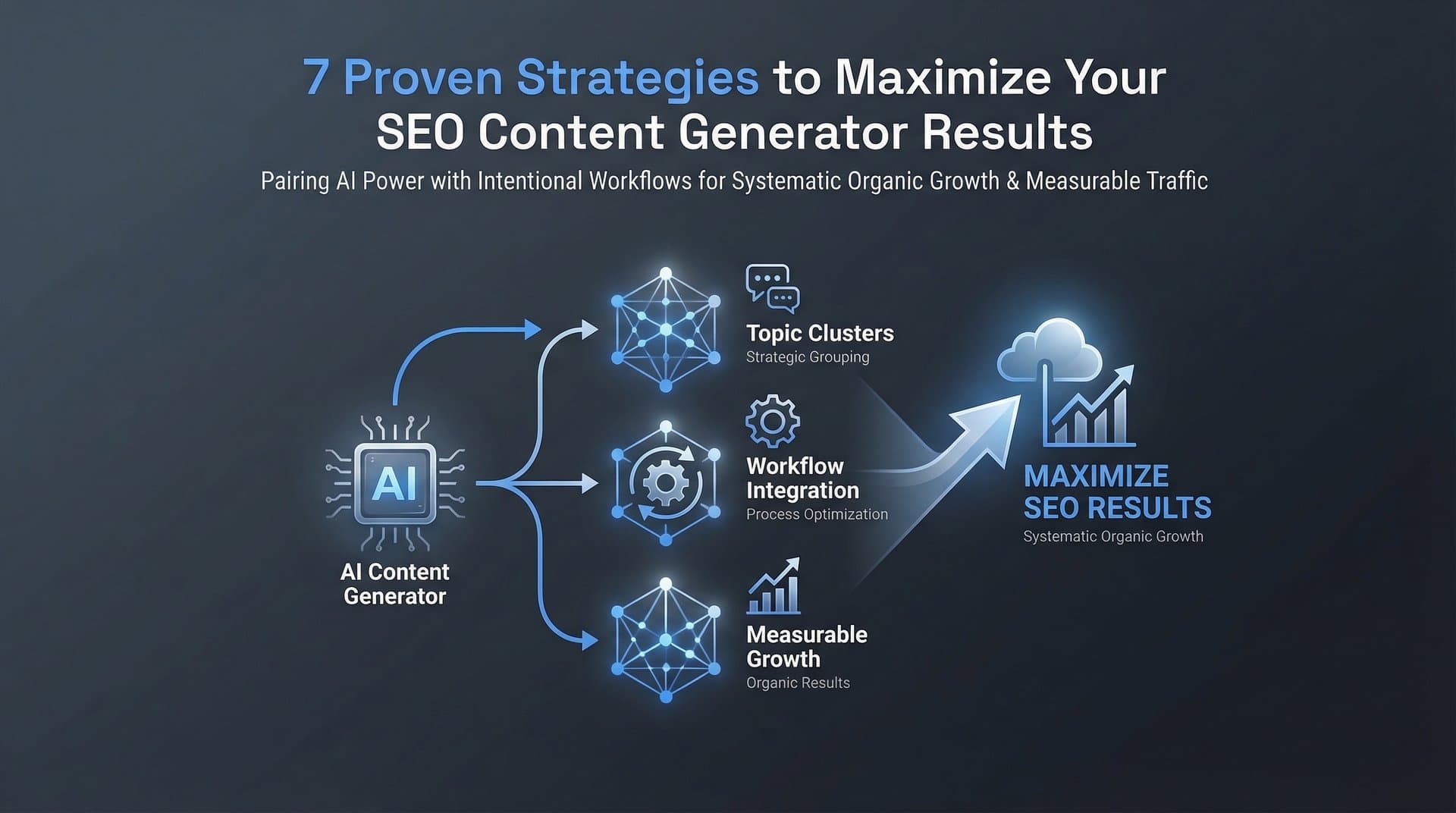
The challenge of scaling quality SEO content has shifted dramatically. Marketers and founders who once spent weeks producing a handful of optimized articles now face a new reality: AI SEO content generators can produce drafts in minutes, but the gap between "content that exists" and "content that ranks" remains as wide as ever.
The difference lies not in the tool itself, but in how strategically you deploy it.
Think of an AI content generator like a high-powered sports car. Hand the keys to someone who's never driven before, and they'll struggle to leave the driveway. But put an experienced driver behind the wheel with a clear destination and route planned? That's when you see real performance.
This guide breaks down seven battle-tested strategies for getting genuine organic traffic results from AI-powered content creation. We're moving beyond basic prompt-and-publish workflows to approaches that compound your visibility across both traditional search and emerging AI platforms like ChatGPT, Claude, and Perplexity.
These aren't theoretical concepts. They're practical frameworks that separate content teams seeing measurable growth from those drowning in AI-generated articles that never gain traction.
1. Build Topic Clusters Before You Generate a Single Word
The Challenge It Solves
Most teams approach AI content generation like a scatter gun: identifying random keyword opportunities and firing off articles without considering how they connect. This creates isolated content islands that search engines struggle to understand and AI models rarely cite.
The result? Individual articles that compete against each other instead of reinforcing your topical authority. You end up with 50 mediocre pieces instead of an interconnected ecosystem that signals expertise.
The Strategy Explained
Topic clustering flips this approach. Before your AI SEO content generator writes a single word, you map out content ecosystems around core themes relevant to your business. Each cluster consists of a comprehensive pillar page surrounded by supporting articles that dive deep into specific subtopics.
Picture a hub-and-spoke model. Your pillar content sits at the center, covering a broad topic comprehensively. The spokes are detailed articles addressing specific questions, use cases, or aspects of that topic. Every spoke links back to the hub, and related spokes link to each other.
This structure does two critical things: it helps search engines understand your topical depth, and it creates the kind of interconnected knowledge base that AI models prefer to cite when answering queries. Understanding what is SEO content strategy becomes essential before building these clusters.
Implementation Steps
1. Identify 3-5 core topics central to your business value proposition and conduct keyword research around each to find the pillar opportunity and 8-12 supporting subtopics.
2. Create a visual map of each cluster showing the pillar page at the center with supporting content radiating outward, noting the specific linking strategy between pieces.
3. Generate your pillar content first using your AI tool, then systematically create supporting articles that reference and link back to the pillar while covering subtopics in detail.
Pro Tips
Start with your smallest viable cluster rather than trying to build everything at once. A complete cluster of one pillar and eight supporting articles outperforms three incomplete clusters every time. Once you see traction, expand to additional topic areas using the same framework.
2. Feed Your AI Generator with First-Party Data and Unique Insights
The Challenge It Solves
Generic AI-generated content faces a fundamental problem: if everyone uses the same tool with similar prompts, the output becomes commoditized. Your articles sound like everyone else's because they're drawing from the same training data and producing similar perspectives.
This creates content that's technically correct but utterly forgettable. Search engines have seen these patterns before, and AI models cite sources that offer something distinct rather than rehashing common knowledge.
The Strategy Explained
The solution lies in feeding your AI SEO content generator with information it can't access anywhere else: your first-party data, proprietary research, customer insights, and unique perspectives from your team's experience.
Think of it like cooking. Two chefs using the same recipe will produce similar dishes, but the chef who adds their grandmother's secret ingredient creates something memorable. Your first-party data is that secret ingredient.
This might include customer survey results, internal performance benchmarks, case study data from your client work, or insights from your support team about common challenges. When you inject this information into your AI generation process, the output becomes genuinely differentiated. The debate around AI content vs human content for SEO often comes down to this unique data injection.
Implementation Steps
1. Create a knowledge base document containing your unique insights, proprietary data points, customer quotes, and internal research findings that can be referenced during content generation.
2. Structure your AI prompts to explicitly incorporate this first-party information by pasting relevant data points directly into the prompt or referencing specific insights you want included.
3. Establish a process where team members with specialized knowledge review and enhance AI drafts with additional context, examples, or perspectives that only insiders would know.
Pro Tips
Even small amounts of proprietary information create meaningful differentiation. A single original statistic from your customer base or a unique framework your team developed can transform generic content into something citation-worthy. Focus on quality of unique insights over quantity.
3. Implement a Human-AI Editorial Workflow That Scales
The Challenge It Solves
The promise of AI content generation is speed and scale, but many teams face a painful reality: their AI produces drafts quickly, but the editing and quality control bottleneck negates any efficiency gains. Articles pile up in review queues, and the pressure to publish leads to subpar content going live.
Meanwhile, teams that over-correct by having humans rewrite everything from scratch wonder why they're using AI at all. Neither extreme works.
The Strategy Explained
The solution is designing a structured editorial workflow that treats AI as a specialized team member rather than a magic button. This means defining clear roles: what AI handles autonomously, what requires light human oversight, and what demands deep expertise.
Picture an assembly line where each station has a specific purpose. AI handles first drafts and structural heavy lifting. A content editor focuses on voice, flow, and strategic positioning. A subject matter expert adds depth and validates technical accuracy. A final reviewer ensures brand consistency.
The key is that each person focuses on what they do best, rather than everyone doing everything. This creates genuine scale while maintaining quality standards. Many teams find that SEO content writing automation works best when combined with strategic human oversight.
Implementation Steps
1. Define three quality tiers for your content based on strategic importance, then assign different review levels to each tier (high-priority content gets full editorial review, while supporting content might need only technical validation).
2. Create specific checklists for each review stage that focus reviewers on their unique contribution rather than general proofreading, such as technical accuracy checks, brand voice alignment, or strategic positioning review.
3. Establish clear turnaround time expectations for each review stage and implement a project management system that tracks content through your workflow pipeline to identify bottlenecks.
Pro Tips
Your workflow should evolve as your team builds confidence with AI output. Start with heavier human oversight, then gradually reduce review intensity for content types where AI consistently performs well. Track which content formats or topics require the most editing to inform your process improvements.
4. Optimize for AI Search Visibility, Not Just Google Rankings
The Challenge It Solves
Traditional SEO focuses exclusively on ranking in Google search results, but a significant shift is underway. Users increasingly turn to AI platforms like ChatGPT, Claude, and Perplexity for answers, and these systems cite sources differently than traditional search engines display results.
Content optimized only for Google may never get mentioned when AI models answer related queries. This creates a visibility gap as user behavior evolves toward conversational AI interfaces.
The Strategy Explained
AI search visibility requires adapting your content strategy for what's often called Generative Engine Optimization (GEO). While traditional SEO prioritizes keywords and backlinks, AI models prioritize authoritative, well-structured content that directly answers questions with clear, citation-worthy information.
Think of it this way: Google shows you a list of potentially relevant pages, but AI models synthesize information and cite specific sources. To get cited, your content needs to be the clearest, most authoritative answer to specific questions within your topic area.
This means structuring content with clear headings that match question patterns, providing definitive answers supported by data, and building topical authority through comprehensive coverage rather than keyword density. Exploring AI content optimization for SEO reveals how these principles apply in practice.
Implementation Steps
1. Audit your existing content to identify which pieces address clear questions with definitive answers versus vague informational content, then prioritize updating high-potential articles with more authoritative, structured information.
2. Restructure your AI-generated content to use question-based H2 headings that match natural language queries, followed by direct answers in the first paragraph of each section.
3. Monitor how AI models currently reference your brand and content by testing relevant queries across ChatGPT, Claude, and Perplexity to identify gaps in your visibility and opportunities for new content.
Pro Tips
AI models favor content that cites credible sources and presents information with confidence. When your AI SEO content generator creates articles, ensure they reference authoritative sources and present information definitively rather than hedging with qualifiers. This builds the citation-worthiness that AI platforms reward.
5. Automate Content Distribution and Indexing for Faster Discovery
The Challenge It Solves
You can generate high-quality content at impressive speed with an AI SEO content generator, but that advantage disappears if your content sits undiscovered for weeks. Traditional indexing relies on search engines crawling your site on their schedule, which can delay visibility for new content significantly.
This creates a frustrating gap between publication and performance, especially when you're trying to capitalize on timely topics or measure content effectiveness quickly.
The Strategy Explained
Modern content operations require automating the entire journey from generation to discovery. This means integrating your AI content workflow with tools that handle immediate indexing notification and streamlined publishing.
IndexNow protocol, supported by platforms like Microsoft Bing and Yandex, allows you to notify search engines instantly when new content goes live. Rather than waiting for the next crawl cycle, you're actively pushing updates to search engines the moment you publish.
Combined with CMS auto-publishing capabilities, you create a system where content moves from AI generation through editorial review to live publication and indexing notification without manual intervention at each step. Teams looking to understand how to automate SEO content creation should prioritize these distribution workflows.
Implementation Steps
1. Implement IndexNow integration on your website to automatically notify supporting search engines whenever new content publishes or existing content updates, ensuring immediate discovery rather than passive crawling.
2. Set up automated sitemap updates that regenerate and submit your XML sitemap to search engines each time new content goes live, maintaining an accurate index of your content inventory.
3. Configure your CMS to auto-publish approved content at optimal times based on your audience activity patterns, removing the manual scheduling bottleneck from your workflow.
Pro Tips
Don't overlook the compounding advantage of faster indexing. When you publish content clusters, getting all pieces indexed quickly creates immediate topical authority signals rather than having your cluster appear gradually over weeks. This acceleration can meaningfully impact how quickly you see ranking improvements.
6. Create Feedback Loops Using Performance Data
The Challenge It Solves
Many teams treat AI content generation as a one-way process: generate, publish, move on. This approach misses the critical learning opportunity hidden in your performance data. Without connecting results back to your generation strategy, you repeat what doesn't work and miss patterns in what succeeds.
The result is stagnant performance despite publishing volume. You're producing more content but not getting better at producing content that performs.
The Strategy Explained
Effective AI content operations require closing the loop between output and outcomes. This means systematically analyzing which content drives traffic, engagement, and conversions, then feeding those insights back into your content planning and AI generation approach.
Picture a pilot adjusting course based on instrument readings. Your analytics are the instruments, and your AI generation strategy is the course. Without checking the instruments, you might be flying in the wrong direction at impressive speed.
This feedback loop identifies which topics resonate, which content structures perform best, which AI-generated formats need the least editing, and which prompting approaches produce the strongest results. Tracking AI generated content SEO performance becomes the foundation for continuous improvement.
Implementation Steps
1. Establish a monthly content performance review where you analyze your top and bottom performing pieces, identifying patterns in topic selection, content structure, format type, and generation approach.
2. Create a performance dashboard that tracks key metrics for AI-generated content separately from other content, allowing you to measure the specific impact of your AI content strategy and identify improvement opportunities.
3. Document successful content patterns in your AI generation guidelines, including effective prompt structures, optimal content lengths for different formats, and topic approaches that consistently drive results.
Pro Tips
Pay special attention to content that overperforms or underperforms relative to your expectations. These outliers reveal insights that average performance obscures. A surprisingly successful article might indicate an underserved topic area, while consistent underperformance in a category might signal a strategic misalignment worth investigating.
7. Diversify Content Formats Beyond Standard Blog Posts
The Challenge It Solves
Most teams default to one content format when using an AI SEO content generator: the standard informational blog post. While these have their place, this narrow approach leaves significant opportunities untapped and creates monotonous content experiences that fail to serve different user intents.
Different questions require different content structures. A user comparing solutions needs a different format than someone seeking step-by-step guidance or looking for quick tips.
The Strategy Explained
Strategic content operations leverage specialized formats matched to specific user intents and search patterns. Listicles excel for strategy roundups and tool comparisons. Comprehensive guides serve users seeking deep understanding. Explainers clarify complex concepts. Comparison articles help decision-making.
The key is recognizing that modern AI SEO content generators can handle multiple specialized formats, each optimized for different ranking opportunities and user needs. This diversification improves your chances of capturing various search intents while creating more engaging content experiences. Reviewing the best AI content generators for SEO reveals which tools handle format diversity most effectively.
Think of it like a restaurant menu. Offering only one dish limits your appeal, but a thoughtfully curated selection of complementary options serves different preferences and occasions. Your content library should work the same way.
Implementation Steps
1. Audit your keyword opportunities to categorize them by user intent (informational, comparison, how-to, strategic), then match each category to the most appropriate content format rather than defaulting everything to standard articles.
2. Develop format-specific templates and prompting approaches for your AI content generator that optimize for each format's unique requirements, such as comparison tables for versus content or numbered frameworks for listicles.
3. Create a content calendar that intentionally balances formats across your publishing schedule, ensuring you're not overweighting any single approach and serving the full spectrum of user needs in your topic areas.
Pro Tips
Start by identifying which format best serves your highest-value keywords. If your most important search terms have comparison intent, prioritize building your comparison content capabilities first. Master one additional format before expanding to others, rather than trying to execute every format simultaneously with mediocre results.
Putting These Strategies Into Action
Start by auditing your current content approach against these seven strategies. Where are your biggest gaps? Most teams find quick wins in areas three and five: establishing proper editorial workflows and automating distribution.
These improvements deliver immediate efficiency gains without requiring major strategic shifts. You'll see faster publication cycles and reduced editorial bottlenecks within weeks of implementation. For teams struggling with consistency, understanding why manual SEO content writing slows down operations can highlight where automation adds the most value.
From there, build toward the compounding benefits of topic clusters and AI visibility optimization. These strategies take longer to show results but create sustainable competitive advantages that strengthen over time.
The marketers seeing the strongest results treat AI SEO content generators not as replacement writers, but as force multipliers for strategic content operations. The tool amplifies your strategy, but the strategy comes first.
Your next step: pick one strategy from this list and implement it this week. Don't try to overhaul everything simultaneously. Start with the approach that addresses your most pressing bottleneck, measure the impact, then expand to additional strategies.
But here's the thing: all the content strategy in the world means nothing if you can't track whether AI models are actually citing your brand. You might be publishing at scale, but are ChatGPT, Claude, and Perplexity mentioning you when users ask relevant questions?
Start tracking your AI visibility today and see exactly where your brand appears across top AI platforms. Stop guessing how AI models talk about your brand, identify content opportunities based on actual AI citations, and automate your path to organic traffic growth with content that gets mentioned.