An SEO content strategy is your master plan for creating and structuring content that both search engines and your target audience will love. Think of it less as a simple to-do list and more as an architectural blueprint for building a powerful, authoritative online presence.
What Is an SEO Content Strategy Really

If you've ever poured hours into a blog post only to hear digital crickets, you've felt what it's like to create content without a strategy. It's a classic mistake: churning out content piece by piece, hoping one will magically strike gold and rank. The hard truth is, search engines like Google don't reward scattered efforts; they reward structure, authority, and relevance.
A modern SEO content strategy is the system that glues every single piece of content you create together. It makes sure each article, guide, and landing page is working in concert to achieve a much bigger goal. Instead of publishing random posts, you're methodically building a cohesive web of information that cements your brand as an expert in its field.
This whole approach is about more than just "doing SEO." It’s about building a brand that search algorithms and AI systems fundamentally trust.
At its core, an SEO content strategy answers four fundamental questions:
- What will we create content about? (Topics & Keywords)
- Who is this content for? (Audience & Intent)
- How will we organize it to build authority? (Structure & Linking)
- Why are we creating it? (Business Goals & KPIs)
By getting clear on these questions upfront, you stop being a reactive content creator and start becoming a proactive brand builder.
The Shift From Keywords To Topical Authority
The game has changed in a big way. An effective SEO content strategy is no longer just about sprinkling a few keywords into your blog posts. Today, it's a structured plan to build topical authority, capture high-intent demand from your audience, and get your content cited by AI systems.
In fact, new research covering over 250,000 search results shows that topical authority has become the strongest on-page ranking factor, blowing past outdated metrics like keyword density. Despite this, a staggering 97% of brands are missing out, with only 3% consistently publishing the long-form content over 2,000 words that so often wins.
This means your entire strategy has to be built around covering a topic comprehensively, not just sniping at isolated keywords. Each piece of content you publish should act like a supporting beam, reinforcing your overall authority on a subject.
Why a Strategy Is Non-Negotiable
Without a documented plan, content efforts quickly become messy, inefficient, and disconnected. A clear strategy is what ensures every piece of content has a real purpose and contributes to your long-term visibility.
For example, a solid strategy dictates how you create and link related articles together. This helps Google understand the depth of your expertise, which is a massive part of effective content optimization. Ultimately, a strong strategy connects your content directly to real business outcomes, turning your blog from a cost center into a reliable engine for growth.
It’s the difference between just publishing content and publishing with purpose.
To see just how much things have changed, let's compare the old way of thinking with a modern strategic approach.
Traditional Content Plan vs Modern SEO Content Strategy
This table highlights the evolution from simply planning content to executing a data-driven strategy designed for today's search landscape.
| Component | Traditional Content Plan | Modern SEO Content Strategy |
|---|---|---|
| Foundation | Based on creative ideas and loose topics. | Grounded in data, audience intent, and competitor analysis. |
| Keywords | Targets individual, high-volume keywords. | Builds topic clusters around core pillars and long-tail queries. |
| Structure | Content is created as standalone pieces. | Content is interlinked to build a web of topical authority. |
| Goal | Increase website traffic and publish consistently. | Drive qualified organic traffic that converts into business results. |
| Measurement | Tracks page views and keyword rankings. | Measures ROI, conversions, and share of voice for key topics. |
| Technology | Relies on basic writing and scheduling tools. | Integrates AI platforms for planning, creation, and optimization. |
The takeaway is clear: the old, scattered approach just doesn't cut it anymore. A modern strategy is a comprehensive, interconnected system that drives measurable business growth.
Understanding the Five Pillars of a Powerful Strategy
A winning SEO content strategy isn't built on guesswork. It’s a carefully constructed system resting on five essential pillars. Each one supports the others, and together they create a powerful, sustainable content engine that drives real results.
Think of them like the structural columns of a building—if one is weak, the whole thing gets shaky. By mastering these five components, you can stop publishing random articles and start building a cohesive machine that consistently attracts the right audience and builds lasting authority.
Let's break them down.
Pillar 1: Audience and Intent Alignment
Before you write a single word, you have to know who you’re writing for and, more importantly, why they’re searching in the first place. This goes way beyond basic demographics like age or location. It’s all about digging into user intent—the real motivation behind every search query.
Is someone looking for a quick answer? Are they comparing products? Or are they ready to pull out their credit card?
Getting this right is everything. If you create a massive "how-to" guide for a user who just wants a simple definition, you've completely missed the mark. On the flip side, a short product description won’t cut it for someone looking for a detailed comparison. When you nail user intent, you provide genuine value, and that’s a massive signal to search engines.
For example, a search for "best running shoes" has a completely different intent than "Nike Pegasus vs. Brooks Ghost." The first is broad and informational, while the second is specific and comparative. A smart strategy has content that precisely matches both.
Pillar 2: Topic and Keyword Research
Once you know what your audience wants, it's time to map out the exact topics and keywords they use to find it. This pillar is about shifting your mindset from chasing individual, high-volume keywords to building topical authority. The goal isn’t just to rank for a single term; it's to own the entire conversation.
This is where the topic cluster model (or "hub-and-spoke") comes into play. It’s a game-changer. The model involves creating:
- A Pillar Page: This is your big, comprehensive guide covering a broad core topic from top to bottom. It acts as the "hub" for all related content.
- Cluster Content: These are shorter, more focused articles that dive deep into specific subtopics. Think of them as the "spokes" that all link back to your central hub.
This structure does two critical things. First, it organizes your content in a logical way that makes it incredibly easy for users to find related information. Second, it sends powerful signals to Google that you have deep expertise on a subject, helping your entire cluster of pages rank higher over time. You can learn more about how this works by exploring what is a pillar page and its role in building authority.
Pillar 3: Content Structure and On-Page SEO
With your topics locked in, the third pillar focuses on how you actually structure and optimize each article. This is where technical precision meets a great user experience. Even the most brilliant article will fall flat if it’s a wall of text or if search engines can't figure out what it's about.
Key elements here include:
- Logical Hierarchy: Using clear headings (H1, H2, H3s) to break up your content and guide the reader through the page.
- Readability: Writing in short paragraphs, using bullet points, and adding visuals to make the content easy to scan and digest.
- On-Page Elements: Nailing the fundamentals like optimizing your title tags, meta descriptions, image alt text, and URLs with relevant keywords.
- Internal Linking: Strategically linking to other relevant pages on your site. This helps users discover more of your content and passes authority between your pages.
This is also where Google's E-E-A-T (Experience, Expertise, Authoritativeness, and Trust) principles become crucial. Search engines want to show content from reliable sources, so things like author bios, citing credible data, and ensuring your information is accurate are non-negotiable.
Pillar 4: Technical Health and Site Performance
Your content could be Pulitzer-worthy, but it won't matter one bit if technical glitches are holding your site back. The fourth pillar is all about the technical foundation—a slow, buggy, or insecure site will sabotage even the best content efforts.
Technical SEO is a huge field, but for a content strategy, you need to focus on a few critical areas:
- Site Speed: Your pages need to load fast. Slow load times are a surefire way to increase bounce rates and tank your rankings.
- Mobile-Friendliness: With most searches now happening on mobile, your site absolutely must look and work perfectly on every device.
- Structured Data: Using schema markup helps search engines understand the context of your content, which can unlock rich results in the SERPs like FAQ snippets and review stars.
- Crawlability: You need to make sure search engine bots can easily find and index all your important pages without running into errors or dead ends.
Think of technical SEO like the plumbing and wiring in your house. It isn't the sexiest part, but if it doesn't work, nothing else does either.
Pillar 5: Promotion and Distribution
Finally, hitting "publish" is just the beginning. The fifth pillar is making sure your amazing content actually gets in front of the right eyeballs. Creating something great and just hoping people find it is not a strategy. You need a proactive plan for promotion and distribution.
This doesn't mean spamming your links everywhere. It means being strategic and sharing your content where your audience already hangs out.
A few effective promotion tactics include:
- Email Marketing: Sharing new articles with your newsletter subscribers who already know and trust you.
- Social Media: Promoting your content on the right platforms to spark conversation and drive initial traffic.
- Community Engagement: Sharing your expertise in forums, groups, and Q&A sites where your content provides real, tangible value.
- Backlink Outreach: Reaching out to other reputable sites to earn links, which remain one of the most powerful ranking signals.
By putting real effort into promotion, you give your content the initial push it needs to gain traction and start attracting organic traffic on its own. Without this final pillar, your strategy is incomplete.
Your Step-by-Step Framework for Building a Strategy
Knowing the pillars of a strong SEO content strategy is one thing. Actually putting them into practice? That’s a whole different ball game. It's easy to get stuck staring at a blank slate, but this section will give you a clear, sequential roadmap to guide you from concept to execution. Think of it as turning abstract theory into a concrete, actionable game plan.
This framework isn’t about chasing every shiny new tactic you hear about on Twitter. It's a durable, repeatable process for building a purposeful content operation from the ground up, making sure every single action contributes directly to your long-term visibility and business goals.
The flow chart below breaks the whole process down into five interconnected stages, starting with understanding why people search and ending with getting your finished content in front of them.
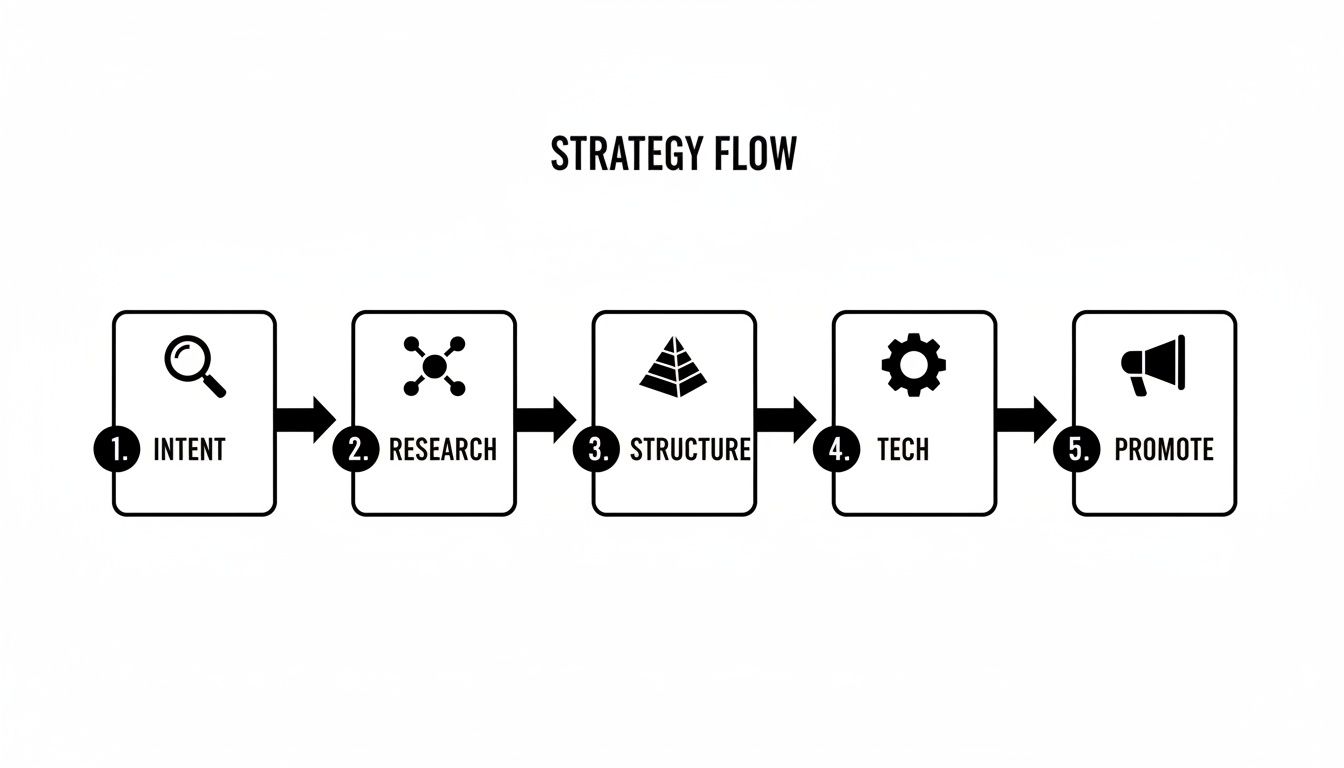
As you can see, a winning strategy moves logically from one step to the next: understanding user needs, researching opportunities, structuring content, ensuring technical soundness, and actively promoting your work.
Step 1: Start with a Content Audit
Before you even think about creating something new, you have to know what you’re already working with. A content audit is your starting line. It gives you a complete inventory of every asset on your site and tells you how it’s performing, helping you find hidden gems, glaring content gaps, and underperforming pages that need a little love.
During the audit, your job is to categorize your content. You’re looking for pages to:
- Keep: These are your all-stars. High-performing content that already ranks well and brings in consistent traffic.
- Improve: Articles that have potential but are outdated, thin, or not fully optimized.
- Consolidate: Multiple weak pages floating around the same topic that could be merged into one powerhouse resource.
- Remove: Low-quality, irrelevant, or duplicate content that adds zero value and might even be hurting your site’s authority.
This process declutters your site and lets you focus your energy where it'll make the biggest difference. It’s all about building on your strengths and pruning what's holding you back.
Step 2: Analyze Your Competitors
Once your own house is in order, it's time to see what the neighbors are up to. Competitor analysis isn't about copying what others are doing—it's about finding the strategic opportunities they've completely missed. You need to understand their strengths, but more importantly, their weaknesses.
Take a hard look at the top-ranking sites for your target topics and start asking some critical questions:
- What keywords and topic clusters are driving most of their traffic?
- What content formats are they leaning on (e.g., long-form guides, videos, free tools)?
- Where are their content gaps? Are there crucial subtopics they’ve totally overlooked?
- How strong is their backlink profile, and more importantly, who is linking to them?
Answering these questions tells you exactly how high the competitive bar is and helps you find a unique angle to make your content stand out. This intelligence is the foundation for a strategy that can actually win.
Step 3: Map the Customer Journey
Now, let's bring the focus back to your audience. A customer journey map is simply an outline of the different stages a person goes through, from first realizing they have a problem to finally making a purchase. Your content needs to show up and provide value at every single step.
Think about the questions your ideal customer is asking at each phase:
- Awareness Stage: The user has a problem, but they might not even know what the solution is called. Content here should be educational and answer broad "what is" or "how to" questions.
- Consideration Stage: The user is actively researching and comparing different solutions. Your content should offer detailed comparisons, case studies, and expert-level guides.
- Decision Stage: The user is ready to pull the trigger. Content should focus on product pages, free trials, and testimonials that build confidence and push them toward conversion.
When you map your content to these stages, you create a cohesive experience that naturally guides users from their very first search to their final click.
Step 4: Design Topic Clusters and an Editorial Calendar
With your research locked in, it's time to give your plan some structure. The best way to do this is by organizing your content ideas into topic clusters, with each cluster built around a central "pillar" page. This hub-and-spoke model is the architectural foundation of a modern SEO strategy, helping you build topical authority and create a logical site structure that search engines love.
Once your clusters are defined, you can translate them into a realistic editorial calendar. This calendar should specify:
- The exact title of each article or page.
- The target keywords and user intent.
- The content format (e.g., blog post, landing page, video).
- The author and the deadline.
- The pillar page it connects back to.
A well-managed calendar turns your high-level strategy into a manageable day-to-day workflow, ensuring you publish consistently. To make sure every piece is created with purpose, using a detailed SEO content brief template is essential for aligning your writers with your optimization goals. It’s the framework that gives your team the clarity they need to execute flawlessly.
How to Measure Success and Prove Your Content ROI
Let's be honest. Creating fantastic content is only half the battle. If you can't show that your hard work is actually moving the needle for the business, your strategy is running on borrowed time. Measurement is how you bridge that gap—it’s how you connect your content directly to the results that executives and stakeholders actually care about.
It's easy to drown in a sea of data, but a smart SEO content strategy focuses on the right key performance indicators (KPIs). We need to look past simple vanity metrics like total page views and zero in on the numbers that demonstrate real growth, authority, and return on investment (ROI). It's all about tracking your progress in a way that tells a powerful story about your content's value.
Moving Beyond Vanity Metrics
Sure, seeing a spike in website traffic feels great, but it doesn't automatically mean your strategy is a winner. A thousand visitors who bounce immediately are far less valuable than ten visitors who turn into qualified leads. To really get a handle on performance, you have to focus on metrics that are tied directly to business goals.
The most powerful KPIs give you a clear view of how your content is building authority and driving conversions. Think less about raw traffic numbers and more about the quality of that traffic.
Here are the metrics that truly matter:
- Keyword Cluster Rankings: Stop obsessing over individual keywords. Instead, monitor your visibility across entire topic clusters. Are you showing up for a wide range of related long-tail queries? That's how you know you're building real topical authority, not just getting lucky with a few terms.
- SERP Feature Ownership: How often is your content snagging featured snippets, showing up in "People Also Ask" boxes, or appearing in video carousels? Owning these SERP features is like getting free billboard space on Google—it skyrockets your visibility and cements your brand as a go-to source.
- Organic Conversion Rates: This is the ultimate bottom-line metric. What percentage of your organic visitors are actually taking the action you want them to, whether it’s signing up for a newsletter, downloading an ebook, or requesting a demo?
- Backlink Velocity: This tracks the rate at which your content is earning new backlinks from reputable sites. A steady climb in backlink velocity is a massive signal that others in your industry see your content as authoritative and worth citing.
Building Your Measurement Toolkit
You don't need a dozen complicated tools to track these KPIs. A few core platforms will give you all the data you need to monitor progress, set realistic goals, and report back on your wins.
The goal is to create a simple, reliable system for tracking the metrics that connect content performance to business outcomes. This clarity is essential for making data-driven decisions and proving the value of your work.
Your essential toolkit should include:
- Google Search Console: This is your direct line to Google. Use it to keep an eye on keyword rankings, click-through rates (CTR), impressions, and any technical hiccups that might be holding you back.
- Google Analytics 4 (GA4): This is your window into user behavior. Set up conversion tracking to see which articles are driving the most leads or sales and to analyze how people are engaging with your content.
- A Rank Tracking Tool: While Search Console is fantastic, a dedicated rank tracker like Ahrefs or Semrush gives you more detailed, consistent data on how your keyword clusters are performing and where you stand against the competition.
To help you get started, here's a simple breakdown of the most important KPIs and where to track them.
Key SEO Content Strategy KPIs and Tracking Tools
| KPI (Key Performance Indicator) | What It Measures | Primary Tracking Tools |
|---|---|---|
| Organic Traffic | The number of visitors arriving from search engines. | Google Analytics 4 (GA4) |
| Keyword Rankings | Your website's position in SERPs for target keywords and clusters. | Google Search Console, Ahrefs, Semrush |
| Organic Conversion Rate | The percentage of organic visitors who complete a goal (e.g., signup, purchase). | Google Analytics 4 (GA4) |
| Backlink Profile & Velocity | The quantity, quality, and growth rate of inbound links. | Ahrefs, Semrush, Moz |
| SERP Feature Ownership | How often your content appears in snippets, PAA boxes, etc. | Ahrefs, Semrush |
| Bounce Rate / Engagement Rate | How users interact with your pages after arriving. | Google Analytics 4 (GA4) |
By combining insights from these tools, you get a full 360-degree view of your content's impact. For a deeper dive, check out our guide on measuring content marketing ROI for more advanced techniques.
Tying Content to Revenue
The business case for a modern SEO content strategy is crystal clear and backed by data. Across industries, roughly 70% of marketers report they can directly show how content has increased leads and engagement. Even more compelling, marketers who prioritize blogging are a whopping 13 times more likely to see a positive ROI. The connection between strategic content and measurable growth couldn't be stronger. You can discover more insights about the impact of AI on SEO from Elementor.
Ultimately, your job is to build a compelling narrative that ties every piece of content back to revenue, leads, and brand visibility. By tracking the right KPIs and presenting your findings clearly, you can prove the immense value of your SEO content strategy and secure the buy-in—and budget—you need to keep growing.
Using AI to Scale Your Content Engine

Let's be honest: the biggest bottleneck in any ambitious SEO content strategy is scale. How do you pump out more high-quality content and build topical authority faster without your quality tanking? The answer isn't just "work harder." It's about building a genuine content engine, powered by artificial intelligence.
This isn’t about hitting a button and letting robots take over. It’s about giving your team superpowers. Think of AI as the ultimate assistant, automating the repetitive, soul-crushing parts of the content lifecycle.
By handing off the grunt work, your team is free to focus on what humans do best: big-picture thinking, creative angles, and connecting with your audience. You’re not replacing strategists; you’re upgrading them.
Automating the Foundational Work
So much of a solid content strategy is built on manual, data-heavy research. This is the first place AI can step in and completely change the game, turning hours of tedious work into a few minutes of focused analysis.
AI platforms are brilliant at handling the crucial prep work with incredible speed and accuracy.
- Competitive Research: Instead of manually combing through the top-ranking pages, AI can instantly dissect them. It pinpoints common themes, glaring content gaps, and the exact structure you need to beat them.
- Topic Ideation: AI can process mountains of search data to uncover long-tail keywords and niche user questions you'd likely never find on your own. This ensures your content isn't just good—it's comprehensive.
- Outline Generation: Based on a deep analysis of the SERPs, AI can generate detailed, SEO-ready outlines. These come complete with suggested headings, subtopics, and important concepts to include.
This isn't just a time-saver; it’s a quality booster. It ensures every single article is built on a solid foundation of data, not just a hunch. Your writers get a clear, optimized roadmap before they even type the first word.
From Strategy to Scalable Production
Once you’ve automated the research, the next frontier is scaling the actual content creation. This is where specialized platforms like Sight AI come in. They are designed to turn your well-laid plans into a steady stream of high-quality, long-form articles.
The goal here is to create a repeatable system that can churn out optimized content without constant hand-holding. This methodical approach is how you truly build topical authority and watch your organic traffic compound month after month. To see how this works in practice, check out our guide on effective content creation with AI.
A platform like this can manage the entire workflow, from generating article ideas based on what’s trending to publishing fully optimized posts directly to your CMS.
The Human-in-the-Loop Approach
At the end of the day, the magic happens when you combine the best of both worlds. The most effective model is what we call "human-in-the-loop."
AI handles the data, generates the outlines, and writes the first drafts. But it’s the human expert who provides the final polish, the strategic direction, and that unique brand voice that a machine can't replicate.
This partnership merges the raw speed and data-crunching power of AI with the creativity, nuance, and critical thinking of your team. It's the secret to scaling an SEO strategy that doesn’t just rank—it resonates. This is how you go from just another voice online to a dominant force in the search results.
Common Questions About SEO Content Strategy
Even with the best-laid plans, you're going to have questions. An SEO content strategy isn't a static document you create once and then file away—it's a living, breathing part of your marketing that needs to adapt. As you start putting the pieces together, you'll inevitably hit some roadblocks or moments of doubt.
This section is all about tackling those common hurdles. We'll answer some of the most frequent questions that come up once you move from theory to practice, giving you the clarity and confidence to push forward.
Think of this as your go-to guide when you get stuck.
What Is the Difference Between a Strategy and a Tactic?
This one trips people up all the time, but getting it right is crucial. The easiest way to think about it is to imagine planning a cross-country road trip.
Your strategy is the big-picture vision: "We're going to drive from New York to Los Angeles in seven days, taking scenic routes through national parks to have an unforgettable adventure." It sets the goal (L.A.), the core approach (scenic routes), and the ultimate outcome (an amazing experience).
Your tactics are the specific moves you make to bring that vision to life:
- Booking a specific motel in Moab for Tuesday night.
- Choosing to write a long-form blog post instead of a short one.
- Using Google Maps to navigate through the Rockies.
- Building backlinks to a specific pillar page.
- Packing a cooler with snacks and making the perfect road trip playlist.
In SEO, your strategy is the grand plan for building authority and driving real business results. Tactics like "optimizing title tags" or "publishing on Tuesdays" are just individual steps along the way. Without a strategy to guide them, your tactics are just random actions that won't get you anywhere meaningful.
How Long Does It Take to See SEO Results?
Ah, the million-dollar question. The most honest answer is: it depends. SEO is a long game, not a get-rich-quick scheme. While you might see some small wins in a few weeks, you should expect significant, lasting results to take anywhere from six to twelve months to really kick in.
A few key factors will speed up or slow down your timeline:
- Competition: Trying to rank in a crowded, competitive industry is going to take a lot longer than targeting an underserved niche.
- Website Authority: An established website with a solid history and backlink profile will see results much faster than a brand-new domain starting from scratch.
- Consistency: This is non-negotiable. If you publish and optimize consistently, you'll see progress. If your efforts are sporadic, your results will be, too.
- Technical Health: Your site could host the best content in the world, but if it's plagued by technical SEO issues, it will be like trying to drive with the emergency brake on.
The secret is to focus on leading indicators in the early days. Don't obsess over hitting the #1 spot in your first month. Instead, look for progress in keyword impressions, small bumps in click-through rates, and landing your first few backlinks. These are the green shoots that prove your strategy is working.
Should I Delete or Update Old Content?
The answer is almost always update. Your existing content, even if it's not performing well, is a valuable asset. When you delete an old post, you're throwing away any authority, backlinks, and indexing history it's built up over the years.
Instead of hitting delete, run a content audit and look for opportunities to:
- Refresh Outdated Content: Is the information stale? Update it with new stats, fresh examples, and current best practices to make it relevant again.
- Beef Up Thin Content: Does an article only scratch the surface? Go deeper. Add more detail and expand on the topic to deliver more value to the reader.
- Consolidate Overlapping Posts: If you have three or four weak articles all about the same thing, combine them into one definitive, powerhouse guide. Then, use 301 redirects to point all the old URLs to your new, consolidated page.
This process, often called content pruning or refreshing, is a seriously powerful tactic. It shows search engines that you're committed to quality and actively maintaining your site. Deleting content should be your absolute last resort, reserved only for pages that are totally irrelevant to your business and have zero traffic or backlinks to their name.
Ready to turn insights into action and scale your content engine? With Sight AI, you can automate the heavy lifting of research, creation, and optimization. Our platform helps you build topical authority, monitor your brand's visibility across AI and search, and publish high-quality, long-form articles with a consistent cadence. Stop guessing and start growing. Discover how you can build a true content machine at https://www.trysight.ai.