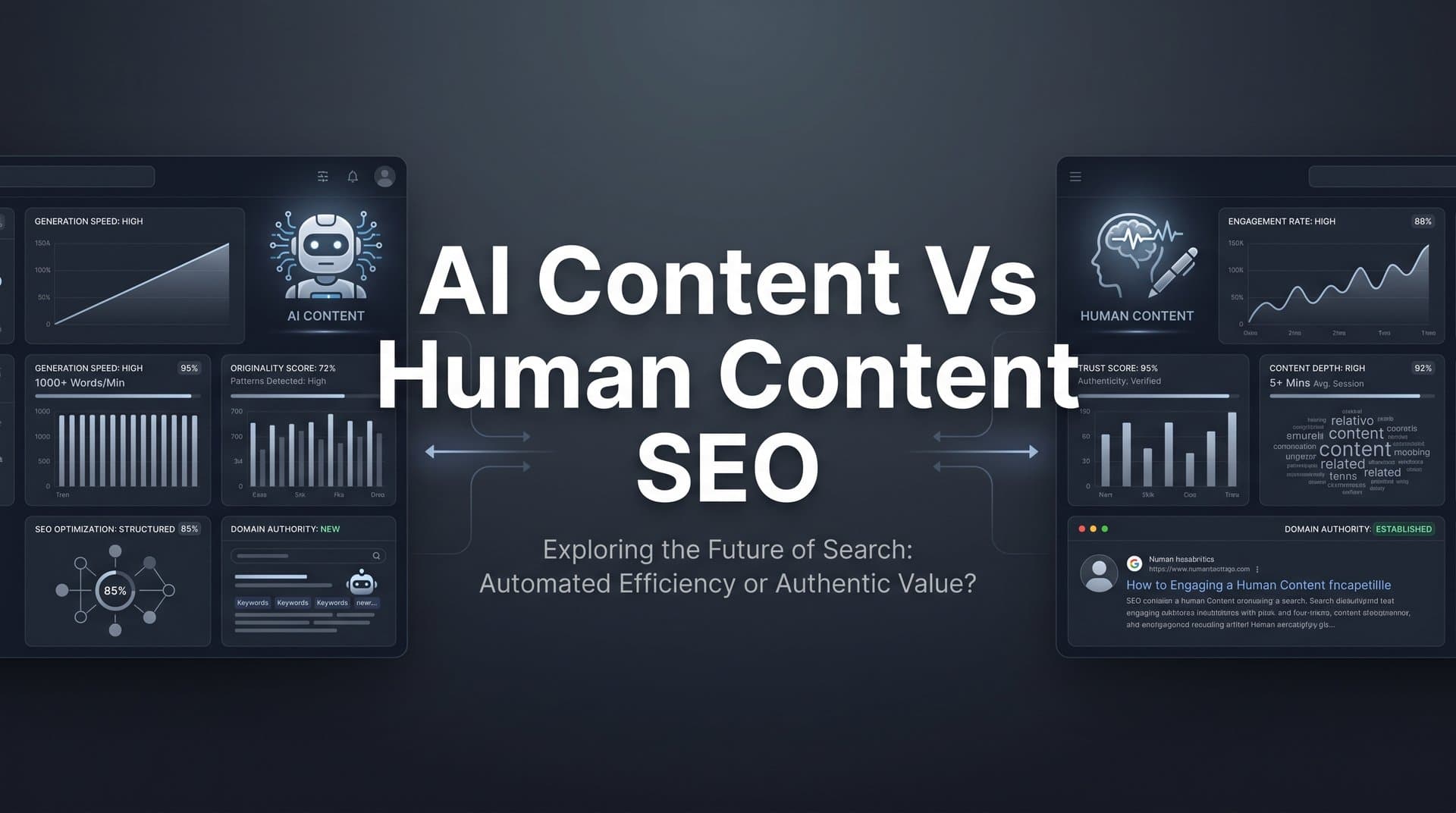
The debate between AI content and human content for SEO misses the point entirely. In 2026, the most successful content strategies don't choose one over the other—they strategically blend both approaches to maximize organic visibility while maintaining authentic brand voice.
Search engines have evolved beyond simple content detection. They now evaluate expertise signals, user engagement patterns, and topical authority regardless of how content is produced. The real question isn't whether to use AI or humans—it's how to combine both methods strategically.
This guide delivers actionable strategies for leveraging AI efficiency without sacrificing the human elements that build trust and drive conversions. Whether you're a founder scaling content operations or an agency managing multiple client portfolios, these frameworks will help you create content that ranks, resonates, and gets mentioned across both traditional search and AI platforms.
1. Map Content Types to Production Methods
The Challenge It Solves
Most teams approach content production with an all-or-nothing mindset, either committing fully to AI generation or avoiding it entirely. This binary thinking creates inefficiency and missed opportunities. Different content types have vastly different requirements for expertise, originality, and update frequency—yet many organizations apply the same production approach across their entire content library.
The Strategy Explained
Create a strategic matrix that categorizes your content by complexity, expertise requirements, and competitive differentiation needs. Match each category to the optimal production method based on where human insight adds the most value versus where AI acceleration makes sense.
Think of it like assembling a kitchen team. You wouldn't have your head chef preparing every single dish from scratch while line cooks stand idle. Similarly, your content strategy should deploy resources where they create maximum impact.
High-value thought leadership, original research, and YMYL topics typically require significant human expertise. Foundational guides, FAQ content, and informational articles can often start with AI drafts that humans refine. Product updates, news summaries, and data compilations can leverage AI heavily with lighter human oversight.
Implementation Steps
1. Audit your existing content library and categorize pieces by topic complexity, required expertise level, competitive landscape, and update frequency needs.
2. Create a production method matrix with three categories: Human-Led (AI assists with research/outlining), Collaborative (AI drafts, humans substantially revise), and AI-Led (AI generates, humans review/polish).
3. Assign each content category to a production method based on where differentiation matters most, document your decision criteria, and establish quality benchmarks for each category.
Pro Tips
Review your matrix quarterly as AI capabilities evolve. What required heavy human involvement six months ago might be ready for collaborative production today. Track performance metrics by production method to identify which content types benefit most from increased human input.
2. Build Human-AI Collaboration Workflows
The Challenge It Solves
The handoff between AI generation and human refinement often becomes a bottleneck where quality suffers. Without clear workflows, team members either over-rely on AI output without sufficient review or waste time redoing work that AI could have handled. This creates inconsistent quality and unpredictable timelines that undermine both efficiency gains and content standards.
The Strategy Explained
Design integrated workflows with explicit handoff points where each contributor—AI and human—handles tasks that play to their strengths. AI excels at research aggregation, outline generation, and first drafts of straightforward content. Humans excel at injecting expertise, verifying accuracy, refining tone, and adding original insights.
Picture this like a relay race where each runner knows exactly when to pass the baton. Your workflow should specify what AI delivers, what format it should be in, and what specific elements humans need to add or verify.
The most effective workflows treat AI as a research assistant and first-draft generator, not a final content producer. Humans then layer in proprietary insights, fact-check claims, adjust tone for brand voice, and add examples that demonstrate real expertise.
Implementation Steps
1. Map your current content creation process from research through publication, identifying which steps consume the most time and which require the most expertise.
2. Define clear AI responsibilities (research compilation, outline generation, section drafting) and human responsibilities (expertise injection, fact verification, tone refinement, quality control) with specific deliverable formats for each handoff.
3. Create workflow templates for different content types with built-in checkpoints where humans review AI output, document revision expectations at each stage, and establish timeline targets that account for both AI speed and human review depth.
Pro Tips
Build feedback loops where your team documents common AI output issues. Use these patterns to refine your AI prompts and reduce revision time. Consider using specialized AI agents for different workflow stages—one for research, another for drafting, another for optimization—rather than relying on a single AI tool for everything.
3. Inject First-Party Data and Original Insights
The Challenge It Solves
AI-generated content often sounds generic because it synthesizes publicly available information without adding unique perspective. This creates a sea of similar articles that fail to differentiate your brand or provide compelling reasons for other sites to link to your content. Without proprietary insights, your content blends into the background regardless of how well it's optimized.
The Strategy Explained
Systematically incorporate data, insights, and perspectives that only your organization possesses. This includes customer feedback patterns, internal research findings, expert team member perspectives, case study results, and proprietary methodologies. These elements transform generic content into authoritative resources that demonstrate genuine expertise.
Think of first-party data as your content's fingerprint—something competitors cannot replicate even if they use the same AI tools. When you reference trends you've observed across your customer base or insights from your team's specialized experience, you create content that provides unique value beyond what AI can synthesize from public sources.
This approach directly addresses E-E-A-T signals that search engines evaluate. Experience and expertise become tangible when you reference specific examples, share original data, or provide perspectives informed by hands-on work in your field.
Implementation Steps
1. Identify proprietary data sources within your organization including customer surveys, support ticket trends, product usage patterns, internal research, and expert team member insights that could inform content.
2. Create a content enrichment checklist requiring each piece to include at least one original data point, one expert perspective, and one specific example from your experience rather than generic industry observations.
3. Establish processes for regularly collecting and documenting insights from customer interactions, team expertise, and internal data analysis, then brief content creators on these insights before they begin production.
Pro Tips
Interview subject matter experts on your team even for AI-drafted content. A 15-minute conversation can yield insights that transform generic content into link-worthy resources. Consider running quarterly surveys or data analyses specifically to generate original statistics you can reference across multiple content pieces.
4. Optimize for AI Visibility Alongside Traditional SEO
The Challenge It Solves
Traditional SEO focuses on ranking in Google's blue links, but AI platforms like ChatGPT, Claude, and Perplexity are becoming major discovery channels. Content optimized solely for traditional search engines may fail to get mentioned when users ask AI assistants for recommendations, missing a growing source of brand visibility and traffic.
The Strategy Explained
Structure content to serve both search engine crawlers and large language models. This means clear information hierarchy, comprehensive topic coverage, direct answers to common questions, and authoritative signals that help AI models understand when to mention your brand. The goal is visibility across all discovery channels—traditional search results and AI-generated responses.
AI models synthesize information differently than search algorithms. They prioritize content that directly answers questions, demonstrates clear expertise, and provides comprehensive coverage without requiring users to visit multiple sources. Your content needs to be both crawlable for traditional SEO and comprehensible for AI synthesis.
This dual optimization approach ensures your brand captures visibility regardless of how users search for information. Whether they type a query into Google or ask ChatGPT for recommendations, your content should position you as the authoritative source.
Implementation Steps
1. Structure content with clear sections that directly answer specific questions, use descriptive headings that signal topic coverage, and include comprehensive explanations that AI models can synthesize without additional context.
2. Add structured data markup, maintain consistent brand mentions across content, and ensure your About pages and author bios clearly establish expertise and authority signals.
3. Monitor how AI platforms mention your brand using visibility tracking tools, identify content gaps where competitors get mentioned but you don't, and create content that fills those gaps with authoritative coverage.
Pro Tips
Test your content by asking AI platforms questions related to your topic and seeing whether your brand gets mentioned. If competitors appear but you don't, analyze what makes their content more reference-worthy. Tools like Sight AI can track your brand mentions across multiple AI platforms, helping you identify optimization opportunities.
5. Establish Quality Benchmarks That Transcend Production Method
The Challenge It Solves
Teams often apply different quality standards to AI-generated versus human-written content, creating inconsistency in what gets published. Some organizations publish AI content with minimal review because it's "efficient," while others hold it to impossible standards that negate any productivity gains. This inconsistency confuses both team members and audiences about what your brand stands for.
The Strategy Explained
Create unified quality frameworks that evaluate content based on user value, expertise demonstration, and engagement potential—not production method. Every piece should meet the same standards for accuracy, helpfulness, and brand alignment whether it started as an AI draft or a human-written outline.
Your quality checklist should focus on outcomes that matter to readers and search engines. Does this content answer the user's question comprehensively? Does it demonstrate genuine expertise? Does it provide unique value beyond what's already available? Is it accurate and trustworthy? These questions matter regardless of how the content was produced.
This approach shifts focus from "how was this made" to "does this serve our audience effectively." It also creates clear expectations for your team about what constitutes publishable content, reducing subjective quality debates.
Implementation Steps
1. Define non-negotiable quality criteria including factual accuracy verification, expertise demonstration requirements, unique value provision, brand voice consistency, and user intent fulfillment.
2. Create a standardized review checklist that applies to all content regardless of production method, with clear pass/fail criteria for each quality dimension and revision guidelines when content falls short.
3. Track quality metrics including engagement rates, time on page, bounce rates, and backlink acquisition across your content library, analyzing performance by topic and format rather than by production method to identify what actually drives results.
Pro Tips
Conduct blind quality reviews where evaluators don't know whether content was AI-generated or human-written. This removes bias and focuses assessment on actual quality. Use these reviews to calibrate your team's quality standards and identify areas where your production process needs refinement.
6. Scale Content Velocity Without Sacrificing Depth
The Challenge It Solves
The pressure to publish consistently often forces a choice between quantity and quality. Teams either publish thin content to maintain velocity or slow production to ensure depth—both approaches have drawbacks. Thin content fails to rank and build authority, while slow production means missed opportunities and stale content calendars.
The Strategy Explained
Use AI to accelerate production of supporting content and foundational guides while maintaining comprehensive coverage through strategic content clustering. Create pillar content with significant human expertise, then use AI to efficiently produce related articles that link back to your authoritative pieces. This approach builds topical authority without requiring every article to be a masterpiece.
Picture your content library as a city with landmarks and neighborhoods. Your pillar content represents major landmarks—comprehensive, authoritative pieces that demonstrate deep expertise. Supporting content represents the neighborhoods—helpful, well-executed pieces that serve specific needs and point visitors toward your landmarks.
AI excels at producing the supporting content that fills out your topical coverage. Humans focus their time on the pillar pieces that establish authority and the unique insights that differentiate your supporting content from generic alternatives.
Implementation Steps
1. Identify core topics where you want to establish authority, then create comprehensive pillar content for each topic with significant human expertise, original research, and unique perspectives that demonstrate genuine authority.
2. Map supporting content clusters around each pillar including specific questions, use cases, and subtopics that users search for, then use AI to draft these supporting pieces efficiently while ensuring they link back to pillar content.
3. Establish different depth requirements for pillar versus supporting content, allocate human expertise proportionally with more time on pillars, and maintain quality standards across both content types while accepting that not every piece needs equal depth.
Pro Tips
Use AI to identify content gaps in your topical coverage by analyzing what questions users ask about your core topics. This helps you build comprehensive coverage efficiently. Consider using AI agents specialized for different content types—one for listicles, another for how-to guides—to maintain consistency within each format.
7. Future-Proof Your Strategy for Algorithm Evolution
The Challenge It Solves
Search algorithms and AI capabilities both evolve rapidly, making rigid content strategies obsolete within months. Teams that hard-code specific AI-to-human production ratios or optimization techniques find themselves constantly reacting to changes rather than adapting smoothly. This creates disruption, wasted effort, and periods where content performance suffers during transitions.
The Strategy Explained
Build adaptable systems that can shift AI-to-human production ratios based on performance data and algorithm changes. Focus on principles that remain constant—user value, expertise demonstration, comprehensive coverage—while maintaining flexibility in how you achieve those outcomes. Create feedback loops that surface performance changes quickly so you can adjust tactics before significant traffic losses occur.
Think of this like building a ship that can adjust its sails as wind conditions change rather than a fixed structure that only works in specific conditions. Your content strategy should have modular components you can adjust independently without rebuilding your entire approach.
This means tracking performance metrics by content type, production method, and topic area so you can identify what's working and what needs adjustment. It also means staying informed about algorithm updates and AI capability improvements so you can capitalize on new opportunities.
Implementation Steps
1. Establish core principles that guide all content decisions including user value first, expertise demonstration, accuracy and trustworthiness, and comprehensive topic coverage, treating these as non-negotiable regardless of production method or algorithm changes.
2. Create flexible production workflows that can adjust AI involvement up or down based on performance data, document decision criteria for when to increase human oversight, and maintain multiple content production approaches you can scale independently.
3. Implement regular performance reviews analyzing content results by production method, topic area, and content type, monitoring algorithm update impacts across your content library, and adjusting your production mix based on what actually drives visibility and engagement.
Pro Tips
Maintain a small percentage of experimental content where you test new production approaches or optimization techniques. This creates learning opportunities without risking your entire content strategy. Document what works and what doesn't so your team builds institutional knowledge about effective AI-human collaboration in your specific context.
Putting It All Together
The AI content versus human content debate resolves when you stop viewing them as competitors and start treating them as complementary tools in your SEO arsenal. The brands winning in 2026 aren't choosing sides—they're building systems that combine the speed of AI automation with the expertise and creativity that only humans provide.
Start by auditing your current content mix and identifying where AI can accelerate production without compromising quality. Map your content types to optimal production methods based on complexity and differentiation needs. Build workflows with clear handoff points where AI handles research and drafting while humans inject expertise and original insights.
Most importantly, measure success through user engagement and search visibility—not production method. Track how your content performs across both traditional search engines and AI platforms. The content that ranks and gets mentioned is the content that provides genuine value, demonstrates expertise, and serves user needs comprehensively.
Start tracking your AI visibility today and see exactly where your brand appears across top AI platforms. Stop guessing how AI models like ChatGPT and Claude talk about your brand—get visibility into every mention, track content opportunities, and automate your path to organic traffic growth. The future of SEO success isn't choosing between AI and human content—it's strategically combining both while monitoring your visibility across every channel that matters.