Shopify store owners are caught in a content treadmill that never stops spinning. Product descriptions need refreshing, blog posts need publishing, category pages need optimizing, and all of it needs to work not just for Google, but for the AI search engines like ChatGPT and Perplexity that are increasingly driving discovery and purchase decisions.
Manual content production doesn't scale. And falling behind means handing organic traffic to competitors who've already automated their workflows. The good news: a new generation of tools handles everything from AI-optimized content generation to direct Shopify publishing, fast indexing, and tracking how AI models actually talk about your brand.
This list covers the best Shopify content automation tools available in 2026, selected for their practical impact on organic growth, AI visibility, and publishing efficiency. Whether you're a solo founder, an in-house marketer, or an agency managing multiple Shopify clients, there's a solution here that fits your workflow.
1. Sight AI
Best for: Shopify brands wanting an all-in-one platform for content generation, auto-publishing, and AI visibility tracking
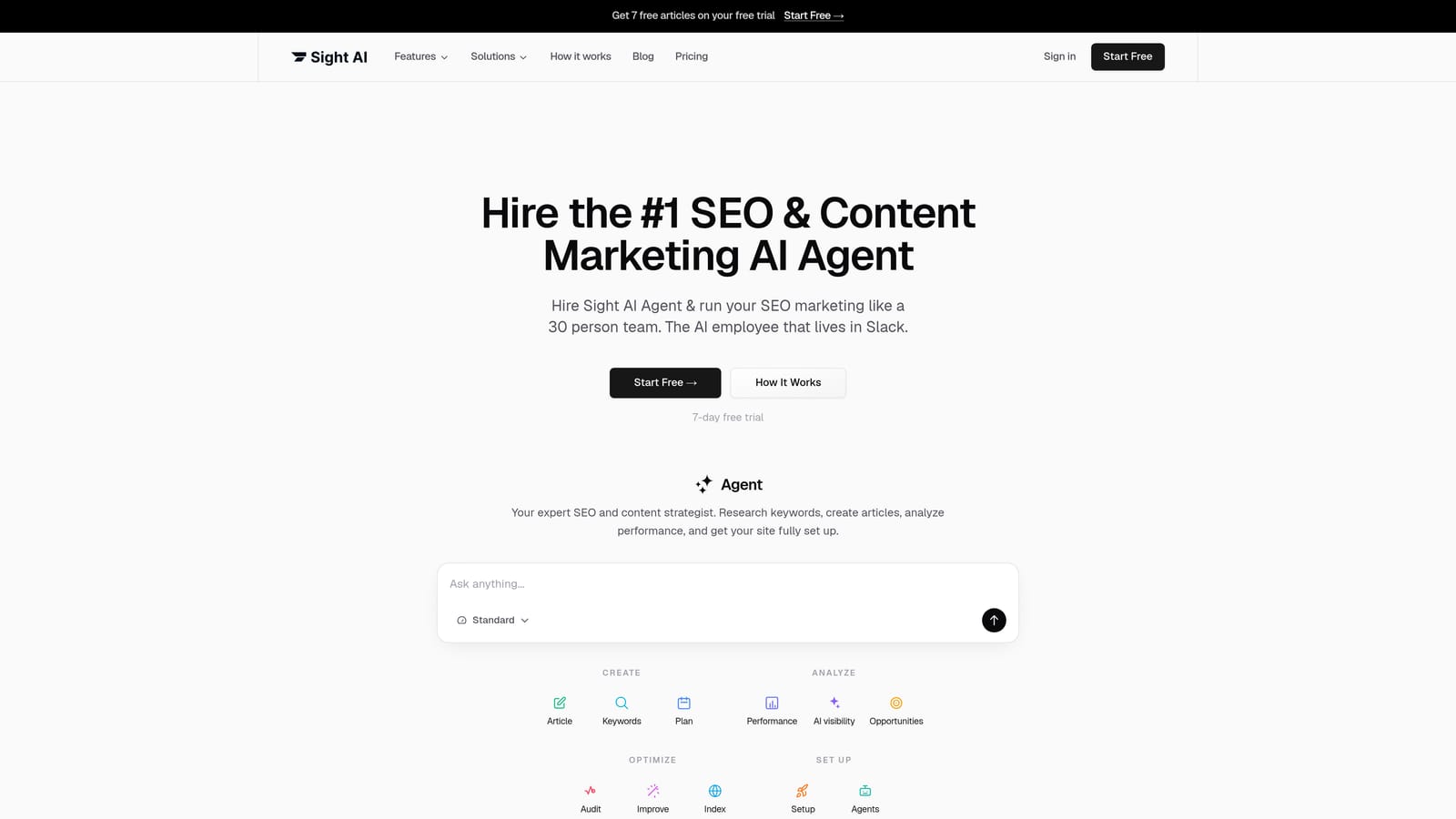
Sight AI is an AI-powered content automation platform built for brands serious about both traditional SEO and the emerging world of AI search visibility.
Where This Tool Shines
What sets Sight AI apart from every other tool on this list is its scope. Most platforms do one thing well: either they generate content, or they track AI visibility, or they handle publishing. Sight AI does all three in a single workflow. That matters for Shopify brands because content operations rarely happen in isolation. You need to write it, publish it, index it, and then verify that it's actually moving the needle in AI-generated search results.
The platform's 13+ specialized AI agents are designed to produce content that performs in both traditional search and generative AI contexts, a distinction known as GEO (Generative Engine Optimization). Its Autopilot Mode takes this further, handling the full production and publishing cycle hands-free, which is particularly valuable for brands with consistent content needs but limited team bandwidth.
Key Features
13+ Specialized AI Agents: Purpose-built agents for generating listicles, guides, product explainers, and other content types optimized for both SEO and AI search discovery.
CMS Auto-Publishing: Direct Shopify integration that publishes finished content to your store without manual intervention, keeping your pipeline moving.
IndexNow Integration: Automatically submits new content to search engines via IndexNow and updates your sitemap, so fresh content gets discovered faster instead of sitting unindexed.
AI Visibility Score: Tracks how your brand is mentioned across ChatGPT, Claude, Perplexity, and three or more additional AI platforms, giving you a consolidated view of your AI search presence.
Sentiment Analysis and Prompt Tracking: Goes beyond counting mentions to analyze the context and tone of how AI models describe your brand, so you can identify and address negative or inaccurate portrayals.
Autopilot Mode: Fully automated content production and publishing that runs on schedule, removing the need for manual oversight on routine content tasks.
Best For
Sight AI is the strongest fit for Shopify brands, founders, and agencies that want a unified platform rather than a stack of disconnected tools. It's especially valuable for teams investing in GEO alongside traditional SEO, where tracking AI model behavior is just as important as generating optimized content.
Pricing
Sight AI offers tiered plans to suit different team sizes and content volumes. Visit trysight.ai for current pricing details, as plans are updated regularly.
2. Writesonic
Best for: High-volume e-commerce content generation including product descriptions, blog posts, and marketing copy
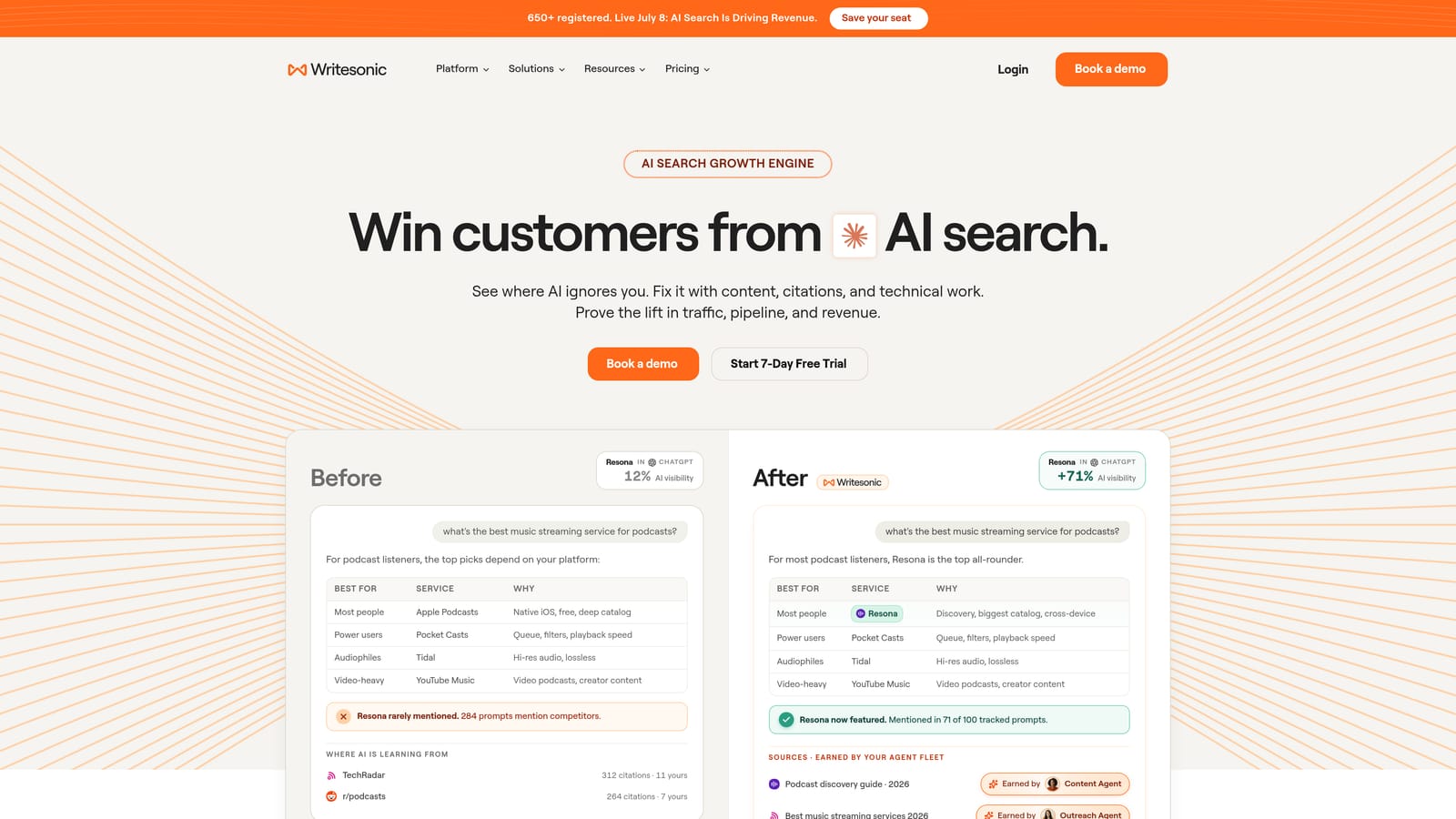
Writesonic is a well-established AI writing platform with a broad feature set that covers the content types Shopify brands produce most often.
Where This Tool Shines
Writesonic has built a strong reputation for handling the sheer volume demands of e-commerce content. If you're running a Shopify store with hundreds of SKUs, the ability to generate product descriptions at scale without sacrificing consistency is genuinely useful. Its e-commerce templates are tailored to the specific formats that convert, not just generic long-form output.
The brand voice customization is worth highlighting for agencies managing multiple Shopify clients. Rather than retraining the tool for each account, you can configure distinct voice profiles and generate on-brand content across different stores without constant manual editing.
Key Features
AI Article Writer: Long-form content generation with support for structured outlines, making it suitable for blog posts and SEO-focused guides.
E-Commerce Templates: Pre-built templates specifically designed for product descriptions and category page copy, reducing the need for custom prompting.
Brand Voice Customization: Configure tone, style, and vocabulary guidelines so generated content stays consistent across campaigns and clients.
Multi-Language Support: Generate content in multiple languages, which is useful for Shopify brands selling across international markets.
Publishing Integrations: Connects to content workflows to reduce the friction between generation and publication.
Best For
Writesonic suits Shopify merchants and agencies that need to produce large volumes of e-commerce content quickly. It's a strong choice when content generation is the primary bottleneck, though brands that also need AI visibility tracking will need to pair it with a separate analytics tool.
Pricing
Writesonic offers a free plan for getting started, with paid tiers unlocking higher usage limits and advanced features. Check writesonic.com for current plan details.
3. AirOps
Best for: Teams and agencies building structured AI content workflows connected to data sources and publishing tools
AirOps is an AI workflow automation platform built for content operations teams that need more than a writing tool: they need a configurable system.
Where This Tool Shines
AirOps occupies a different position in the content automation landscape. Rather than giving you a writing interface, it gives you a workflow builder. You design pipelines that pull data from spreadsheets or databases, pass it through AI generation steps, and route the output to publishing destinations. For Shopify brands with structured product data, this is a meaningful advantage because you can generate content at scale directly from your existing data without reformatting everything manually.
Agencies managing multiple Shopify clients will find the team collaboration features particularly useful. Content operations that involve multiple stakeholders, reviewers, and approval steps can be systematized inside AirOps rather than managed through a patchwork of shared documents and email threads.
Key Features
Visual Workflow Builder: A no-code interface for designing multi-step AI content pipelines without engineering resources.
Data Source Connections: Integrates with spreadsheets, databases, and external data sources so content generation can be driven by your existing product or content data.
Bulk Content Generation: Produce large batches of content from structured inputs, which is particularly efficient for product description projects.
Team Collaboration: Workflow-level collaboration tools that support content ops teams with multiple contributors and reviewers.
API and Custom Integrations: Supports custom publishing workflows through API connections, giving technical teams flexibility to route content wherever it needs to go.
Best For
AirOps is best suited for content operations teams and agencies that manage structured, repeatable content workflows across multiple clients or large product catalogs. It requires more setup than a plug-and-play writing tool but delivers greater control and scalability for complex operations.
Pricing
AirOps pricing varies by team size and usage. Contact AirOps directly or visit airops.com for current plan details.
4. Profound
Best for: Brands tracking how AI search engines surface and describe them in answer engine responses
Profound is an AI search visibility platform focused on helping brands understand and improve how they appear in AI-generated answers.
Where This Tool Shines
As AI search engines become a meaningful traffic channel for e-commerce, knowing whether your brand appears in AI-generated responses is no longer optional. Profound addresses this directly by monitoring how AI models surface your brand across major answer engines. For Shopify brands investing in GEO, this kind of visibility data is the feedback loop that tells you whether your content strategy is actually working in AI contexts.
The competitive benchmarking capability adds another useful dimension. Understanding how your brand's AI visibility compares to direct competitors helps prioritize content investments, particularly for category-level queries where AI models recommend specific brands or products.
Key Features
Brand Mention Tracking: Monitors how your brand appears in AI search engine responses across major platforms.
Competitive Visibility Benchmarking: Compares your AI search presence against competitors to identify gaps and opportunities.
GEO-Focused Analytics: Analytics specifically designed for answer engine optimization, going beyond traditional keyword ranking data.
Prompt Monitoring: Tracks AI model behavior across relevant queries to understand patterns in how your brand is referenced.
Visibility Trend Reporting: Dashboards that show how your AI search presence changes over time, enabling iterative strategy refinement.
Best For
Profound is a strong fit for Shopify brands and marketers who are actively investing in GEO and need rigorous analytics to measure the impact. It's a monitoring and analytics tool rather than a content generation platform, so it works best alongside content creation tools in a broader stack.
Pricing
Visit profound.io for current pricing information.
5. Peec
Best for: E-commerce brands tracking brand citations and competitive mentions within AI-generated search responses
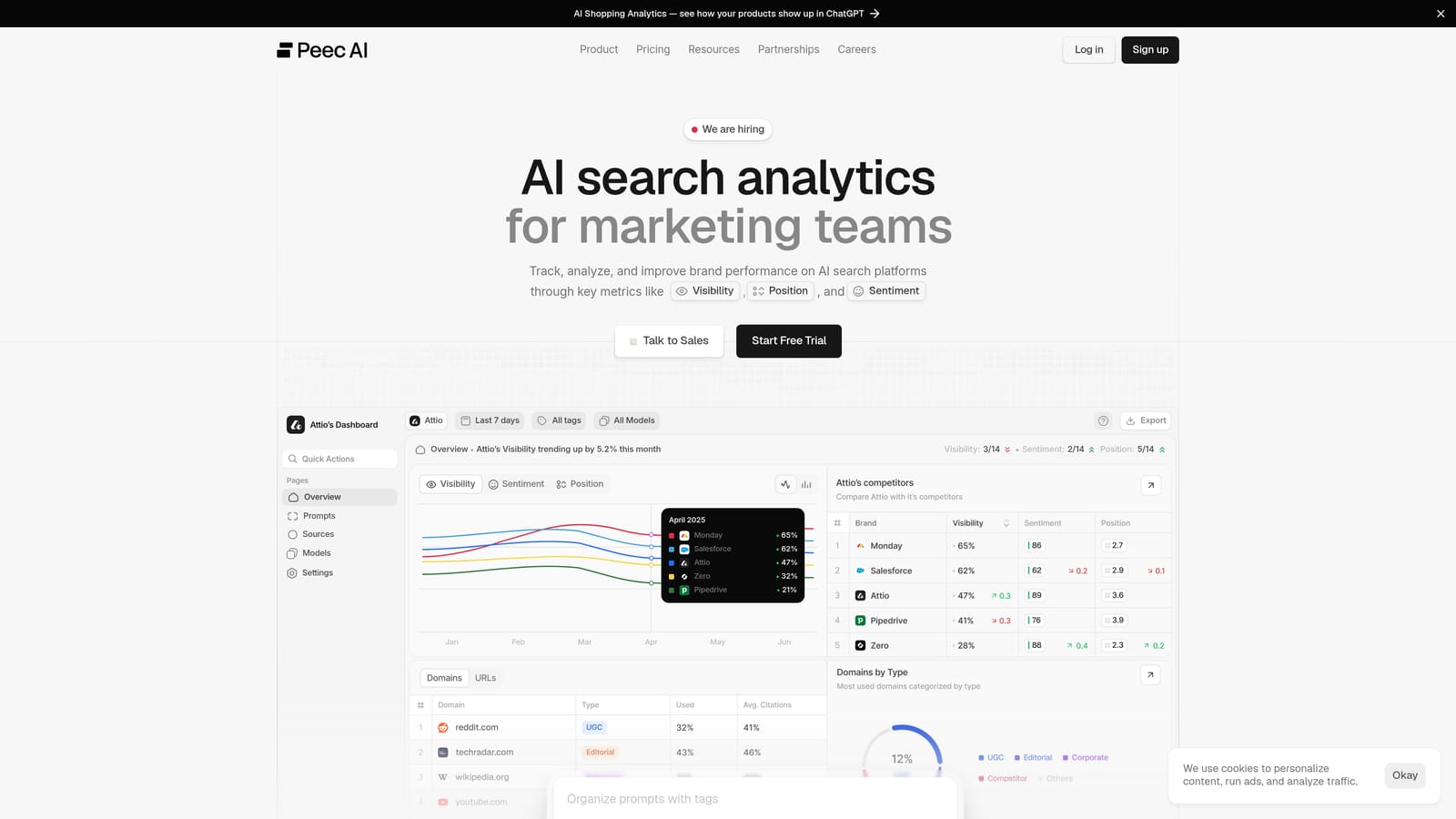
Peec is an AI search analytics tool designed to give e-commerce brands clear visibility into how they're cited and mentioned in AI-generated search results.
Where This Tool Shines
Peec approaches AI visibility from an e-commerce-first perspective, which makes it particularly relevant for Shopify brands. Its citation tracking goes beyond simple mention counting to provide context around how your brand appears: in what categories, alongside which competitors, and in response to which types of queries. That context is what turns raw visibility data into actionable content strategy.
The competitor mention analysis is a standout capability for brands operating in crowded product categories. Understanding which competitors AI models frequently recommend alongside or instead of your brand helps identify the content gaps your strategy needs to address.
Key Features
Citation Tracking: Monitors brand citations across AI search platforms to show where and how often your brand appears in AI-generated responses.
E-Commerce Brand Visibility Scoring: A scoring system calibrated for e-commerce contexts, giving Shopify brands a relevant benchmark for their AI search presence.
Keyword and Category Monitoring: Tracks AI search visibility at the keyword and product category level, not just at the brand level.
Competitor Mention Analysis: Reveals how competitors are referenced in AI responses alongside your brand, highlighting opportunities to strengthen your positioning.
Actionable Insights: Surfaces recommendations for improving AI search presence based on citation data and competitive analysis.
Best For
Peec suits Shopify brands and e-commerce marketers who want detailed citation analytics to guide their GEO content strategy. Like Profound, it's an analytics tool that complements content generation platforms rather than replacing them.
Pricing
Visit peec.ai for current pricing details.
6. Promptwatch
Best for: Marketers running active GEO strategies who need granular prompt-level tracking of AI model responses
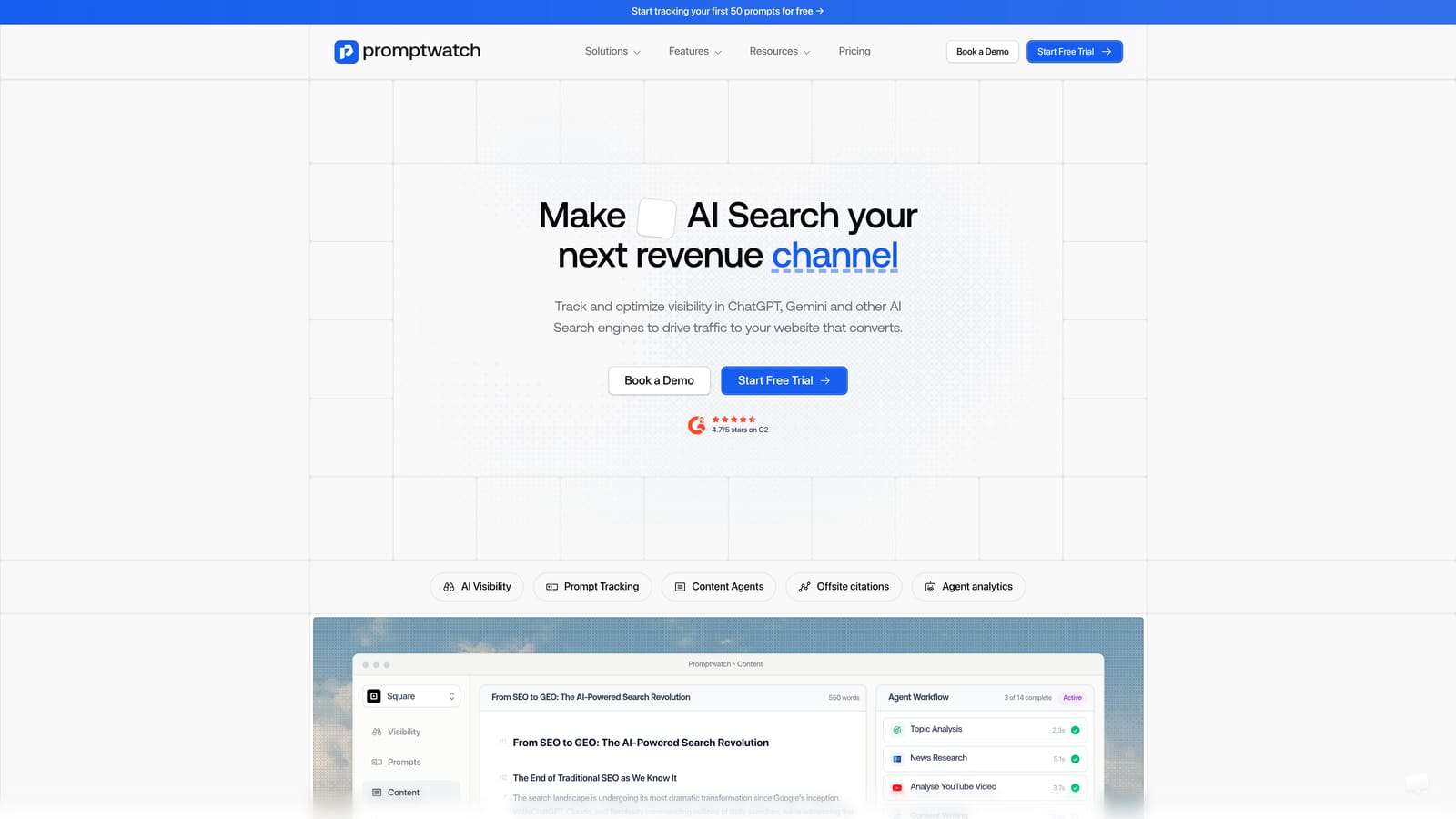
Promptwatch is a prompt-level monitoring tool that tracks how AI models respond to specific brand and product-related queries over time.
Where This Tool Shines
Where other AI visibility tools track brand mentions broadly, Promptwatch operates at the prompt level. You define the specific queries you care about, and the tool monitors exactly how AI models respond to those queries, how often your brand appears, in what context, and how those responses change as you publish new content. For brands running iterative GEO strategies, this level of granularity is what closes the feedback loop between content production and AI search impact.
The historical response tracking capability is particularly valuable for measuring the impact of content changes over time. Rather than relying on indirect signals, you can see directly whether a new article or updated product page shifted how AI models reference your brand in response to specific queries.
Key Features
Granular Prompt Tracking: Monitors AI model responses at the individual prompt level for precise, query-specific visibility data.
Brand Mention Frequency and Context Analysis: Tracks not just whether your brand appears, but how it's described and in what context within AI responses.
Historical Response Tracking: Maintains a record of how AI model responses evolve over time, enabling before-and-after measurement of content strategy changes.
Change Alerts: Notifies you when AI models shift how they describe or reference your brand, so you can respond quickly to negative changes.
GEO Strategy Refinement: Provides the data needed to iteratively improve content for better AI search performance rather than guessing what works.
Best For
Promptwatch is best suited for marketers and SEO professionals who are deeply invested in GEO and need precise measurement tools to guide their content strategy. It's a specialist analytics tool that pairs well with content generation platforms for brands running sophisticated AI search optimization programs.
Pricing
Visit promptwatch.io for current pricing information.
Which Tool Is Right for Your Shopify Store?
The tools on this list fall into two broad categories: content generation and publishing platforms, and AI visibility analytics tools. Understanding which category your biggest bottleneck falls into will point you toward the right starting point.
For content generation and publishing: Sight AI and Writesonic are the strongest options. Writesonic excels at high-volume e-commerce copy production. Sight AI goes further by combining content generation with auto-publishing, fast indexing, and AI visibility tracking in a single platform.
For structured workflow automation: AirOps is the standout choice for agencies and content ops teams that need to build repeatable, data-driven content pipelines across multiple Shopify clients or large product catalogs.
For AI visibility tracking: Profound, Peec, and Promptwatch each offer a distinct angle. Profound provides broad AI search visibility benchmarking. Peec focuses on e-commerce citation tracking with competitive analysis. Promptwatch delivers the most granular prompt-level monitoring for active GEO strategies.
The question of whether to build a multi-tool stack or use an all-in-one platform comes down to your team's capacity for integration and maintenance. A stack of specialized tools can be powerful, but it requires connecting data between platforms, managing multiple subscriptions, and reconciling different reporting frameworks. For most Shopify brands, particularly those without dedicated technical resources, an all-in-one platform removes that friction and keeps the entire workflow coherent.
Sight AI is the only tool on this list that spans the full workflow: generating SEO and GEO-optimized content, publishing directly to Shopify, indexing new content fast via IndexNow, and tracking how AI models like ChatGPT, Claude, and Perplexity actually reference your brand. If you're serious about building organic traffic in an era where AI search is reshaping discovery, that unified visibility matters.
Stop guessing how AI models like ChatGPT and Claude talk about your brand. Start tracking your AI visibility today and see exactly where your brand appears across top AI platforms, what's driving those mentions, and where your next content opportunity is waiting.