Content marketing automation has shifted from a nice-to-have to a core competitive advantage. With AI-driven search changing how audiences discover brands, marketers and agencies can no longer afford to manually track performance, create content, and manage distribution in silos. The right SaaS platform handles the heavy lifting, from ideation and writing to indexing and AI visibility monitoring, so your team can focus on strategy.
This list covers the best content marketing automation SaaS tools available in 2026, evaluated on automation depth, AI-readiness, content quality, and value for marketers, founders, and agencies focused on organic growth. Whether you're scaling a content operation or trying to appear in AI-generated answers from ChatGPT, Perplexity, or Claude, there's a platform here for you.
1. Sight AI
Best for: End-to-end content marketing automation combining AI visibility tracking, content creation, and indexing
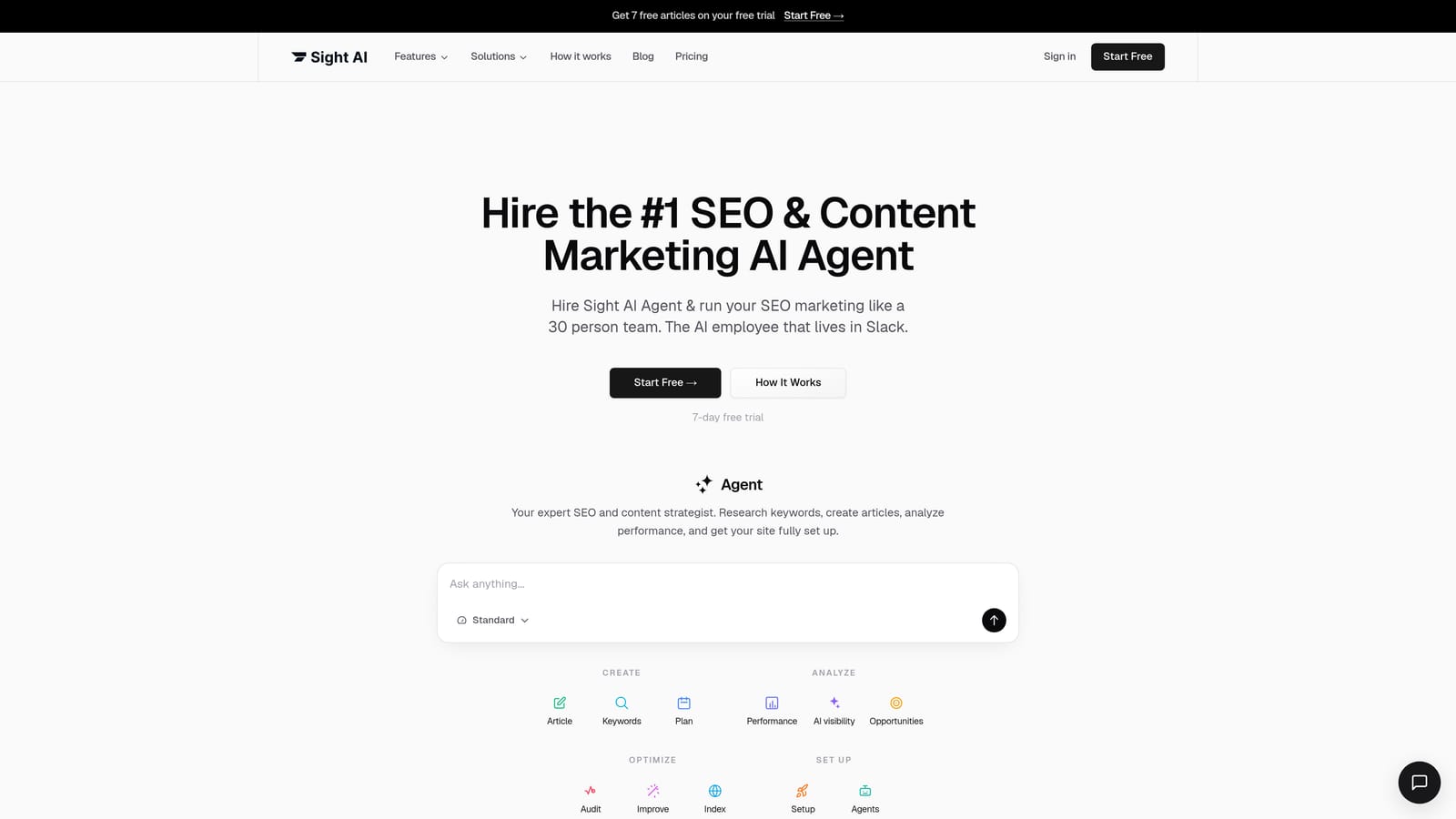
Sight AI is an all-in-one platform that connects AI visibility monitoring, SEO/GEO-optimized content generation, and automated website indexing in a single workflow.
Where This Tool Shines
Most content marketing stacks require three or four separate tools to cover what Sight AI handles in one place. You get brand mention tracking across AI models, a multi-agent content writer, and technical indexing automation without stitching together integrations or managing separate dashboards.
The platform is particularly well-suited for teams navigating the shift toward Generative Engine Optimization (GEO). Instead of guessing whether your content influences AI-generated answers, Sight AI gives you measurable visibility into how and where your brand appears across platforms like ChatGPT, Claude, and Perplexity.
Key Features
AI Visibility Score: Tracks brand mentions across 6+ AI platforms with sentiment analysis so you understand not just whether your brand appears, but how it's being described.
Prompt Tracking: Monitors how AI models respond to queries relevant to your brand, giving you actionable data to optimize content for AI answer inclusion.
13+ Specialized AI Writing Agents: Covers listicles, guides, explainers, and more with an Autopilot Mode that handles content production hands-free at scale.
IndexNow Integration: Automatically submits new content for faster search engine discovery, cutting the lag between publishing and indexing.
CMS Auto-Publishing and Sitemap Automation: Publishes content directly to your CMS and keeps sitemaps current without manual intervention.
Best For
Marketers, founders, and agencies who want a single platform covering content creation, AI search monitoring, and technical indexing. Especially valuable for teams building GEO strategies who need both content output and visibility measurement in one place.
Pricing
Visit trysight.ai for current pricing plans. Multiple tiers are available to suit different team sizes and usage levels.
2. Writesonic
Best for: High-volume AI content production across multiple formats and brand voices
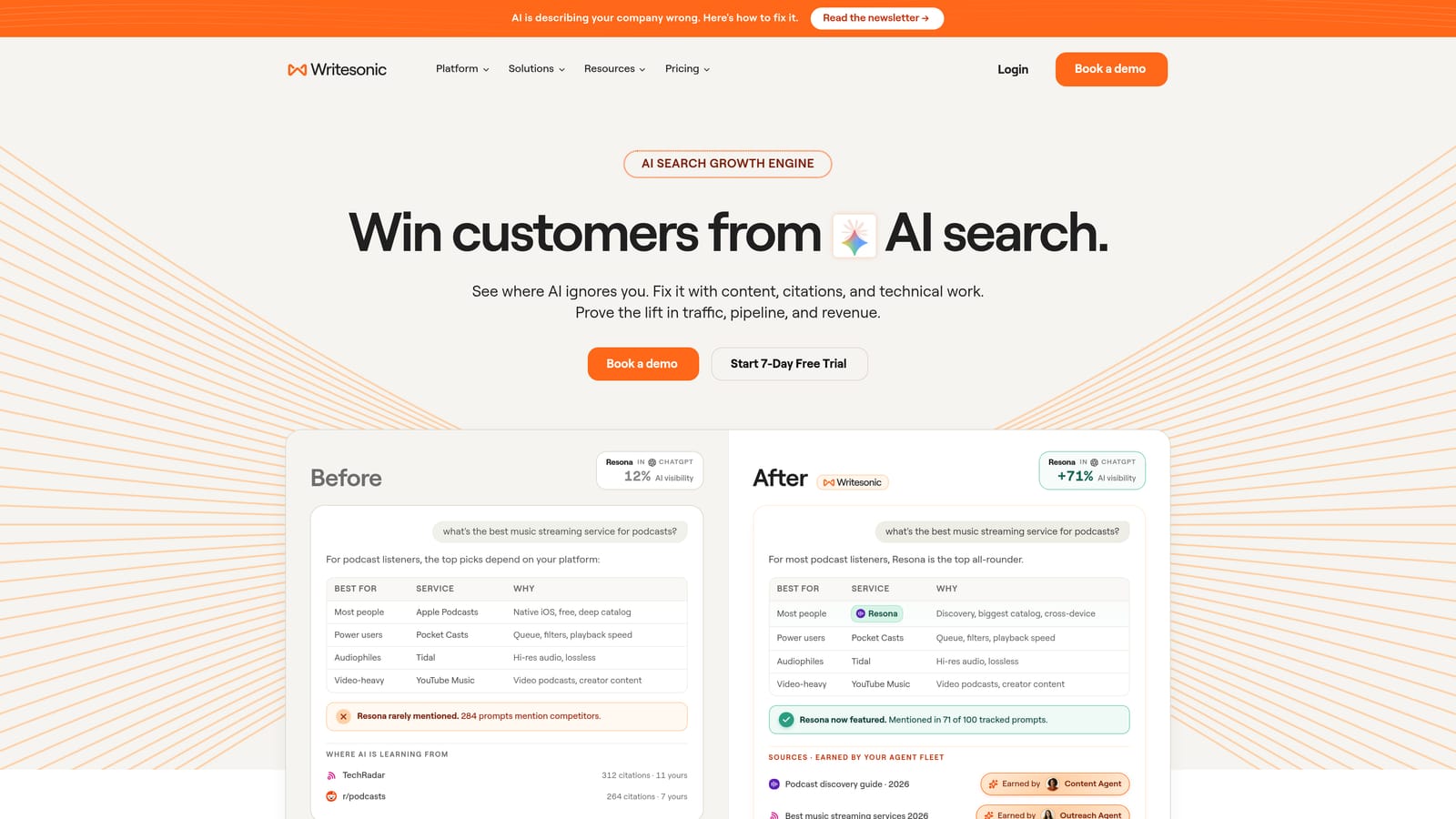
Writesonic is an AI-powered content generation platform built for teams that need to produce large volumes of content across blogs, ads, landing pages, and social media.
Where This Tool Shines
Writesonic's strength is breadth. The platform covers a wide range of content formats under one roof, making it practical for agencies managing multiple clients with different content needs. Brand voice training is a standout capability: you can train the platform on your tone and style so output stays consistent across content types and team members.
The built-in SEO optimization features help ensure long-form articles are structured for search performance, not just readability. For teams focused purely on content output at scale, Writesonic delivers a reliable production pipeline.
Key Features
Long-Form AI Article Writer: Generates full blog posts and articles with SEO optimization built into the drafting process.
Brand Voice Training: Trains the platform on your specific tone and style for consistent output across content types and team members.
Broad Template Library: Covers blogs, ad copy, emails, landing pages, and social content from a single interface.
Botsonic AI Chatbot Builder: Lets you create content-driven chatbot experiences for audience engagement without separate tooling.
Team Collaboration Features: Supports agency workflows with shared workspaces and multi-user access.
Best For
Content teams and agencies prioritizing high-volume production across multiple formats. Works well when brand consistency across clients or content types is a key requirement.
Pricing
A free tier is available with limited credits. Paid plans scale by usage and features. Verify current pricing at writesonic.com.
3. AirOps
Best for: Building custom AI-powered content workflows without writing code
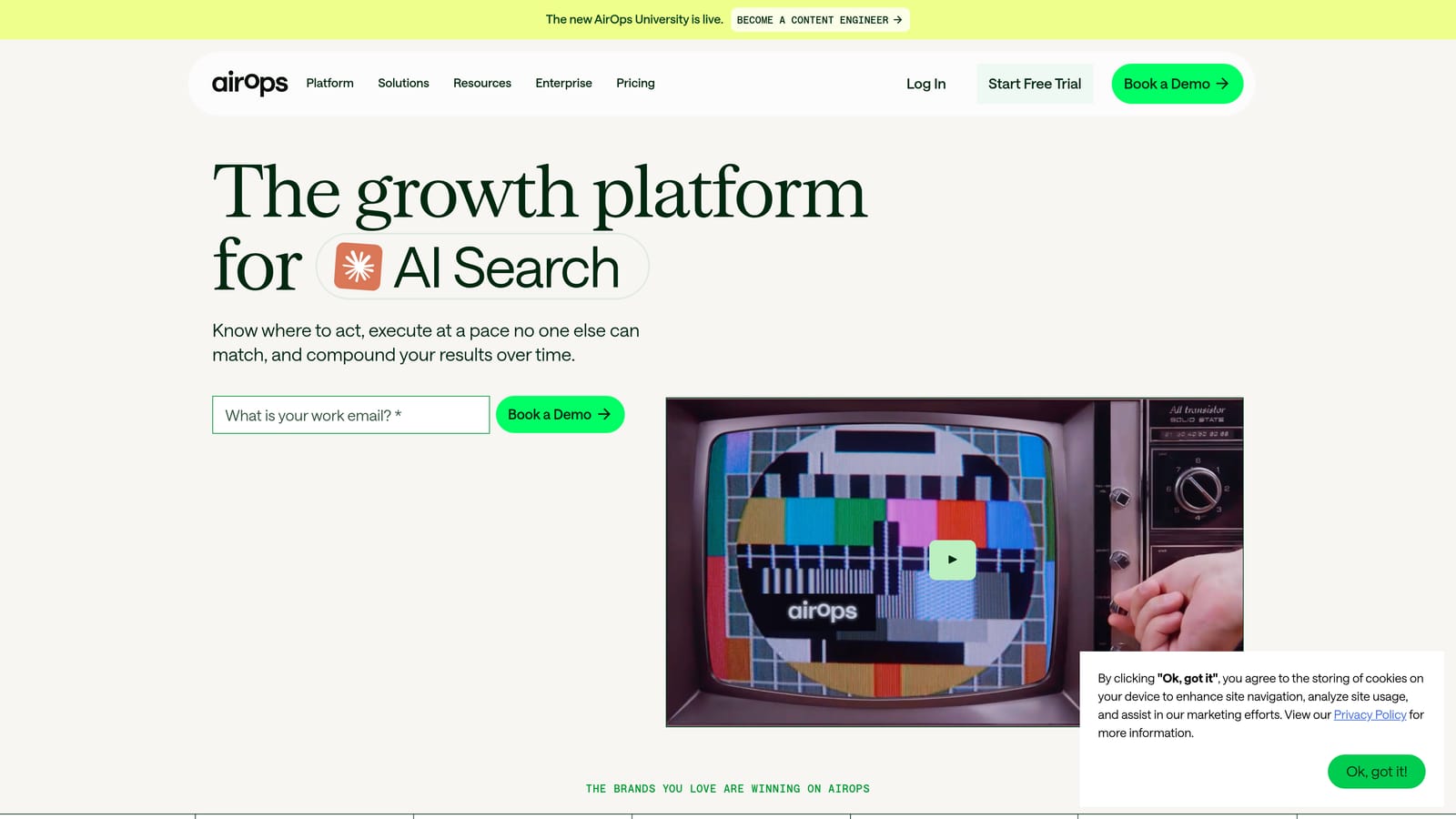
AirOps is a no-code LLM workflow automation platform that lets content and operations teams build custom AI pipelines connecting language models to existing data sources and content systems.
Where This Tool Shines
Think of AirOps less as a content writer and more as an automation infrastructure layer. It lets you design exactly how AI fits into your content operations, whether that's enriching a spreadsheet of product descriptions, running batch content generation from a database, or chaining multiple AI prompts together into a repeatable workflow.
This flexibility makes it particularly useful for operations-minded teams that have specific content processes they want to automate but don't want to hire developers to build custom integrations. The visual workflow builder handles the logic without requiring code.
Key Features
Visual Workflow Builder: Chain AI prompts and logic together in a drag-and-drop interface without writing code.
Data Source Integrations: Connects to Google Sheets, databases, and APIs so content workflows can pull from real business data.
Batch Processing: Handles high-volume content enrichment and generation tasks efficiently across large datasets.
Shared Workflow Templates: Teams can collaborate on and reuse AI workflow templates across projects.
Flexible LLM Selection: Choose different language models for different tasks based on cost, speed, or capability requirements.
Best For
Content operations teams, growth marketers, and agencies that want to build tailored AI workflows around existing data and processes rather than using a fixed content generation tool.
Pricing
Usage-based and seat-based plans are available. Verify current pricing at airops.com.
4. Profound
Best for: Enterprise-grade competitive benchmarking and analytics for AI search visibility
Profound is an AI search visibility analytics platform that tracks how brands and competitors appear in AI-generated answers, providing share-of-voice metrics and performance benchmarking across major AI platforms.
Where This Tool Shines
Profound is built for teams that need rigorous, data-driven reporting on AI search performance. The competitive benchmarking capabilities are a core differentiator: you can see not just how your brand appears in AI-generated answers, but how that compares to competitors across the same queries and platforms.
For enterprise marketing and SEO teams that need to report on AI search performance to stakeholders, Profound provides the structured analytics dashboards and trend data to make that reporting credible and actionable.
Key Features
AI Answer Inclusion Tracking: Monitors whether and how your brand appears in AI-generated responses across major platforms.
Competitor Share-of-Voice Benchmarking: Compares your AI search presence against competitors on the same queries.
Analytics Dashboards: Visualizes AI search performance trends over time for reporting and strategy decisions.
Multi-Platform Monitoring: Tracks visibility across multiple AI search platforms simultaneously from one interface.
Enterprise Reporting Tools: Supports structured reporting workflows suited to larger marketing and SEO teams.
Best For
Enterprise marketing teams and SEO practitioners who need competitive intelligence and structured analytics around AI search visibility, particularly those reporting to leadership on AI search performance.
Pricing
Enterprise and custom pricing. Verify current plans at profound.io.
5. Peec
Best for: Accessible AI brand mention monitoring for smaller teams and individual brand managers
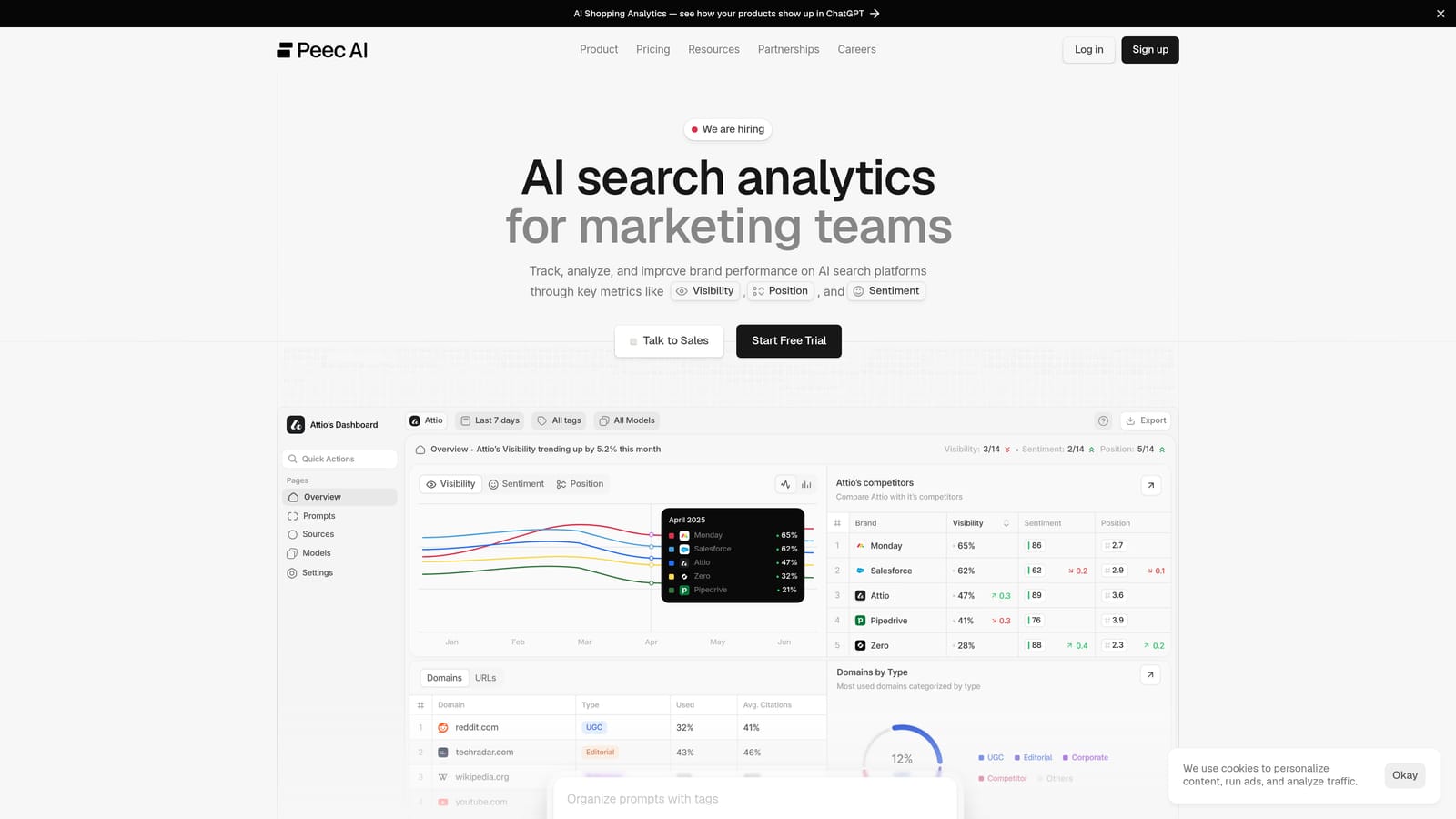
Peec is an AI brand mention monitoring tool that tracks how AI models reference your brand in conversational responses, with prompt-based visibility tracking and sentiment reporting.
Where This Tool Shines
Peec occupies a practical middle ground in the AI visibility monitoring category. It's more accessible than enterprise analytics platforms, making it a realistic option for smaller teams or individual brand managers who want to understand their AI search presence without navigating complex dashboards or enterprise pricing.
The sentiment analysis layer adds useful context beyond simple mention tracking. Knowing that your brand appears in AI answers is valuable; knowing whether those mentions are positive, neutral, or negative is what actually informs content strategy decisions.
Key Features
AI Brand Mention Monitoring: Tracks when and how AI models reference your brand in conversational responses.
Prompt-Based Visibility Tracking: Identifies which queries trigger brand mentions so you can understand the context of your AI search presence.
Sentiment Analysis: Reports on the tone of AI-generated brand references, not just their frequency.
Mention Frequency Alerts: Notifies you when there are notable changes in how often or how your brand is mentioned.
Accessible Interface: Designed for usability by individual brand managers and smaller teams without dedicated analytics resources.
Best For
Smaller marketing teams, individual brand managers, and early-stage companies that want straightforward AI brand monitoring without the complexity or cost of enterprise-tier platforms.
Pricing
Verify current plans at peec.ai.
6. Promptwatch
Best for: Granular prompt-level tracking for GEO practitioners optimizing content for AI answer inclusion
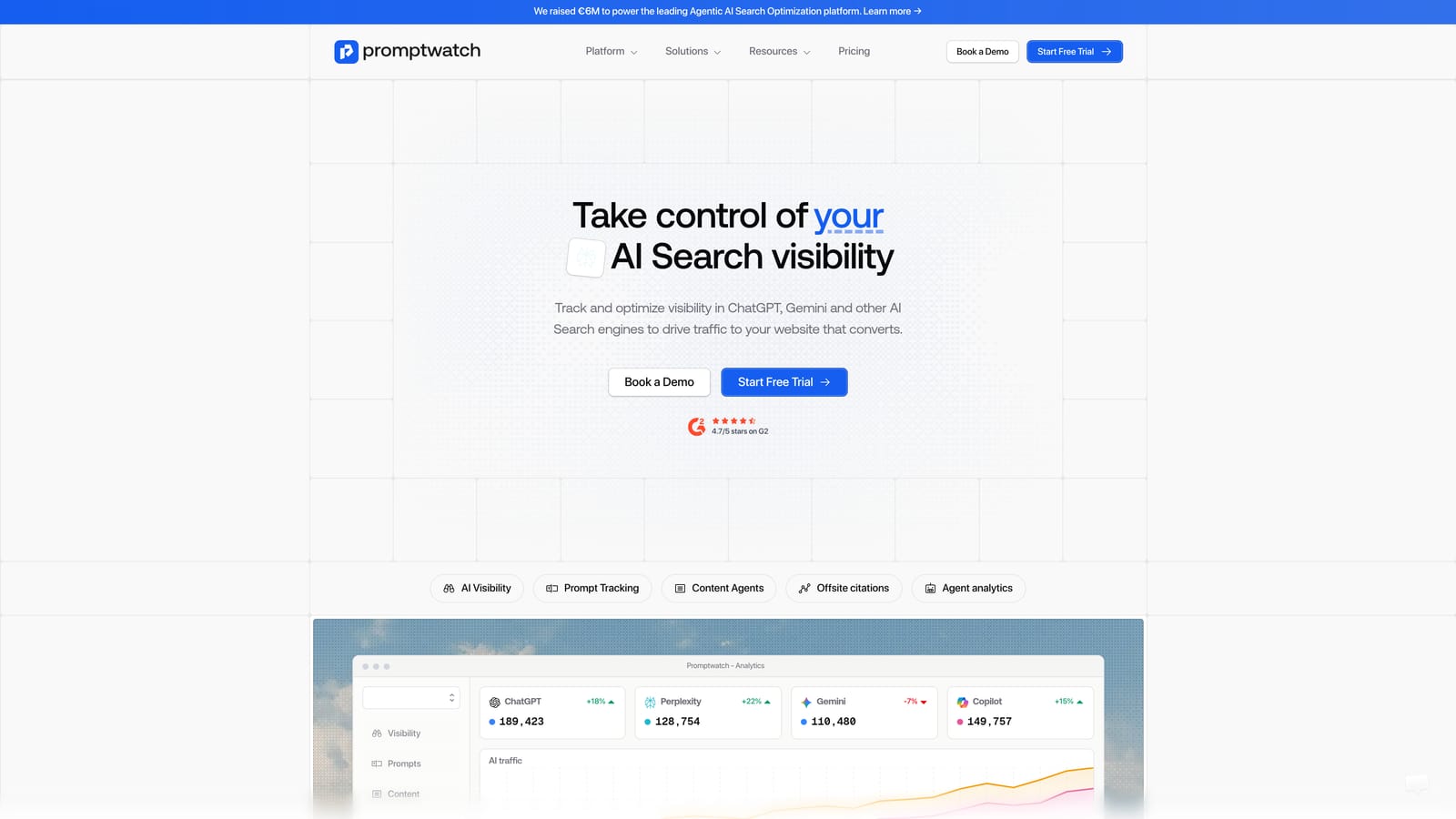
Promptwatch is a prompt performance and AI response tracking tool that monitors how specific queries return brand-relevant answers across AI models, with historical comparison to identify content optimization opportunities.
Where This Tool Shines
Promptwatch goes deeper than general brand monitoring. Instead of just tracking whether your brand appears in AI answers, it tracks which specific prompts trigger those appearances and how those responses change over time. This granularity is exactly what GEO practitioners need to understand the relationship between content changes and AI answer inclusion.
The historical comparison capability is particularly useful: you can see whether a content update caused your brand to appear in, or disappear from, AI-generated answers for specific queries. That feedback loop is difficult to establish with broader monitoring tools.
Key Features
Granular Prompt-Level Tracking: Monitors performance at the individual prompt level across multiple AI models, not just aggregate brand mentions.
Historical Response Comparison: Compares AI responses over time to detect when and why brand mentions change.
Brand Mention Appearance and Disappearance Tracking: Identifies exactly when your brand enters or exits AI-generated answers for tracked queries.
GEO Optimization Support: Designed to help practitioners understand which content changes influence AI answer inclusion.
Prompt Performance Trend Reporting: Surfaces trends in how tracked prompts perform over time for ongoing optimization decisions.
Best For
SEO and GEO practitioners, content strategists, and agencies actively optimizing content for AI answer inclusion who need detailed, prompt-level data to guide their decisions.
Pricing
Verify current plans at promptwatch.io.
Which Tool Is Right for Your Stack?
The content marketing automation landscape in 2026 has split into two broad categories: tools that create and distribute content, and tools that measure how that content performs in AI-generated search. The most efficient stacks consolidate around one primary platform rather than managing five separate point solutions.
Here's how to match your needs to the right tool:
End-to-end automation (creation + AI visibility + indexing): Sight AI is the only platform on this list that covers all three layers in a single workflow, making it the natural anchor for any modern content marketing stack.
High-volume content production across formats: Writesonic is built for teams that need to produce large amounts of varied content quickly, with brand voice consistency across clients or channels.
Custom AI workflow automation: AirOps is the right choice when your content operations have specific, non-standard processes you want to automate around existing data sources.
Enterprise AI search analytics and competitive benchmarking: Profound provides the structured reporting and competitive intelligence that enterprise teams need to track AI search performance at scale.
Accessible brand mention monitoring: Peec suits smaller teams and individual brand managers who want clear, actionable AI visibility data without enterprise complexity.
Granular prompt-level GEO optimization: Promptwatch is the specialist tool for practitioners who need to understand exactly which content changes influence AI answer inclusion at the prompt level.
If you're building a content marketing operation from scratch in 2026, starting with an all-in-one platform and adding specialist tools where gaps emerge is almost always more efficient than assembling a stack of point solutions from day one.
Stop guessing how AI models like ChatGPT and Claude talk about your brand. Start tracking your AI visibility today and see exactly where your brand appears across top AI platforms, what content opportunities you're missing, and how to automate your path to organic traffic growth.