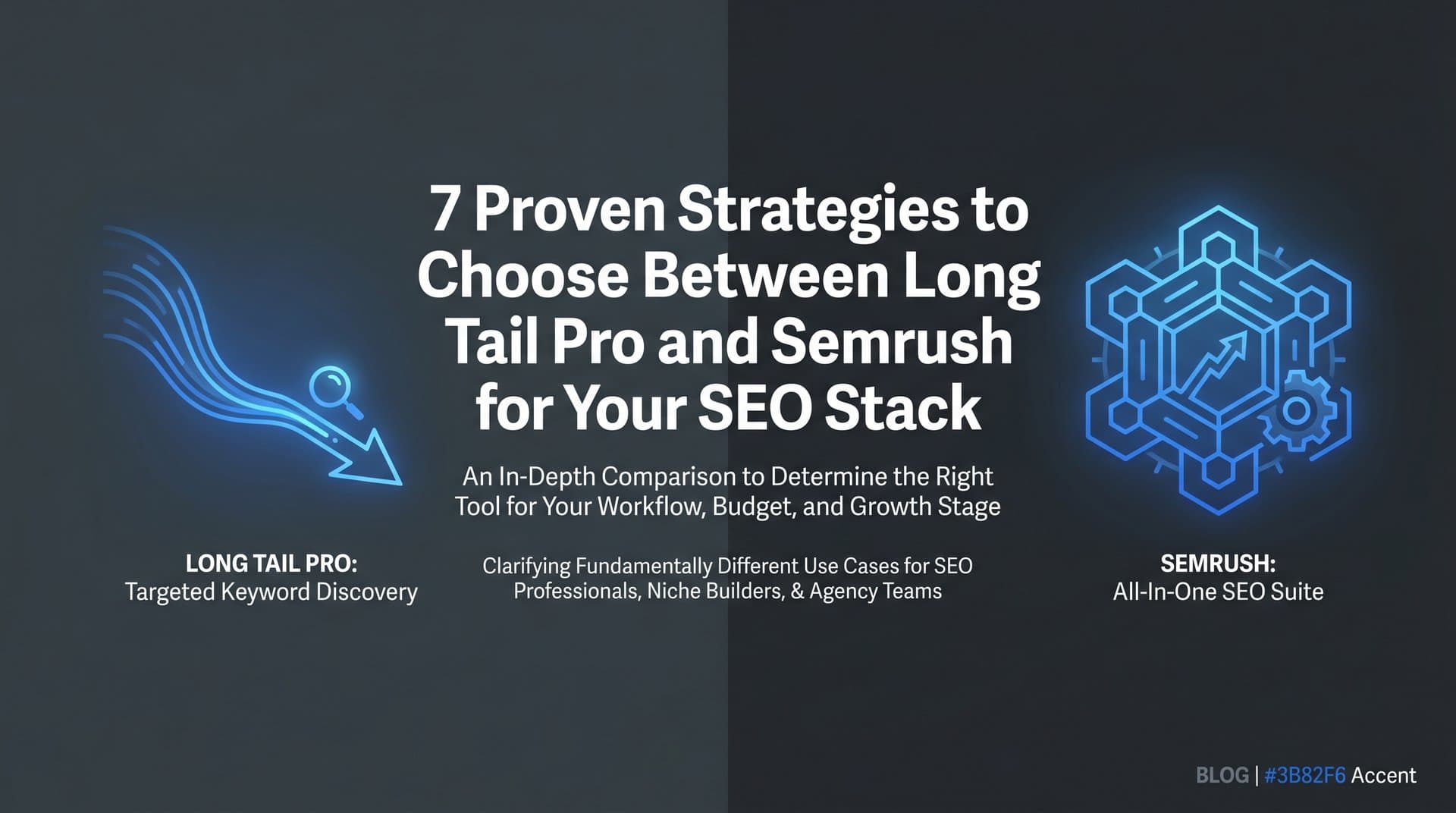
Choosing the right keyword research and SEO tool can make or break your organic growth strategy. And right now, the debate around Long Tail Pro vs Semrush is one of the most common conversations happening in SEO communities, agency Slack groups, and founder forums alike.
The challenge is that these tools aren't really competing in the same category. Long Tail Pro, originally created by Spencer Haws, built its reputation on one thing: helping niche site builders and affiliate marketers find low-competition, long-tail keywords using its proprietary Keyword Competitiveness (KC) score. Semrush, by contrast, is a sprawling all-in-one platform covering 50+ tools across SEO, PPC, content marketing, backlink analysis, social media, and competitive research.
Comparing them feature-for-feature misses the point. The real question is which tool fits your actual workflow, team size, budget, and growth stage.
This guide gives you seven actionable strategies to evaluate both tools against your real needs, not a generic checklist. You'll also discover something most comparison articles completely ignore: both platforms have a significant blind spot when it comes to AI search visibility, and that gap is growing fast.
Whether you're a solo founder hunting for low-competition niches or an agency managing dozens of client campaigns, these strategies will help you invest your tool budget where it delivers the highest return.
1. Map Your Keyword Research Depth Before Comparing Features
The Challenge It Solves
Most marketers jump straight to feature comparisons without first auditing what they actually do with keyword data. The result is paying for capabilities they never use, or worse, choosing a tool that's technically impressive but doesn't match how their team actually researches and prioritizes keywords.
The Strategy Explained
Before opening either tool's pricing page, document your real keyword research workflow. Ask yourself: Are you primarily hunting for low-competition long-tail keywords in a specific niche? Or do you need broad keyword universe mapping across multiple topics, industries, or client verticals?
Long Tail Pro's KC score excels at the former. It's purpose-built for identifying keywords where you can realistically rank without a massive domain authority. If your strategy revolves around niche content sites, affiliate marketing, or finding overlooked keyword pockets in a defined topic area, that focused approach is genuinely valuable.
Semrush, on the other hand, offers a much larger keyword database and broader discovery features, including topic clusters, keyword gaps, and intent filtering. If you're managing content strategy across multiple domains or need to map an entire competitive keyword landscape, that depth matters. Understanding how to improve organic search ranking should inform which tool's approach aligns with your goals.
Implementation Steps
1. List the last ten keyword research tasks you completed and categorize them: niche discovery, competitive gap analysis, content ideation, or PPC research.
2. Identify which category dominates your workflow. If niche discovery is more than half your use cases, Long Tail Pro deserves serious consideration. If you're spread across multiple categories, Semrush's breadth may justify the investment.
3. Run a free trial or demo of each tool using one of your actual keyword research tasks, not a generic example, to see how each handles your real workflow.
Pro Tips
Don't evaluate tools based on their marketing pages. Evaluate them based on the output you need to produce. A tool that generates beautiful reports you never act on is worth less than a simpler tool that consistently surfaces keywords you actually publish content around.
2. Evaluate Competitive Analysis Capabilities Against Your Market
The Challenge It Solves
Generic feature comparisons tell you that Semrush has competitive analysis and Long Tail Pro doesn't go as deep in that area. But what matters is whether those competitive intelligence features actually surface actionable insights for your specific market, not whether they look impressive in a demo.
The Strategy Explained
Competitive analysis is one of Semrush's clearest advantages over Long Tail Pro. Semrush allows you to analyze competitor domains directly, uncover their top-performing pages, identify keyword gaps between your site and theirs, and track backlink profiles. Long Tail Pro's competitive insights are more narrowly focused on keyword-level competition scoring rather than domain-level competitive intelligence.
The key is to test this with your actual competitors, not hypothetical ones. Pull your top three to five competitors and run them through both tools. What does each tool tell you that you didn't already know? Which insights are immediately actionable for your content calendar or link-building strategy?
For niche site operators, Long Tail Pro's KC score may tell you everything you need to know about whether a keyword is winnable. For agencies or brands competing in crowded markets, Semrush's domain-level competitive intelligence is often indispensable when you're focused on how to improve organic traffic at scale.
Implementation Steps
1. Identify your top three direct competitors by domain and list the specific questions you want competitive data to answer.
2. Use Semrush's domain overview and keyword gap tools against those competitors and record which insights are genuinely new or actionable.
3. Use Long Tail Pro to evaluate keyword competitiveness for the same topic areas and assess whether KC scores alone give you enough signal to make content decisions.
Pro Tips
The best competitive analysis tool is the one your team will actually use consistently. A sophisticated platform that requires hours of setup per competitor audit may deliver less real-world value than a simpler tool your team runs every week.
3. Calculate True Cost-Per-Feature for Your Team Size
The Challenge It Solves
Sticker price comparisons between Long Tail Pro and Semrush are misleading because they don't account for what you're replacing or consolidating. The real question is what your total tool stack costs today, and whether switching or adding either platform changes that math.
The Strategy Explained
Semrush's entry-level pricing is significantly higher than Long Tail Pro's plans. But Semrush is also designed to replace multiple separate tools: keyword research, site auditing, backlink analysis, rank tracking, content marketing, social media management, and PPC research can all live inside one Semrush subscription.
If you're currently paying for a separate rank tracker, a backlink analysis tool, a site audit tool, and a keyword research tool, Semrush's consolidation value may actually make it the more cost-efficient option despite the higher headline price. Ultimately, the right investment should drive measurable content marketing ROI improvement for your business.
Long Tail Pro, by contrast, is priced as a focused tool. If you already have a robust SEO stack and only need to add stronger long-tail keyword discovery, Long Tail Pro's narrower pricing reflects that narrower scope.
Implementation Steps
1. List every SEO and marketing tool you currently pay for, along with its monthly cost and primary use case.
2. Map each tool's primary function against Semrush's feature set. Identify which tools Semrush would fully replace versus partially replace versus not replace at all.
3. Calculate your current stack's total monthly cost versus the Semrush plan tier that covers your needs. Then compare that against keeping your current stack and adding Long Tail Pro for keyword discovery.
Pro Tips
Be honest about partial replacements. If Semrush covers 70% of what a specialized tool does, you may still need that specialized tool, which erodes the consolidation argument. Focus on full replacements when calculating your true cost-per-feature.
4. Stress-Test Content Workflow Integration
The Challenge It Solves
Keyword research tools don't exist in isolation. They feed into content briefs, editorial calendars, writing workflows, and publishing systems. If a tool creates friction at any point in that pipeline, its theoretical capabilities don't translate into published content or organic traffic.
The Strategy Explained
Trace your content pipeline from start to finish: keyword discovery, intent analysis, brief creation, writing, optimization, publishing, and performance tracking. Then map where Long Tail Pro and Semrush each plug in, and more importantly, where they leave gaps.
Semrush has invested heavily in content marketing features, including its SEO Writing Assistant and content audit tools. These can bridge the gap between keyword research and content creation within a single platform. Streamlining your process through content production workflow automation can amplify the value of whichever tool you choose. Long Tail Pro is primarily a research tool and doesn't extend into content creation or optimization workflows.
Here's where it gets interesting: even Semrush's content tools don't address the growing need for GEO-optimized content, content specifically structured to earn mentions in AI-generated answers from platforms like ChatGPT, Perplexity, and Claude. That's a gap in both platforms that increasingly matters for organic visibility.
Platforms like Sight AI are purpose-built to fill exactly this gap, combining AI content generation with visibility tracking across AI models, something neither Long Tail Pro nor Semrush currently offers.
Implementation Steps
1. Draw a simple flowchart of your content pipeline from keyword idea to published article. Mark every step where you currently switch tools or experience friction.
2. Identify which of those friction points either Long Tail Pro or Semrush would eliminate based on their actual feature sets.
3. Flag any pipeline gaps that neither tool addresses, particularly around AI-optimized content creation and GEO, and evaluate whether those gaps need a dedicated solution.
Pro Tips
The best SEO tool is the one that keeps your content pipeline moving. A tool that improves keyword discovery but creates bottlenecks elsewhere in your workflow may slow you down overall. Measure integration quality, not just feature quantity.
5. Assess Technical SEO and Site Audit Needs
The Challenge It Solves
Technical SEO issues, crawl errors, broken links, slow page speeds, indexing problems, can quietly undermine even the best keyword strategy. If you don't have a reliable way to surface and fix these issues, keyword research becomes a leaky bucket.
The Strategy Explained
This is one of the clearest differentiators between the two platforms. Semrush includes a robust site audit tool that crawls your website, identifies technical issues, prioritizes them by severity, and tracks fixes over time. It's a genuine technical SEO capability built into the platform.
Long Tail Pro does not offer site audit functionality. It's a keyword research and rank tracking tool, not a technical SEO platform. If you need site auditing, you'll need a separate tool in your stack regardless of whether you choose Long Tail Pro. For common crawl and indexation challenges, understanding how to fix website indexing problems is essential regardless of which platform you use.
The strategic question is whether you already have a dedicated technical SEO tool, such as Screaming Frog, Ahrefs, or a similar crawler, that you're satisfied with. If you do, Semrush's site audit capability may be redundant. If you don't, it represents real additional value in the Semrush subscription.
Implementation Steps
1. Audit your current technical SEO workflow. Do you regularly crawl your site for issues? If yes, what tool do you use and are you satisfied with it?
2. If you lack a reliable site audit tool, factor Semrush's audit capability as a genuine consolidation benefit when calculating cost-per-feature from Strategy 3.
3. If you already have a technical SEO tool you trust, remove site auditing from your Semrush evaluation criteria and focus on the features that are actually differentiated for your needs.
Pro Tips
Don't let impressive technical SEO features sway your decision if technical auditing isn't a real gap in your current stack. Evaluate each feature category based on whether it solves an actual problem you have, not a theoretical one.
6. Factor in AI Search Visibility: The Gap Neither Tool Fully Covers
The Challenge It Solves
Both Long Tail Pro and Semrush were built for traditional search engine optimization: ranking in Google and Bing. But a significant and growing share of user discovery now happens through AI-powered answers in ChatGPT, Claude, Perplexity, and similar platforms. Neither tool currently provides dedicated tracking for how your brand appears in those AI-generated responses.
The Strategy Explained
Generative Engine Optimization, often called GEO, is the practice of optimizing your content and brand presence to earn mentions in AI-generated answers. It's distinct from traditional SEO in important ways: AI models don't rank pages the way Google does. They synthesize information from their training data and real-time retrieval, and the brands that appear in their answers have often built authoritative, well-structured content that AI models find easy to reference. Learning how to improve AI search visibility is becoming a critical skill alongside traditional keyword research.
If your growth strategy depends on organic discovery, and for most marketers and founders it does, ignoring AI search visibility is increasingly risky. Users are asking ChatGPT which tools to use, asking Perplexity which brands are most trusted in a category, and asking Claude to recommend solutions to problems your product solves. If your brand isn't appearing in those answers, you're invisible to a growing segment of your audience.
This is where a platform like Sight AI addresses a genuine gap. Sight AI tracks your brand mentions across six or more AI platforms, provides an AI Visibility Score with sentiment analysis, and monitors which prompts are surfacing your competitors instead of you. Neither Long Tail Pro nor Semrush provides this capability.
Implementation Steps
1. Manually test your brand visibility by asking ChatGPT, Claude, and Perplexity questions that your ideal customers would ask when looking for solutions like yours. Note whether your brand appears, and if not, which competitors do.
2. Identify the content gaps this reveals. Are there topics, use cases, or comparison queries where you're absent from AI-generated answers?
3. Evaluate whether AI visibility tracking needs to be a dedicated capability in your stack, separate from whichever traditional SEO tool you choose.
Pro Tips
Manual testing of AI visibility is useful for a snapshot, but it doesn't scale. AI model responses change as models are updated, as new content is indexed, and as competitors publish new material. Systematic tracking is what turns a one-time audit into an ongoing competitive advantage.
7. Build a Hybrid Stack Instead of Choosing Just One
The Challenge It Solves
The framing of "Long Tail Pro vs Semrush" implies you must choose one or the other. But many successful SEO practitioners use both, alongside complementary tools, because each platform's strengths genuinely complement the other's weaknesses. The real strategic question is how to build a stack that covers all your needs without unnecessary redundancy.
The Strategy Explained
Think of it like this: Long Tail Pro is a precision instrument for long-tail keyword discovery and competitiveness scoring. Semrush is a comprehensive platform for competitive intelligence, site health, content strategy, and broad keyword research. They serve different moments in the SEO workflow.
A lean but powerful hybrid stack might look like this: Long Tail Pro for niche keyword discovery and KC scoring, Semrush for competitive analysis, site audits, and backlink research, and a dedicated AI visibility platform like Sight AI for tracking and optimizing your presence across AI search platforms. This combination covers traditional SEO from keyword discovery through technical health, and extends into the emerging AI search landscape.
For agencies managing multiple clients, this stack provides differentiated value: you can offer AI visibility reporting as a premium service that competitors using only traditional SEO tools can't match. Strategies for how to improve brand mentions in AI responses are becoming a key differentiator for forward-thinking agencies. For founders and in-house teams, it future-proofs your organic strategy against the continued growth of AI-powered discovery.
Implementation Steps
1. Use the cost-per-feature analysis from Strategy 3 to determine whether your budget supports both Long Tail Pro and a Semrush plan, or whether one platform covers enough of your needs to be your primary tool.
2. Identify the specific use cases where each tool would be your go-to resource, and document this so your team uses each tool intentionally rather than defaulting to one for everything.
3. Add AI visibility tracking as a third layer in your stack. Audit your current AI search presence, identify content gaps, and build a GEO content strategy that earns your brand mentions in AI-generated answers alongside your traditional SEO efforts.
Pro Tips
The goal of a hybrid stack isn't to use more tools. It's to eliminate blind spots. If your current stack has no answer for AI search visibility, that's a blind spot that will only grow more costly to ignore as AI-powered discovery continues to expand.
Putting It All Together: Your Decision Framework
Seven strategies might feel like a lot to process, so here's a quick decision matrix to make this actionable.
Choose Long Tail Pro if: Your primary workflow is niche keyword discovery and competitiveness scoring, you're a solo founder or small team with a lean budget, you already have other tools covering competitive analysis and site audits, and you need a focused tool that does one thing exceptionally well.
Choose Semrush if: You're an agency or scaling team that needs competitive intelligence, content tools, site audits, and keyword research in one dashboard, you're currently paying for multiple separate tools that Semrush would consolidate, and you need domain-level competitive analysis beyond keyword-level difficulty scores.
Build a hybrid stack if: Your workflow genuinely spans niche keyword discovery and broad competitive analysis, your budget supports multiple tools when justified by ROI, and you're ready to treat AI search visibility as a first-class part of your organic strategy.
That last point deserves emphasis. Regardless of whether you choose Long Tail Pro, Semrush, or both, the biggest emerging gap in both platforms is AI visibility tracking. As ChatGPT, Claude, Perplexity, and similar platforms increasingly influence how users discover brands, products, and content, your presence in those AI-generated answers is becoming as important as your Google rankings.
Both Long Tail Pro and Semrush were built for a world where Google was the primary discovery channel. That world is evolving quickly, and the brands that build AI visibility into their organic strategy now will have a meaningful head start.
Start by auditing your current workflow using the seven strategies in this guide. Make a confident, data-driven decision between Long Tail Pro and Semrush based on your actual needs. Then layer in AI visibility tracking to cover the gap both tools leave open. Start tracking your AI visibility today and see exactly where your brand appears across top AI platforms, so you stop guessing and start optimizing for the full landscape of organic discovery.