Getting your website to rank higher really comes down to two things: making sure it’s technically perfect for search engines and creating killer content that people are actually searching for. I always tell clients to start with a rock-solid technical foundation first. Once that's in place, you can build on it with a smart content and backlink strategy.
Build a Rock-Solid Technical SEO Foundation
Before a single word of your content has a chance to shine, search engines need to be able to read your website perfectly. Think of technical SEO as the basic grammar of your site. If Google can't make sense of it, it has no idea how to rank you. This is a classic stumbling block; too many people obsess over keywords while their site's underlying structure is a mess.
A solid technical base means search engines can find, crawl, and index your content without hitting any roadblocks. It's not about mindlessly ticking off a generic checklist. It's about creating a smooth, clear path for Googlebot to follow.
Crawl Your Site Like Google Does
The first thing I do in any technical audit is look at the site through a search engine's eyes. Tools like Screaming Frog or Ahrefs' Site Audit are indispensable here. They crawl your site just like Googlebot does, following every link and uncovering hidden issues that a regular browser would miss.
This initial crawl acts as a diagnostic report, flagging the technical gremlins that are actively kneecapping your rankings. You get an immediate, comprehensive list of what’s broken, what’s slow, and what’s just plain confusing to search engines.
A site crawl will almost always turn up issues like:
- Broken Links (404s): These are dead ends for users and crawlers alike. They waste your crawl budget and chip away at your site's authority.
- Redirect Chains: When one URL redirects to another, which redirects to another... you get the picture. This slows everything down and can dilute the power of your backlinks.
- Orphan Pages: These pages have zero internal links pointing to them, making them virtually invisible to search engines.
- Incorrect Directives: A simple mistake in a
robots.txtfile or a misplacednoindextag can accidentally tell Google to ignore your most important pages.
Prioritize Page Speed and Mobile Experience
Page speed isn't just a nice-to-have for users; it's a confirmed ranking factor. Google’s Core Web Vitals (CWV) are designed to measure the real-world experience people have on your site, focusing on how fast it loads, how quickly it becomes interactive, and whether it’s visually stable. A slow site screams low quality to search engines.
And with mobile-first indexing, Google now primarily uses the mobile version of your site to determine rankings. If your site is a pain to use on a smartphone, it doesn't matter how great it looks on a desktop—you're going to struggle.
Let’s be real: if a user on a 4G connection has to wait more than three seconds for your page to load, they're gone. You've lost them before they even saw your content. Every page needs to be fast and flawless on any device.
Master Indexing and Site Architecture
Great content is worthless if Google can't find it. A clean, well-structured XML sitemap is your roadmap for search engines, guiding them straight to all your important pages. Make sure it’s always up-to-date and submitted through Google Search Console. If you're serious about getting content discovered even faster, we have a detailed guide on website indexing speed optimization.
Beyond the sitemap, your site architecture—how your pages are organized and linked together—is absolutely critical. A logical structure helps spread authority (link equity) across your site and makes it much easier for crawlers to understand how your content is related.
Finally, you need to get a handle on duplicate content by using canonical tags. A rel="canonical" tag is a simple piece of code that tells search engines which version of a page is the "main" one. This consolidates your ranking signals and prevents confusion from similar URLs. It’s a small but essential detail for a clean, authoritative site. Nailing these technical elements gives all your future SEO efforts a powerful launchpad.
Create Content That Actually Ranks

Once your site's technical foundation is solid, the game shifts. From here on out, your ability to climb the search rankings hinges almost entirely on the quality of your content.
But "quality" is a tricky word. It isn't just about sharp writing or a clever turn of phrase. It’s about creating strategic assets that directly answer the burning questions your customers are typing into Google every single day.
Modern SEO content has to win on two fronts. First, it needs to be perfectly structured for search engine crawlers to understand its purpose and hierarchy. Second, it has to be genuinely useful and engaging for the human on the other side of the screen. Drop the ball on either one, and you're just creating noise.
Find What Your Customers Are Really Searching For
Great keyword research isn't about chasing single, high-volume terms. It's about getting inside your customer's head to understand their intent—the specific problems, questions, and pain points that led them to search in the first place.
This is where the magic of long-tail keywords comes into play. These are longer, more descriptive phrases (think "best quiet dishwasher for open concept kitchen" instead of just "dishwasher") that tell you exactly what a person needs. They might have less search volume, but the traffic is ridiculously qualified and usually much closer to making a decision.
You can use tools to uncover these, of course, but don't forget good old-fashioned common sense. How do you search? You probably ask a full question or describe a unique situation. That's the mindset you need.
A killer tactic is to see what's already working for your competition. What specific questions are their top articles answering? An AI platform like Sight AI can give you a huge leg up here, automatically spotting content gaps between you and your rivals. It can surface entire topic clusters you can build content around to start claiming some of that authority for yourself.
Structure Articles for Humans and Search Engines
The way you structure your content is just as important as the words you use. Search engines don't read an article from start to finish like we do. They parse it, breaking it down into chunks to understand what's most important.
A well-structured article makes their job easy. Here's what you need to nail:
- A Magnetic Title Tag and H1: Your title tag is your billboard in the search results, and the H1 is the headline on the page. They should be closely related, clearly state the article's promise, and use your primary keyword in a natural way.
- Descriptive Subheadings (H2s, H3s): Use subheadings to create a logical flow. Think of them as chapter titles that guide both human readers and search crawlers through your main points.
- Short Paragraphs: No one wants to hit a wall of text. Seriously. Keep your paragraphs to 1-3 sentences. This dramatically improves scannability, which is how most people consume content online.
The goal is to make your content "snippable." AI-driven search engines love pulling concise answers, bullet points, and clear definitions directly into featured snippets and AI overviews. If your best info is buried in a dense paragraph, it's getting skipped over.
If you want to go deeper on this, our complete guide to building an SEO content strategy will walk you through the entire process.
On-Page SEO Optimization Checklist
Before you hit publish on any piece of content, run it through this quick checklist. It’s a simple way to ensure you’ve covered the on-page basics that give your content the best possible chance to rank.
| Element | Best Practice | Impact Level |
|---|---|---|
| Title Tag | Under 60 characters, includes primary keyword near the front. | High |
| Meta Description | Under 160 characters, compelling and includes the keyword. | Medium |
| H1 Tag | One per page, clearly states the topic with the primary keyword. | High |
| Subheadings (H2, H3) | Logically break up content, use secondary keywords where natural. | Medium |
| URL Slug | Short, descriptive, and includes the primary keyword. | High |
| Internal Links | Link to 2-3 other relevant pages on your site. | Medium |
| Image Alt Text | Describe the image accurately for accessibility and search. | Low |
Following these best practices for every post is a non-negotiable part of a winning content strategy.
Scale High-Quality Content Production
Here’s the rub: consistently publishing high-quality, optimized content is tough. The entire process—from research and outlining to writing and optimizing—is a massive time sink. It's the number one reason content calendars get abandoned.
This is where specialized AI agents can be a total game-changer. I'm not talking about generic text generators. Platforms like Sight AI deploy AI agents trained for specific content marketing tasks. These agents can research a topic by analyzing top competitors, build a comprehensive outline based on what's already ranking, and then write a full-length, SEO-friendly article.
By handing off the heavy lifting, you can dramatically scale your content output without letting quality slide. This is how you start consistently targeting new keywords, filling those competitive content gaps, and building topical authority faster than you ever could manually. It's a powerful engine for improving your search rankings month after month.
Earn High-Authority Backlinks That Matter

Let's talk about backlinks. For years, they've been a powerful signal to search engines, and that hasn't changed. Think of every high-quality backlink as a vote of confidence from a respected site in your field. The old days of chasing hundreds of low-quality links are officially over. Today, the game is all about relevance and authority.
A single link from an industry-leading publication can move the needle more than dozens of links from unknown blogs. This means your link-building has to be strategic. It's not a numbers game anymore; it's about where the links come from and the context surrounding them. This is a core part of learning how to improve search engine rankings for the long haul.
Go Beyond Basic Guest Blogging
Guest blogging is a classic for a reason, but the old "spray and pray" method just doesn't cut it. Don't waste your time sending generic pitches to every blog in your niche. Instead, pinpoint a handful of truly authoritative sites—the ones your ideal customers are already reading and trust implicitly.
Before you even think about pitching, get on their radar. Become a real part of their community by reading their content, leaving thoughtful comments, and engaging with their social media posts. When you finally do reach out, don't just offer a generic article. Propose a specific, high-value piece that you've noticed fills a genuine gap in their content. Your goal isn't just to snag a link; it's to provide so much value that they're excited to feature your work.
Create Link-Worthy Assets
Honestly, the most sustainable way to earn backlinks is to create something that people genuinely want to link to. This means going beyond standard blog posts and developing what we call "link-worthy assets."
These are substantial, definitive resources on a topic. Some of the most effective types I've seen are:
- Original Research and Data Studies: Run a survey, analyze some unique industry data, or conduct an experiment. Package your findings into a sharp report or infographic. Journalists and bloggers are always hungry for fresh statistics, making this a magnet for high-authority links.
- Comprehensive "Ultimate" Guides: Create the absolute go-to resource that covers a complex topic from A to Z. If your guide is the most thorough explanation out there, other sites will naturally link to it as a foundational reference for their own audience.
- Free Tools and Templates: Develop a simple calculator, a handy checklist, or a useful template that solves a common problem for your audience. Practical tools are incredibly valuable and earn links consistently over time.
The impact of a strong backlink profile is undeniable. Research shows that sites increasing their referring domains by just 25% over six months saw their organic traffic jump by an average of 342%. What's more, building as few as 20 relevant, high-quality backlinks per month led to first-page rankings for 68% more keywords.
Reverse-Engineer Your Competitors' Backlinks
Why guess what works when you can use data? One of the smartest link-building tactics is to see who is already linking to your top competitors' best content. If a website linked to their guide on a specific topic, there's a very good chance they'd be interested in your new, improved, and more up-to-date version.
This is where AI-driven insights can give you a massive advantage. A platform like Sight AI can analyze your competitors' content and automatically identify the high-authority domains linking to them, giving you a pre-qualified list of outreach targets.
Once you have this list, the process is pretty straightforward:
- Analyze the Linked Content: First, figure out why they linked to your competitor. What was the angle? What data or visuals did it include? What made it link-worthy?
- Create Something Better: Use what you learned to create a resource that's more detailed, features newer data, has better visuals, or offers a unique perspective. This is the heart of the "Skyscraper Technique."
- Conduct Targeted Outreach: Finally, reach out to the sites that linked to the original piece. Keep it brief and to the point. Mention that you saw they linked to the older resource and that you've created an updated, more comprehensive version they might find valuable. A great outreach message is key, and you can get some ideas from our guide on crafting the perfect PR email template.
This targeted approach dramatically boosts your success rate because you're contacting people who have already shown interest in your topic. You aren't just begging for a link; you're offering them an opportunity to improve their own content by pointing to a better resource. It’s a true win-win that builds real relationships and earns links that actually matter.
Win the Local and Mobile Search Battleground
For a lot of businesses, the real action happens locally. While it's great to rank for big, national keywords, the searches that actually bring people through your door are the ones like "best coffee shop near me." Nailing your SEO in this arena requires a totally different playbook.
Winning here is all about understanding your customer's context. They're usually on their phone, on the move, and looking for something right now. This is where your mobile experience and your local search signals become absolutely non-negotiable.
Master Your Google Business Profile
Your Google Business Profile (GBP) is hands down your most powerful local SEO weapon. It’s often the very first thing a potential customer sees, popping up in map packs and local results. If you’re not giving it constant attention, you're leaving money on the table.
And just having a profile isn't enough. You need to treat it like a living, breathing hub for your business.
- Gather Positive Reviews Consistently: Don't be shy about asking happy customers for reviews. A steady flow of fresh, positive feedback is a massive trust signal for both searchers and Google itself.
- Utilize the Q&A Feature: Get ahead of customer questions by answering them directly on your profile. You can even seed this section by posting and answering your own FAQs to deliver instant value.
- Leverage Google Posts: Think of Posts as free ad space right on your profile. Share updates, run promotions, highlight new products, or announce events. This keeps your profile looking fresh and tells Google your business is active.
Build a Foundation of Local Citations
Beyond your GBP, your business needs to show up consistently all over the web. This is where local citations come in. These are simply mentions of your business's name, address, and phone number (NAP) on other sites like Yelp, Yellow Pages, and directories specific to your industry.
Consistency is everything. Mismatched info—like an old address on one site and the wrong phone number on another—sends confusing signals to search engines and tanks their trust in your business. A clean, consistent NAP across dozens of reputable sites is what solidifies your local authority. To really dial this in, check out this excellent guide to citation building for local SEO.
Think of it this way: every consistent citation is another small vote of confidence telling Google, "Yes, this business is real, it's located where it says it is, and it's a legitimate part of this local community."
Don't forget to create location-specific pages on your own website, too. If you operate in multiple areas, each location needs its own dedicated page with unique content, its own hours, and local customer testimonials. This is absolutely critical for snagging those valuable "near me" searches. We dive deeper into this in our guide on localised keyword research.
Prioritize a Flawless Mobile Experience
Google switched to mobile-first indexing years ago, which means the mobile version of your site is the only one that matters for ranking. If your site is a clunky, slow-loading mess on a smartphone, your rankings are going to pay the price, no matter how slick it looks on a desktop.
Your mobile site needs to be fast and frictionless. That means optimizing your images, using a responsive design that just works on any screen, and making sure buttons are big enough for human thumbs to tap. Every extra second a visitor has to wait is another chance for them to bounce and give their business to your competitor. Getting these local and mobile details right is how you capture high-intent customers the moment they’re ready to buy.
Create Your SEO Execution Roadmap
A brilliant SEO strategy is just a document until you put it into action. All the technical audits, content plans, and backlink targets in the world are worthless without a clear path to execution. This is where you transform theory into tangible ranking improvements.
The key is turning a long to-do list into a prioritized, step-by-step roadmap. Not all SEO tasks are created equal; some offer massive returns for minimal effort, while others are time-consuming with a slower payoff. Your job is to identify the quick wins and foundational projects that will build momentum.
Prioritize Tasks by Impact and Effort
A simple but effective way to organize your roadmap is to plot every single task on an impact vs. effort matrix. This little exercise is a game-changer because it helps you visually separate the low-hanging fruit from the long-term strategic initiatives.
- High-Impact, Low-Effort: These are your top priorities. Think fixing critical 404 errors, optimizing the title tags of your most important pages, or setting up your Google Business Profile correctly. Get these done first.
- High-Impact, High-Effort: These are your big, needle-moving projects. This category includes creating a comprehensive pillar page, launching a data-driven link-building campaign, or overhauling your site architecture.
- Low-Impact, Low-Effort: These are the nice-to-haves. You can knock these out when you have spare time, but they shouldn't distract you from the bigger goals.
- Low-Impact, High-Effort: Avoid these like the plague. These tasks drain resources with very little to show for it.
By categorizing your initiatives this way, you create a logical sequence of work that ensures you’re always focusing on activities that actually move the needle. If you're ready to take a hands-on approach and build a sustainable strategy, you can learn how to do search engine optimization yourself by following structured guidance.
Streamline Your Workflow with a Unified Platform
Juggling a dozen different tools for keyword research, content creation, rank tracking, and technical monitoring is a recipe for chaos. A unified platform pulls your entire workflow under one roof, connecting insights directly to execution.
This is where a system like Sight AI becomes the central hub for your SEO operations. It’s designed to close the loop between discovering an opportunity and actually doing something about it.
Instead of just giving you data, a unified platform helps you execute. It’s the difference between seeing a competitor’s weakness and having the automated tools to immediately create and publish content that targets that exact gap.
For example, you can monitor mentions of your brand across both traditional search and AI answer engines. Those insights can then directly inform your content strategy, helping you create articles that answer the exact questions people are asking.
Automate and Accelerate Your Execution
Manual processes are the biggest bottleneck in scaling your SEO. To truly get a competitive edge, you have to automate the repetitive, time-consuming parts of your workflow. This is how you learn how to improve search engine rankings at scale.
This screenshot shows how an integrated platform can bring all your visibility and content creation tools into a single dashboard.
Having everything in one place—from AI mention tracking to automated publishing—eliminates friction and speeds up your entire process.
Platforms like Sight AI use specialized AI agents to handle the heavy lifting. These agents can research, outline, and write SEO-optimized articles, then push them directly to your CMS. This frees up your team to focus on high-level strategy instead of getting bogged down in production.
Plus, integrating features like automatic IndexNow submissions is a huge win. When you publish a new page, the platform instantly notifies Google and Bing, which can significantly speed up the discovery and indexing process. You can find more detail on tracking your progress in our guide on SEO rank tracking.
For teams looking to truly compound their organic traffic, an "Autopilot" mode can be a game-changer. By setting it to generate and publish one high-quality, optimized article per day, you create a powerful, consistent content engine. This steady stream of fresh content continuously builds your site's authority and drives measurable growth over time, turning your roadmap into a reality.
Frequently Asked Questions About SEO
If you're diving into SEO, you've probably got questions. I get it—it's a complex world, and everyone seems to have a different opinion. Let's cut through the noise and tackle some of the most common questions I hear from clients and colleagues.
This simple roadmap breaks the process down into three core stages, which is how any successful SEO program should operate. You prioritize, you automate, and you monitor.
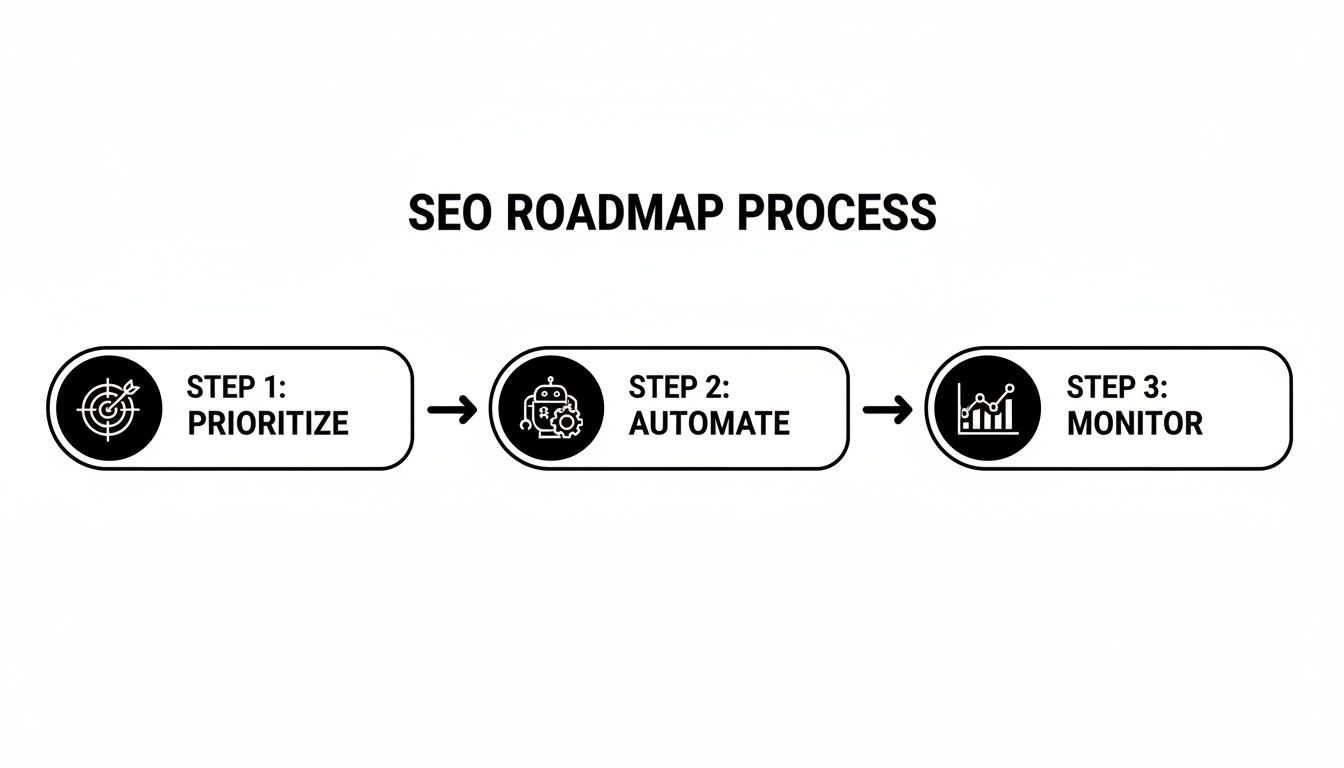
Without this kind of focused approach, it's easy to get lost in the weeds. A solid SEO program always starts with prioritizing high-impact tasks, finds ways to automate the repetitive work, and never stops monitoring results to see what needs tweaking.
How Long Does It Take to See Results from SEO?
This is the million-dollar question, isn't it? The honest answer is: it depends. Anyone who gives you a hard-and-fast timeline is selling something. Your results hinge on so many factors—your website's current authority, how tough your keywords are, and how consistently you put in the work.
As a general rule of thumb, you can expect to see some initial movement in your rankings within 3 to 6 months. But for the kind of significant, stable results that really move the needle on traffic? That often takes closer to 6 to 12 months.
SEO is a long game, not a get-rich-quick scheme. You're building a real asset. That said, using tools to speed up content creation and indexing—like Sight AI’s automatic IndexNow submissions—can help you build that momentum a lot faster by getting your new content in front of search engines almost immediately.
What Is More Important: Technical SEO or Content?
This is a classic debate, but it’s the wrong question. It's like asking what's more important for a car: the engine or the fuel? You need both, and they are completely dependent on each other for any real success.
Think of it this way: Technical SEO is the engine and chassis of your car. Content is the fuel. A powerful engine is useless without fuel, and a full tank of gas does nothing in a car with four flat tires.
First, make sure your technical foundation is solid. This ensures search engines can even find, crawl, and understand what your site is about. Once that's handled, you can pour your energy into creating a steady stream of high-quality, optimized content. They work in tandem, not in competition.
How Can I Track My Search Engine Ranking Improvements?
If you're not tracking your progress, you're flying blind. Measuring your efforts is the only way to know what's working and justify the investment. A combination of tools will give you the most complete picture.
- Google Search Console: This is non-negotiable and it’s free. It’s your direct line to Google, showing you which queries you're ranking for, your average position, click-through rates, and any critical technical issues.
- Dedicated Rank Tracking Software: For more granular, competitive insights, you'll want a platform like Ahrefs or SEMrush. They're invaluable for monitoring specific keywords over time and seeing how you stack up against the competition.
- AI Answer Engine Monitoring: Visibility today goes beyond the classic blue links. It’s crucial to track how your brand is being mentioned in AI-driven answer engines like ChatGPT and Perplexity. Tools like Sight AI are built for this, giving you a complete view of your true online presence.
Ready to turn AI and search visibility into measurable growth? With Sight AI, you can discover high-value content gaps, automate content production with specialized AI agents, and accelerate indexing to climb the rankings faster. See how Sight AI can transform your SEO workflow.