Organic traffic remains one of the most valuable acquisition channels for digital businesses, but earning it consistently in 2026 requires more than publishing blog posts and hoping search engines notice. The search landscape has fundamentally shifted. AI-powered tools like ChatGPT, Perplexity, and Google's AI Overviews now answer user queries directly, which means your content needs to satisfy both traditional ranking algorithms and generative AI models simultaneously.
For marketers, founders, and agencies, the question isn't whether organic traffic matters. It's how to build a repeatable system that drives it without depending on paid ads or short-lived tactics.
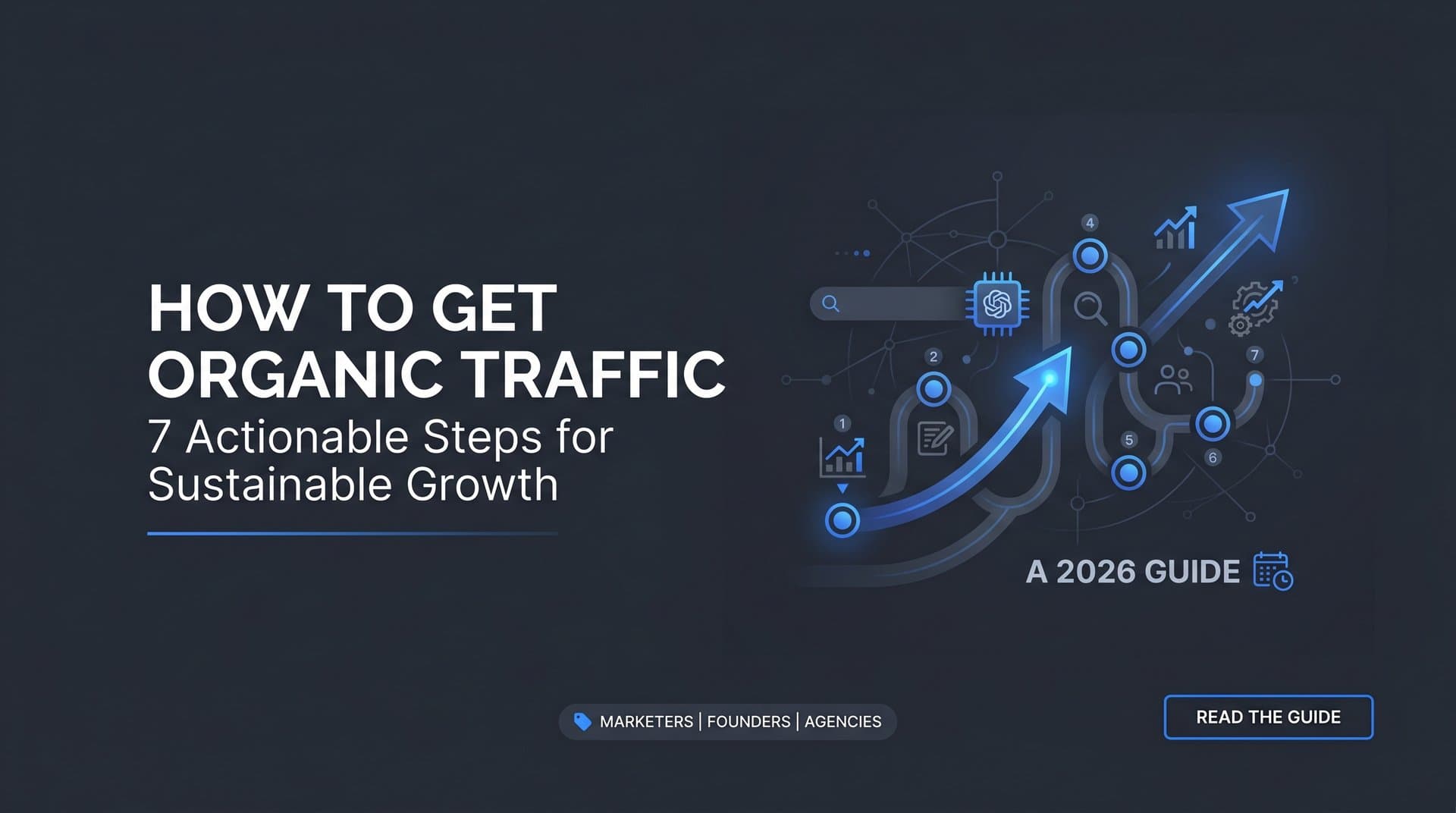
This guide walks you through seven concrete steps to get organic traffic, from benchmarking your current visibility to scaling a content operation that compounds over time. Each step builds on the previous one, giving you a clear workflow you can start implementing this week. Whether you're starting from scratch or trying to accelerate an existing content program, these steps will help you attract qualified visitors through channels that keep working long after you hit publish.
One thing to note before you dive in: this isn't just a traditional SEO playbook. We'll cover GEO (Generative Engine Optimization) alongside the fundamentals, because the teams seeing the strongest organic growth right now are the ones treating AI visibility as a first-class metric alongside keyword rankings and backlinks. Let's get into it.
Step 1: Audit Your Current Visibility Across Search and AI Platforms
Before you create a single new piece of content, you need to know where you actually stand. Skipping this step is like renovating a house without checking the foundation first. You might invest weeks of effort in the wrong direction.
Start with Google Search Console. Pull your indexed pages, impressions, clicks, and click-through rates for the past three to six months. You're looking for three categories of pages: those performing well (your benchmarks), those indexed but underperforming (low CTR, declining impressions, high impressions but no clicks), and those that aren't indexed at all. Each category requires a different response.
Underperforming indexed pages are often your fastest wins. A page sitting at position 8 with 5,000 monthly impressions but a 1% CTR doesn't need to be rebuilt from scratch. It needs a stronger title tag, a clearer meta description, or better alignment with search intent. Fixing these pages can move the needle faster than creating new content, and understanding organic traffic in Google Analytics helps you identify exactly which pages need attention.
Pages that aren't indexed are a different problem entirely. They can't rank if search engines can't see them. Common culprits include noindex tags left in place after a site migration, canonical conflicts, thin content flags, or pages sitting outside your sitemap. We'll address indexing more directly in Step 5, but flag these now.
Here's where this audit goes beyond what most SEO guides recommend: test your AI visibility baseline. Open ChatGPT, Claude, and Perplexity and run prompts related to your brand, your products, and the key topics in your industry. Ask questions your target customers would ask. Notice which brands and sources get mentioned. Notice if yours does.
This reveals something Google Search Console can't show you: how generative AI models perceive your authority on a given topic. If competitors are being cited in AI responses and you're not, that's a content and authority gap you need to close. If your brand isn't mentioned at all in your core topic area, that's your GEO baseline.
Success indicator: A clear spreadsheet or dashboard showing your indexed pages, top-performing queries, CTR by page, and AI mention status across at least three major AI platforms. This becomes your baseline for measuring everything that follows.
Step 2: Find High-Intent Keywords That Match Your Audience's Real Problems
Volume is a vanity metric. A keyword with 200 monthly searches and strong commercial intent will often drive more qualified traffic and conversions than a 10,000-volume term that attracts people who have no interest in buying or engaging with what you offer.
When you're doing keyword research for organic SEO, start with intent. For each keyword you're evaluating, ask: what does someone searching this actually want? Are they trying to learn something (informational intent), compare options (commercial intent), or make a purchase (transactional intent)? Your content strategy needs all three, but they serve different stages of the funnel.
Rather than targeting isolated keywords, build topic clusters. A topic cluster groups a central pillar topic with a set of related subtopics, all linked together. This approach signals depth of expertise to search engines and makes it easier for crawlers to understand the relationship between your pages. It's also how you build the kind of topical authority that AI models draw from when generating answers.
Here's a layer most keyword strategies miss: identify where AI models are already generating answers in your topic area. Run key questions through ChatGPT, Perplexity, and Claude and observe what sources they cite. If AI is already answering queries in your niche, that's not a threat. It's a GEO opportunity. Your goal is to become the source those models cite, and learning how to get organic traffic from AI search is becoming essential for modern content strategies.
Look specifically for content gaps: queries where competitors rank on page one but you don't, and prompts where AI models mention competitor brands but not yours. These gaps represent the highest-priority opportunities because someone has already validated demand. You just need to show up with better, more citable content.
Keyword difficulty matters, but don't let it paralyze you. Lower-difficulty, high-intent keywords in underserved topic areas often deliver faster results than chasing competitive head terms. Build authority in a specific niche first, then expand outward.
Success indicator: A prioritized keyword list organized by topic cluster, intent type, and estimated difficulty. Each cluster should map to a pillar page and a set of supporting articles you'll create or update.
Step 3: Create SEO and GEO-Optimized Content That Earns Citations
This is where most content programs either succeed or stall. The difference between content that ranks and content that gets buried isn't usually effort. It's structure, specificity, and whether the piece actually answers the question better than anything else out there.
For traditional SEO, the fundamentals still apply. Use your target keyword naturally in the title, first paragraph, at least one H2, and throughout the body. Structure your content with a clear heading hierarchy. Include internal links to related content on your site. Write for humans first, but don't ignore the signals search engines use to evaluate relevance and quality.
For GEO optimization, the approach shifts slightly. AI models don't just look for keyword density. They look for content that provides clear, authoritative, well-structured answers to specific questions. Think about how AI models generate responses: they pull from sources that state things definitively, explain concepts clearly, and provide information that's easy to extract and synthesize. Understanding the principles of AI SEO optimization helps you structure content that both search engines and generative models reward.
Certain formats consistently perform well in both traditional search and AI citation: step-by-step guides (like this one), comparison articles, listicles with substantive explanations, and FAQ-style content. These formats work because they match how people ask questions and how AI models structure responses.
Original insights matter more than ever. If your content simply restates what's already ranking on page one, there's no reason for AI models to cite you over those existing sources. Include unique frameworks, proprietary observations from your own experience, or analysis that adds something genuinely new to the conversation. This is what separates content that gets recommended from content that gets ignored.
Scaling content production without sacrificing quality is a real challenge, especially for lean teams. AI content creation for organic traffic can help you maintain publishing cadence while keeping optimization standards high. The key is using these tools to accelerate the process, not to generate generic content at volume. Quality and structure still determine whether content earns traffic and citations.
Entity-rich writing also helps with GEO. Reference relevant people, organizations, tools, and concepts in your space. This helps AI models understand what your content is about and connect it to the right topic areas when generating responses.
Success indicator: Each published piece targets a specific keyword cluster, is structured for both SERP features (featured snippets, People Also Ask) and AI citation, and includes at least one original insight or framework that differentiates it from existing content on the topic.
Step 4: Nail Your On-Page SEO and Technical Foundation
Great content on a technically broken site is like a brilliant speaker with a dead microphone. The message might be excellent, but no one can hear it. Technical SEO isn't glamorous, but it's the foundation everything else sits on.
Start with the basics on every page: an optimized title tag that includes your target keyword and compels clicks, a meta description that previews the value of the page, and a clean header hierarchy (one H1, logical H2s and H3s beneath it). These remain meaningful ranking signals, and they directly affect your click-through rate in search results. For a deeper dive into these fundamentals, our guide on how to improve organic search ranking covers each element in detail.
Page speed and mobile responsiveness are non-negotiable. Search engines prioritize pages that load quickly and render properly across devices. Run your pages through a performance testing tool and address any critical issues. Even modest improvements in load time can meaningfully affect both rankings and user engagement.
Schema markup is one of the most underutilized technical SEO levers available. Implementing structured data for content types like FAQ, HowTo, and Article helps search engines and AI models understand your content's structure and purpose. It also increases your eligibility for rich results in SERPs, which can significantly improve click-through rates. If you're publishing step-by-step guides or FAQ content, HowTo and FAQ schema should be standard practice.
Internal linking architecture deserves more attention than most teams give it. Every new page you publish should link to related content on your site and receive links from relevant existing pages. This does two things: it distributes authority across your site and helps crawlers discover and understand the relationship between your pages. Orphan pages (pages with no internal links pointing to them) are invisible to crawlers and often underperform even when the content itself is strong.
Run a site crawl using a tool like Screaming Frog or a similar crawler to surface broken links, redirect chains, duplicate content issues, and crawl errors. Understanding crawl budget optimization ensures search engines spend their crawl capacity on your most important pages rather than wasting it on low-value URLs.
Success indicator: A clean technical audit with no critical errors, schema markup implemented across relevant content types, and a clear internal linking structure that connects your topic clusters.
Step 5: Get Your Content Indexed Fast with Proactive Submission
Here's something that surprises many content teams: publishing a page doesn't mean search engines will find it anytime soon. Waiting passively for Googlebot to crawl and index new content can take days or weeks. During that window, your content isn't ranking, isn't driving traffic, and isn't getting cited by AI models. Proactive indexing closes that gap.
The first tool to use is Google Search Console's URL Inspection feature. After publishing a new page, paste the URL into the inspection tool and request indexing. It's a simple step that signals to Google that new content is ready for review. Do this for every important page you publish.
Beyond Google Search Console, the IndexNow protocol has become an increasingly important part of fast content discovery. Our IndexNow implementation guide walks through how to notify search engines (including Bing, Yandex, and others) the moment new content is published, rather than waiting for their crawlers to find it on their own schedule. Tools that integrate IndexNow can automate this notification process, so every piece of content you publish is flagged to search engines immediately.
Maintain an accurate XML sitemap that reflects your current site structure and submit it to both Google and Bing Webmaster Tools. Your sitemap should be updated automatically whenever new content is published or existing pages are significantly updated. A stale sitemap that references old URLs or misses new pages creates crawl inefficiencies that slow down indexing.
Monitor your indexing rate regularly. Many sites have a significant portion of their content invisible to search engines, not because of quality issues, but because of technical problems that prevent indexing. If you're experiencing content indexing delays costing traffic, common culprits include noindex tags left in place by mistake, canonical tags pointing to the wrong URL, pages blocked in the robots.txt file, or thin content that Google decides isn't worth indexing.
If you notice a pattern of pages not getting indexed, diagnose the cause systematically. Check the Coverage report in Google Search Console for specific error categories. Crawl budget waste (where search engines spend crawl capacity on low-value URLs like parameter-based pages or internal search results) can also suppress indexing of your important content.
Success indicator: New content indexed within 24 to 48 hours of publication, with an indexing rate above 90% for your priority pages. Tracking this metric monthly will reveal whether your technical setup is supporting or hindering your organic growth.
Step 6: Build Authority Through Strategic Link Earning and Brand Mentions
Links remain one of the most powerful ranking signals in search, and brand mentions across AI platforms are emerging as an equally important authority signal in the GEO context. Building both requires a deliberate strategy, not just hoping that good content will attract attention on its own.
The most durable link-building approach is creating assets that other sites genuinely want to reference. Original research, free tools, comprehensive guides, and data visualizations naturally attract links because they provide value that other content creators want to point their readers toward. These "linkable assets" require more upfront investment, but they generate compounding returns over time.
Digital PR and guest contributions on industry-relevant publications serve a dual purpose: they build domain authority through high-quality backlinks and they increase brand visibility in the communities where your target audience already spends time. Focus on publications your actual customers read, not just sites with high domain authority scores.
For GEO authority, the metric that matters is how frequently and positively AI models mention your brand when answering relevant questions. Learning the best ways to get mentioned by AI is critical because when tools like ChatGPT or Perplexity cite your brand in responses, it functions as a new form of referral traffic and a strong signal of topical authority. Building this requires consistent content production, strong internal linking, and being active in the communities and publications that AI models draw from.
Community-driven content distribution amplifies everything else. Share insights on LinkedIn, participate in industry forums, and contribute to niche communities where your audience gathers. This isn't just about social traffic. It increases the likelihood that your content gets linked to, discussed, and eventually cited by AI models.
Success indicator: Steady month-over-month growth in referring domains, an increase in branded search volume, and growing AI platform mentions across the topics you're targeting.
Step 7: Track Performance, Iterate, and Scale What Works
The difference between a content program that compounds and one that plateaus usually comes down to this step. Teams that track performance rigorously and iterate based on data consistently outperform teams that publish and move on without looking back.
Build a performance dashboard that brings together the metrics that actually matter: organic sessions, keyword rankings, indexing rate, referring domain growth, and AI visibility score. Having these in one place makes it easier to spot trends, identify problems early, and make data-driven decisions about where to focus next.
Review content performance monthly. Identify which pages are driving the most traffic, which keywords are climbing toward the top of page one, and which pieces of content are underperforming relative to expectations. This review process is where your next set of priorities gets defined.
Don't default to always creating new content when you have underperforming pages that could be refreshed. Updating existing content with more current information, stronger optimization, better internal links, and clearer structure often delivers faster ranking improvements than publishing something brand new. Search engines reward freshness, and a well-executed content refresh can re-signal relevance for pages that have started to slip.
AI visibility tracking deserves its own place in your performance review. Monitor how your brand appears in AI-generated answers over time, which topics you're being cited for, and how your sentiment compares to competitors. This is an emerging discipline, but the teams investing in it now are building a significant advantage as AI continues to reshape search traffic. Tools like Sight AI's AI visibility tracking give you a structured way to monitor brand mentions across platforms like ChatGPT, Claude, and Perplexity, with sentiment analysis and prompt tracking built in.
Once you've validated what works, scale it systematically. If a particular content format consistently earns citations and rankings, build a production workflow around it. If a specific topic cluster is generating strong organic traffic, expand it with additional supporting content. Organic growth automation software and AI-assisted publishing pipelines let you increase cadence without proportionally increasing effort, which is how you build a content operation that compounds rather than one that requires constant manual intervention to sustain.
Success indicator: Month-over-month organic traffic growth, improving AI visibility scores across your core topic areas, and a clear, data-driven content pipeline that tells you exactly what to publish next and why.
Putting It All Together: Your Path to Sustainable Organic Growth
Getting organic traffic isn't a one-time project. It's a system you build, refine, and scale over time. The seven steps in this guide form a complete workflow: audit your current visibility across search and AI platforms, identify high-intent keyword opportunities, create content optimized for both SEO and generative engines, lock down your technical foundation, get indexed fast through proactive submission, build authority through links and brand mentions, and continuously track and iterate on performance.
The teams seeing the strongest organic growth in 2026 are the ones treating AI visibility as equally important as traditional rankings. By combining SEO fundamentals with GEO optimization and fast indexing workflows, you create a compounding engine where every piece of content strengthens the next, and where your brand becomes increasingly visible across both search results and AI-generated answers.
The most important thing you can do right now is start with Step 1. Even a basic audit of your indexed pages and AI mention status will reveal immediate opportunities you can act on this week. You don't need a perfect system to begin. You need a clear baseline and a commitment to iterating from there.
Start tracking your AI visibility today and see exactly where your brand appears across top AI platforms. Stop guessing how AI models like ChatGPT and Claude talk about your brand. Get visibility into every mention, uncover content opportunities you're currently missing, and automate your path to organic traffic growth that compounds over time.