Your content team is underwater. You're publishing three articles a week, but competitors are pushing out twenty. Your keyword research backlog grows faster than you can write, and every organic traffic opportunity feels like a race you're losing before you start.
This isn't a resource problem—it's a production capacity problem. And AI content creation has emerged as the answer, but not in the way most marketers initially expect.
AI content tools don't replace your content strategy. They multiply your ability to execute it. When used correctly, they transform how quickly you can move from keyword opportunity to published, ranking content. But "correctly" is the operative word here, because the gap between AI content that drives organic traffic and AI content that wastes your time comes down to understanding how these systems actually work and where human judgment remains non-negotiable.
The Architecture Behind AI Content That Actually Ranks
Modern AI content systems don't work like a single writer typing an article from start to finish. They operate through specialized agent architectures, where different AI models handle distinct phases of content creation—each optimized for a specific task.
Think of it like an assembly line for content, but instead of physical components, you're assembling research insights, structural frameworks, written sections, and SEO optimizations. The research agent analyzes your target keyword, scrapes top-ranking competitor content, identifies content gaps, and extracts key topics that need coverage. This agent isn't writing yet—it's building the intelligence foundation.
The outlining agent takes that research and constructs article structure. It determines section hierarchy, allocates word count across topics based on search intent signals, and creates a logical flow that matches what searchers actually want to learn. This is where search intent analysis happens—the system identifies whether your keyword demands a how-to guide, a comparison article, or an informational explainer.
Only then does the writing agent generate actual content. But here's the critical distinction: it's writing against a detailed brief created by the research and outlining agents. This constraint dramatically improves output quality because the writing agent isn't making structural decisions—it's executing a plan that's already been validated against competitor analysis and search intent.
The optimization agent handles the final layer: keyword placement, internal linking opportunities, meta description generation, and readability improvements. It ensures the content meets technical SEO requirements without keyword stuffing or sacrificing natural language flow.
This multi-agent approach explains why AI content quality varies so dramatically across tools. Single-model systems that try to handle research, outlining, writing, and optimization simultaneously produce generic outputs that lack strategic depth. Specialized agent architectures create content that reflects actual editorial thinking—because the system mimics how professional content teams actually work.
But even the most sophisticated AI architecture produces drafts, not finished articles. Human oversight enters at critical checkpoints: validating the research phase to ensure the AI identified the right competitive landscape, reviewing the outline to confirm it matches your brand's angle on the topic, fact-checking claims in the written draft, and adjusting voice to align with your brand guidelines. The AI handles production velocity; humans handle strategic quality control.
Strategic Content Alignment: Matching AI Output to Traffic Intent
Not all organic traffic opportunities are created equal, and AI content creation works best when you match content types to specific stages of the customer journey.
Informational content sits at the top of your funnel—articles that answer questions, explain concepts, or provide educational value without pushing a specific product. This is where AI content creation tools excel. When someone searches "what is content marketing" or "how to optimize meta descriptions," they want clear, comprehensive explanations. AI systems can research these topics thoroughly, structure information logically, and produce articles that genuinely help readers while targeting featured snippet opportunities.
These informational pieces drive volume. They capture searchers early in their research phase, build topical authority for your domain, and create internal linking opportunities that support your commercial content. The AI advantage here is production speed—you can cover dozens of related informational topics in the time it would take to manually write three articles.
Commercial investigation content targets mid-funnel searchers who are comparing solutions, evaluating options, or trying to understand which approach fits their situation. Articles like "best project management tools for remote teams" or "email marketing platforms compared" fall into this category. AI content can handle the structural heavy lifting—creating comparison frameworks, organizing feature lists, and maintaining consistent evaluation criteria across options.
However, this content type requires more human involvement in the review phase. Your competitive positioning matters here, and AI systems don't inherently understand your unique value proposition or how you want to frame competitor comparisons. The AI can draft the comparison structure, but human editors need to ensure the framing aligns with your go-to-market strategy.
Long-tail keyword strategies represent AI content's sweet spot. These are the highly specific, lower-volume searches where competition is lighter but intent is often stronger. Instead of targeting "content marketing," you target "content marketing strategy for B2B SaaS startups" or "content marketing metrics that matter for small teams." AI systems can identify these long-tail opportunities through keyword research tools, then rapidly produce targeted articles that speak directly to specific searcher needs.
The economic advantage becomes clear here: manually writing articles for long-tail keywords with 50-200 monthly searches doesn't scale. But content generation for organic growth makes it viable to target hundreds of these opportunities, collectively driving significant traffic while facing minimal competition for rankings.
Quality Control: Where AI Content Fails and How to Prevent It
The quality gap between AI content that ranks and AI content that languishes on page five comes down to three failure modes—and your ability to prevent them.
Generic outputs represent the most common failure. The AI produces technically correct content that covers the topic but adds zero unique value. It reads like every other article on the subject because the AI simply synthesized existing top-ranking content without introducing new insights, frameworks, or perspectives. Search engines have become increasingly sophisticated at identifying this derivative content, and it rarely ranks well even when technically optimized.
Prevention requires injecting unique value during the content creation process. This might mean adding proprietary data, incorporating expert interviews, introducing a novel framework for thinking about the topic, or connecting concepts in ways that existing content hasn't explored. The AI can't generate these unique elements—you need to brief them in or add them during editorial review.
Factual errors create the second major failure mode. AI models sometimes generate plausible-sounding claims that aren't actually true, cite non-existent studies, or present outdated information as current. This isn't malicious—it's a fundamental limitation of how language models work. They predict plausible text based on training data, not retrieve verified facts from a knowledge database.
Your quality control framework must include fact-checking protocols. For any statistical claim, verify the source. For any case study reference, confirm it's real and accurately represented. For technical explanations, validate against authoritative sources. This doesn't mean AI content is inherently unreliable—it means you need editorial processes that catch and correct errors before publication.
Thin content represents the third failure mode. The AI produces articles that technically cover the topic but lack depth, skip important nuances, or fail to address the full scope of what searchers need to know. This happens when the research phase is shallow or when the content brief doesn't adequately specify coverage requirements.
E-E-A-T signals—Experience, Expertise, Authoritativeness, and Trustworthiness—become your quality benchmark. Does this content demonstrate actual expertise on the topic? Does it provide comprehensive coverage that reflects deep understanding? Would a human expert consider this article valuable? If the answer is no, the content needs more development before publication.
The strategic question becomes: when should you use AI content versus investing in human-written articles? AI content works best for scalable informational content where the value comes from clear explanation and comprehensive coverage. Human expertise remains essential for thought leadership, highly technical content requiring specialized knowledge, content where your unique perspective is the primary value, and pieces where brand voice differentiation is critical to positioning.
Closing the Indexing Gap: From Publication to Discovery
Publishing content doesn't guarantee search engines will find it, and the speed of content discovery directly impacts your ability to capture organic traffic—especially for time-sensitive topics or competitive keywords where being first matters.
Traditional indexing relies on search engine crawlers discovering your new content through sitemaps or by following links from already-indexed pages. This process can take days or even weeks, creating a discovery gap where your content exists but isn't competing for rankings. For rapidly moving topics or competitive keywords, this delay means competitors who get indexed faster capture the traffic first.
IndexNow protocol changes this dynamic by enabling instant notification to search engines when new content is published. Instead of waiting for crawlers to discover your sitemap updates, you actively push notifications that say "new content is available here." Major search engines including Bing and Yandex support IndexNow, and the protocol is gaining broader adoption across the search ecosystem.
For AI content operations producing multiple articles daily, automated IndexNow submissions become critical infrastructure. Manual submission doesn't scale when you're publishing ten or twenty pieces per week. Integration between your content management system and IndexNow ensures every published article gets immediate discovery notification without adding manual workflow steps.
Sitemap freshness matters equally. Search engines use your sitemap as a content inventory, but if your sitemap updates lag behind your actual publication schedule, you're creating artificial delays in content discovery. Always-updated sitemaps that automatically reflect new content within minutes of publication ensure search engines have accurate information about your content inventory.
But indexing speed is only valuable if your content is actually ready to compete for rankings. This means technical SEO fundamentals can't be skipped: proper heading hierarchy, optimized meta descriptions, internal linking to establish topical relationships, and mobile-friendly formatting. AI content tools can handle most of these technical requirements automatically, but validation during your editorial review ensures nothing slips through. For more on accelerating this process, explore strategies for faster indexing for new content.
Monitoring becomes the final piece. Track which content gets indexed quickly versus slowly, correlate indexing speed with ranking performance, and identify patterns that indicate technical issues preventing efficient discovery. This feedback loop helps you optimize both content production and technical infrastructure for faster time-to-traffic.
Operationalizing AI Content: From Experiment to System
Moving from occasional AI content experiments to a sustainable production operation requires thinking about content creation as a system, not a series of one-off projects.
Content calendar planning changes when AI dramatically increases your production capacity. Instead of planning around how many articles your team can manually write, you plan around strategic opportunity. Identify your priority keyword clusters, map content to customer journey stages, and sequence publication to build topical authority progressively. AI production capacity means you can execute comprehensive content coverage that would be impossible with manual writing alone.
The constraint shifts from "how much can we produce" to "what should we produce." Your content strategy becomes the bottleneck, not your production capability. This is actually a positive shift—it forces clearer strategic thinking about which topics matter most for your business goals and where content investment will drive the strongest return.
CMS integration for content automation determines whether AI content creation feels like a productivity multiplier or an administrative burden. Manual copy-paste workflows don't scale. Look for AI content tools that can publish directly to your content management system, preserving formatting, handling image placement, and maintaining your site's style conventions. Autopilot modes that handle publication scheduling eliminate another manual step, letting you review and approve content while the system handles technical publishing tasks.
Workflow integration with your existing content processes matters equally. AI content shouldn't exist in a silo separate from your editorial calendar, SEO strategy, or content promotion workflows. The content produced by AI tools needs to flow through the same review, optimization, and distribution processes as any other content your team creates. This ensures consistent quality standards and prevents AI content from becoming a disconnected experiment.
ROI measurement provides the feedback loop that makes continuous improvement possible. Track organic traffic growth from AI-generated content versus historical baselines. Monitor ranking improvements for target keywords covered by AI content. Calculate content production costs—both the tool costs and the human time invested in review and editing—against the traffic and conversion value generated. These metrics tell you whether your AI content operation is actually moving business outcomes or just creating more published pages. Understanding AI generated content SEO performance helps you benchmark what's actually working.
The most successful AI content operations treat the technology as a capability multiplier that enables execution of a stronger content strategy. They don't use AI to produce more of the same content they were already creating—they use it to pursue content opportunities that were previously uneconomical to target.
Putting It All Together: AI Content as Strategic Infrastructure
AI content creation for organic traffic succeeds when you recognize it as infrastructure that enables better strategy execution, not as a replacement for strategic thinking itself.
The technology handles production velocity—researching topics, structuring articles, generating initial drafts, and optimizing for technical SEO requirements. This compression of the production timeline from days to hours creates strategic advantages: you can respond to emerging topics faster, target long-tail opportunities that were previously uneconomical, and build comprehensive topical coverage that establishes domain authority.
But velocity without quality control produces content that doesn't rank. Your editorial oversight, fact-checking protocols, unique value injection, and brand voice alignment remain essential. The AI multiplies your team's productivity, but human judgment determines whether that productivity translates into content that actually drives organic traffic.
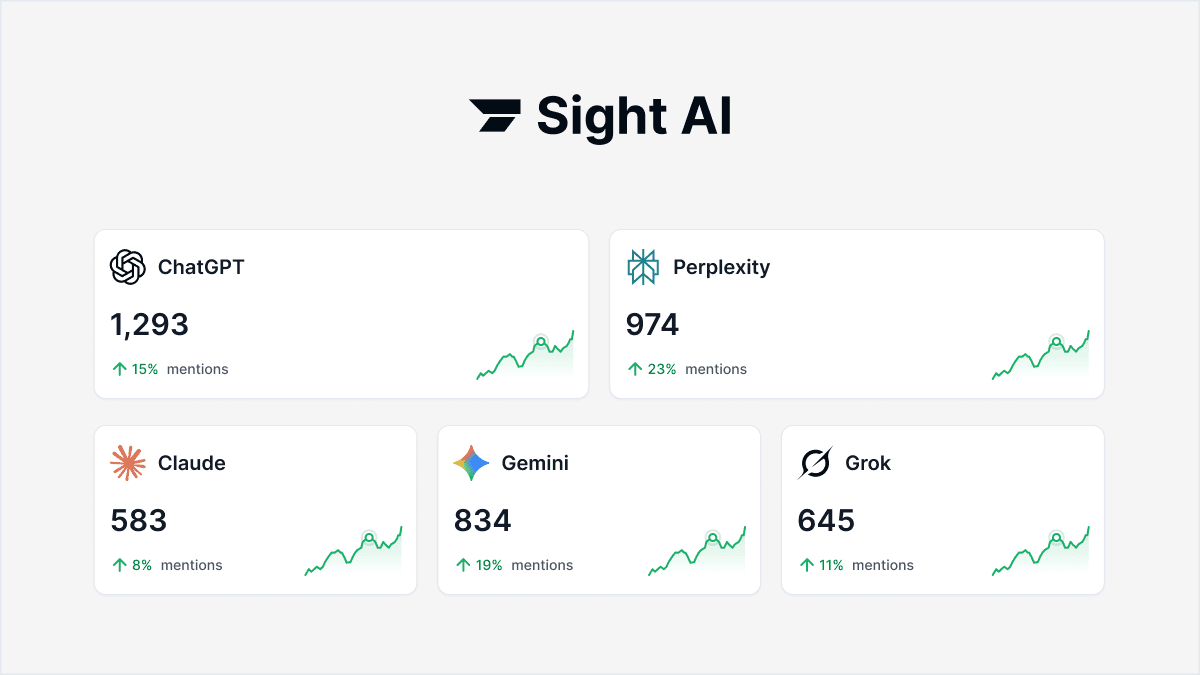
The search landscape is evolving beyond traditional Google rankings. AI-powered search through platforms like ChatGPT, Perplexity, and Claude creates new distribution channels where your content can reach audiences. Articles that get cited by AI assistants gain visibility beyond SERP rankings, creating additional traffic pathways. This shift toward Generative Engine Optimization alongside traditional SEO means your content needs to perform across multiple discovery surfaces.
Understanding how AI models talk about your brand, which content gets cited in AI responses, and where opportunities exist to improve your AI visibility becomes increasingly important. Learning to optimize content for AI search isn't about gaming AI systems—it's about ensuring your content provides the kind of comprehensive, authoritative information that AI models recognize as valuable sources worth citing.
The competitive advantage goes to teams that combine AI production efficiency with strategic content thinking and quality control rigor. You move faster than competitors relying solely on manual content creation, while maintaining the quality standards that search engines reward with rankings and traffic.
Start tracking your AI visibility today and see exactly where your brand appears across top AI platforms. Stop guessing how AI models like ChatGPT and Claude talk about your brand—get visibility into every mention, track content opportunities, and automate your path to organic traffic growth. When you understand both traditional search performance and AI citation patterns, you can optimize content strategy for the full spectrum of organic discovery.