
Keyword research for organic SEO is all about figuring out the exact words and phrases your audience is typing into Google to find what you offer. It’s way more than just grabbing terms with high search volume. The real magic happens when you understand the why behind the search—the user's intent—and create content that perfectly matches it. Get this right, and you'll drive targeted traffic that grows over time.
Building Your Strategic SEO Foundation

Before you even think about opening a keyword tool, you have to do the most important thing: define what winning actually looks like for your business. So many people make the mistake of chasing high-volume keywords without a clear purpose. That’s a fast track to vanity metrics and a ton of wasted effort. The real goal is to tie your content directly to real business results.
Stop and ask yourself what you're actually trying to accomplish. Do you need more brand awareness? Are you hunting for qualified leads? Or is it all about driving direct sales from your e-commerce site? Each of these goals demands a completely different keyword strategy. For example, a brand just trying to get its name out there would target broad, top-of-funnel informational keywords, while a company desperate for leads needs to zero in on queries that scream "I'm ready to buy."
Aligning Keywords with Business Goals
When you map your keyword strategy back to your business goals, SEO stops feeling like a guessing game and starts becoming a reliable engine for growth. A solid foundation here means every single article you publish has a clear job to do.
Here’s a simple way to frame your objectives:
- Brand Visibility: Go after broad, informational keywords that introduce your brand to a huge audience. Think "what is..." or "how to..." searches related to your field.
- Lead Generation: Focus on keywords that show someone is weighing their options. This often includes comparisons like "service A vs. service B" or terms like "best software for..."
- Direct Sales: Target transactional keywords that have strong commercial intent. These are the specific, bottom-of-the-funnel queries like "buy [product name]" or "[service] pricing."
Getting this alignment right is crucial because organic search is an absolute powerhouse. It drives around 53% of all website traffic globally, making it a non-negotiable channel if you want to grow. But the competition is intense—the top five organic results get the lion's share of all clicks.
The most powerful keyword lists are built on a deep understanding of the customer journey. You must anticipate the questions, problems, and needs of your audience at every stage, from initial awareness to the final purchase decision.
Mapping Keywords to the User Journey
Once your goals are crystal clear, you can start mapping potential keywords to the different stages of the marketing funnel. This is how you create content that meets people exactly where they are, guiding them from discovery to purchase without a hitch. Someone searching "what is content marketing" is in a completely different headspace than someone searching "content marketing agency cost." Knowing that difference is everything.
While this guide covers the A-to-Z of general organic keyword research, if you're running an e-commerce store, you might find a dedicated modern guide to keyword research for Amazon more helpful for platform-specific tactics.
By building this strategic framework first, every keyword you find and target will have a purpose. This approach doesn't just boost your ranking potential; it ensures the traffic you attract is actually valuable and far more likely to convert. Creating content that hits these strategic goals requires specific techniques, which you can dive into in our guide to content SEO best practices.
Uncovering Your Universe of Keywords

Alright, you've got your goals and user intent figured out. Now for the fun part: moving from theory to practice and actually building out your keyword universe. This is where we map out every possible way a customer might search for what you offer.
It all starts with what we call "seed" keywords. These are the foundational, obvious terms that describe your product or service.
Let's say you sell high-end coffee brewing equipment. Your seed keywords are the no-brainers: "pour-over coffee maker," "espresso machine," or "cold brew system." But these are just the starting blocks. The real magic in keyword research for organic SEO happens when you expand this short list into hundreds, or even thousands, of related terms.
Mining Competitors for Proven Winners
One of the smartest shortcuts is to see what's already working for your competition. They've already spent the time, money, and effort to figure out which keywords bring in qualified traffic. Why not learn from their wins?
Grab a good SEO tool, pop in a competitor's domain, and see which keywords are sending them the most organic traffic. Pay attention to the difference between the informational keywords driving their blog traffic and the commercial keywords leading to product pages. This isn't about blindly copying them; it's about spotting proven topics and finding angles where you can create something even better.
If you want a deeper look at this process, we break it down in our guide to identifying valuable organic search keywords.
Listening to the Voice of Your Customer
Keyword tools are powerful, but they lack the human element. They tell you what people search for, but not always how they think. To really connect with your audience, you need to go where they hang out online and just... listen.
- Reddit: Dive into subreddits like r/coffee. Hunt for threads with tons of engagement. The raw, unfiltered language people use—their specific questions, frustrations, and even their slang—is a goldmine for long-tail keywords.
- Quora: Search for your seed keywords here and just read the questions people are asking. The phrasing is often a direct copy-paste of what they'd type into a search bar.
- Industry Forums: Don't sleep on old-school forums. They're often filled with die-hard enthusiasts and experts. Their discussions can surface hyper-specific, advanced topics that most keyword tools will completely miss.
This approach helps you uncover the authentic language of your audience, making your content feel like it was written just for them.
The goal isn't just to find what people search for, but how they search. Analyzing community discussions reveals the exact phrasing, pain points, and questions that form the foundation of a powerful, intent-driven content strategy.
Leveraging Google SERP Features
Did you know Google itself is one of the best keyword research tools out there? And it's free. The search engine results page (SERP) is littered with clues about what users really want and other topics they're interested in.
Type one of your seed keywords into the search bar and keep your eyes peeled for these features:
- People Also Ask (PAA): This little box is pure gold. Each question is a ready-made keyword and content idea. Click on one, and Google will load even more, letting you branch out into a whole tree of related topics.
- Related Searches: Scroll to the bottom of the page. Google will literally hand you a list of other queries people used. This is perfect for finding semantic variations and different angles on your core topic.
- Autocomplete: As you type, pay attention to Google's suggestions. These aren't random; they're based on popular and trending searches, giving you a real-time pulse on what's on your audience's mind.
Unearthing Hidden Gems in Your Own Data
Finally, don't forget to look in your own backyard. If your website has an internal search bar, its logs are a direct line into the minds of your visitors. What are they looking for once they're already on your site?
This data can reveal high-intent keywords you're completely overlooking. These are people who are telling you, in their own words, exactly what they want to find or buy from you. It’s a source of incredibly qualified, bottom-of-funnel keywords you simply won't find anywhere else.
A huge list of potential keywords isn't a strategy; it's just raw data. The real magic in keyword research for organic SEO happens when you turn that data into a roadmap for growth. This is where we move beyond just chasing high search volumes and start thinking like a strategist.
Your job is to dig into each keyword and figure out its true potential. It’s about more than just numbers—it’s about understanding who is searching, what they desperately want to find, and what it will really take to show up on their screen. Let's break down how the pros do it.
Deconstruct the Competitive Landscape
Before you can even think about winning a keyword, you have to size up the competition. Sure, the Keyword Difficulty (KD) score in tools like Ahrefs or Semrush gives you a quick first look. But treating that number as gospel is a classic rookie mistake.
A high KD score can be misleading. A KD of 70 might mean you're going head-to-head with global brands with bottomless budgets. Or, it could just mean the top spots are held by outdated articles with a ton of old backlinks—the kind of content you could blow out of the water with a genuinely better, more modern resource.
Keyword Difficulty is a compass, not a map. It points you in a direction, but you still need to get out and survey the terrain yourself to spot the real shortcuts and roadblocks.
The next move is always a manual SERP analysis. Fire up an incognito browser window and type in your keyword. Take a hard look at the top 10 results and start asking questions:
- Who is actually ranking? Are we talking about titans like Wikipedia and Forbes, or are they niche blogs and businesses that look a lot like you?
- What's the content quality like? Is it thin, out of date, or just plain boring? This is where you can find your opening to create something 10x better.
- What do their backlinks look like? Use your favorite SEO tool to peek at the number of referring domains pointing to these top pages. This gives you a much clearer picture of the link-building mountain you'll need to climb.
Decode the Nuances of Searcher Intent
This might be the single most important part of keyword analysis. If you get the why behind a search wrong, you'll attract visitors who bounce the second they land on your page because you didn't solve their problem. Every search query falls into one of four main intent categories.
Understanding these intent types is crucial for aligning your content with what users actually want to see. This framework helps you decide what kind of content to create for each keyword you target.
Keyword Intent Analysis Framework
| Intent Type | User Goal | Example Keywords | Appropriate Content Format |
|---|---|---|---|
| Informational | To learn something or find an answer. | "how to brew coffee" | Blog posts, guides, tutorials |
| Navigational | To find a specific website or brand. | "IndexPilot login" | Homepage, login page |
| Commercial | To research before making a purchase. | "best espresso machine under 500" | Review articles, comparison pages |
| Transactional | To buy something right now. | "buy Nespresso pods" | Product pages, e-commerce categories |
The SERP itself gives you all the clues you need. If Google is serving up a buffet of blog posts and YouTube tutorials for your keyword, trying to rank a product page is like trying to swim upstream. It's a losing battle. Your content format must match what searchers are expecting.
And once you’ve picked your battles and started to win, you have to keep score. We’ve put together a full guide on how to track keyword rankings to help you measure what's working.
Gauge Real-World Click-Through Rate Potential
Search volume tells you how many people are looking, but it says nothing about how many will actually click on a classic organic result. Today's search results pages are cluttered with features that can steal clicks away from the traditional blue links.
When you're looking at a SERP, be on the lookout for these click-thieves:
- Paid Ads: How many are sitting at the top? Four ads can shove the first organic result way down the page, killing its CTR.
- Featured Snippets: If a snippet gives a direct answer, the searcher might not need to click anything else. Their journey ends right there.
- "People Also Ask" Boxes: These accordions can satisfy a user's curiosity or send them down an entirely different rabbit hole.
- Video Carousels & Image Packs: These visual elements are magnets for eyeballs and can easily draw clicks away from standard web results.
A keyword with 10,000 monthly searches might sound amazing, but if its SERP is packed with ads and snippets, it could realistically send you less traffic than a keyword with 2,000 searches and a clean, traditional results page.
You have to factor in this "SERP real estate" to make an accurate traffic forecast. This is especially true for e-commerce. For a deeper dive into this for Amazon sellers, check out this excellent guide on mastering long-tail keywords for Amazon. This level of analysis is what separates a long list of keywords from a smart SEO strategy that actually drives real business results.
Turning Keywords into a Content Roadmap
Alright, you've done the hard work and now you have a vetted list of keywords. This is where the real strategy begins, turning that raw data into a powerful content roadmap.
Forget the old-school approach of "one keyword, one page." That's not just outdated; it's a surefire way to burn yourself out with minimal results. Modern, effective keyword research for organic SEO is all about building topical authority. We're not just targeting keywords anymore—we're building themes.
The goal is to organize all those semantically related keywords into what we call topic clusters. This is a game-changer because it mirrors how search engines like Google actually understand content today: by mapping the relationships between different concepts across your entire site.
From Keywords to Topic Clusters
So, what exactly is a topic cluster? It's pretty straightforward. You have a "pillar page" and your "cluster content." The pillar page is a broad, comprehensive guide on a core topic. Think of it as your ultimate resource. The cluster content is a series of more specific, in-depth articles that dive into the subtopics related to that pillar.
This infographic breaks down the core elements you should be evaluating to turn a keyword into a piece of content.
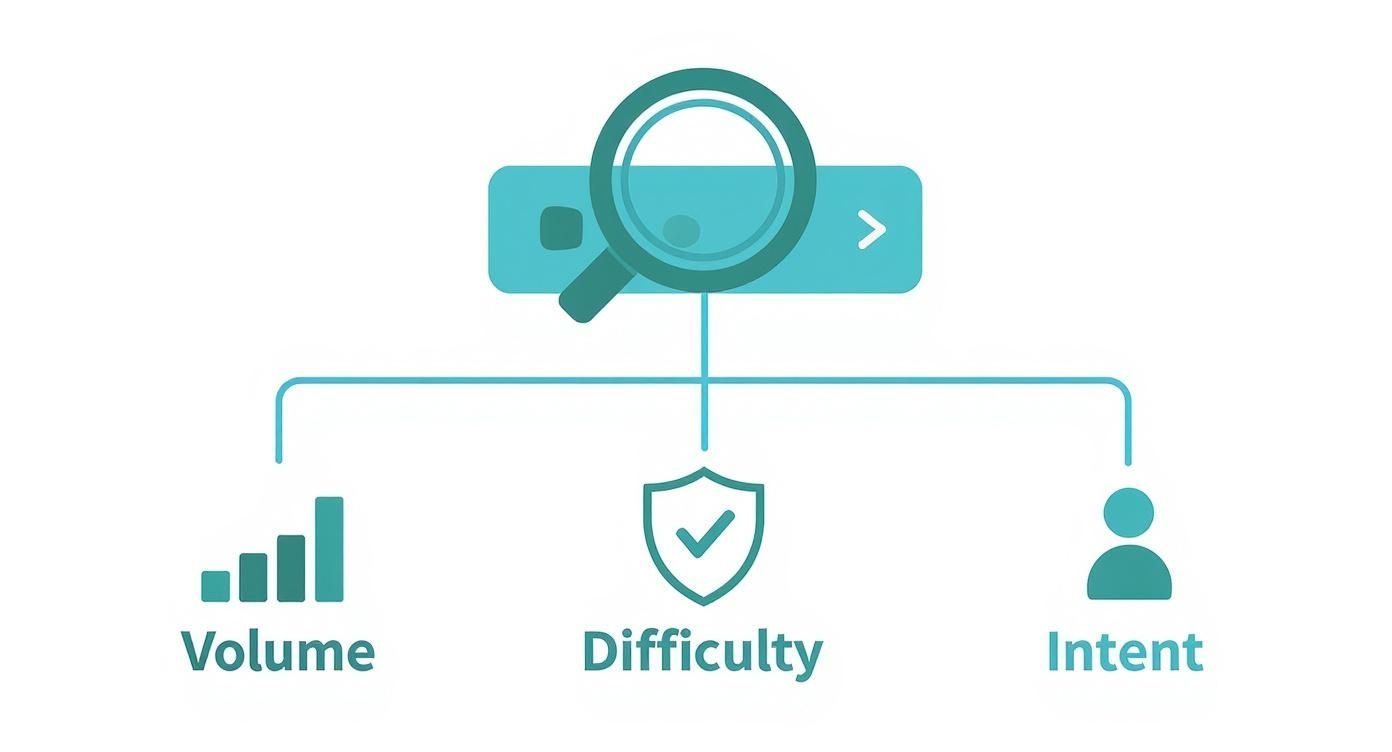
Each of those metrics—volume, difficulty, and intent—helps you decide where a keyword fits. Is it big enough to be a pillar, or is it better as a supporting piece of cluster content?
Let's say you sell project management software. Your main pillar topic might be something broad like "project management basics."
From there, your cluster content would branch out to cover the more specific, long-tail keywords you found earlier:
- "what is agile methodology"
- "how to create a project timeline"
- "best tools for team collaboration"
- "gantt chart vs kanban board"
Crucially, each of these cluster articles links back to your main "project management basics" pillar page. This creates a powerful internal linking web that signals to Google, "Hey, we know everything about project management." This helps you rank for a massive array of related terms, not just one.
Building topic clusters isn't just an SEO tactic; it's a user-centric approach to content. You're creating an organized, interconnected library of resources that helps visitors find exactly what they need, establishing your site as the go-to authority.
Mapping Clusters to Your Content Plan
Once you've grouped your keywords into clusters, the next step is mapping them to your content calendar and your site's existing structure. Remember, not every cluster needs a brand new blog post. The user intent you identified earlier will tell you exactly what kind of content to create.
Here’s how that plays out in the real world:
- Informational clusters are perfect for blog posts, how-to guides, or in-depth tutorials. A keyword like "how to improve team productivity" is begging to be a detailed article.
- Commercial investigation clusters, such as "Asana vs Trello," are tailor-made for comparison pages or deep-dive reviews.
- Transactional clusters targeting terms like "buy project management software" should map directly to your product, services, or pricing pages.
Don't sleep on your long-tail keywords for the cluster content. These specific, multi-word phrases are absolute gold. In fact, they account for a whopping 69-70% of all search traffic and tend to have conversion rates 2.5 times higher than broader, more generic terms. This data from Backlinko's SEO stats research makes it crystal clear why building out detailed cluster pages around these queries is so incredibly effective for bringing in qualified leads.
By meticulously planning which keywords belong to which cluster and what format they need, you build a cohesive site architecture that search engines and users love. This organized approach makes your content strategy scalable and, most importantly, effective. Of course, once the plan is in place, the real work of creating the content begins. If you need a hand with that part, check out our comprehensive guide on how to optimize content for SEO.
Prioritizing Keywords for Maximum Impact
So, you've done the heavy lifting. You’ve brainstormed keywords, analyzed the data, grouped them into neat topic clusters, and sketched out a content roadmap. Now for the hard part: Where do you actually start?
This is the moment of truth in any SEO campaign. You can't possibly target everything at once, and the choices you make here are often what separate a strategy that builds momentum from one that just spins its wheels. It’s time to stop thinking like a data analyst and start thinking like a business strategist. A solid, data-informed prioritization framework is what turns your keyword list from a jumble of ideas into a clear, actionable battle plan.
Creating a Custom Priority Score
Search volume and keyword difficulty are great starting points, but they don't paint the full picture. A keyword's real value is completely unique to your business. To really nail this, we need to build a simple scoring model that layers your business goals on top of the raw SEO metrics.
Let's build a quick framework. For every keyword or topic cluster, score it on a scale of 1-5 for these criteria:
- Traffic Potential (1-5): Forget single keyword volume. How much organic traffic could this entire topic realistically drive if you owned it? Think bigger.
- Business Value (1-5): How directly does this topic tie into making money? A keyword with high commercial intent that leads straight to a product page gets a 5. An informational "what is" query might be a 2.
- Difficulty (1-5): How tough is the climb to the top five spots? A 1 means you're up against giants. A 5 means the SERP is filled with weak, outdated content you can easily beat.
Add these up to get your custom "Priority Score." Anything in the 13-15 range is a screaming priority. Something scoring a 3-5 can probably be put on the back burner. This simple math forces you to look at the whole picture instead of getting distracted by shiny objects like massive search volume.
A keyword with 10,000 monthly searches and zero business relevance is infinitely less valuable than a keyword with 100 searches that converts 20% of its traffic into customers. Prioritization is about finding the sweet spot between opportunity and impact.
Balancing Quick Wins with Long-Term Goals
A truly smart prioritization strategy is a mix of offense and defense—you need to balance short-term wins that build momentum with the long-term projects that build authority. You need some points on the board now while you lay the groundwork for the bigger, tougher keywords.
This is where "striking distance" keywords are your best friend. These are terms you already rank for, just not where it counts—think positions 6-20. Pushing these up the page is almost always easier than starting from scratch with a new keyword.
- Find Your Striking Distance Keywords: Fire up Google Search Console or your favorite SEO tool and filter for keywords where you rank on page two or the bottom half of page one.
- Analyze the Content: Is the page thin? Outdated? Poorly optimized? Often, all it takes is a content refresh—adding more depth, updating stats, or improving the on-page SEO—to jump into the top five.
- Build Some Internal Links: Find other relevant, high-authority pages on your site and point a few internal links to your "striking distance" page. Sometimes that little boost is all it needs to pop.
Dedicating some of your time to these quick wins delivers tangible results fast, which helps get buy-in for the bigger SEO vision. While you're banking those easy victories, you can devote your other resources to building out the massive pillar content needed to eventually rank for those ambitious, high-difficulty terms.
To manage all this effectively, knowing what to look for in SEO tools can be a game-changer for spotting opportunities and actually executing your plan.
Common Questions About Keyword Research
Even with a solid workflow in place, you’re going to hit a few roadblocks. Keyword research is a complex discipline with a lot of moving parts, and it’s way too easy to get stuck in the weeds. Let's tackle some of the most common hurdles I see people run into.
Getting these fundamentals right is what separates a keyword list from a real SEO strategy. The answers below come from years of doing this stuff in the trenches, not just from a textbook.
How Often Should I Perform Keyword Research?
It's a huge mistake to treat keyword research as a one-and-done task you check off when launching a site. Think of it more like tending a garden; it needs constant attention to actually produce anything. A massive research project is non-negotiable when you're starting from scratch or launching a major new product line.
But after that initial deep dive? You should be revisiting your keyword strategy quarterly, at a minimum.
Search trends shift, new competitors pop up out of nowhere, and your own business goals will change. A regular refresh keeps your content efforts locked in on what real people are searching for right now. Even blocking off a few hours each month to poke around for new terms can keep you way ahead of the curve.
What Are the Best Free Keyword Research Tools?
While the premium tools offer incredible depth, you can get surprisingly far without spending a dime. In fact, some of the most powerful, unfiltered insights come from tools that are completely free.
- Google's SERP: Honestly, your best friend is the search results page itself. Features like Autocomplete, "People Also Ask," and "Related Searches" are direct, real-time windows into what users are thinking.
- Google Keyword Planner: It was built for advertisers, sure, but it's still a solid starting point for getting rough search volume estimates and brainstorming new ideas.
- Google Trends: This one is fantastic for understanding the seasonality of a topic and comparing the relative popularity of different keywords over time.
These free resources give you a direct line into Google's own data. You're seeing what your audience is actually interested in without spending a penny.
The best keyword tool is the one you actually use consistently. Don't get paralyzed trying to find the "perfect" software. Start with these free, reliable sources and just start analyzing the data.
Should I Target Keywords My Competitors Dominate?
Absolutely—but you have to be smart about it. Going head-to-head with an industry giant for a broad, high-difficulty keyword is usually a losing battle, unless you have a monster budget. Instead, you need to use your competitor analysis to find their weak spots.
Look for keywords where they rank, but the content is thin, outdated, or just plain low-quality. That’s your golden opportunity. You can swoop in, create a genuinely superior resource, and steal that spot right out from under them.
This is a core principle of effective keyword research for organic SEO: you don’t need to reinvent the wheel, just build a much better one.
Also, dig for the long-tail variations they might have overlooked. These super-specific queries almost always have lower competition and much higher conversion intent. Your goal isn't to just copy your competitor's strategy, but to find the gaps where you can provide way more value to the searcher. By focusing on those opportunities, you can carve out your own space and build authority piece by piece.
Ready to turn your keyword list into compounding organic traffic? IndexPilot uses trainable AI Agents to automate the entire SEO content workflow—from research and writing to optimization and publishing. Stop the manual busywork and start scaling your content engine. Get started with IndexPilot today.