The strongest AirOps competitors in 2026 split into three groups. Writesonic is an AI writing platform. Profound, Peec and Promptwatch are AI visibility monitoring tools. Sight AI is an all-in-one platform that combines AI visibility tracking, GEO-optimized content generation and automated indexing. Pick a writing-workflow tool if your bottleneck is content volume, a monitoring tool if you need to know whether ChatGPT, Claude or Perplexity cite your brand, and an integrated platform if you need both without stitching tools together.
AirOps built its reputation as an AI workflow tool for content and SEO teams, and it does that job well. Teams now often need more than workflows. They need to know whether their content actually gets their brand cited by AI models, and to close that gap quickly. Each tool below was evaluated on four criteria: AI content capabilities, brand monitoring features, indexing automation and overall value for teams focused on organic growth in an AI-first search environment.
AirOps Competitors at a Glance
| Tool | Primary category | AI content generation | AI visibility tracking | Indexing automation | Typical buyer |
|---|---|---|---|---|---|
| Sight AI | All-in-one AI visibility + content | Yes (13+ agents) | Yes (6+ AI models, sentiment) | Yes (IndexNow, sitemaps) | Marketers, founders, agencies |
| AirOps | AI content workflows | Yes (workflow builder) | Check current plans | No | Content ops teams |
| Writesonic | AI writing | Yes | Limited / check current plans | No | Volume content teams |
| Profound | Enterprise AI answer monitoring | No | Yes | No | Enterprise, agencies |
| Peec | Prompt-level AI visibility | No | Yes | No | Analytics-led SEO teams |
| Promptwatch | Targeted prompt monitoring | No | Yes | No | Teams running focused GEO campaigns |
1. Sight AI
Best for: Teams that need AI visibility tracking, GEO-optimized content generation and automated indexing in one platform.
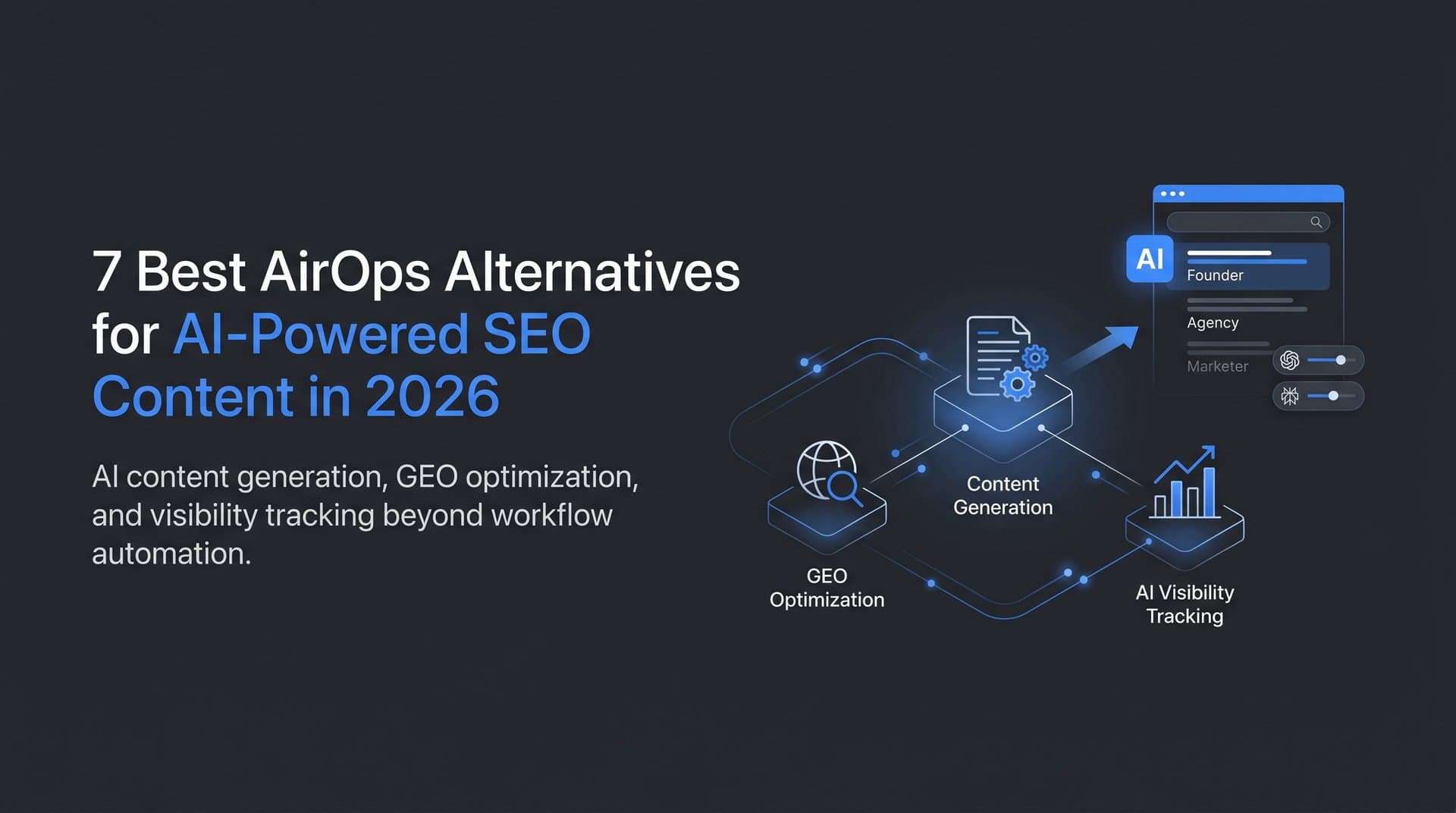
Sight AI is an all-in-one AI visibility and SEO content platform. It closes the loop between content creation and AI search presence by tracking brand mentions across 6+ AI models, generating SEO/GEO-optimized content with 13+ specialized AI agents, and automating website indexing via IndexNow.

Where This Tool Shines
The core differentiator here is scope. Most tools in this space do one thing: either they help you create content, or they help you monitor how AI models talk about your brand. Sight AI does both, so you're not stitching together three separate platforms to cover the full workflow.
The AI Visibility Score is particularly useful. It tells you whether your brand is being mentioned in AI-generated answers and also how it's being mentioned, with sentiment analysis and prompt-level tracking. That distinction matters when you're trying to understand whether AI models recommend your brand positively or only reference it in passing.
Key Features
AI Visibility Score: Tracks how AI models mention your brand with sentiment analysis, giving you qualitative insight beyond simple mention counts.
Multi-Platform Brand Monitoring: Monitors brand mentions across ChatGPT, Claude, Perplexity and 3+ additional AI platforms from a single dashboard.
13+ Specialized AI Agents: Purpose-built agents generate listicles, guides and explainers optimized for both traditional SEO and generative engine optimization (GEO).
Autopilot Mode: Enables hands-off, continuous content production, so your publishing cadence doesn't depend on manual input every cycle.
Automated IndexNow Integration: Submits new content to search engines automatically and updates sitemaps, accelerating content discovery without manual intervention.
CMS Auto-Publishing: Pushes finished content directly to your CMS without extra steps.
Best For
Sight AI is the strongest fit for marketers, founders and agencies who want to compete in AI search as well as traditional SEO. Your team may be asking two questions: "How do we get mentioned when someone asks ChatGPT about our category?" and "How do we produce enough content to make that happen?" This platform addresses both at once.
Pricing
Pricing details are available directly at trysight.ai. Verify current tiers and plan options on the official site before making a decision.
2. AirOps
Best for: Content and marketing teams building repeatable, prompt-driven AI content workflows at scale.
AirOps is an AI workflow automation platform. Content teams use it to design structured, multi-step pipelines for content production with prompt templates and LLM integrations.

Where This Tool Shines
AirOps is genuinely strong at what it was built to do: systematizing content operations. If your team has defined processes for content production and wants to apply AI consistently across them, the workflow builder and prompt template library make that tractable. You can build reusable pipelines that enforce consistency across large content programs.
The collaboration features also stand out. Content ops at scale often involves multiple contributors, editors and approvers. AirOps provides the structure to manage that without everything falling apart in a shared Google Doc.
Key Features
Prompt Template Library: Standardizes AI-assisted content tasks so your team applies consistent prompting logic across every piece of content.
Workflow Builder: Chains AI tasks together into repeatable, auditable multi-step pipelines.
CMS and Data Source Integrations: Connects with popular content management systems and data inputs to reduce manual handoffs.
Team Collaboration Features: Supports content ops at scale with shared workflows and team-level access controls.
Best For
AirOps suits teams with established content operations who want to apply AI systematically to existing workflows. Its core strength is workflow orchestration rather than AI visibility measurement or indexing. Teams that need deep AI search monitoring should confirm current capabilities with AirOps or pair it with a dedicated visibility tool.
Pricing
AirOps offers a free tier; paid plans scale with usage and seat count. Verify current pricing and plan details at airops.com.
3. Writesonic
Best for: Content teams that need high-volume AI writing with built-in SEO guidance and a conversational AI assistant.
Writesonic is a broad-scope AI writing platform for marketing and content teams. It offers long-form article generation, an SEO Auditor, a conversational AI assistant and image generation tools.

Where This Tool Shines
Writesonic covers a wide range of content production needs from a single interface. The long-form article writer is capable and fast. The built-in SEO Auditor gives writers on-page scoring without switching to a separate SEO tool. For teams producing high volumes of marketing content, that consolidation has real practical value.
Chatsonic, the platform's conversational AI assistant, is useful for research, ideation and drafting tasks that don't fit neatly into a structured article format. Think of it as a content-focused alternative to general-purpose AI chat tools, with more awareness of marketing context.
Key Features
Long-Form AI Article Writer: Generates full-length articles with SEO optimization guidance built into the drafting process.
Chatsonic: A conversational AI assistant built for content research, ideation and marketing-specific tasks.
Built-In SEO Auditor: Scores on-page SEO factors so writers can optimize without leaving the platform.
AI Image Generation: Creates visual assets alongside written content, reducing the need for separate design tools.
Best For
Writesonic works well for content teams focused on volume production and traditional SEO optimization. It is a weaker fit for teams whose primary goal is GEO strategy or in-depth AI search visibility tracking, so verify the current feature set if that matters to you.
Pricing
Writesonic offers a free plan with limited usage, plus paid plans at several tiers. Verify current pricing at writesonic.com.
4. Profound
Best for: Enterprise teams and agencies that need structured analytics on how their brand appears in AI-generated responses.
Profound is an enterprise-focused AI answer engine monitoring platform. It tracks how brands appear in LLM-generated responses across major AI models, with analytics and reporting built for larger organizations.

Where This Tool Shines
Profound takes a data-first approach to AI visibility. The analytics dashboard gives enterprise teams a structured view of their brand's presence in AI-generated answers over time. That helps teams track the impact of GEO initiatives and report trend data to stakeholders.
The competitive benchmarking feature adds meaningful context. Knowing your brand appears in AI answers is useful; knowing how that compares to your direct competitors is actionable. Profound surfaces both, which makes it a reasonable choice for teams running competitive intelligence programs.
Key Features
Brand Visibility Monitoring: Tracks how your brand appears in AI-generated responses across major AI answer engines.
Analytics Dashboard: Provides trend data on AI search presence over time, supporting ongoing performance tracking.
Enterprise Reporting Tools: Offers structured reporting designed for larger teams and agency client reporting workflows.
Competitive Benchmarking: Compares your brand's AI visibility against named competitors across the same queries.
Best For
Profound is a strong fit for enterprise marketing teams and agencies that need formal reporting on AI visibility. It does not offer content generation or automated indexing, so teams will need separate tools to act on the data it surfaces.
Pricing
Profound uses enterprise pricing. Contact their team for details, and verify current information at profound.co.
5. Peec
Best for: SEO teams that want granular, prompt-level data on brand visibility across AI platforms.
Peec is an AI search visibility monitoring tool focused on prompt-level brand tracking and competitive benchmarking. It shows SEO teams which queries surface their brand across AI platforms.

Where This Tool Shines
Peec's strength is specificity. Some monitoring tools give you a high-level view of brand mentions. Peec operates at the prompt level, so you can see exactly which queries surface your brand in AI-generated answers and which ones don't. That granularity helps you identify content gaps and understand why a competitor appears in answers where you don't.
The competitive benchmarking layer adds practical context. Instead of viewing your AI visibility in isolation, you can compare it directly against named rivals across the same prompt sets. That comparison often reveals where the real content and optimization opportunities are.
Key Features
Prompt-Level Brand Tracking: Monitors which specific queries surface your brand in AI-generated answers, giving you precise visibility into your AI search footprint.
Competitor Comparison: Benchmarks your AI visibility against named competitors across shared prompt sets.
Query Analytics: Identifies which queries do and don't drive brand mentions, informing content strategy decisions.
Multi-Platform Monitoring: Tracks brand presence across multiple AI platforms rather than a single model.
Best For
Peec suits analytics-oriented SEO teams who want detailed data to inform their GEO strategy. It does not offer content generation or indexing automation, so it works best as a data layer alongside other tools in your stack.
Pricing
Verify current pricing and plan options at peec.ai.
6. Promptwatch
Best for: Teams managing specific, high-priority prompts that need granular tracking of brand mentions in AI outputs.
Promptwatch is a focused AI monitoring tool. It tracks how specific prompts surface brand mentions in AI model outputs, giving teams targeted visibility into their AI search presence at the query level.

Where This Tool Shines
Promptwatch is built for teams who already know which prompts matter to them and want to monitor those prompts closely. Instead of broad brand monitoring, it goes deep on the specific queries you care about. It tracks changes in how AI models respond over time and alerts you when something shifts.
That focused approach suits teams running targeted GEO campaigns. If you've identified a set of high-value prompts where you want your brand to appear, Promptwatch shows whether your efforts are working. It also flags when AI model responses change in ways that affect your presence.
Key Features
Prompt-Specific Monitoring: Tracks brand mentions at the individual prompt level rather than through broad keyword sweeps.
AI Model Response Tracking: Monitors how specific AI models respond to targeted queries over time.
Alerts and Reporting: Notifies your team when brand mention patterns change, so you can respond quickly to shifts in AI-generated answers.
Focused Interface: Designed for teams managing defined prompt sets rather than broad monitoring programs.
Best For
Promptwatch fits teams running specific, targeted GEO campaigns who need precise tracking of a defined set of prompts. Its scope is narrower than full-platform competitors, and it does not offer content generation, broader SEO tooling or indexing automation.
Pricing
Verify current pricing at promptwatch.io.
AirOps vs Writer and GrowthBar: How AirOps Compares to Other AI Tools
Two comparisons come up often but sit outside the list above, because neither tool is a direct like-for-like AirOps competitor.
AirOps vs Writer: Writer (writer.com) is an enterprise generative AI platform built on its own Palmyra models. Its core strengths are brand voice and style-guide enforcement, a company knowledge graph, and tooling for building internal AI apps across departments. AirOps is narrower: it focuses on content and SEO workflows. Editorial teams that mainly need governance, terminology control and company-wide rollout usually lean toward Writer. Teams that mainly need SEO-driven content pipelines at volume usually lean toward AirOps.
AirOps vs GrowthBar: GrowthBar is a lightweight AI SEO writing tool aimed at bloggers and small teams, with keyword suggestions and quick draft generation. It is simpler to start with but has little workflow orchestration. AirOps scales further for multi-step, multi-contributor content operations. GrowthBar's advantage is speed and low setup cost for small programs.
Neither Writer nor GrowthBar is built primarily for AI visibility tracking. If measuring citations in ChatGPT, Claude or Perplexity is part of the goal, you'll need a dedicated tool. Our roundup of AI visibility software tools compares those options in more depth.
How to Choose an AirOps Alternative: A 5-Step Checklist
- Define the bottleneck. Decide whether your constraint is content output, insight into AI citations, or the time it takes for new pages to get indexed.
- List your priority prompts. Write down 20–50 buyer-intent prompts, such as "best [category] tool for [use case]". Confirm that any monitoring tool can track that set and a custom competitor list.
- Count the tools you'd need. A writing tool plus a monitoring tool plus a publishing/indexing setup means three logins, three bills and manual handoffs. Weigh that against an integrated platform.
- Check the feedback loop. The tool should show which prompts you're missing and help you create content that targets them. Data you can't act on is a dead end.
- Trial with a real workload. Run a 2–4 week pilot on one topic cluster and compare output quality, editing time and changes in AI mentions before committing to annual plans.
If your evaluation is mostly about workflow automation, see our comparison of content pipeline automation software for more AirOps-style options.
Which Tool Is Actually Right for Your Team?
The honest answer depends on the problem you're trying to solve. These tools fall into two broad categories: content production tools (AirOps, Writesonic) and AI visibility monitoring tools (Profound, Peec, Promptwatch). Most teams in 2026 need both capabilities, which is where the platform choice gets interesting.
If you need content production at scale: AirOps suits teams with defined content operations who want to systematize AI-assisted workflows. Writesonic works well for teams prioritizing volume and traditional SEO optimization.
If you need AI visibility data: Profound suits enterprise teams who need formal analytics and reporting. Peec fits SEO teams who want prompt-level granularity to inform their GEO strategy. Promptwatch is ideal for teams running targeted campaigns around specific, high-priority prompts.
If you need both: Sight AI is the only platform on this list that combines AI visibility tracking, GEO-optimized content generation and automated indexing in a single workflow. For teams who don't want to manage separate tools for monitoring, creating and publishing, that consolidation is the practical differentiator.
The market gap is real: most tools help you either produce content or monitor AI mentions. Sight AI closes that loop. You track where you stand, generate content designed to improve that standing, and get it indexed fast enough to matter.
Frequently asked questions
What are the best AirOps alternatives?
It depends on your goal. For AI writing at volume, Writesonic is the closest substitute. For AI visibility monitoring, Profound (enterprise), Peec (prompt-level analytics) and Promptwatch (targeted prompts) lead the category. For a single platform that covers visibility tracking, GEO content and indexing, Sight AI is the most complete option. The comparison table near the top of this article summarizes the trade-offs.
Is AirOps an alternative to enterprise AI tools like Writer?
Only partly. AirOps overlaps with Writer on AI-assisted content creation, but Writer is a company-wide generative AI platform with its own models, brand governance and knowledge graph. AirOps is focused on content and SEO workflow automation. Many editorial teams can use AirOps in place of Writer for marketing content, but organizations that need cross-department AI governance usually need Writer-class tooling.
Which AirOps alternatives track AI visibility?
Sight AI, Profound, Peec and Promptwatch all track how your brand appears in AI-generated answers from models such as ChatGPT, Claude and Perplexity. Sight AI adds sentiment scoring and pairs tracking with content generation and indexing. The other three are monitoring-only, so you'll need separate tools to act on what they find.
Can AirOps compare AI share-of-voice against a custom competitor set automatically?
AirOps is primarily a content workflow platform, and its AI search measurement features have been evolving, so confirm current capabilities directly with AirOps. If automated share-of-voice against a custom competitor list is a core requirement, dedicated tools are built for it: Peec, Profound and Sight AI all benchmark your AI visibility against named competitors across the same prompt sets.
What is the best AirOps alternative for startups?
Startups usually lack the headcount to run several tools, so consolidation matters more than depth in any single feature. An integrated platform like Sight AI covers content production, AI visibility tracking and indexing in one place. If budget is the main constraint, start with a free tier, such as Writesonic's or AirOps's own, and add monitoring once you publish consistently.
Stop guessing how AI models like ChatGPT and Claude talk about your brand. Start tracking your AI visibility today and see exactly where your brand appears across top AI platforms, so you can build a content strategy that actually moves the needle in AI search.