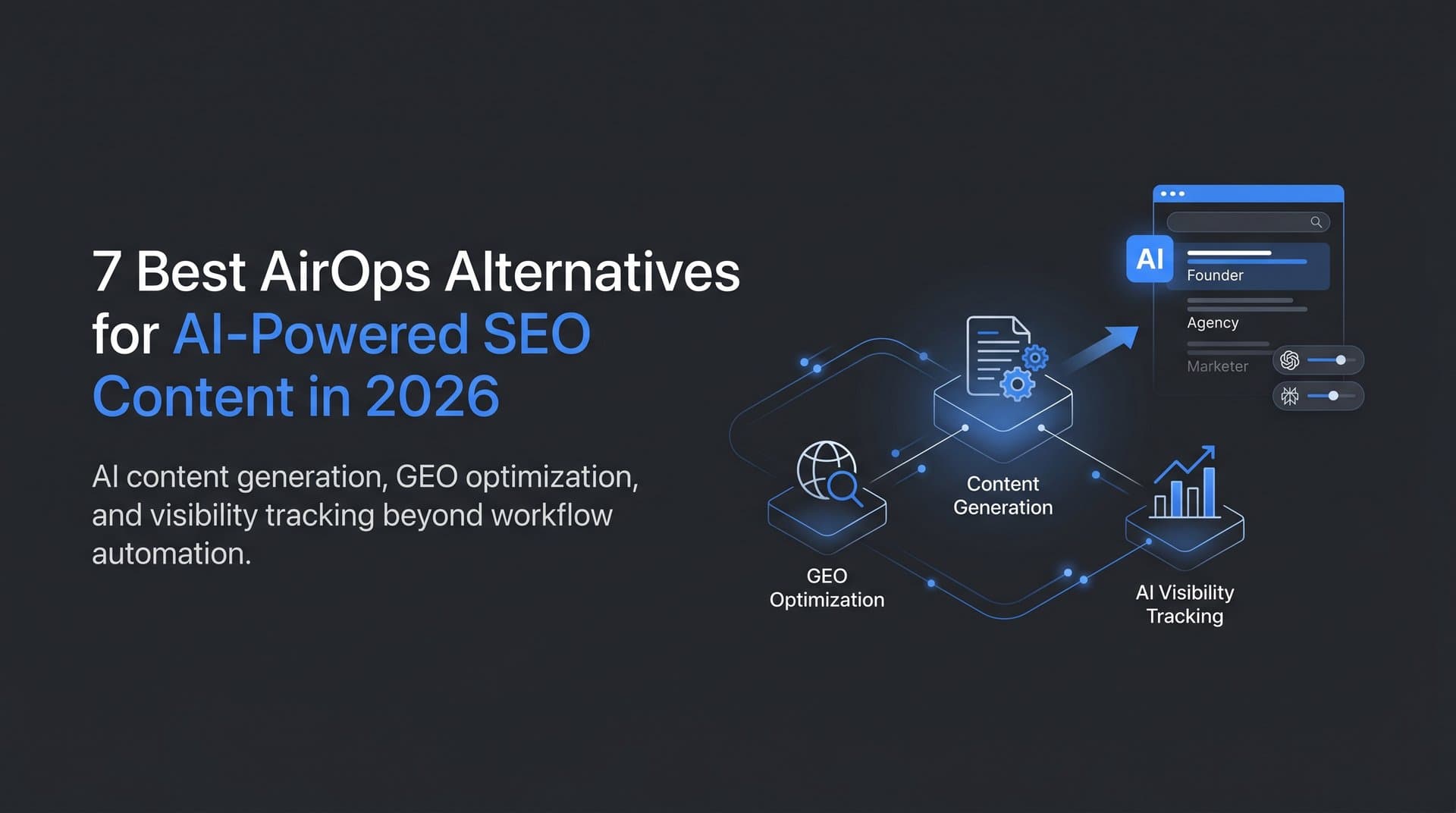
AirOps has built a solid reputation as an AI workflow platform for content operations, letting teams stitch together custom AI pipelines for various content tasks. But here's the reality many marketers are discovering in 2026: workflow automation alone isn't enough. You also need AI visibility tracking, GEO-optimized content generation, and fast indexing to compete in a search landscape where ChatGPT, Claude, and Perplexity are increasingly the first stop for information.
Whether you're a founder who wants a single platform to handle everything, an agency scaling content production across dozens of clients, or a marketer trying to understand how AI models talk about your brand, the right AirOps alternative can fundamentally change your results.
This guide covers seven of the strongest alternatives, each evaluated for a specific use case rather than a generic feature checklist. We'll look at what each platform does best, how to implement it in a real workflow, and who it's actually built for. By the end, you'll have a clear decision framework for choosing the tool that fits your content marketing stack — not just the one with the most impressive landing page.
Let's get into it.
1. Sight AI: The All-in-One Platform for AI Visibility and SEO/GEO Content
The Challenge It Solves
Most AirOps alternatives solve one part of the content problem: either they help you write faster, optimize for search, or track performance. But almost none of them address the emerging question that every marketer should be asking in 2026: how does your brand appear across AI search platforms like ChatGPT, Claude, and Perplexity? Sight AI is built specifically to close that gap, combining AI visibility tracking with content generation and automated indexing in a single platform.
The Strategy Explained
Sight AI operates across three interconnected layers. First, its AI visibility tracking monitors how your brand is mentioned across 6+ AI models, giving you an AI Visibility Score along with sentiment analysis and prompt tracking. This tells you not just whether you're appearing in AI responses, but how you're being described and in what context.
Second, its content generation engine uses 13+ specialized AI agents to produce SEO and GEO-optimized articles, including listicles, guides, and explainers, all structured to increase the likelihood of being cited by AI models. The Autopilot Mode handles content production at scale without requiring manual prompting for every piece.
Third, built-in IndexNow integration and automated sitemap updates ensure that new content gets discovered by search engines quickly, removing the lag between publishing and indexing that slows down organic traffic growth.
Implementation Steps
1. Set up AI visibility tracking by connecting your brand and key competitors, then review your AI Visibility Score to identify where you're appearing and where you're missing from AI-generated responses.
2. Use the prompt tracking feature to understand which queries trigger mentions of your brand versus competitors, then build a content calendar around closing those gaps.
3. Activate the AI content agents to generate GEO-optimized articles targeting your identified content gaps, then use Autopilot Mode to maintain consistent publishing velocity without manual intervention.
4. Let IndexNow integration handle automatic indexing notifications so your new content enters search engine indexes as quickly as possible after publishing.
Pro Tips
Pay close attention to the sentiment analysis in your AI visibility reports. Appearing in AI responses is good, but appearing with positive, accurate framing is what drives actual brand trust and click-through behavior. Use sentiment data to identify content that might be creating a negative or neutral impression, and prioritize updating those pages before creating net-new content.
2. Jasper: Enterprise Brand Voice at Scale
The Challenge It Solves
Large organizations with multiple content contributors often struggle to maintain a consistent brand voice across high volumes of output. When dozens of writers and marketers are producing content simultaneously, brand drift becomes a real operational problem. Jasper addresses this by building brand voice enforcement and style guide controls directly into the content creation workflow, making consistency a system feature rather than a manual review burden.
The Strategy Explained
Jasper's core strength is its Brand Voice feature, which allows teams to upload style guides, tone references, and approved terminology so that every piece of content generated reflects the same voice. Its team collaboration workflows make it straightforward to manage content production across large groups, with approval flows and role-based access built in.
For enterprise content teams running campaigns across multiple channels simultaneously, Jasper provides templates and workflows that standardize output without sacrificing flexibility. If you're exploring other options in this space, our guide to finding a Jasper AI alternative covers additional platforms worth considering.
Implementation Steps
1. Upload your brand style guide, tone of voice documentation, and approved terminology lists into Jasper's Brand Voice configuration to establish guardrails for all content generated on the platform.
2. Build out templates for your most frequently produced content types, including blog posts, email sequences, and ad copy, so contributors have a structured starting point that already reflects brand standards.
3. Set up team roles and approval workflows to create a review process that catches brand inconsistencies before content goes live.
Pro Tips
Jasper works best when your brand voice documentation is detailed and specific. Vague style guides produce vague guardrails. Invest time upfront in documenting not just tone but specific phrases to use, phrases to avoid, and examples of on-brand versus off-brand writing. The more precise your inputs, the more consistent your outputs.
3. Surfer SEO: Data-Driven On-Page Optimization
The Challenge It Solves
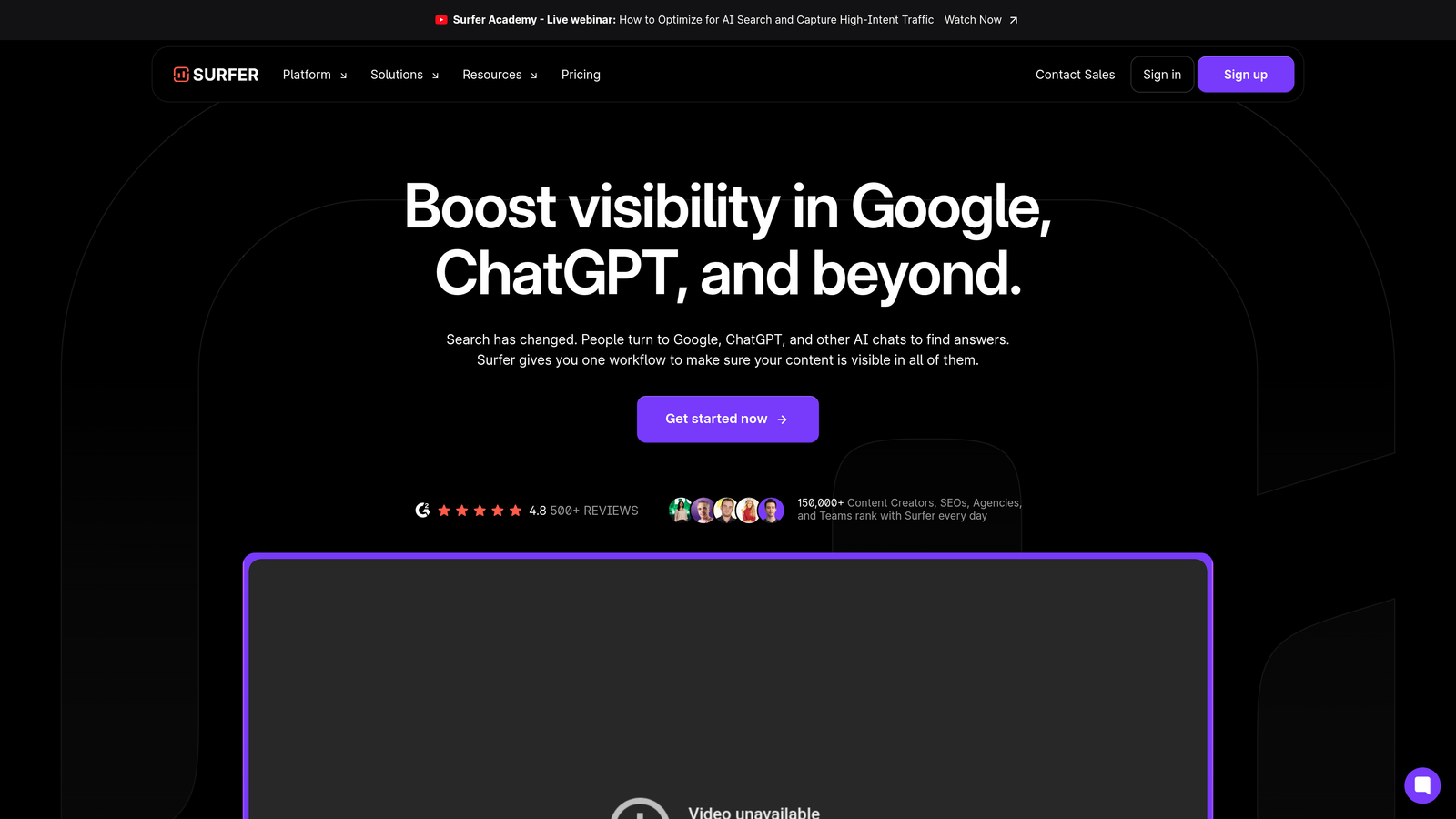
Creating content is only half the battle. Getting that content to rank requires understanding what search engines are rewarding in the current SERP landscape for your specific target keyword. Many teams write strong content that underperforms simply because it's not calibrated to what's already ranking. Surfer SEO solves this by analyzing top-ranking pages and providing real-time scoring and optimization guidance during the writing process.
The Strategy Explained
Surfer uses NLP analysis to compare your content against the pages currently ranking for your target keyword, scoring factors like keyword usage, content length, structure, and semantic coverage. Its Content Editor provides a live score that updates as you write, making it easier to identify gaps before publishing rather than after. For a deeper comparison of tools in this space, check out our breakdown of the best Surfer SEO alternative options.
The platform also includes a SERP Analyzer for deeper competitive research and a Content Audit feature for identifying existing pages that could rank higher with targeted optimization. For teams managing large content libraries, the audit capability is particularly valuable for finding quick wins without creating new content.
Implementation Steps
1. Run a SERP analysis for your target keyword to understand the competitive landscape, including average content length, heading structure, and semantic keyword patterns among top-ranking pages.
2. Open the Content Editor and use the real-time score to guide your writing, focusing first on the highest-impact recommendations around keyword coverage and content structure.
3. After publishing, use the Content Audit feature to identify existing pages with ranking potential that haven't been optimized, and prioritize those for updates before creating new content.
Pro Tips
Don't treat Surfer's content score as a target to hit at any cost. Stuffing keywords to inflate your score can make content feel mechanical and harm user experience. Use the score as a directional guide, not a rigid requirement. Focus on the semantic coverage recommendations, which tend to improve content quality alongside SEO performance.
4. Copy.ai: GTM Workflow Automation for Growth Teams
The Challenge It Solves
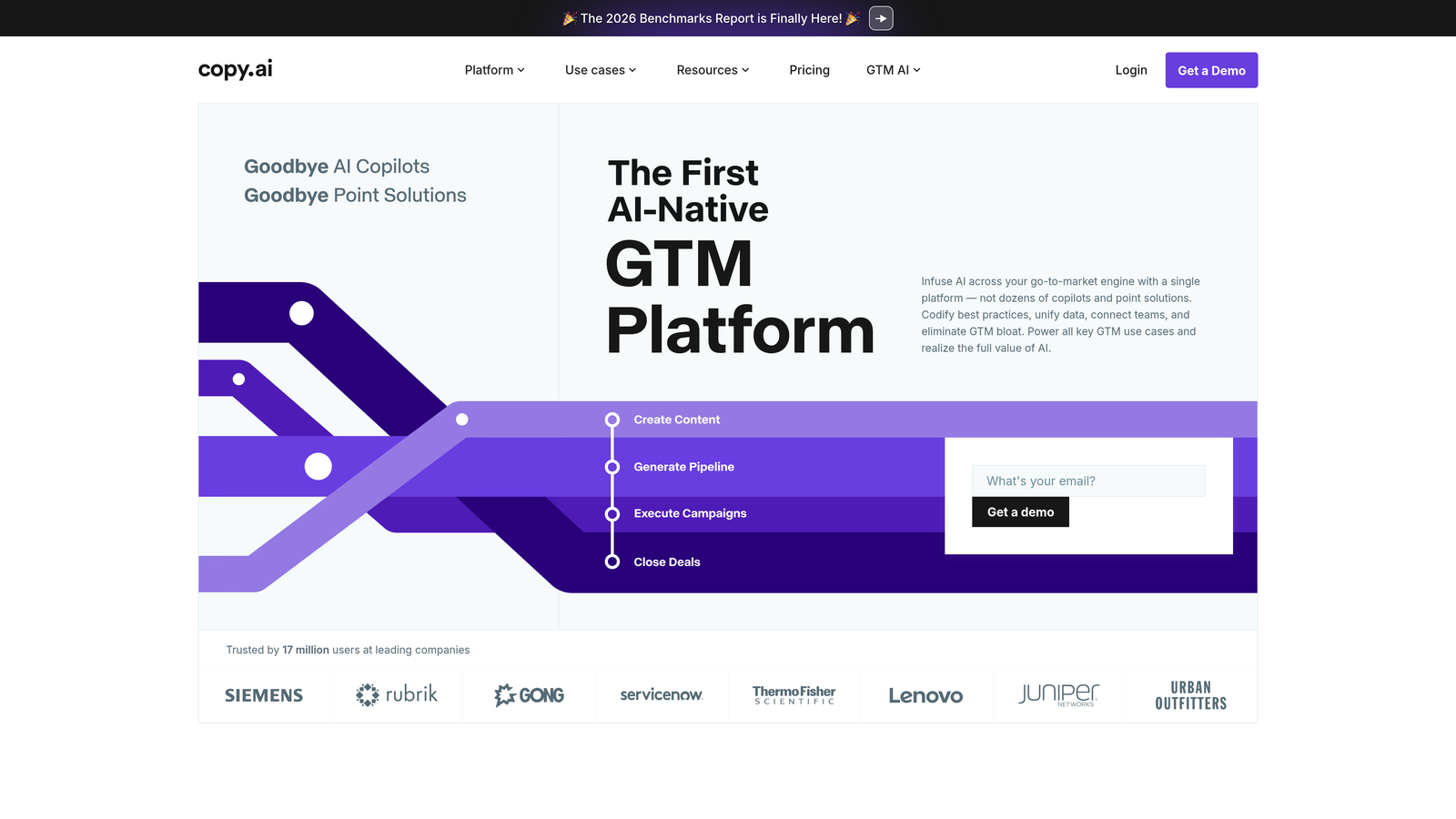
Growth and GTM teams need high-volume copy across multiple channels simultaneously: ads, emails, landing pages, social posts, outreach sequences. Managing that volume manually creates bottlenecks that slow down campaign execution. Copy.ai addresses this with workflow automation designed specifically for go-to-market use cases, allowing teams to generate and iterate on multi-channel copy at a pace that manual writing simply can't match.
The Strategy Explained
Copy.ai has evolved beyond a simple AI writing tool into a GTM workflow platform. Its Workflows feature allows teams to build automated content pipelines that pull in inputs like product data, audience segments, or campaign briefs and output ready-to-use copy across multiple formats simultaneously.
For growth teams running paid and organic campaigns in parallel, this means you can generate ad variants, email sequences, and social content from a single brief without switching between tools. We've also written a detailed guide on finding the right Copy AI alternative if you want to compare additional platforms in this category.
Implementation Steps
1. Map your most repetitive content production tasks, such as generating ad variants for A/B testing or writing product description updates, and identify which ones are best suited for workflow automation.
2. Build a Copy.ai Workflow for each high-volume task, defining the inputs your team will provide and the output formats you need, then test the workflow with a small batch before scaling.
3. Create a review and approval step within your workflow so that automated output is always checked by a human before going live, maintaining quality control without adding significant time to the process.
Pro Tips
Copy.ai's real value compounds when you treat it as a workflow tool rather than a one-off writing assistant. Invest time in building well-structured workflows upfront, and the time savings on each subsequent campaign run will significantly outweigh the initial setup effort.
5. Frase: Research-First Content Strategy
The Challenge It Solves
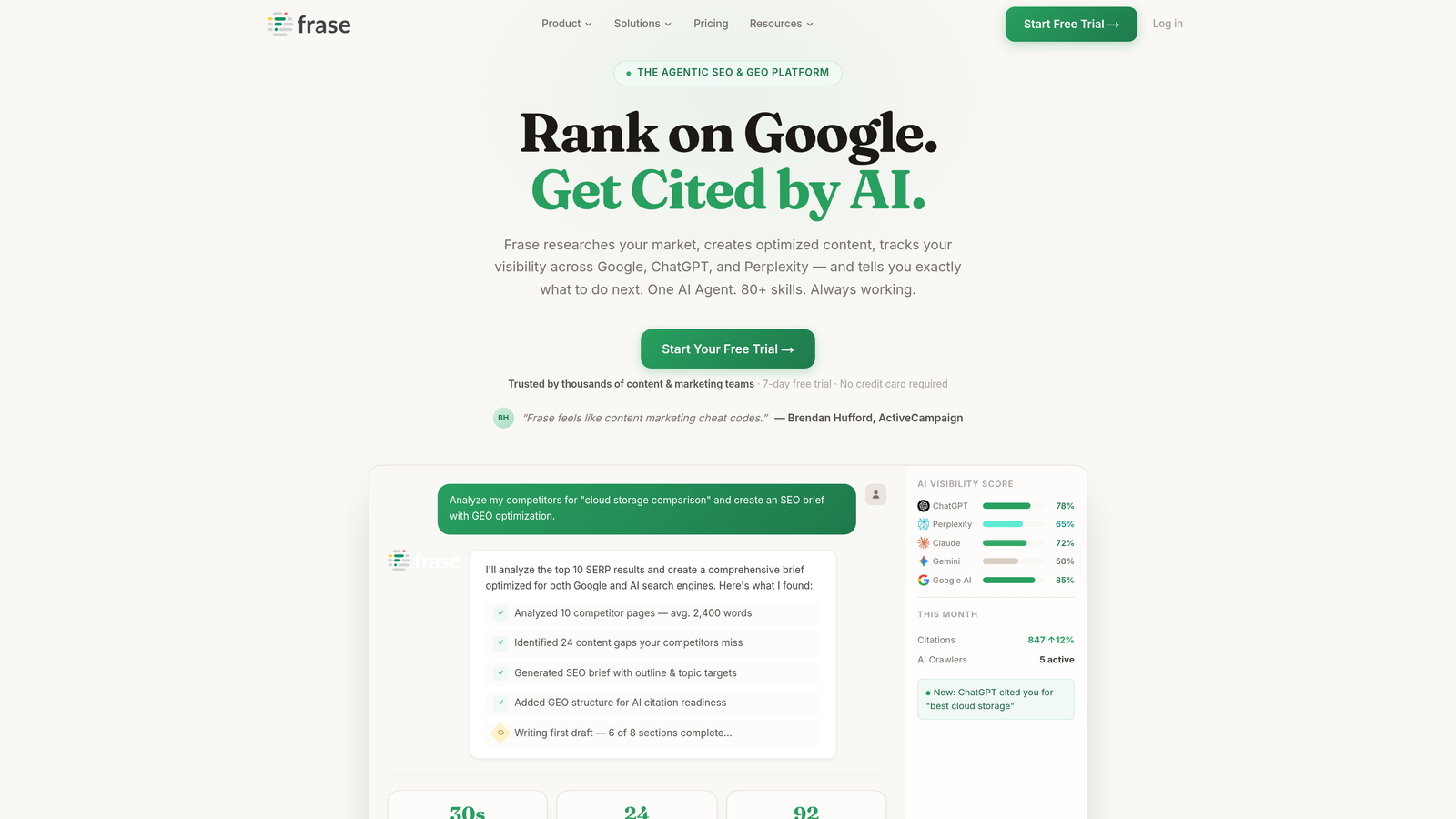
Content that doesn't start with solid research tends to miss what users actually want to know. Many AI writing tools jump straight to generation without grounding content in real SERP data or audience questions. Frase takes the opposite approach, making research the foundation of every piece of content with SERP-based brief generation, question research, and real-time scoring built into a structured workflow.
The Strategy Explained
Frase analyzes the top search results for your target keyword and automatically generates a content brief that includes key topics, questions users are asking, and structural recommendations based on what's already ranking. For a broader look at tools in this space, our Frase alternative guide covers several comparable platforms.
Its real-time content scoring updates as you write, showing how well your content covers the topics and questions that matter for your target keyword. For content strategists managing multiple writers, Frase's brief generation capability standardizes the research process and ensures every piece starts from the same quality foundation.
Implementation Steps
1. Enter your target keyword into Frase to generate an automated content brief, then review the SERP analysis to understand what topics and questions the top-ranking pages are addressing.
2. Customize the brief to reflect your specific angle and audience, adding or removing sections based on your content strategy before handing it off to a writer or using Frase's AI to generate a draft.
3. Use the real-time content score during the writing and editing process to ensure comprehensive topic coverage, then review the final piece against the original brief before publishing.
Pro Tips
Frase's question research feature is particularly valuable for finding content angles that competitors haven't fully addressed. Look for questions that appear frequently in search results but aren't well-answered by existing top-ranking pages. Those gaps represent opportunities to create content that genuinely outperforms the current SERP.
6. Writer: Governance-First AI for Regulated Industries
The Challenge It Solves
In regulated industries like healthcare, finance, and legal services, content accuracy and compliance aren't optional. Using a general-purpose AI writing tool in these environments creates real risk if the output contains inaccurate claims, unapproved terminology, or content that doesn't meet regulatory standards. Writer is built specifically for organizations where governance, compliance, and terminology control are non-negotiable requirements.

The Strategy Explained
Writer's platform includes compliance guardrails that flag content violating predefined rules, a Knowledge Graph that grounds AI output in your organization's verified information, and terminology enforcement that ensures approved language is used consistently across all content.
For enterprise teams in regulated sectors, this means AI-assisted content production doesn't require sacrificing oversight. Writers and editors can work faster with AI assistance while the platform's guardrails catch issues that would otherwise require manual review. Learning how to optimize content for SEO while maintaining compliance is a balancing act that Writer helps manage effectively.
Implementation Steps
1. Build out your compliance ruleset within Writer, including prohibited claims, required disclosures, and terminology standards specific to your industry and regulatory environment.
2. Populate the Knowledge Graph with verified, approved information sources from your organization so that AI-generated content is grounded in accurate, sanctioned information rather than general AI knowledge.
3. Run a pilot with a small content team, using Writer's flagging system to identify where compliance issues arise most frequently, then refine your ruleset based on real usage patterns before rolling out more broadly.
Pro Tips
Writer's value in regulated industries is proportional to the quality of your compliance ruleset and Knowledge Graph. Treat the initial setup as a strategic investment. Involve your legal and compliance teams in building the rules so that the platform reflects your actual regulatory requirements rather than a generalized interpretation of them.
7. MarketMuse: Building Long-Term Topical Authority
The Challenge It Solves
Ranking for individual keywords is one challenge. Building the kind of topical authority that causes search engines to treat your domain as a trusted source across an entire subject area is a fundamentally different, longer-term challenge. Many content teams publish without a coherent topical strategy, creating coverage gaps that limit their ability to rank for competitive terms. MarketMuse addresses this by mapping content coverage across your entire domain and identifying exactly where those gaps exist.
The Strategy Explained
MarketMuse analyzes your domain's existing content coverage against the full topic landscape for your subject area, then provides personalized difficulty scores that reflect your specific domain's authority rather than generic keyword difficulty metrics. This means a keyword that's highly competitive for a new site might be very achievable for a domain with strong existing coverage in that topic cluster.
Its content gap analysis identifies which subtopics you're missing, which pages need to be strengthened, and which new content would have the highest strategic impact given your current authority profile. For teams focused on how to increase organic traffic through long-term strategy, this shifts content planning from intuition-based to data-driven.
Implementation Steps
1. Run a domain analysis in MarketMuse to get a full picture of your current topical coverage, identifying which topic clusters you have strong authority in and which have significant gaps.
2. Use the personalized difficulty scores to prioritize your content roadmap, focusing first on topics where your existing authority gives you a realistic path to ranking before tackling more competitive territory.
3. Build a content cluster plan based on the gap analysis, mapping out which hub pages and supporting content pieces you need to create to establish comprehensive coverage in your target topic areas. Strengthening your site's automated internal links between these cluster pages amplifies the authority signals MarketMuse helps you build.
Pro Tips
MarketMuse is most powerful when used at the planning stage rather than the execution stage. Use it to build your quarterly content roadmap before you start writing, not as a tool to retroactively evaluate content you've already created. The earlier you integrate topical authority planning into your workflow, the more compounding benefit you'll see over time.
Choosing the Right AirOps Alternative for Your Stack
Each of these platforms solves a distinct problem, and the right choice depends entirely on where your biggest content challenge actually lives.
If you need AI visibility tracking plus SEO/GEO content generation and automated indexing: Sight AI is the only platform in this list that covers all three in one place, making it the strongest choice for teams that want to compete in both traditional and AI search simultaneously.
If brand consistency across a large team is your primary concern: Jasper's brand voice controls and collaboration workflows make it the natural fit for enterprise content operations.
If you need to optimize existing content for higher rankings: Surfer SEO's data-driven scoring and SERP analysis give you the most precise on-page guidance available.
If you're running high-volume GTM campaigns across multiple channels: Copy.ai's workflow automation is purpose-built for that use case.
If research-backed content briefs are your bottleneck: Frase's SERP-based brief generation and question research solve that problem directly.
If you operate in a regulated industry where compliance is non-negotiable: Writer's governance features and Knowledge Graph integration make it the only safe choice.
If you're building long-term topical authority across your domain: MarketMuse's gap analysis and personalized difficulty scoring give you the strategic foundation you need.
In 2026, the differentiator that most teams are underestimating is AI visibility. Traditional SEO tools tell you how you rank in Google. They don't tell you how ChatGPT, Claude, or Perplexity describe your brand when users ask relevant questions. That's the visibility gap that's quietly costing brands organic reach as AI search continues to grow.
Start tracking your AI visibility today and see exactly where your brand appears across top AI platforms. Stop guessing how AI models talk about your brand and start using that data to drive your content strategy, close visibility gaps, and build the kind of presence that earns mentions in both traditional and AI search results.