Most people type a query into Google, hit enter, and never glance at what appears in the browser bar. But that URL is doing a lot of work. It's not just an address: it's a structured data string that tells Google exactly what to show, in what language, for which country, and in what format. Every parameter in that URL is a signal.
For marketers, founders, and agencies, understanding the Google search engine URL isn't a nerdy curiosity. It's a practical skill. It affects how accurately you track keyword rankings, how confidently you audit international SEO performance, and how clearly you understand what your competitors see when they search for your category. Get it wrong, and your data is quietly misleading you.
This article breaks down the full anatomy of a Google search URL, explains how localization and personalization shape results, and connects these fundamentals to modern challenges like AI Overviews and generative search visibility. Whether you're running rank tracking workflows, auditing a multilingual site, or trying to understand how your brand appears across search surfaces, this is the foundation you need.
Anatomy of a Google Search URL: Breaking Down Every Component
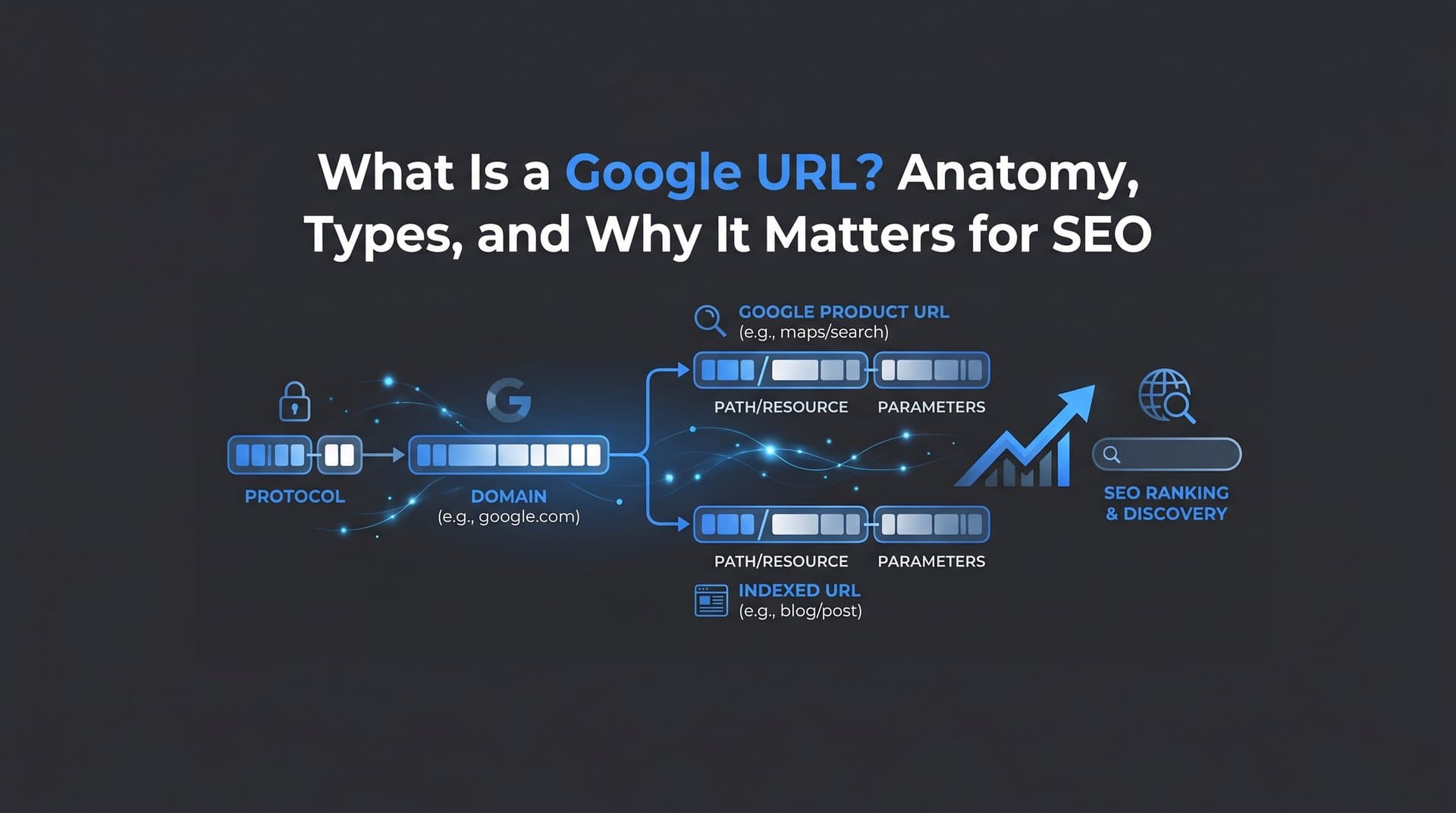
Every Google search starts with the same base: https://www.google.com/search. That's the endpoint. Everything after the question mark is the query string, a series of parameters that define the context and nature of the search. Understanding each component helps you read these URLs like a map.
Here's what a typical search URL looks like in practice:
https://www.google.com/search?q=seo+tools&hl=en&gl=us&num=10
Let's break down the key parameters one by one.
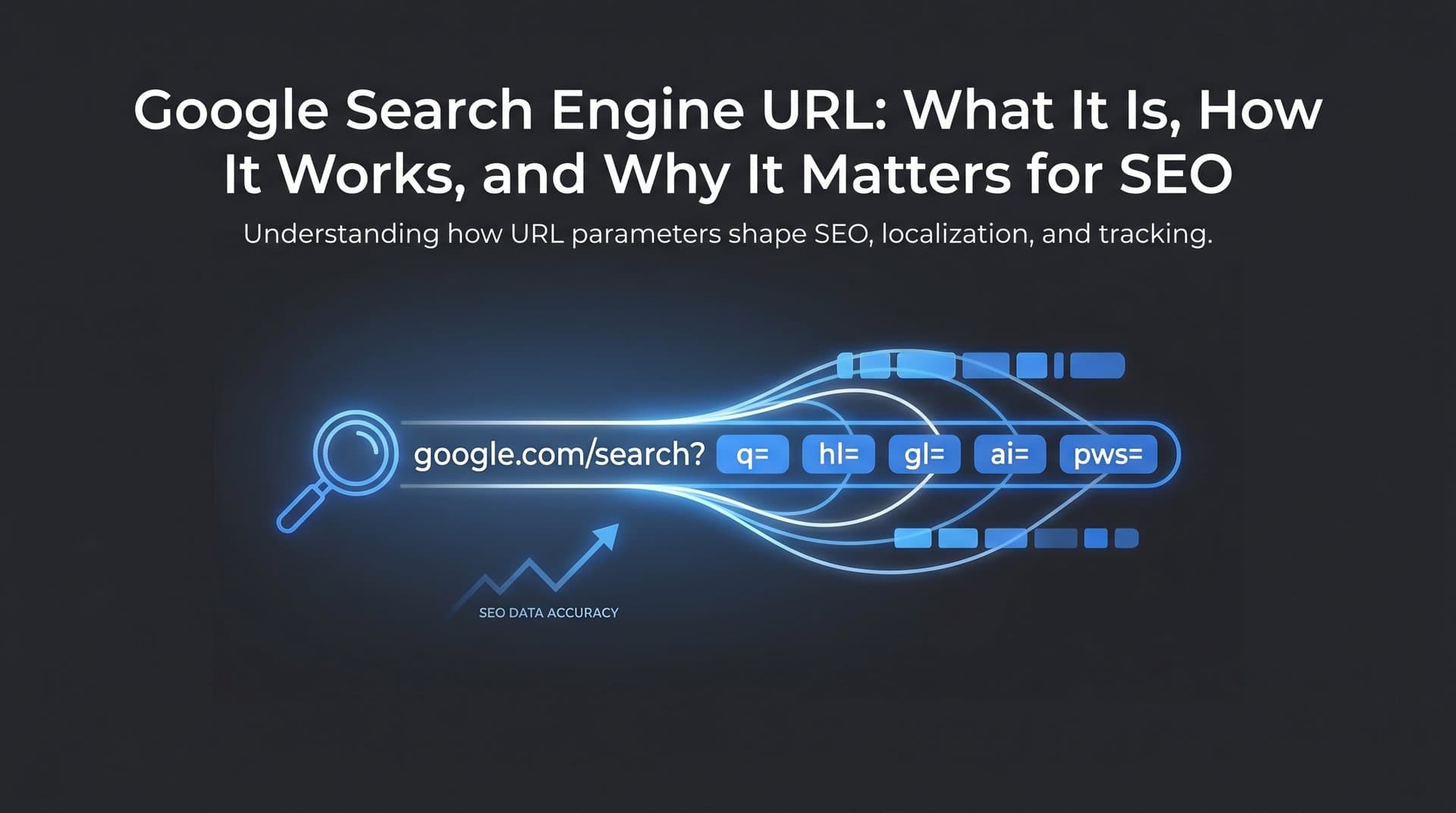
q= (Query): This is the search term itself. Spaces are replaced with plus signs or encoded as %20. Everything you type into the search box lives here. It's the most essential parameter in the string.
hl= (Host Language): This defines the language of Google's interface, not necessarily the language of the results. Setting hl=en forces the interface labels, buttons, and navigation to appear in English. This matters when you're testing how results appear for English-speaking users regardless of their physical location.
gl= (Geolocation): This is arguably the most important parameter for SEO professionals. It tells Google which country's search results to return. Setting gl=de returns results as if the searcher is in Germany. Combined with hl=, you can simulate a specific user profile: a French speaker browsing from Canada, for example, would be gl=ca&hl=fr.
num= (Number of Results): By default, Google returns ten results per page. Setting num=20 doubles that. This is useful for scraping or auditing SERPs without paginating through multiple pages.
start= (Pagination Offset): This controls which result position to start from. start=10 gives you results 11 through 20, effectively page two. Rank tracking tools use this to navigate through pages programmatically.
tbm= (Type of Search / Tab): This switches between Google's verticals. tbm=isch returns image results, tbm=nws pulls news, tbm=vid shows videos, and tbm=shop opens the shopping tab. If you're auditing visibility beyond the standard web SERP, this parameter is essential.
tbs= (Time-Based and Custom Filters): This parameter handles a range of filters. For time-based filtering: tbs=qdr:d limits results to the past day, qdr:w for the past week, and qdr:m for the past month. This is particularly useful for content gap analysis and monitoring fresh content in competitive niches.
pws= (Personalized Web Search): Setting pws=0 was historically used to disable personalized results. Google has adjusted how personalization works over the years, and this parameter alone no longer fully depersonalizes results. But it remains part of many SEO workflows as a starting point for cleaner SERP checks.
When these parameters combine, they create a precise search context. A URL like ?q=best+crm+software&gl=gb&hl=en&num=10&tbs=qdr:m is asking Google to show the top ten UK results for "best CRM software" published in the last month, in English. That level of specificity is exactly what separates rigorous SEO auditing from guesswork, and it's why understanding search intent in SEO starts with reading the URL itself.
Country Domains, Localization, and How Google Personalizes Results
Google operates country-code top-level domains (ccTLDs) like google.co.uk, google.de, google.com.br, and google.fr. For years, visiting these domains was the standard way to see localized results. The assumption was simple: go to google.fr, see French results. But Google shifted that model significantly starting around 2017.
Google announced that it would unify search results through geolocation rather than domain. This means that today, google.com can serve fully localized results based on where the user is physically located, without requiring them to visit a country-specific domain. The ccTLDs still exist and still function, but they no longer carry the same weight they once did as the primary localization mechanism.
For marketers, this creates an important practical implication: you can't assume that visiting google.co.uk from a US IP address will show you what a UK user actually sees. Google reads your IP address, browser settings, and search history to determine what results to serve. The domain is just one signal among many.
This is exactly where the gl= and hl= parameters become critical tools. By constructing a search URL with gl=gb and hl=en, you're explicitly instructing Google to return results for Great Britain in English, regardless of your physical location or the domain you're using. For agencies running international SEO audits, this is the most reliable way to approximate localized results without physically being in that country or using a VPN.
That said, it's worth being clear about the limits. URL parameters help approximate localized results, but they don't perfectly replicate the experience of a local user with local browsing history and local device settings. For truly accurate localization testing, dedicated rank tracking tools that use proxy infrastructure in target countries provide more reliable data. A robust search engine visibility tool can automate this process across dozens of markets simultaneously.
The implications for international SEO strategy are substantial. If you're optimizing content for multiple markets, understanding how the gl= parameter works helps you audit whether your pages are actually appearing in the right regional results. It helps you identify whether your hreflang tags are functioning correctly, whether your content is being indexed for the right locale, and whether competitors are outranking you in specific geographies you care about.
Country-specific domains also carry a subtle trust signal in some markets. Users in Germany may be more likely to click a result served through google.de because it feels locally relevant. This behavioral dynamic doesn't change the underlying URL mechanics, but it's worth factoring into your broader international strategy alongside the technical parameters.
Why Marketers Need to Understand Google Search URLs
Here's a common scenario: a marketer checks their ranking for a target keyword, sees their site in position three, and reports that to their client. But the result they saw was personalized to their browsing history, their location, and their device. The actual average ranking for that keyword, for a neutral user in the target market, might be position seven. That's a meaningful difference built on a misread URL.
Understanding Google search URLs helps you avoid that trap. The first practical application is constructing depersonalized search URLs for manual rank checks. By appending &pws=0 to your query string and using the appropriate gl= and hl= parameters, you get closer to a neutral view of the SERP. Combine this with a private browsing window to reduce cookie-based personalization, and you have a reasonably clean baseline. For a deeper dive into this workflow, see our guide on how to check your position in Google search.
The important caveat: URL parameters alone don't fully eliminate personalization. Google's personalization engine draws from many signals beyond cookies and search history, including IP geolocation and device type. For reliable, scalable rank tracking, dedicated tools that use distributed proxy networks across multiple locations provide the most accurate data. But understanding the URL structure helps you evaluate what those tools are doing and interpret their results intelligently.
Beyond rank tracking, Google search URL parameters are fundamental to SEO audit workflows. When you're conducting competitor SEO research, being able to construct a precise search URL means you can replicate the exact search context your target audience is experiencing. You can check how a competitor's site appears in image results using tbm=isch, monitor their presence in news results with tbm=nws, or audit their content freshness by filtering to the past month with tbs=qdr:m.
URL parameters also support content gap analysis. By constructing search URLs with specific time filters and query variations, you can identify what content is ranking for your target keywords right now, what's trending recently, and where your content library has gaps relative to what's currently appearing in SERPs.
For campaign tracking, understanding the difference between organic search URLs and paid search URLs matters for attribution. Paid clicks typically include UTM parameters or Google Ads click identifiers (gclid=) in the URL. Organic clicks don't. Knowing how to read these patterns helps you accurately attribute traffic sources in your analytics platform and avoid misclassifying paid traffic as organic or vice versa.
The broader point is this: search URL literacy is a prerequisite for data accuracy. Every rank tracking tool, every SEO audit platform, and every competitive intelligence product is built on top of these URL structures. Understanding them makes you a more informed consumer of that data and a more effective practitioner of the discipline.
Google Search URLs in the Age of AI Overviews and Generative Search
The SERP has changed dramatically. AI Overviews, which Google rolled out broadly through 2024 and 2025, now appear at the top of many search results pages, synthesizing information from multiple sources into a generated summary before any traditional blue links appear. The visual experience of search has shifted, but here's what hasn't: the underlying URL structure that triggers a Google search remains exactly the same.
When a user searches for a query that triggers an AI Overview, the URL in their browser bar still follows the standard google.com/search?q= format with the same parameters. The difference is in what Google renders at the top of the page. For marketers, this means that the URL-based workflows you use for rank tracking and SERP auditing are still valid. What's changed is what you're tracking and what "visibility" means.
Being cited in an AI Overview is now a distinct form of search visibility, separate from appearing in position one of the traditional organic results. A page can rank in position three and still be pulled into an AI Overview summary. Conversely, a page can appear in the standard results but never be cited in the AI-generated section. These are different types of presence, and they require different tracking approaches. Understanding the AI search engine ranking factors that drive citation selection is essential for this new landscape.
This is where the concept of Generative Engine Optimization (GEO) enters the picture. GEO refers to the practice of optimizing content specifically to be cited and referenced by AI-powered search systems, whether that's Google's AI Overviews, ChatGPT with web browsing, Perplexity, or Claude. The mechanics differ from traditional SEO because these systems don't always use a URL-based SERP. They generate responses that may include citations, but the ranking logic is different from Google's PageRank-influenced algorithm.
For brands, this creates a new visibility challenge. Your Google search engine URL performance tells you one part of the story: how you appear in traditional and AI Overview-enhanced SERPs. But it doesn't tell you how ChatGPT describes your product when someone asks for a recommendation, or whether Perplexity cites your blog post when answering a question in your category. That requires a different kind of tracking entirely, and our AI search engine optimization guide covers those strategies in depth.
Understanding search URL mechanics is foundational to both traditional SEO and GEO because it anchors your understanding of how structured information retrieval works. The parameters, the query strings, the localization signals: these are the building blocks of how search systems interpret intent. As AI search evolves, that foundation doesn't become irrelevant. It becomes the baseline from which everything more complex is built.
Practical Tips: Using Google Search URLs for SEO Workflows
Let's get concrete. Here are actionable ways to use Google search URL parameters in your day-to-day SEO work.
Building a Depersonalized Rank Check URL: To check how a keyword ranks for a neutral UK user searching in English, construct this URL: https://www.google.com/search?q=your+keyword+here&gl=gb&hl=en&num=10&pws=0. Open it in a private browsing window. This gives you a reasonable approximation of the SERP without your personal search history influencing results. Swap gl=gb for gl=us, gl=de, gl=au, or any other country code to check different markets.
Filtering by Time Period for Content Gap Analysis: To see what content has been published and indexed in the past month for a target keyword, use: ?q=your+keyword&tbs=qdr:m. Switch to qdr:w for the past week or qdr:d for the past day. This is particularly valuable for identifying trending topics, monitoring competitor publishing activity, and finding gaps where fresh content could rank quickly.
Checking Vertical Search Presence: To audit whether your images are appearing in Google Image search for relevant queries, use tbm=isch. For news visibility, use tbm=nws. For video presence, use tbm=vid. These vertical checks are often overlooked in standard SEO audits but can reveal significant traffic opportunities, especially for e-commerce sites and publishers. If you're struggling with visibility overall, learning how to improve search engine rankings provides a broader framework for diagnosing issues.
Common Mistake: Trusting Personalized Results: One of the most frequent errors in manual rank checking is forgetting that Google personalizes results heavily. Even in a private window, your IP geolocation still influences results. If you're in New York checking rankings for a keyword you're targeting in London, the results you see are not what London users see. Always use the gl= parameter to specify your target market explicitly.
Common Mistake: Ignoring Device-Specific Differences: Google serves different results for mobile and desktop queries. A desktop search URL doesn't tell you how your site ranks on mobile, and mobile-first indexing means mobile rankings are often the more important signal. Dedicated rank tracking tools account for this by running queries through mobile user agents. Be aware that manual URL-based checks default to desktop unless you're using browser developer tools to simulate a mobile device.
Common Mistake: Overlooking Pagination in Audits: When auditing SERP features or competitor presence, don't stop at page one. Using the start= parameter to navigate to start=10, start=20, and beyond gives you a fuller picture of where content is ranking and what SERP features appear across multiple pages. Many rank tracking workflows only capture page one data, which misses the broader competitive landscape.
From Search URLs to Search Visibility: Building a Complete Strategy
Understanding the Google search engine URL is where strategy starts, not where it ends. Knowing how to construct and interpret these URLs gives you better data. But data without action is just observation. A complete search visibility strategy requires connecting URL mechanics to the full content and indexing pipeline.
The first connection is indexing. Your pages can only appear in the results that these URLs point to if Google has crawled and indexed them. Submitting an accurate XML sitemap through Google Search Console, ensuring your robots.txt isn't blocking important pages, and using tools that support IndexNow for faster indexing notification are all foundational steps. If your content isn't indexed, no amount of URL parameter expertise will surface it in SERPs. For a complete walkthrough, our article on how to get indexed by search engines faster covers the full process.
The second connection is content optimization. Understanding what parameters users and tools use to trigger specific searches helps you align your content with the intent those parameters encode. A query with tbs=qdr:m favoring fresh content means that publishing cadence and content freshness matter for that keyword. A query using tbm=nws means structured, newsworthy content with proper markup is what competes in that vertical.
The third connection is the one that's newest and fastest-growing: AI visibility. Traditional search URL analysis tells you how you appear in Google's SERP. But as AI platforms like ChatGPT, Perplexity, and Claude become significant discovery channels, your brand's visibility in conversational AI responses is a separate dimension of search presence that requires dedicated tracking. Understanding how AI search engines work helps you bridge the gap between traditional URL-based analysis and this emerging channel.
Modern platforms that combine SEO fundamentals with AI visibility tracking give marketers a unified view of where their brand appears across both traditional SERPs and AI-generated responses. This includes monitoring which AI models mention your brand, how they describe your products, and whether those mentions are accurate and positive. It also includes identifying content opportunities where your brand could be referenced but currently isn't.
The brands that will lead in search visibility over the next few years are those that treat traditional SEO mechanics and AI visibility as complementary disciplines, not separate silos. Understanding Google search URLs is the technical foundation. Building content that earns citations across both traditional and AI search surfaces is the strategic goal.
The Bottom Line
A Google search URL is a deceptively simple-looking string. To most users, it's invisible noise in the browser bar. To a skilled marketer or SEO practitioner, it's a precise specification of search context: the query, the language, the country, the vertical, the time filter, and more. Reading and constructing these URLs accurately is a practical skill that directly improves your rank tracking data, your international SEO audits, and your competitive analysis workflows.
The fundamentals haven't changed with the rise of AI Overviews. The URL structure that triggers a Google search is the same as it's always been. What has changed is the definition of search visibility itself. Appearing in position one is no longer the only form of presence that matters. Being cited in an AI Overview, referenced by ChatGPT, or surfaced by Perplexity are all forms of search visibility that sit alongside traditional SERP rankings.
The marketers and founders who will stay ahead are those who understand both layers: the technical mechanics of how Google search URLs work, and the broader landscape of where their brand appears when people ask AI systems for recommendations. Stop guessing how AI models like ChatGPT and Claude talk about your brand. Start tracking your AI visibility today and see exactly where your brand appears across top AI platforms, alongside the traditional SERP presence you've been optimizing for all along.