
Competitor SEO research is the art of reverse-engineering your rivals' search engine optimization strategies to figure out what makes them tick. Think of it as strategic intel for your own SEO campaigns—a way to see what's already winning in your niche so you can build a roadmap for your own growth.
Why Competitor SEO Research Is Your Secret Weapon

Before we get into the how, let's talk about why this is such a game-changer. This whole process yanks you out of the world of guesswork and plants you firmly in data-backed strategies that have a proven track record.
The goal isn't to just copy what your rivals are doing. It's about deconstructing their success to build a smarter, more effective plan for yourself. By digging into what your competitors are up to, you can unlock some serious wins for your own bottom line.
To truly understand a competitor's SEO playbook, you need to look at a few key areas. This quick breakdown shows you what to investigate.
Key Areas of Competitor SEO Research
| Analysis Area | What You Discover | Metric to Watch |
|---|---|---|
| Keyword Strategy | The exact terms they rank for and drive traffic from. | Organic Keywords |
| Top Content | Their highest-performing pages and content formats. | Estimated Traffic |
| Backlink Profile | Who links to them and the authority of those links. | Referring Domains |
| Content Gaps | Topics they aren't covering that you can own. | Keyword Overlap |
| Technical SEO | Site speed, mobile-friendliness, and site structure. | Core Web Vitals |
Each of these pieces gives you a clue, and when you put them all together, you get a clear picture of their entire strategy.
Pinpoint Proven Traffic-Driving Tactics
The most immediate payoff here is seeing exactly which keywords and content pieces are sending the most organic traffic to your competitors. You can pinpoint their top-performing blog posts, landing pages, and product pages.
This insight lets you create better content targeting the same high-value search terms, effectively getting in front of their audience.
This analysis shows you:
- High-value content topics you might have completely missed.
- The specific user intent behind their successful keywords (are people looking to learn, buy, or compare?).
- Formats that resonate with your shared audience, like in-depth guides, case studies, or comparison articles.
Uncover Exploitable Weaknesses and Gaps
Let's be real: no SEO strategy is perfect. Your competitor might be crushing it for a handful of keywords but have massive content gaps in other areas. A proper analysis helps you find these underserved topics where you can swoop in, establish authority, and capture traffic before they even notice.
Competitor research is your chance to find the questions your rivals aren't answering. By filling these content gaps, you become the go-to resource in your niche, building trust and authority that search engines reward.
You might also discover that their backlink profile looks strong on the surface but lacks diversity, or maybe their on-page SEO has some glaring technical flaws. These are the weaknesses you can turn into your strengths.
Accelerate Your SEO Growth
At the end of the day, understanding the competitive landscape gives you a blueprint for success. Organic search is still one of the most important channels out there, and the fight for the top spots is fierce.
Consider this: the #1 position in Google's search results grabs a massive 39.8% click-through rate. That number plummets to just 18.7% for the second position. Effective competitor SEO research helps you figure out what it takes to climb those rankings faster.
You can discover more insights about crucial SEO statistics and see just how much of an impact even small ranking changes can make.
Finding Your Real SEO Competitors
One of the first places SEO strategies go wrong is focusing on the wrong enemy. It's a classic mistake: assuming your biggest business rivals are automatically your top search competitors. This single misstep can send your entire plan sideways, leaving you chasing the wrong domains and missing massive opportunities.
The truth is, the company that keeps your sales team up at night might be a ghost in the search results. Your real competition is often someone you've never even heard of.
Direct Business Rivals vs. SERP Competitors
Let's break this down. There are two types of competitors you need to care about, and they are rarely the same.
A direct competitor sells a similar product or service. If you sell project management software, other companies selling project management software are your direct competition. Simple enough.
A SERP competitor, on the other hand, is any website that ranks for the keywords you want to own. This could be an industry blog, a review site, a news publication, or even a savvy affiliate marketer. They might not sell a thing, but they're fighting for the exact same audience attention in the search results.
Think about it like this: if you run a B2B SaaS company selling accounting software for small businesses, your direct competitors are obvious. But when you Google "best accounting software for freelancers," who actually shows up? It's probably:
- A high-authority tech blog with a massive, in-depth comparison post.
- A major financial news site that published a roundup of essential business tools.
- A popular YouTuber whose video review is embedded on a page that ranks on the first page.
These sites don't sell accounting software, but they absolutely dominate the top positions for a high-intent keyword your ideal customer is typing into Google. If you ignore them, you’re fighting the wrong battle entirely. Analyzing what they're doing right tells you exactly what content formats and authority signals Google wants to see for that query.
Your goal isn't just to find who sells what you sell. It's to identify who owns the digital real estate you want to occupy. Your true SEO rivals are those who consistently appear for your most valuable organic search keywords.
Getting this distinction right is the critical first step. To really nail this, you need a solid grasp on which keywords are truly valuable for your business. You can learn more about how to identify valuable organic search keywords in our comprehensive guide, which is essential before building out your competitor list.
Building Your List of SEO Competitors
So, how do you find these elusive SERP competitors? Simple: you let the data do the talking.
Instead of guessing from your C-suite's list of business rivals, fire up an SEO tool like Ahrefs, Semrush, or Moz. These platforms will show you who is actually ranking.
Start by brainstorming a core list of 10-15 "seed" keywords. These should be the high-level, foundational terms that represent what you do. For that accounting software company, the list might look like this:
- "small business accounting software"
- "invoice tracking app"
- "freelance bookkeeping tools"
Plug these keywords into your tool of choice and look at the domains that consistently rank in the top 10. Don't just check one keyword and call it a day; you need to analyze the results across your entire list. Pretty soon, you'll see a clear pattern emerge as a handful of the same domains show up again and again.
Your goal here is to create a focused list of 5-10 primary SEO competitors. These are the sites that have a significant keyword overlap with your goals and prove they know how to rank for the terms that drive your business. This curated list becomes the foundation for everything else you'll do in your analysis.
Assembling Your Competitor Analysis Toolkit
Doing effective competitor SEO research without the right tools is like trying to be a detective without a magnifying glass. You might have a sharp strategy, but you're essentially working blind, unable to see the crucial clues your competitors are leaving all over the SERPs.
The world of SEO software can feel like a crowded marketplace, with dozens of platforms all screaming they're the best. To cut through the noise, it's helpful to think about these tools in a few key categories. This way, you can build a well-rounded toolkit that covers every angle of your competitor's strategy, from their keywords to their backlinks.
The All-In-One SEO Platforms
For most of us in the SEO game, the journey starts with an all-in-one platform. These are the Swiss Army knives of our industry, packing everything from keyword tracking to backlink analysis into one dashboard. The two undisputed heavyweights here are Ahrefs and SEMrush.
While both are incredibly powerful, they each have their own flavor. Businesses that get serious about competitor analysis, using tools like these, have reported up to a 50% increase in organic traffic in just six months. SEMrush, for example, is famous for its absolutely massive databases—we're talking over 43 trillion backlinks and 25+ billion keywords as of 2025. This sheer depth lets you dig incredibly deep into what your rivals are doing.
Ahrefs, on the other hand, is often praised for its best-in-class backlink index and a super clean user interface, especially its "Site Explorer" feature.
This dashboard gives you that perfect high-level overview of a competitor's site. At a glance, you can see core metrics like Domain Rating (DR), Referring Domains, and Organic Keywords. It's the ideal starting point to quickly size up a competitor before you dive into the nitty-gritty reports. Honestly, choosing between them often boils down to personal preference and which dataset you find more reliable for your industry.
Specialized Tools for Specific Tasks
All-in-one suites are your foundation, but sometimes you need a specialized tool to do a specific job really, really well. A truly complete toolkit often means supplementing your main platform with a few niche pieces of software.
Here are a few types of specialized tools I find myself reaching for:
- SERP Analysis Tools: When you need to deconstruct the top-ranking pages for a specific keyword, tools like SurferSEO or Frase are fantastic. They break down everything from content structure and keyword density to word count, giving you a data-driven blueprint for creating content that can actually outrank the competition.
- Technical SEO Auditors: While the big platforms have site audit features, a dedicated crawler like Screaming Frog SEO Spider provides a level of detail that's just unmatched for technical analysis. You can use it to find every broken link, audit redirects, or analyze page titles on a competitor's site with surgical precision.
- Rank Trackers: For daily, eagle-eyed monitoring of keyword movements, a dedicated rank tracker like AccuRanker is invaluable. These tools give you the most precise, up-to-the-minute data on how you and your competitors are positioned for your most important keywords.
Your toolkit doesn't need to break the bank to be effective. The key is to have a primary all-in-one platform for the heavy lifting and then supplement it with one or two specialized tools that fill specific gaps in your research process.
Of course, a tool is only as good as the strategist using it. That's why understanding the broader methodology for how to conduct comprehensive competitive analysis is so crucial. A clear framework is just as important as the software you choose.
Ultimately, the best toolkit is the one you’ll actually use day-in and day-out. Before you pull out your credit card, take the time to really understand what to look for in SEO tools. This will ensure your investment fits your workflow and is perfectly aligned with your strategic goals.
Running a Keyword and Content Gap Analysis
You've got your list of competitors and your SEO tools fired up. Now it's time to get your hands dirty. We're moving from a bird's-eye view to a ground-level assault, digging into the keyword and content gaps that hold the biggest potential for your growth.
This isn't just about creating a monster spreadsheet of keywords. The real goal is to build a smart, prioritized content plan based on terms that have proven traffic potential and clear user intent. Once you know who you're up against, the first real move is a deep dive into what they rank for, which always starts with in-depth keyword research.
Uncovering Your Competitors' Keywords
Your first tactical play is a keyword gap analysis. Pretty much every major SEO platform has a feature for this—you’ll see it called "Keyword Gap," "Content Gap," or something similar. Just plug in your domain next to two or three of your top SERP competitors, and the tool will spit out some incredibly valuable keyword lists.
For this initial pass, you want to zero in on one specific data set: Keywords where your competitors rank, but you don't. This is the lowest-hanging fruit you'll find. These are topics your shared audience is actively searching for, and you're completely invisible.
Imagine a project management software company discovers its two main rivals both rank on page one for "Gantt chart templates," a term they've never even thought to target. That's an instant, high-value content idea that speaks directly to their ideal customer's pain points.
The market for this kind of data is massive. The SEO competitor analysis space is projected to grow from $82.3 billion in 2023 to an incredible $143.9 billion by 2030. This boom is fueled by platforms like Ahrefs, which hit $100 million in ARR by leveraging its vast database to help SEOs find these exact kinds of opportunities.
Finding Your "Striking Distance" Keywords
Once you've identified the keywords you're completely missing, it's time to find your "striking distance" opportunities. These are the terms where you're almost there—ranking somewhere on page two or three (think positions 11-30).
A little effort here can go a long, long way. Pushing a keyword from position 12 to position 5 will almost always have a bigger traffic impact than clawing your way from unranked to position 30.
Here’s how to spot them:
- Filter your own keyword rankings to show only positions 11 through 30.
- Compare that list against the keywords your competitors are ranking for in the top 5.
- Pinpoint the terms where your current content just doesn't quite match the user intent of the pages that are outranking you.
This process often shines a light on an old blog post that needs a serious refresh or a complete rewrite to better serve what people are actually looking for. Getting these rankings to pop is a huge part of a successful strategy, which is why having a solid system for how to track keyword rankings is so important.
Analyzing Content Type and User Intent
A keyword list alone is only half the picture. The most critical part of this whole exercise is analyzing the type of content that's winning for those keywords. This is where you decode user intent.
For every high-priority keyword you find, you need to do a manual Google search. Open an incognito window, type it in, and look closely at the top five results. Ask yourself:
- What format is Google rewarding? Are the top spots filled with long-form blog posts, product pages, free online tools, videos, or comparison guides?
- What's the angle? Is the content a "how-to" tutorial, a "best of" listicle, an in-depth case study, or a big-picture thought leadership article?
- What SERP features are showing up? Do you see a Featured Snippet at the top? "People Also Ask" boxes? A video carousel?
If the top five results for "how to use a Gantt chart" are all detailed video tutorials, then writing a 1,000-word blog post is probably a waste of time. You have to match the dominant content format to even have a chance.
This quick SERP audit is non-negotiable. It ensures the content you create actually aligns with what both users and Google want to see, which massively stacks the odds of ranking in your favor.
This flowchart shows the typical data flow in this process—moving from keyword opportunities to backlink and traffic analysis.
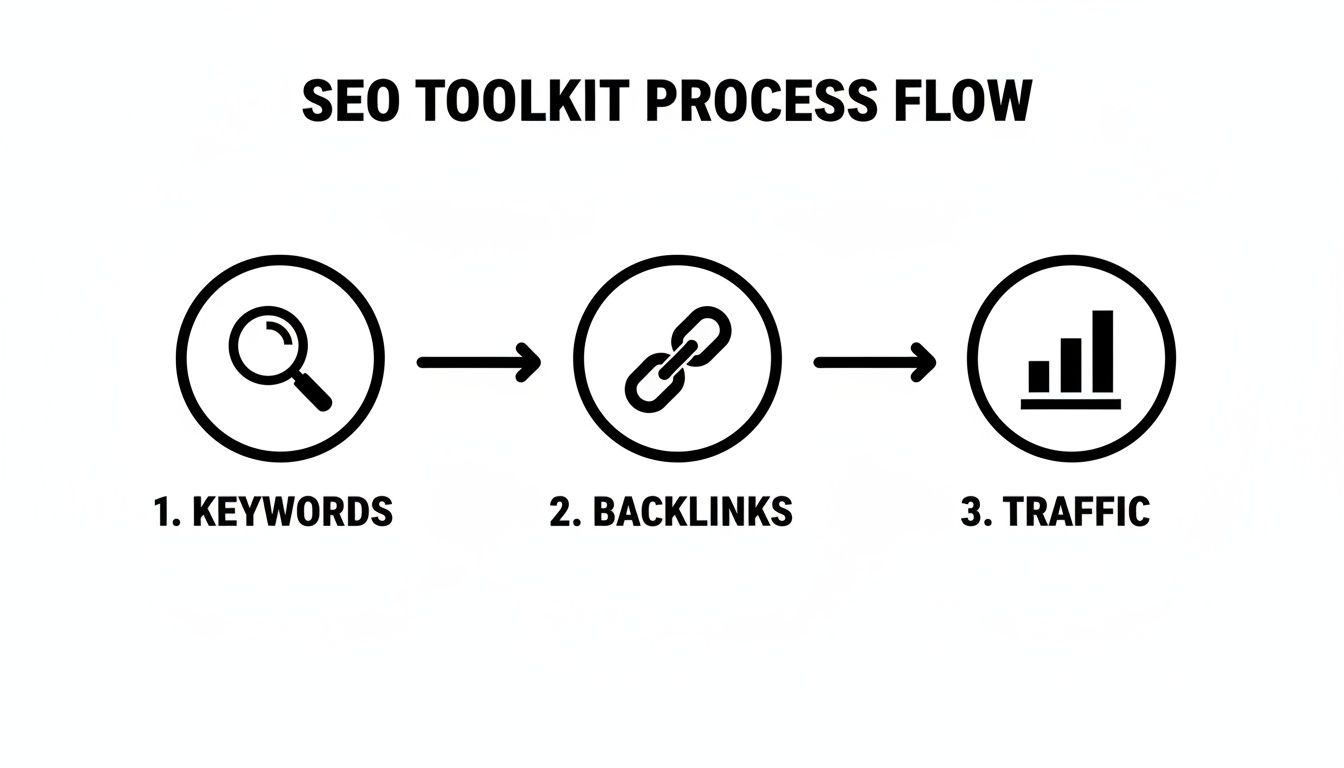 As you can see, insights from one area, like keyword gaps, directly feed into the next stage of your strategy, like deciding what content to build and which links to pursue.
Reverse-Engineering Your Competitor's Backlink Strategy

If high-quality content is the engine of SEO, then backlinks are the high-octane fuel. In hyper-competitive search results, a strong backlink profile is often the single factor that separates the winner from everyone else on the page.
This is where you shift gears from analyzing what’s on your competitor's site to understanding who is vouching for them across the web.
The goal isn't just to gawk at their Domain Rating. It's to build an actionable outreach plan by deconstructing their link-building success, finding replicable patterns, and identifying high-authority sites already linking to your rivals.
Identifying Their Highest-Quality Links
Your first move is to dive into their backlink profile with a tool like Ahrefs or SEMrush. Running a competitor's domain through a site explorer tool spits out a raw list of every site linking to them—but that data firehose can be overwhelming. You need to filter for quality over quantity.
Focus on pinpointing their most authoritative and relevant links. You can do this by filtering or sorting the backlink report by:
- Domain Rating (DR) or Authority Score (AS): Prioritize links from websites with high authority scores (think DR 60+), as these pass the most "link equity."
- "Dofollow" Links: These are the links that actually pass SEO value. While "nofollow" links have their place, your primary focus should be on acquiring dofollow links.
- Contextual Relevance: A link from a niche industry blog is often way more valuable than a generic link from a high-DR news site that has no topical connection to your business.
This initial filtering helps you cut through the noise and see the links that are genuinely moving the needle for their SEO.
Finding Replicable Link Opportunities
Once you have a clean list of high-quality links, the real detective work begins. Your mission is to find opportunities you can realistically replicate. This means figuring out the type of link they landed.
Was it a guest post they wrote for an industry publication? A mention in a "best of" resource list? Or maybe they were cited as an expert source in a news article? Knowing the context is everything—it tells you how to tailor your own outreach.
The most powerful tactic in competitor SEO research is finding "link gap" opportunities. Pinpoint the high-authority websites that have linked to two or more of your top competitors but haven't linked to you yet. These sites have already demonstrated a willingness to link to content in your niche, making them prime targets for your outreach campaigns.
This approach transforms your link-building from a guessing game into a targeted, data-driven strategy. You’re no longer cold-emailing random sites; you're reaching out to editors and webmasters with a proven interest in your subject matter.
Analyzing Anchor Text and Link Velocity
A sophisticated backlink analysis goes beyond just who is linking to your competitor; it also looks at how they are linking. Analyzing their anchor text distribution is crucial for building a natural-looking link profile that avoids Google penalties.
Take a look at the breakdown of their anchor text. A healthy profile is usually a mix of:
- Branded Anchors: "Sight AI"
- Naked URLs: "https://www.trysight.ai"
- Generic Anchors: "click here" or "read more"
- Partial and Exact-Match Keyword Anchors: "competitor analysis tools"
If a competitor's profile is 90% exact-match keyword anchors, they might be using risky tactics. A natural, diverse distribution is what you should aim for.
Likewise, monitoring their link velocity—how quickly they are acquiring new links—can reveal if they’ve recently launched a big digital PR campaign. Sometimes, you'll also find that a competitor has a surprising number of broken inbound links, presenting a unique opportunity. If you're looking for more ways to capitalize on this, our guide on how to fix broken links provides actionable strategies you can apply.
Turning Your Research Into An Actionable SEO Roadmap
All the keyword data, backlink profiles, and content audits in the world are just noise without a clear plan of attack. This is the moment where you translate your competitor SEO research from passive analysis into an active, revenue-driving strategy. The goal is to synthesize everything you’ve learned into a prioritized roadmap that your entire team can get behind.
This process involves taking your long lists of content ideas, keyword targets, and link-building opportunities and organizing them into a logical sequence. You can't tackle everything at once, so prioritization is absolutely critical. It’s where you separate the quick wins from the long-term projects.
Prioritizing Your SEO Initiatives
To build a roadmap that actually works, you need a simple framework for scoring each opportunity. This stops you from chasing low-impact tasks while high-value projects sit on the back burner. A straightforward scoring model helps you focus on what truly moves the needle.
One of the most effective ways to do this is with a prioritization matrix. It’s a simple but powerful way to rank each initiative based on a few key factors.
SEO Opportunity Prioritization Matrix
Use this framework to score and rank opportunities from your research, helping you focus on what will drive the most impact with the least effort.
| Opportunity (Keyword/Content/Link) | Potential Impact (1-5) | Conversion Intent (1-5) | Effort/Difficulty (1-5) | Priority Score |
|---|---|---|---|---|
| Create "Gantt Chart Templates" Page | 5 (High Traffic) | 4 (Problem-Aware) | 3 (Moderate) | 12 |
| Refresh "Project Mgmt Tips" Post | 3 (Med Traffic) | 2 (Top-of-Funnel) | 2 (Low) | 7 |
| Outreach for Guest Post on TechBlog | 4 (High Authority) | 3 (Brand Awareness) | 5 (High) | 12 |
| Fix Broken Links to Old Guide | 2 (Low Traffic) | 1 (Informational) | 1 (Very Low) | 4 |
Here's a quick breakdown of what these columns mean:
- Potential Impact refers to the estimated traffic or authority gain.
- Conversion Intent scores how likely the audience is to become a customer.
- Effort/Difficulty estimates the resources needed—time, budget, and personnel.
- Priority Score is your guide—a higher score signifies a higher priority.
The most effective SEO roadmaps focus on a mix of initiatives. Blend high-effort, high-reward "big bets" with low-effort "quick wins" to maintain momentum and show consistent progress each quarter. This keeps your team motivated and stakeholders happy.
This scoring system gives you a data-informed way to decide what to work on next, taking the guesswork out of the equation.
From here, you can map these prioritized tasks onto a quarterly timeline, creating a clear and actionable SEO roadmap. This plan should outline the specific content to create, pages to optimize, and link-building campaigns to launch.
Ultimately, your roadmap is a living document, not something set in stone. It's crucial to track your progress and adjust your priorities based on performance. As you start to see results, understanding how to measure SEO success will be vital for demonstrating ROI and refining your future strategy. This ensures your competitor insights continue to drive tangible growth.
Got Questions? We’ve Got Answers.
Even the clearest roadmap can have a few tricky turns. When you’re deep in the weeds of competitor SEO research, questions are bound to come up. Here are some quick, straightforward answers to the ones we hear most often.
How Often Should I Run a Competitor SEO Analysis?
This is a great question, and the answer isn't "constantly." You'll burn out.
For most businesses, a comprehensive, deep-dive analysis is perfect to do quarterly. This timing is frequent enough to catch important market shifts, algorithm updates, and competitor strategy pivots without getting bogged down in data overload.
That said, you can't completely ignore your closest rivals for three months. Keep a closer eye on your core SEO competitors—those top 3 to 5 domains you're always battling. A lighter, monthly check-in is a good idea.
Look for things like:
- A brand new piece of content that's rocketing up the rankings.
- Sudden rankings for a new cluster of keywords, signaling a change in focus.
- A handful of powerful new backlinks from major industry sites.
This hybrid approach gives you the best of both worlds: you see the big picture every quarter while staying agile enough to react to immediate threats and opportunities month-to-month.
What’s the Difference Between a Direct Competitor and a SERP Competitor?
This distinction trips up so many teams, but getting it right is crucial.
A direct competitor is exactly who you think it is: another business selling a similar product or service to your same audience. They're the ones your sales team loses sleep over.
A SERP competitor, on the other hand, is any website that shows up for the keywords you care about, no matter what they sell. They're competing for the same digital real estate and audience attention, even if they aren't after the same dollars.
Think about it: if you're a SaaS company trying to rank for "project management tips," your biggest SERP competitor probably isn't another SaaS tool. It’s more likely a high-authority industry blog or a publication like Forbes or Inc. If you only focus on your direct business rivals, you're fighting the wrong battle.
What Are the Most Important Metrics to Track?
It's incredibly easy to get lost in a sea of data. To avoid analysis paralysis, you need to zero in on the metrics that actually tell a story. While there are dozens of data points you could look at, these five give you the most bang for your buck:
- Organic Keywords: The total number (and quality) of non-branded keywords they rank for. This shows the breadth of their reach.
- Estimated Organic Traffic: A directional metric showing how much search traffic they get per month. It helps you quickly spot their most valuable pages.
- Top Pages by Traffic: The specific URLs driving the lion's share of their organic visitors. This is your roadmap to their most successful content.
- Referring Domains: The number of unique websites linking to them. This is a classic proxy for their domain authority and credibility.
- Keyword Gaps: The juicy, valuable keywords your competitors rank for that you don't. This is where you'll find low-hanging fruit.
Focusing on these core five will give you actionable insights without making the process overly complicated.
Turn AI visibility insights into action with Sight AI. Our platform monitors how AI models talk about your brand, then uses those insights to generate high-value content topics and produce SEO-optimized articles that drive measurable growth. Discover your AI content gaps and start publishing consistently at https://www.trysight.ai.