Manual rank checking doesn't scale. Whether you're building a client reporting dashboard, automating competitive monitoring, or powering an internal SEO workflow, you need programmatic access to search position data that's reliable, fast, and flexible enough to handle real-world complexity.
The landscape has also shifted considerably. Traditional Google SERP position tracking is still essential, but it's no longer the complete picture. Brands now need to monitor how they appear in AI-powered search experiences like ChatGPT, Perplexity, and Claude, where recommendations and mentions happen entirely outside of blue-link rankings. The best tools in this space are starting to bridge both worlds.
To build this list, we evaluated tools across several dimensions: API reliability and uptime, data accuracy and freshness, geographic and device targeting options, SERP feature extraction depth, pricing flexibility, documentation quality, and ease of integration. Here are the top Google position checker APIs worth considering for your stack in 2026.
1. Sight AI
Best for: Teams that need both traditional SEO tracking and AI search visibility monitoring in one platform.
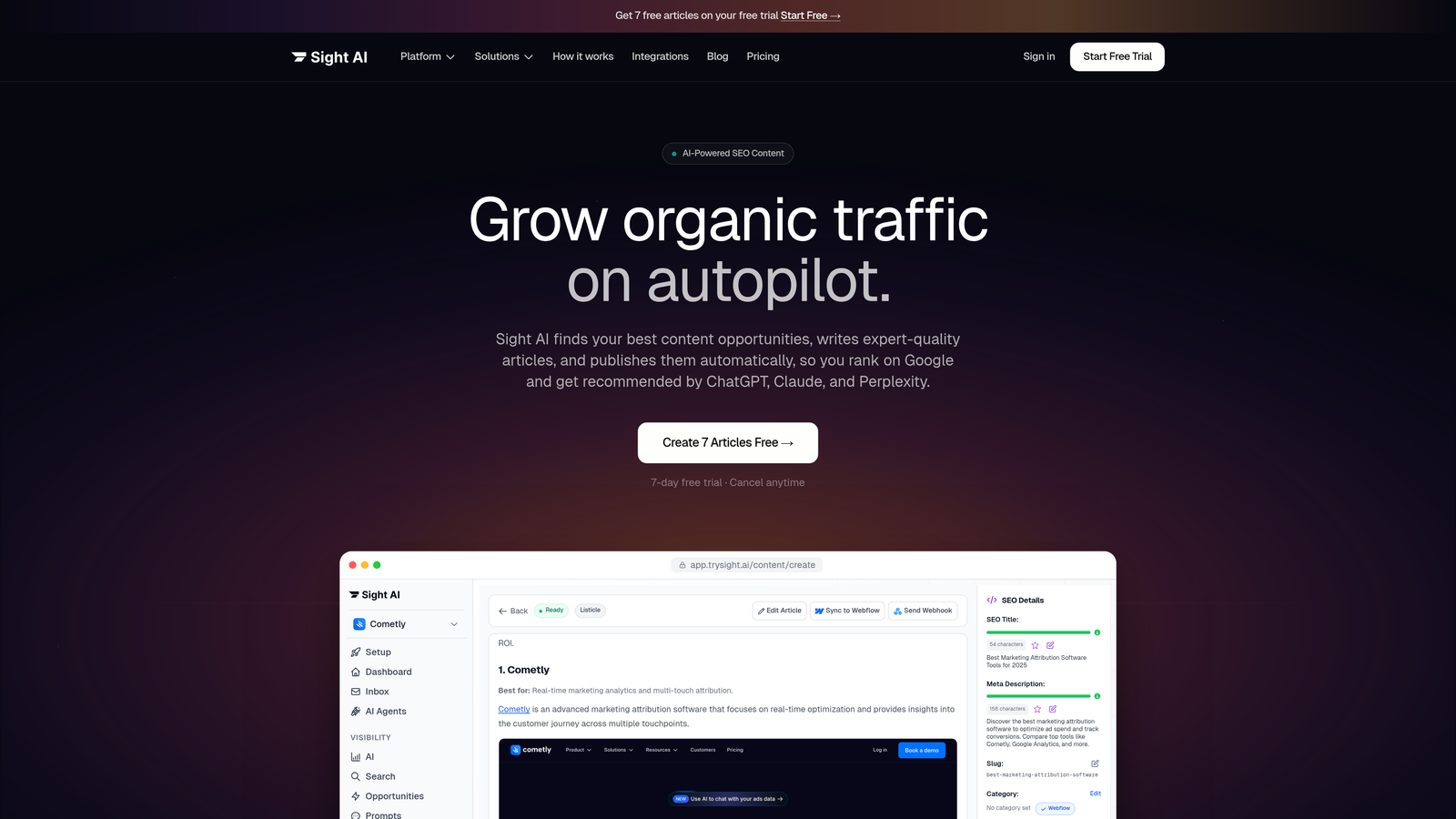
Sight AI is an AI visibility and content platform that tracks how your brand appears across AI models like ChatGPT, Claude, and Perplexity, while also powering SEO content creation and website indexing workflows.
Where This Tool Shines
Most rank tracking APIs focus exclusively on Google's blue-link results. Sight AI takes a different approach by treating AI search visibility as a first-class metric alongside traditional SEO performance. If your audience is increasingly using AI assistants to discover products, services, and brands, that's a blind spot most conventional SERP APIs simply can't address.
The platform combines monitoring with action. Beyond tracking where your brand appears, Sight AI includes a content generation engine with 13+ specialized AI agents that produce SEO and GEO-optimized articles, plus IndexNow integration to accelerate content discovery by search engines. It's built for teams that want to close the loop between visibility data and content output.
Key Features
AI Visibility Score: Tracks brand mentions and sentiment across 6+ AI platforms including ChatGPT, Claude, and Perplexity, with prompt-level monitoring to show exactly which queries surface your brand.
AI Content Writer: 13+ specialized AI agents generate SEO and GEO-optimized content formats including listicles, guides, and explainers, with Autopilot mode for continuous publishing.
IndexNow Integration: Automatically notifies search engines of new and updated content, reducing the time between publishing and indexing.
Brand Mention Tracking: Monitors how AI models describe, recommend, or reference your brand, including sentiment analysis across responses.
CMS Auto-Publishing: Connects content generation directly to your CMS, enabling end-to-end automation from topic selection to live publication.
Best For
Marketers, founders, and agencies who recognize that search visibility now extends beyond Google rankings. Particularly valuable for brands in competitive categories where AI assistants are increasingly influencing discovery and purchase decisions.
Pricing
Visit trysight.ai for current plans and pricing. Multiple tiers are available to accommodate different team sizes and usage volumes.
2. SERPstack
Best for: Developers who need lightweight, affordable SERP data access with minimal setup overhead.
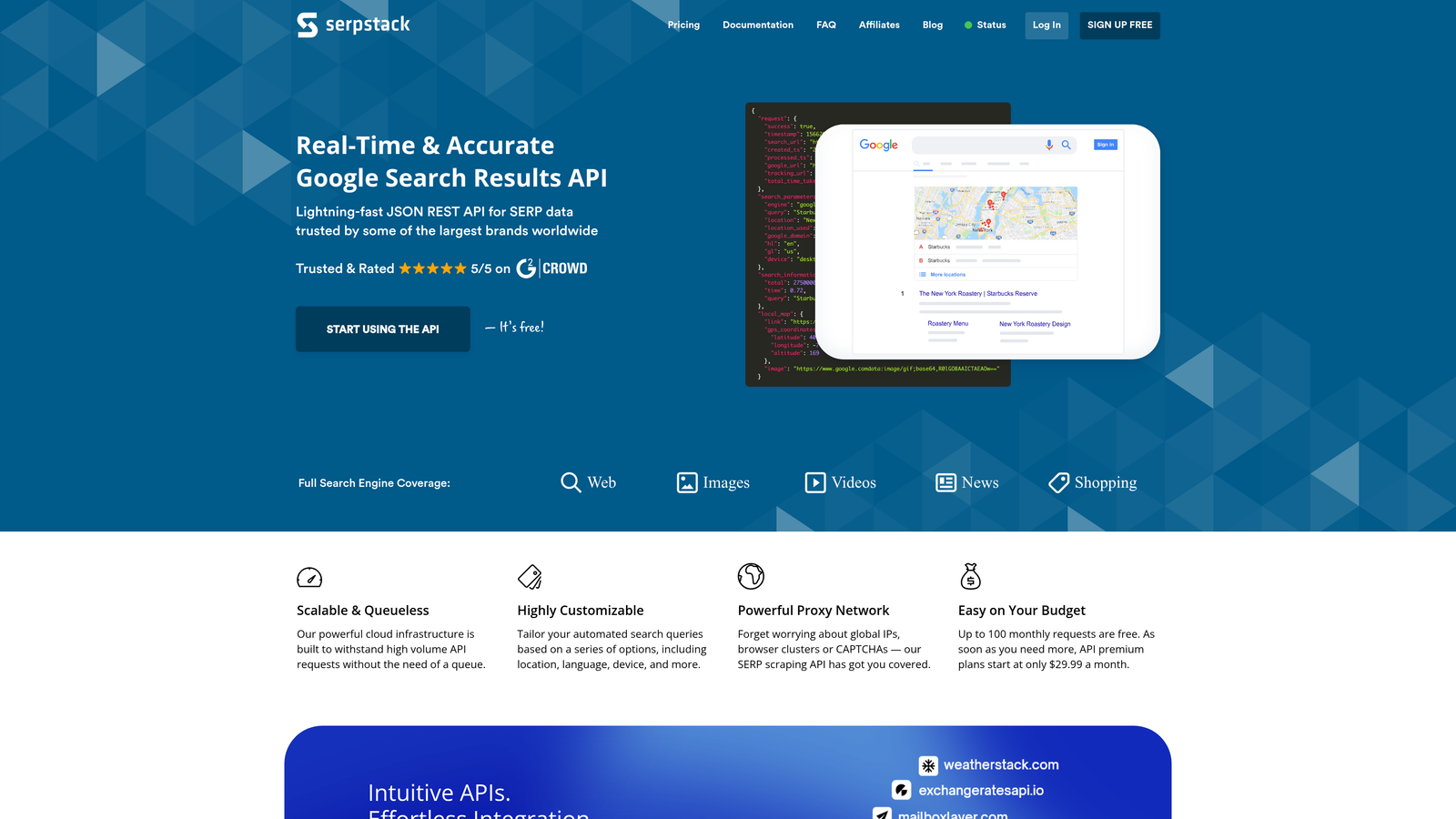
SERPstack is a real-time Google SERP API built for simplicity, delivering structured search results data through clean REST endpoints with JSON responses.
Where This Tool Shines
SERPstack earns its place through straightforward implementation. There's no complex SDK to learn and no heavy onboarding process. You authenticate, send a query, and get back structured JSON. For developers building lightweight rank tracking tools or prototyping SEO features, this low-friction entry point is genuinely useful.
The free tier makes it accessible for experimentation and low-volume use cases without committing to a paid plan upfront. For small teams or solo developers testing an idea, that matters.
Key Features
Real-Time SERP Data: Returns live Google search results via REST API with clean JSON formatting that's easy to parse and integrate.
Localized Results: Supports country, language, and location-specific queries for geo-targeted position checking.
Device Targeting: Differentiates between desktop and mobile search results for accurate device-specific rank tracking.
Results Types: Extracts organic results, paid ads, and local pack data from a single query.
Free Tier: Available for low-volume usage, making it practical for testing and small-scale projects.
Best For
Individual developers, small teams, and early-stage projects that need reliable SERP data without the complexity or cost of enterprise APIs. A solid starting point before scaling to higher-volume solutions.
Pricing
Free tier available for low-volume usage. Paid plans start at approximately $29.99/month for higher request volumes and additional features.
3. SEMrush API
Best for: Agencies and enterprise teams that need historical ranking data, competitive intelligence, and keyword research in a single API.
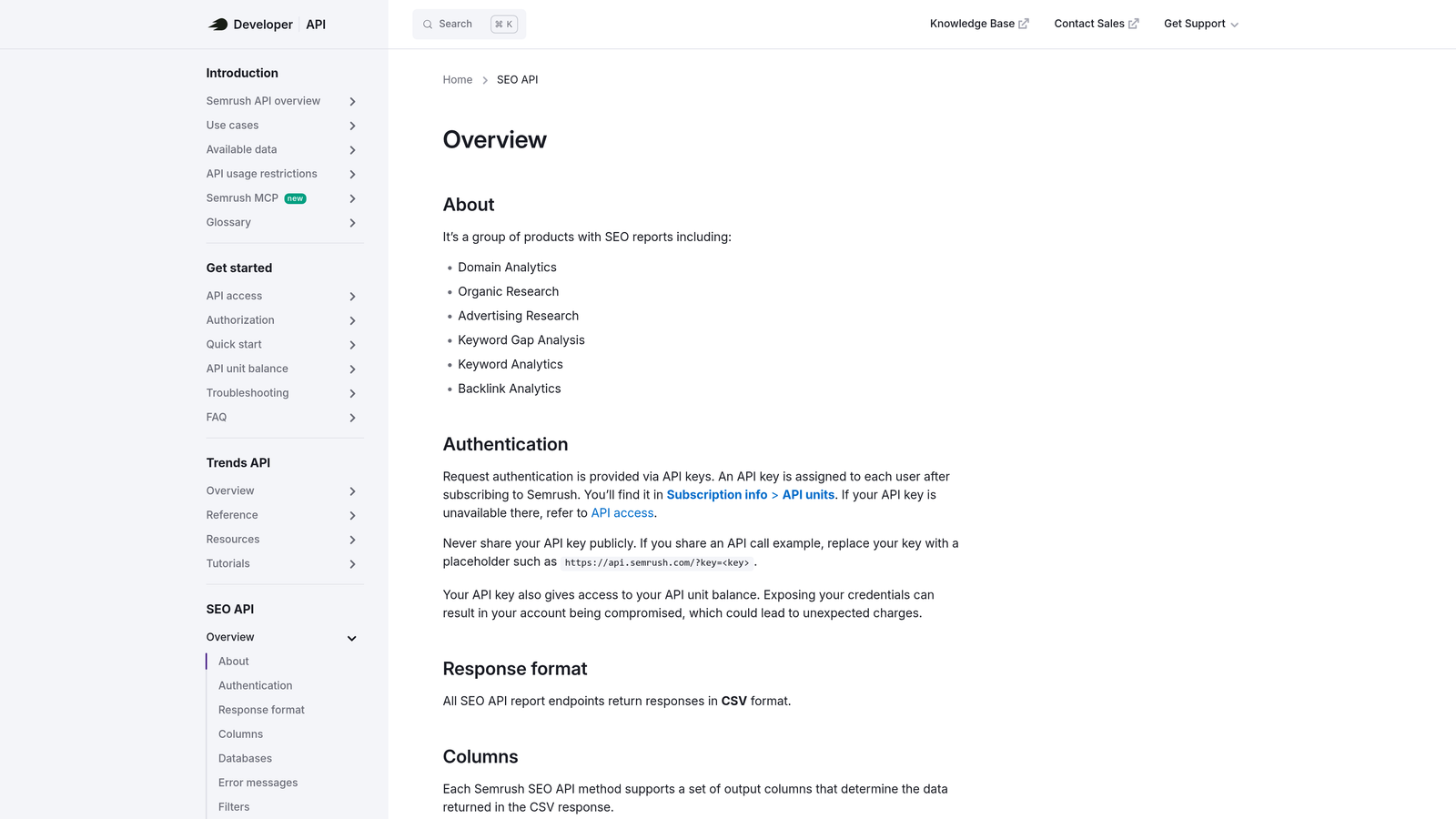
SEMrush API provides programmatic access to one of the largest SEO databases available, covering position tracking, competitor analysis, backlink data, and traffic estimation.
Where This Tool Shines
The depth of SEMrush's data is its primary advantage. Historical position data going back years, competitor keyword gap analysis, and domain-level traffic estimates are all accessible through the same API. For agencies building comprehensive client dashboards, this breadth reduces the number of data sources you need to manage.
The API unit system allows usage to scale across different endpoints, though teams with high query volumes should map out their unit consumption carefully before committing to a plan.
Key Features
Keyword Database Access: One of the largest keyword databases globally, covering search volume, difficulty, and trend data across multiple markets.
Historical Position Data: Track ranking changes over time with trend analysis endpoints for long-term performance monitoring.
Competitor Analysis: Keyword gap and position comparison endpoints for competitive benchmarking at scale.
Domain Analytics: Traffic estimation, backlink data, and domain overview endpoints for comprehensive site analysis.
Developer Resources: Comprehensive documentation with SDK options for multiple programming languages.
Best For
Agencies managing large keyword portfolios across multiple clients, and enterprise SEO teams that need historical data and competitive intelligence alongside real-time position tracking.
Pricing
API access is included with SEMrush subscription plans and operates on a usage-based API units system. Check semrush.com for current plan details and unit allocations.
4. Ahrefs API
Best for: SEO teams that need to correlate rank data with backlink authority metrics for link-informed position analysis.
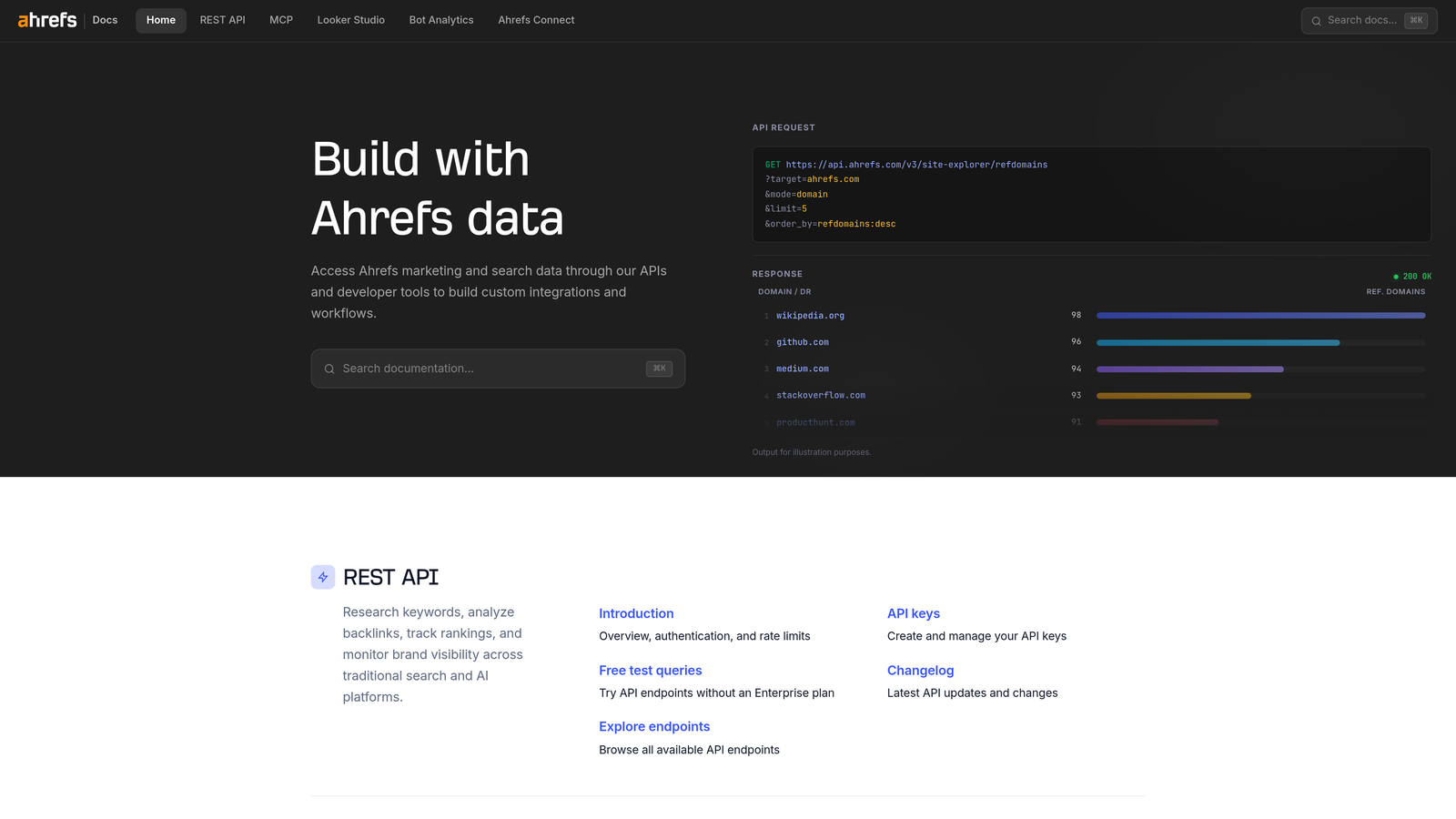
Ahrefs API combines rank tracking endpoints with access to one of the largest backlink indexes available, enabling developers to build richer position analysis tools.
Where This Tool Shines
Where Ahrefs differentiates itself is in the connection between rankings and link authority. Being able to query Domain Rating, URL Rating, and backlink counts alongside position data in the same workflow makes it easier to understand why pages rank where they do, not just where they rank.
Batch processing support is a practical feature for high-volume workflows. If you're tracking thousands of URLs across multiple clients, being able to process queries in bulk rather than one at a time significantly reduces both latency and API overhead.
Key Features
Rank Tracking Endpoints: Position data with SERP feature identification, showing whether a result appears as a featured snippet, image pack, or standard organic listing.
Backlink Index: Domain Rating and URL Rating metrics from one of the largest backlink databases, accessible via API for enriched analysis.
Keyword Metrics: Keyword difficulty scores and search volume data for SEO opportunity assessment.
Traffic Estimation: Organic traffic estimates per page or domain for competitive benchmarking.
Batch Processing: Support for high-volume queries, reducing overhead for large-scale rank tracking workflows.
Best For
SEO professionals and development teams building tools that need to combine ranking data with link authority signals. Most valuable for teams already using Ahrefs for link analysis who want to extend that data into custom workflows.
Pricing
API access is available on higher-tier Ahrefs plans. Check ahrefs.com for current plan structures and API access thresholds.
5. DataForSEO
Best for: Developers and agencies with variable workloads who need granular SERP feature extraction at a competitive per-task price.
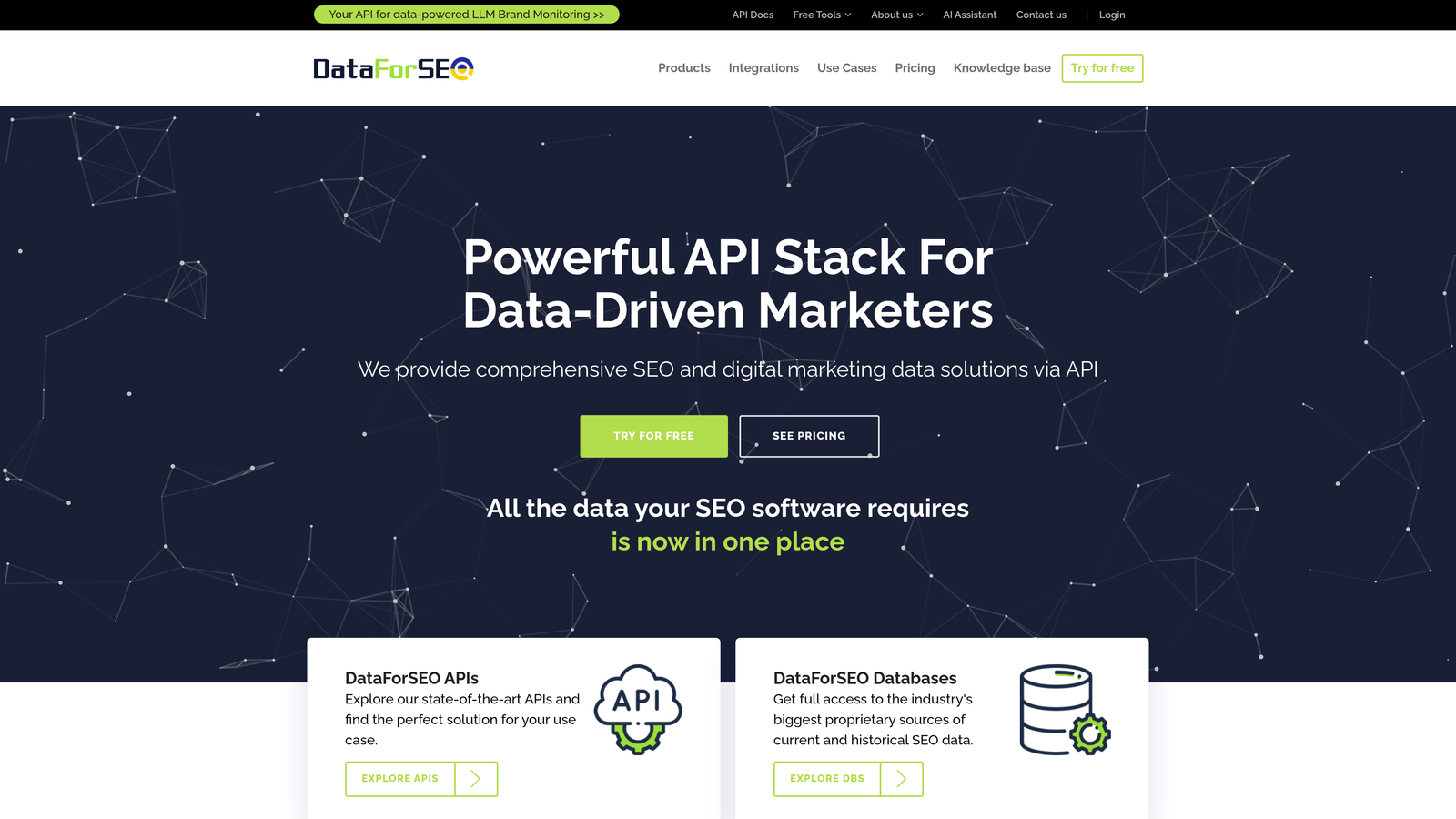
DataForSEO is a developer-focused SERP data infrastructure provider offering detailed search results parsing, SERP feature extraction, and flexible task-based pricing.
Where This Tool Shines
DataForSEO's task-based pricing model is genuinely well-suited to workloads that aren't uniform month to month. Rather than paying for a fixed request volume you may not use, you pay for what you actually query. For agencies with seasonal campaigns or variable client loads, this flexibility can translate to meaningful cost savings.
The depth of SERP feature extraction is also notable. Featured snippets, People Also Ask boxes, local packs, and knowledge panels are all parsed and returned as structured data, which is considerably more useful than raw HTML scraping for most downstream applications.
Key Features
Task-Based Pricing: Pay-per-task model that scales cost directly with actual usage rather than fixed monthly allowances.
SERP Feature Extraction: Granular parsing of featured snippets, PAA boxes, local packs, and knowledge panels as structured data.
Geographic Coverage: Support for 100+ Google locales with mobile and desktop differentiation for accurate geo-targeted tracking.
Real-Time and On-Demand: Flexible data collection modes to balance speed against cost depending on use case requirements.
Extended API Suite: Keyword research, backlink, and on-page SEO APIs available alongside core SERP data endpoints.
Best For
Developers building custom SEO tools, agencies with fluctuating query volumes, and teams that need SERP feature data beyond standard organic positions. Particularly strong for projects where cost predictability matters.
Pricing
Pay-per-task pricing model. SERP API starts at approximately $0.0015 per task, making it one of the more cost-competitive options for high-volume use cases.
6. SerpApi
Best for: Developers who want structured SERP data without managing proxies, CAPTCHAs, or parsing logic themselves.
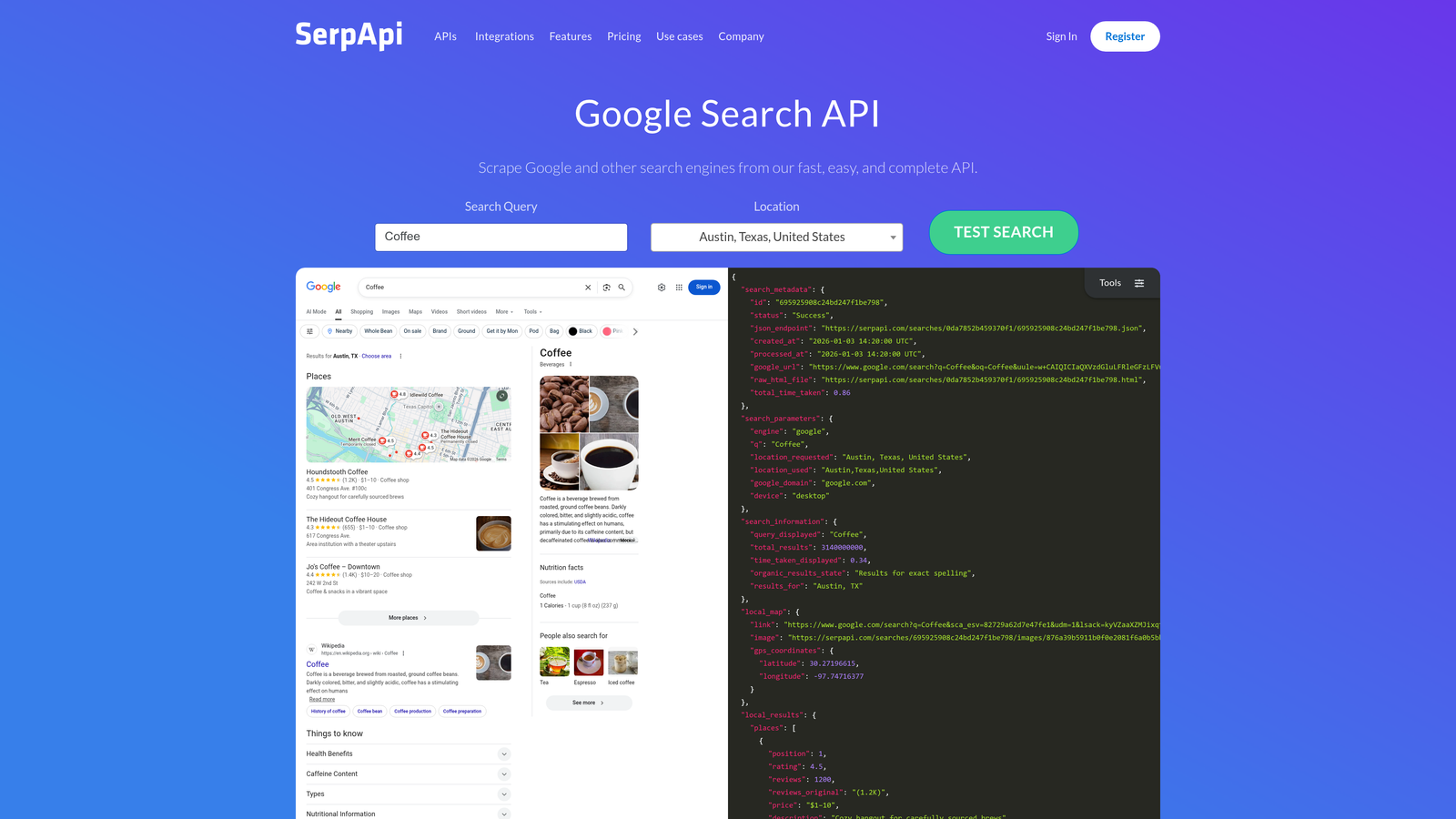
SerpApi handles the infrastructure complexity of querying search engines at scale, returning clean structured JSON for organic results, ads, featured snippets, and more across 10+ search engines.
Where This Tool Shines
The core value proposition is infrastructure abstraction. Querying Google programmatically at scale involves managing proxy rotation, CAPTCHA solving, and result parsing. SerpApi handles all of that automatically, so your development effort goes into using the data rather than collecting it reliably.
Multi-engine support is a meaningful differentiator for teams tracking visibility across Google, Bing, YouTube, and other platforms simultaneously. The playground tool for testing queries before integration also speeds up development cycles considerably.
Key Features
Automatic Infrastructure Management: Handles proxy rotation and CAPTCHA solving automatically, removing the most technically complex parts of SERP data collection.
Structured JSON Output: Clean, consistently formatted responses for organic results, ads, featured snippets, and knowledge panels.
Multi-Engine Support: Covers Google, Bing, Yahoo, YouTube, and other search engines from a single API integration.
Query Playground: Interactive testing tool for validating queries and inspecting response structure before writing integration code.
SDK Availability: Official SDKs for Python, Ruby, Node.js, Java, and other popular languages to accelerate integration.
Best For
Development teams that want to move fast without building proxy infrastructure from scratch. Also well-suited to projects tracking visibility across multiple search engines rather than Google alone.
Pricing
Free tier includes 100 searches per month. Paid plans start from $50/month for higher volume access.
7. Moz API
Best for: SEO analysts who need rank data enriched with Domain Authority and Page Authority metrics for authority-aware position analysis.
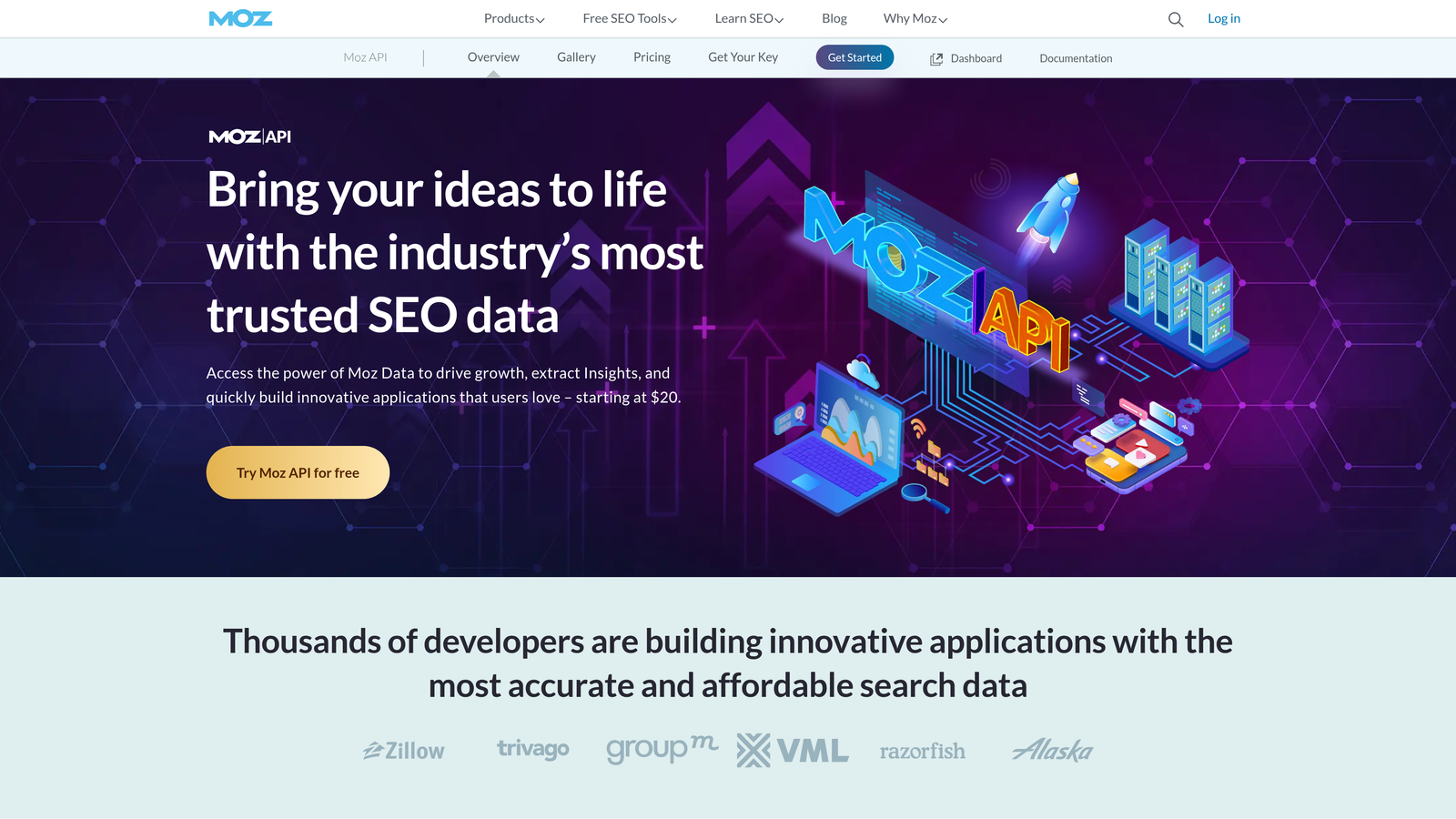
Moz API combines SERP data access with Moz's proprietary authority metrics, enabling developers to build position tracking tools that factor in link authority signals alongside raw rankings.
Where This Tool Shines
Domain Authority and Page Authority remain widely used benchmarks in SEO reporting, and having those metrics available through the same API as rank data simplifies the workflow for teams that use them regularly. Rather than pulling position data from one source and authority metrics from another, Moz consolidates both.
The developer community around Moz's API is well-established, with solid documentation and a history of stable endpoints. For teams that prioritize reliability and clear documentation over cutting-edge features, that track record carries weight.
Key Features
Domain and Page Authority: Moz's proprietary DA and PA scores accessible alongside rank data for authority-enriched position analysis.
Link Analysis: Backlink data and spam score endpoints for link profile assessment at scale.
Keyword Ranking Data: Position tracking with SERP feature identification across target keywords.
Bulk Data Access: Support for large-scale analysis with batch query capabilities for high-volume workflows.
Developer Documentation: Well-maintained API documentation with an active developer community for support and integration guidance.
Best For
SEO teams and agencies that rely on Domain Authority as a reporting metric and want to integrate it directly into custom dashboards or automated reporting workflows alongside position data.
Pricing
Free tier available with limited access. Paid plans with higher rate limits start from $99/month. Check moz.com for current plan details.
8. Valueserp
Best for: Budget-conscious developers and small teams who need reliable localized SERP data without enterprise pricing.
Valueserp is a cost-effective Google SERP API offering fast response times, localized results, and multiple output formats at a price point accessible to smaller teams and individual developers.
Where This Tool Shines
Valueserp positions itself squarely on price-to-performance ratio. The plans are straightforward, the pricing is predictable, and the request allowances are generous relative to cost. For developers who don't need the full feature depth of enterprise APIs but still need reliable, localized SERP data, this hits a practical middle ground.
The support for multiple Google result types, including Images, News, Shopping, and Maps alongside standard web search, makes it more versatile than it might appear at first glance. Teams tracking visibility across different Google surfaces can do so from a single integration.
Key Features
Predictable Pricing: Simple plan structure with generous request allowances and no hidden usage fees or complex unit systems.
Localization Support: Country, language, and device-specific results for accurate geo-targeted and mobile rank tracking.
Multiple Output Formats: JSON and CSV output options to fit different downstream data processing needs.
Google Surface Coverage: Supports Google Search, Images, News, Shopping, and Maps from a single API.
Response Speed: Fast median response times suitable for near-real-time rank checking workflows.
Best For
Individual developers, small agencies, and early-stage startups that need dependable SERP data at a budget-friendly price point. A strong option when enterprise API costs aren't justified by current query volume.
Pricing
Plans start from $25/month for 2,500 searches, with higher-volume tiers available as needs grow.
9. Bright Data SERP API
Best for: Enterprise teams that need geo-targeted SERP data at high volume, backed by enterprise-grade infrastructure and SLAs.
Bright Data SERP API is an enterprise-grade search data collection API powered by one of the world's largest proxy networks, built for accurate geo-targeted position checking at scale.
Where This Tool Shines
The infrastructure behind Bright Data is its defining advantage. When accurate geo-targeted results are critical, whether for tracking local pack positions in specific cities or verifying rankings from different countries, the quality of the underlying proxy network directly affects data accuracy. Bright Data's network scale gives it a meaningful edge for this use case.
Enterprise SLAs and dedicated support are relevant for teams where downtime or data gaps have direct business consequences. For high-stakes use cases like client reporting at scale or competitive intelligence at the enterprise level, that accountability structure matters.
Key Features
Proxy Network Scale: Backed by one of the largest global proxy networks for accurate geo-targeted results across regions, cities, and countries.
Real-Time and Batch Collection: Flexible data collection modes supporting both live queries and high-volume batch processing.
Structured SERP Output: Parsed data with SERP feature extraction for organic results, ads, and rich results.
Multi-Engine Support: Covers Google, Bing, and other search engines from the same infrastructure.
Enterprise SLAs: Dedicated support, uptime guarantees, and account management for high-volume enterprise accounts.
Best For
Large agencies, enterprise SEO teams, and data-intensive applications where geo-targeting accuracy, uptime reliability, and volume capacity are non-negotiable requirements. Best suited to teams with the budget and query volume to justify enterprise pricing.
Pricing
Pay-per-request model with volume-based pricing. Contact Bright Data's sales team for enterprise rates and custom arrangements.
Choosing the Right Google Position Checker API for Your Stack
The right API depends on what you're actually trying to build and who you're building it for. There's no single best option across the board, but there are clear patterns based on use case.
If your primary need is affordable, lightweight SERP data for a small project or prototype, Valueserp or SERPstack offer the most accessible entry points with minimal setup friction. Both handle localized results and common SERP types without requiring enterprise-level investment.
For developers who want to avoid managing proxy infrastructure entirely, SerpApi is the most developer-friendly option. The automatic CAPTCHA handling and multi-engine support make it particularly well-suited to projects that need to move fast without building data collection infrastructure from scratch.
If you need variable-volume pricing and deep SERP feature extraction, DataForSEO's task-based model is worth serious consideration. It's one of the more cost-efficient options for high-volume workflows where monthly request volumes fluctuate significantly.
For enterprise teams requiring authority metrics, historical data, or competitive intelligence alongside position tracking, SEMrush API, Ahrefs API, and Moz API each bring substantial proprietary data that goes beyond raw SERP results. The best choice among these three typically comes down to which platform your team already uses for SEO analysis.
For high-volume, geo-targeted enterprise use cases where infrastructure reliability and SLAs are critical, Bright Data SERP API is the strongest option, though it comes at a price point that reflects that positioning.
Here's the broader point worth sitting with: traditional Google rank tracking is necessary, but it's no longer sufficient. As AI assistants increasingly influence how people discover brands, products, and services, visibility in ChatGPT, Claude, and Perplexity responses is becoming just as strategically important as a page-one Google ranking. Sight AI is the only platform on this list that addresses both dimensions, making it particularly relevant for forward-looking teams that want to track and improve their presence across both traditional search and AI-powered discovery.
Start tracking your AI visibility today and see exactly where your brand appears across top AI platforms, so you can stop guessing how AI models like ChatGPT and Claude talk about you and start optimizing for the search landscape that's actually emerging.