Generative AI has fundamentally changed how marketers, founders, and agencies produce content at scale. But not every AI content tool is built for the same job. Some focus on raw output volume, others on SEO optimization, GEO (Generative Engine Optimization), or brand visibility across AI platforms like ChatGPT, Claude, and Perplexity.
This list covers the best generative AI content creation tools available in 2026, selected specifically for teams focused on organic traffic growth and AI search visibility. Each tool was evaluated on content quality, SEO and GEO capabilities, workflow automation, and how well it supports getting your brand discovered — not just by Google, but by the AI models answering your audience's questions.
Whether you're a solo founder publishing weekly or an agency managing dozens of clients, one of these tools will fit your content engine. If you're also working to improve organic search performance, our guide on how to optimize content for SEO is a useful companion read.
1. Sight AI
Best for: Teams that need AI content creation AND brand visibility tracking across AI platforms
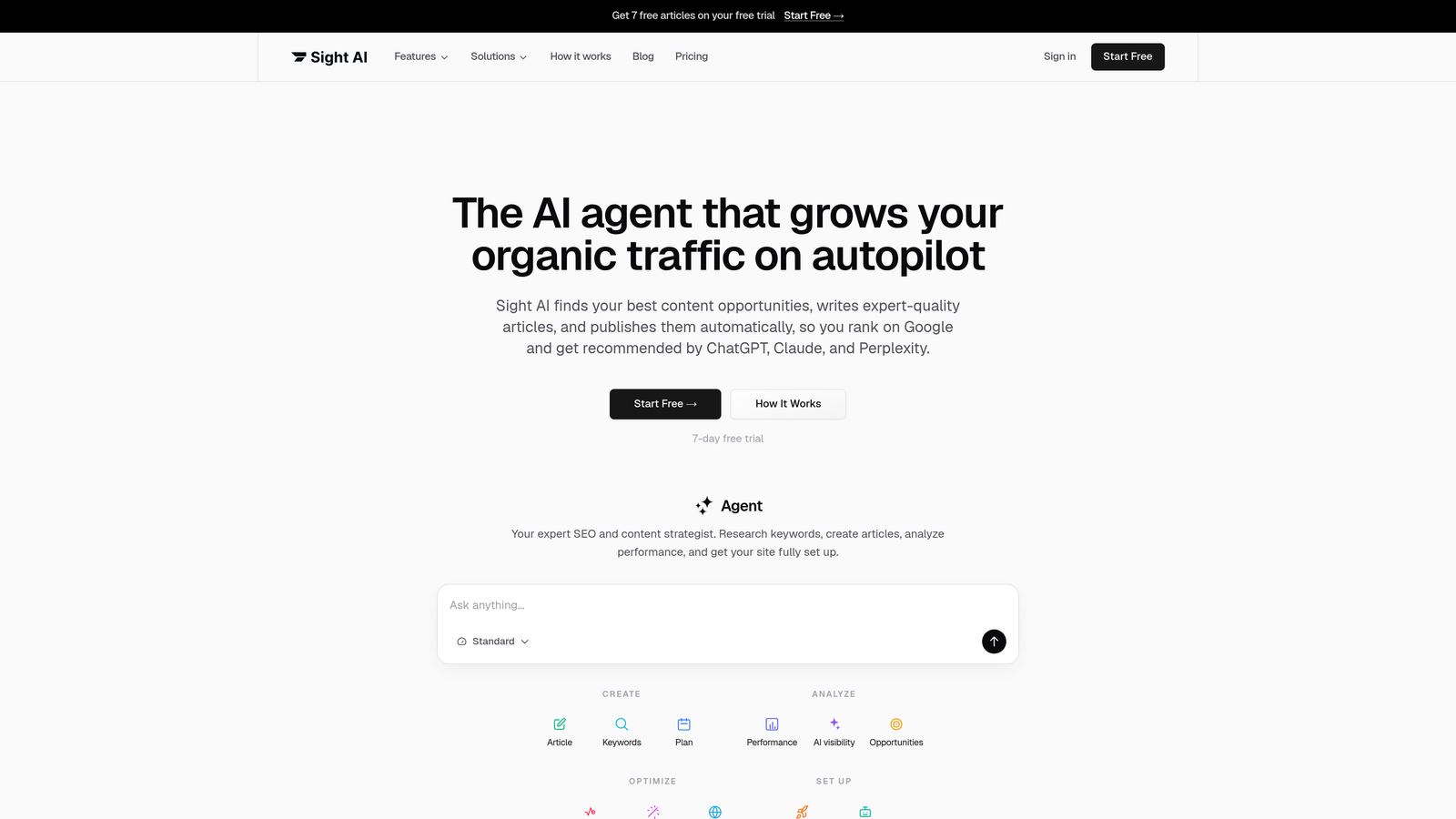
Sight AI is an all-in-one AI content platform that combines SEO and GEO-optimized article generation with AI visibility tracking across ChatGPT, Claude, Perplexity, and other major AI platforms.
Where This Tool Shines
Most generative AI content tools stop at the publish button. Sight AI goes further by closing the loop between what you publish and whether AI models actually cite your brand. That combination is rare in this category and increasingly important as AI answer engines become a primary discovery channel for many audiences.
The platform's AI Visibility Score gives you a concrete, trackable metric for how your brand appears across AI platforms, complete with sentiment analysis. This means content teams can tie their publishing activity to measurable AI share of voice, not just traditional search rankings.
Key Features
13+ Specialized AI Agents: Purpose-built agents for generating listicles, how-to guides, and explainers, each optimized for different content formats and SEO structures.
Autopilot Mode: Automates content publishing workflows end-to-end, allowing teams to maintain consistent output without manual intervention at every step.
AI Visibility Score: Tracks brand mentions across 6+ AI platforms with sentiment analysis and prompt tracking, giving you a real measure of GEO performance.
IndexNow Integration: Automates sitemap updates and triggers faster content indexing so new articles get discovered by search engines and AI crawlers sooner.
CMS Auto-Publishing: Connects directly to your CMS so content moves from generation to publication without manual copying or reformatting.
Best For
Sight AI is the strongest fit for marketers, founders, and agencies who need to produce SEO and GEO-optimized content consistently while also monitoring how AI models represent their brand. It's particularly valuable for teams that have started asking "does our content actually get cited by ChatGPT?" and want a systematic way to answer that question.
Pricing
Visit trysight.ai for current pricing plans. The platform offers options suited to solo operators and larger agency teams.
2. Writesonic
Best for: Content teams managing high output volume with built-in SEO features
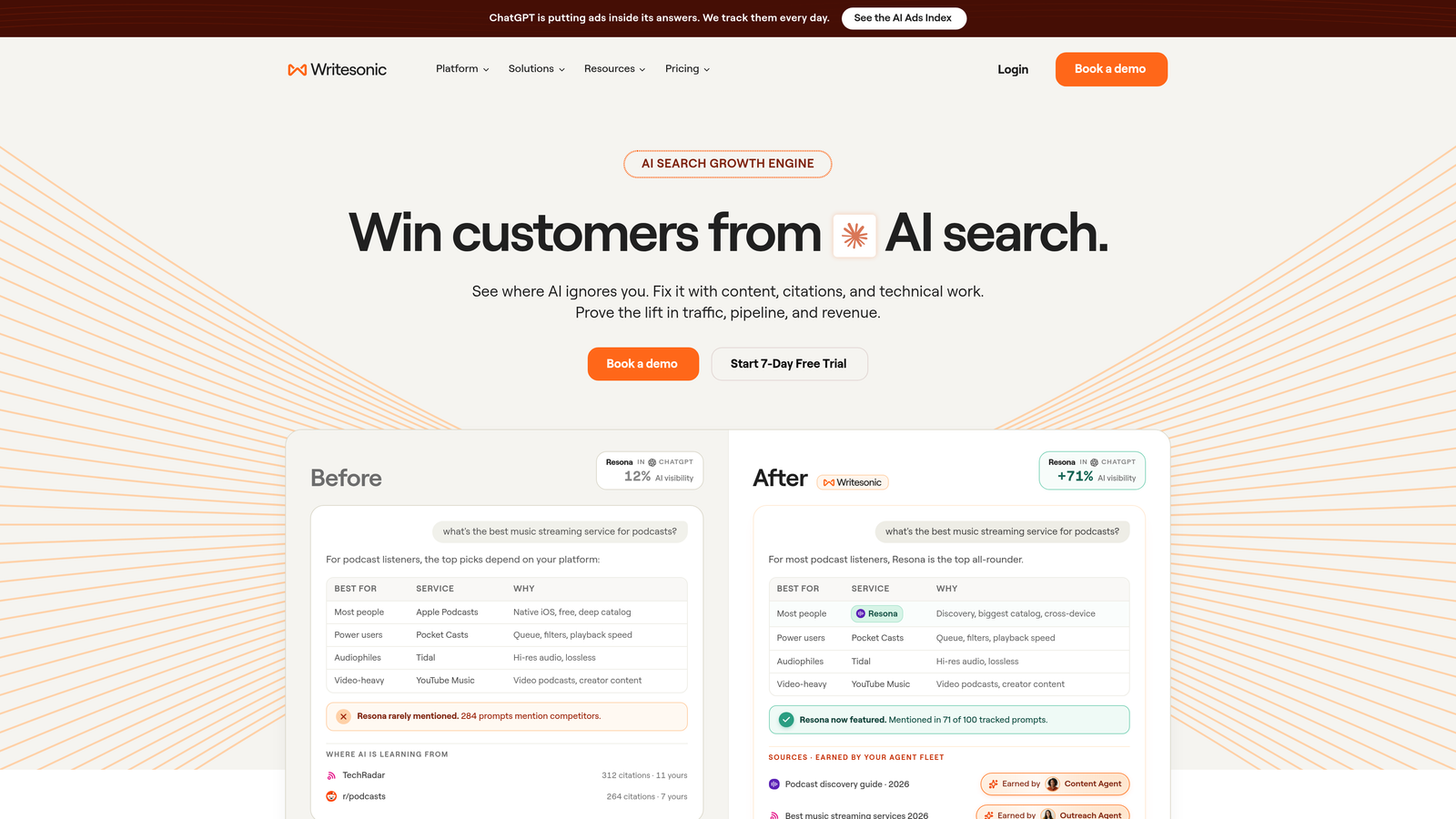
Writesonic is a broad-scope AI writing platform with SEO-focused content generation, conversational AI tools, and multi-language support for teams that need to produce a lot of content across different formats.
Where This Tool Shines
Writesonic has built a substantial feature set around the practical needs of content teams: long-form article generation, keyword integration, and a dedicated SEO AI Agent that handles much of the brief-to-draft workflow. For teams that need consistent volume across blogs, landing pages, and social content, it covers a wide surface area.
The inclusion of Chatsonic (a conversational AI assistant) and Botsonic (an AI chatbot builder) also makes it useful for teams that want to extend their AI content capabilities beyond articles into interactive customer-facing experiences.
Key Features
SEO AI Agent: Handles long-form article generation with keyword integration built into the workflow, reducing the need for separate SEO tooling.
Chatsonic: A conversational AI assistant for brainstorming, drafting, and refining content in a chat-based interface.
Botsonic: An AI chatbot builder that lets teams create custom AI assistants for their websites or products.
Multi-Language Support: Generates content in multiple languages, useful for teams serving international audiences.
Content Brief Tools: Supports structured workflows from keyword research through to finished drafts.
Best For
Writesonic suits content marketers and agencies that need reliable, high-volume output with SEO features integrated into the generation process. It works well as a primary writing tool for teams that handle their own distribution and don't yet need AI visibility monitoring.
Pricing
A free tier is available. Paid plans scale with usage and team size. See writesonic.com for current pricing details.
3. AirOps
Best for: Growth and content ops teams building scalable, repeatable LLM-powered content pipelines
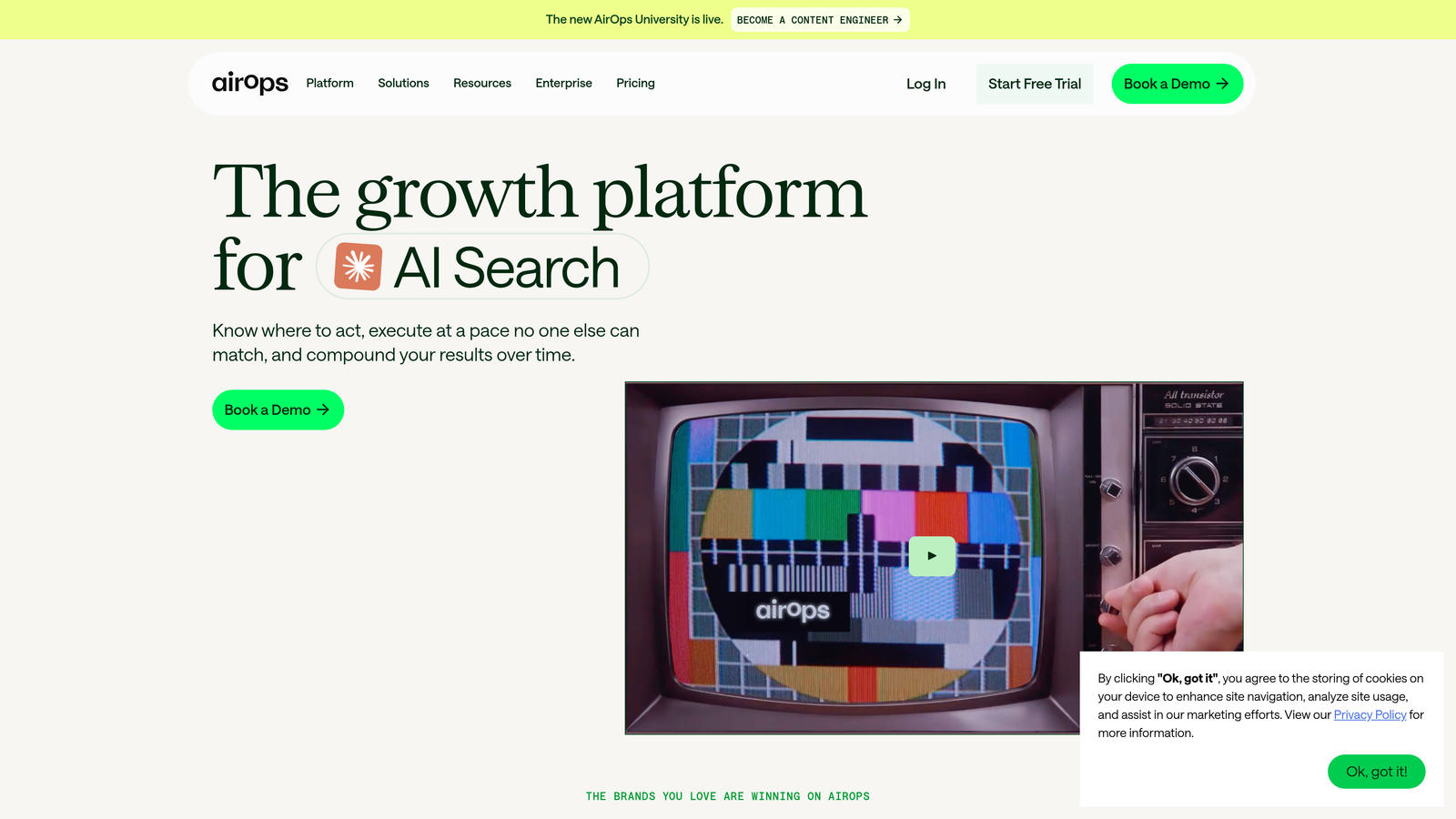
AirOps is an AI workflow orchestration platform that lets content operations teams build custom, repeatable LLM-powered content pipelines without requiring engineering resources.
Where This Tool Shines
AirOps is less of a "write an article now" tool and more of a "build a content system" platform. If your team has specific, repeatable content production requirements, such as generating product descriptions at scale, building structured content briefs from a data source, or running multi-step content enrichment workflows, AirOps gives you the infrastructure to do that reliably.
The ability to orchestrate across multiple LLM providers within a single workflow is particularly useful for teams that want to use different models for different tasks without building custom integrations from scratch.
Key Features
Custom LLM Workflow Builder: Design multi-step content workflows visually, connecting inputs, AI processing steps, and outputs without writing code.
Multi-Model Orchestration: Run workflows across multiple leading AI providers, choosing the right model for each stage of your content process.
Scalable Content Pipeline Automation: Handles high-volume content production tasks that would be impractical to run manually.
Template Library: Pre-built workflow templates for common content operations use cases, reducing setup time.
Team Collaboration and Versioning: Manage workflow versions and collaborate across content ops teams with shared access controls.
Best For
AirOps is the right fit for enterprise content teams, growth engineers, and content operations leads who need to systematize AI-powered content production. It's less suited to individual writers looking for a quick drafting tool, and better suited to teams building content infrastructure at scale.
Pricing
See airops.com for current pricing plans, which are structured around team size and workflow volume.
4. Promptwatch
Best for: Technical marketing teams managing complex LLM prompt libraries in content workflows
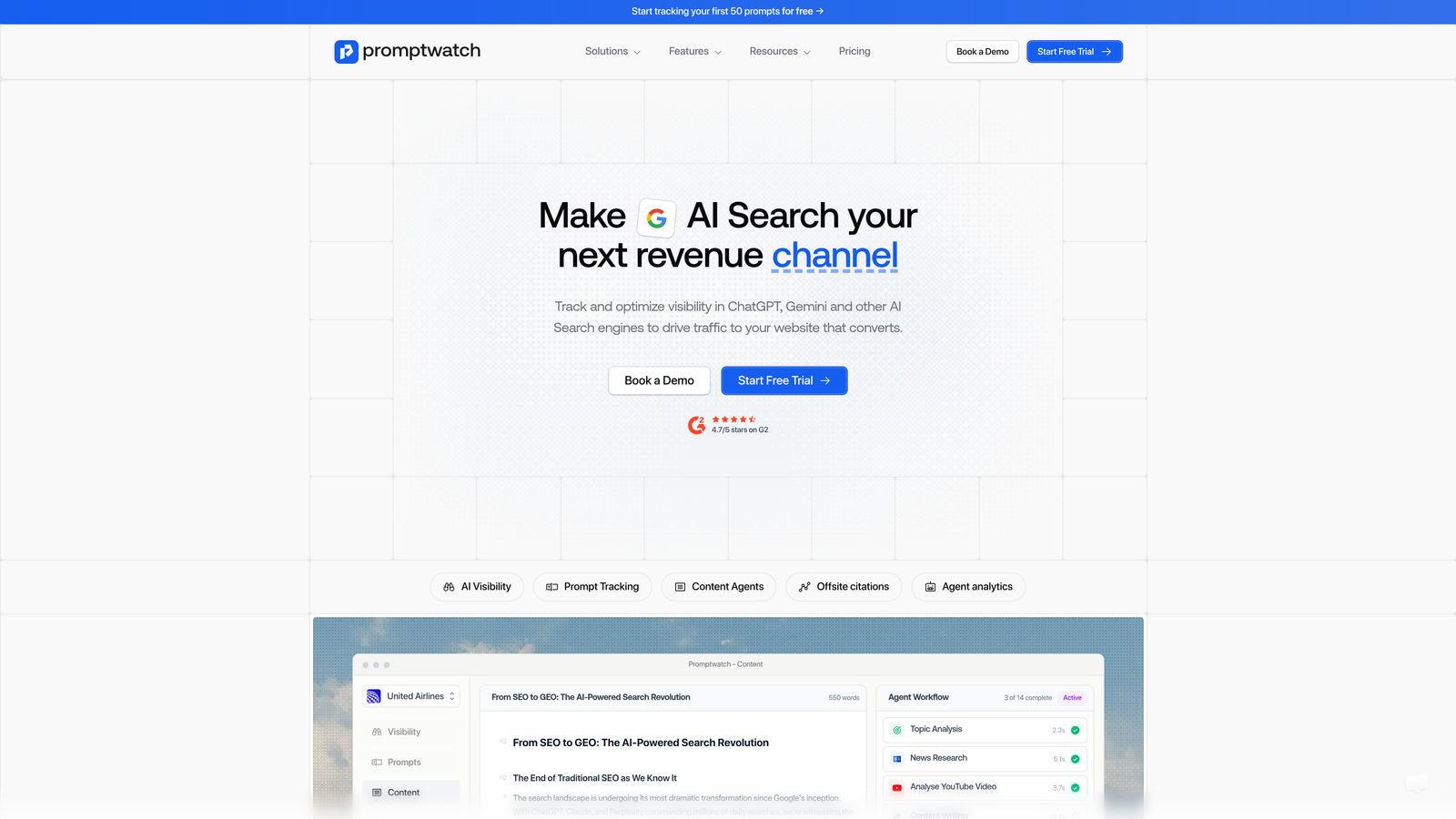
Promptwatch is a prompt monitoring and analytics platform that gives technical marketing and AI-forward teams visibility into how their LLM prompts perform over time across content generation workflows.
Where This Tool Shines
As content teams build more sophisticated AI workflows, prompt quality becomes a variable that directly affects output quality. Promptwatch addresses a gap that most content teams don't notice until they're already experiencing it: prompt drift, where outputs degrade over time as models update or prompts become stale relative to the task.
For teams running large-scale content operations powered by custom prompts, having a dedicated layer for prompt versioning, quality monitoring, and performance comparison is the kind of operational discipline that separates reliable content systems from inconsistent ones.
Key Features
Prompt Versioning and Change Tracking: Maintain a full history of prompt changes and understand how modifications affect output quality over time.
LLM Output Monitoring: Track quality metrics across generated outputs to catch degradation before it affects published content.
Prompt Library Management: Organize and share prompts across content teams with structured access and documentation.
Performance Comparison: A/B test prompt iterations to identify which versions consistently produce better content.
LLM Provider Integrations: Connects with major LLM providers so monitoring works across your existing AI stack.
Best For
Promptwatch is best suited to technically-oriented content teams, AI engineers supporting marketing functions, and any team running content workflows where prompt quality is a meaningful production variable. It's an operational layer rather than a standalone content creation tool, and works best alongside a primary content generation platform.
Pricing
See promptwatch.io for current pricing details.
5. Profound
Best for: SEO strategists and content teams optimizing for AI answer engine visibility
Profound is an AI answer engine optimization platform that helps brands monitor how they appear in AI-generated search results and identify content gaps to improve GEO performance.

Where This Tool Shines
Profound is built for a problem that has emerged alongside the rise of AI search: your brand might rank well on Google but be largely absent from the AI-generated answers that users increasingly rely on for research and decision-making. Profound gives content and SEO teams the data to understand that gap and act on it.
The content gap identification feature is particularly practical. Rather than guessing which topics to cover for GEO improvement, Profound surfaces specific areas where AI models are answering questions in your category without referencing your brand, giving content teams a clear signal for where to invest.
Key Features
AI Answer Engine Monitoring: Tracks how your brand appears across major AI search platforms, providing ongoing visibility into AI-generated responses in your category.
Content Gap Identification: Surfaces topics where AI models answer relevant queries without mentioning your brand, highlighting specific content opportunities.
Brand Visibility Scoring: Quantifies your presence in AI-generated answers so teams can track progress over time.
Competitive AI Share of Voice: Benchmarks your AI visibility against competitors to contextualize performance and prioritize efforts.
GEO Content Recommendations: Provides actionable guidance on what content to create or update to improve performance in AI-generated answers.
Best For
Profound is a strong fit for SEO strategists, content directors, and digital marketing teams that have started incorporating GEO into their planning. It's particularly useful for brands in competitive categories where AI models are already shaping research and purchase decisions.
Pricing
See profound.co for current pricing information.
6. Peec
Best for: Content teams benchmarking AI brand visibility against competitors
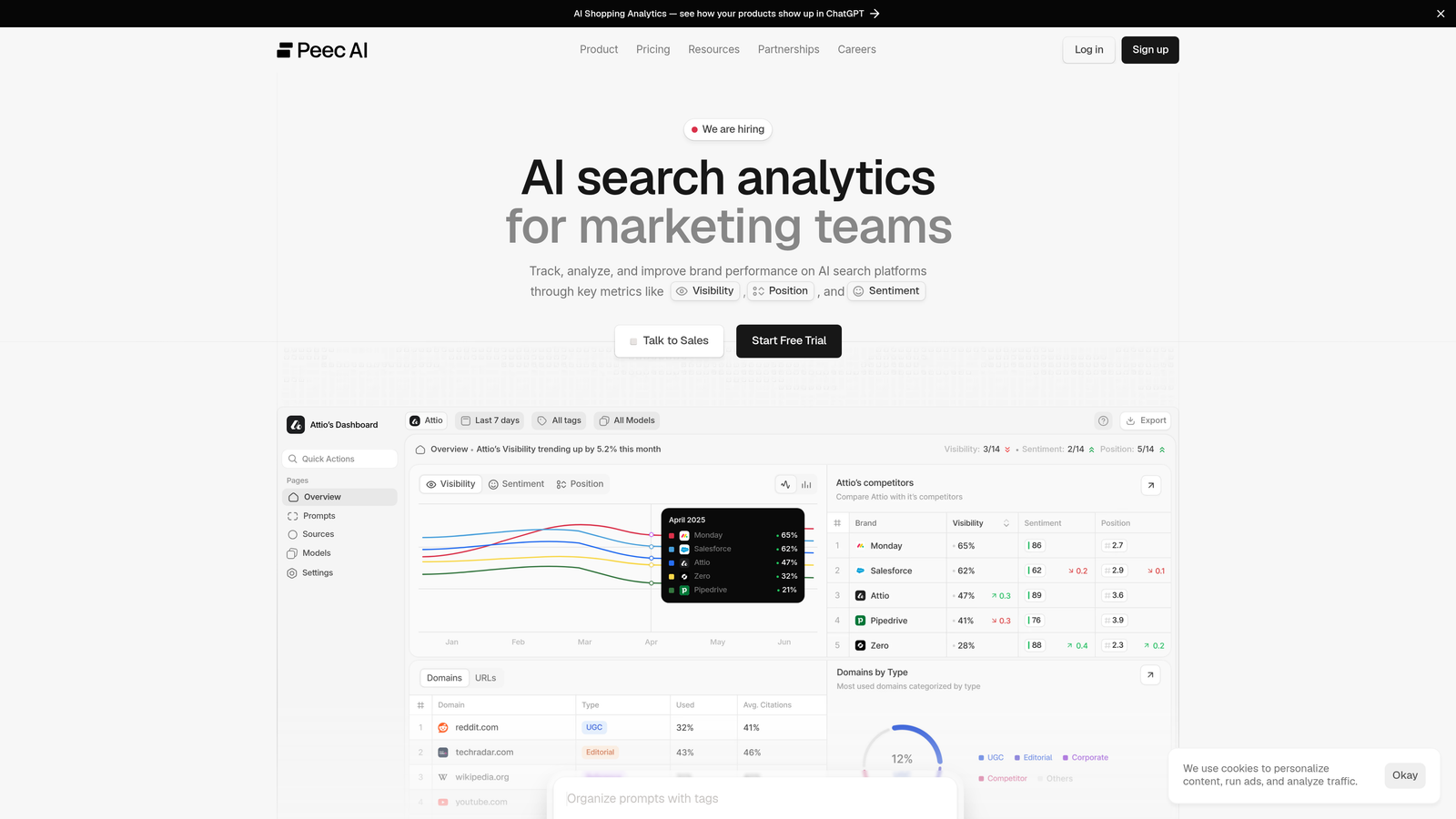
Peec is an AI brand mention tracking tool that benchmarks how often and how positively your brand appears in AI model responses compared to competitors, helping content teams align strategy with AI visibility goals.
Where This Tool Shines
Peec approaches AI visibility from a competitive intelligence angle. Rather than focusing solely on your own brand's presence in AI responses, it helps you understand your position relative to others in your category. That competitive context is often what translates AI visibility data into actionable content decisions.
The sentiment analysis layer adds nuance that raw mention counts don't capture. Knowing that your brand is mentioned frequently but with neutral or negative framing in AI responses is a very different strategic signal from being mentioned positively, and Peec surfaces that distinction.
Key Features
AI Brand Mention Tracking: Monitors how often your brand appears in responses across multiple AI platforms, providing a consistent baseline for measurement.
Competitive Benchmarking: Compares your AI share of voice against named competitors so you can contextualize your visibility performance.
Sentiment Analysis: Evaluates the tone and framing of brand mentions in AI responses, not just frequency.
Content Strategy Recommendations: Translates AI visibility data into specific content actions to improve brand representation in AI-generated answers.
Ongoing Monitoring Dashboard: Provides a persistent view of AI brand presence so teams can track changes over time as they publish new content.
Best For
Peec is well-suited to brand marketers, content strategists, and competitive intelligence teams that want to understand their AI share of voice in a competitive context. It works as a standalone monitoring tool or alongside a content creation platform to close the loop between publishing and AI visibility outcomes.
Pricing
See peec.ai for current pricing details.
Which Tool Is Right for Your Content Engine?
The right tool depends on where your biggest gap is: content production, AI discoverability, or both.
If you need an all-in-one platform that handles content creation and tracks whether AI models are actually citing your brand, Sight AI is the clear choice. It's the only tool on this list that combines SEO and GEO-optimized content generation with real-time AI visibility monitoring, making it especially valuable as AI answer engines become a primary discovery channel.
For pure content volume with solid SEO features, Writesonic delivers reliable output at scale. For enterprise teams that need to build custom content production systems, AirOps provides the workflow infrastructure to do that without engineering overhead. For AI visibility monitoring focused on competitive benchmarking, Profound and Peec each offer strong tracking capabilities from complementary angles. And for teams managing complex prompt pipelines, Promptwatch adds an important operational oversight layer.
The broader shift toward AI-generated answers in search means content strategy can no longer stop at Google rankings. You need to know how AI models represent your brand, and you need content that earns those citations. Tools that combine content creation with AI visibility tracking will have a compounding advantage in 2026 and beyond.
Stop guessing how AI models like ChatGPT and Claude talk about your brand. Start tracking your AI visibility today and see exactly where your brand appears across top AI platforms. For more on building a content system that drives organic growth, explore our guides on how to automate content creation and how to increase organic traffic.