Automated publishing platforms have moved well beyond simple scheduling. Today's best tools combine AI content generation, SEO and GEO optimization, CMS integration, and indexing automation into unified workflows, so marketers, founders, and agencies can publish at scale without sacrificing quality or search visibility.
The challenge is knowing which platform to trial first. Some tools excel at generating high volumes of SEO-optimized content. Others are built for custom workflow automation, prompt governance, or tracking how your brand appears in AI-generated answers from models like ChatGPT and Claude. A handful try to do all of it.
This guide covers the top automated publishing platforms worth testing in 2026, evaluated on content quality, AI capabilities, publishing automation depth, indexing speed, and pricing transparency. We've featured Sight AI at the top given its genuinely all-in-one approach, but every tool here earns its place on merit.
1. Sight AI
Best for: Teams that need AI content generation, CMS publishing, indexing automation, and AI visibility tracking in one platform.
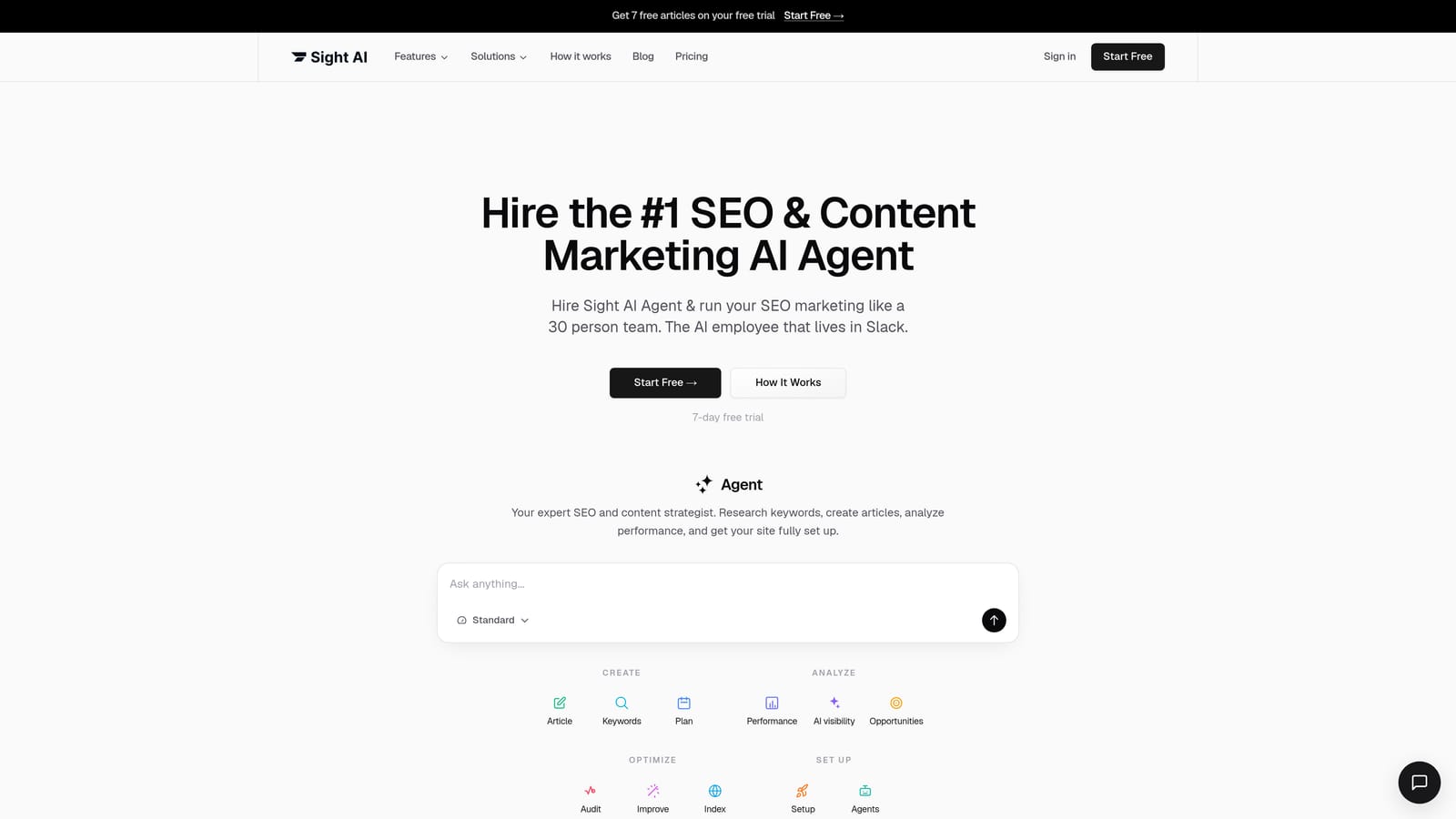
Sight AI is an all-in-one platform combining AI-powered content generation, CMS auto-publishing, IndexNow-integrated website indexing, and AI visibility tracking across 6+ AI models including ChatGPT, Claude, and Perplexity.
Where This Tool Shines
Most publishing platforms solve one piece of the puzzle. Sight AI is notable for solving several simultaneously. You can generate SEO and GEO-optimized content, publish it directly to your CMS, trigger indexing through IndexNow, and then track whether that content is influencing how AI models talk about your brand, all within the same platform.
The Autopilot Mode is where this becomes genuinely compelling for agencies and growth teams. Rather than manually triggering each stage of a content pipeline, Autopilot handles generation, publishing, and sitemap updates in a near-fully automated loop. For teams trying to compound organic traffic without compounding headcount, that's a meaningful operational advantage.
Key Features
13+ Specialized AI Agents: Purpose-built agents handle different content formats including listicles, how-to guides, explainers, and comparison articles, each optimized for its specific structure and search intent.
Autopilot Mode: Enables near-fully automated content pipelines from generation through publishing and indexing, reducing manual intervention at each stage.
CMS Auto-Publishing with Sitemap Updates: Publishes content directly to your CMS and automatically updates your sitemap so new pages are discoverable immediately.
IndexNow Integration: Submits new content to search engines via IndexNow upon publishing, accelerating the time between publication and search discovery.
AI Visibility Score: Tracks how your brand is mentioned across ChatGPT, Claude, Perplexity, and 3+ additional AI platforms, including sentiment analysis and prompt-level tracking.
GEO-Optimized Content Generation: Generates content structured to improve brand representation in AI-generated answers, not just traditional search rankings.
Best For
Sight AI is the strongest fit for marketers, founders, and agencies who need to address both traditional SEO and AI search presence simultaneously. If your team is asking "how do we appear in ChatGPT responses?" alongside "how do we rank on Google?", this platform is built for exactly that dual mandate. It's particularly well-suited for teams that want automation depth without stitching together multiple tools.
Pricing
A trial is available at trysight.ai. Paid plans are tiered to accommodate different team sizes and publishing volumes. Check the site for current plan details.
2. Writesonic
Best for: Content teams and agencies needing high-volume SEO-optimized article production with CMS publishing integrations.
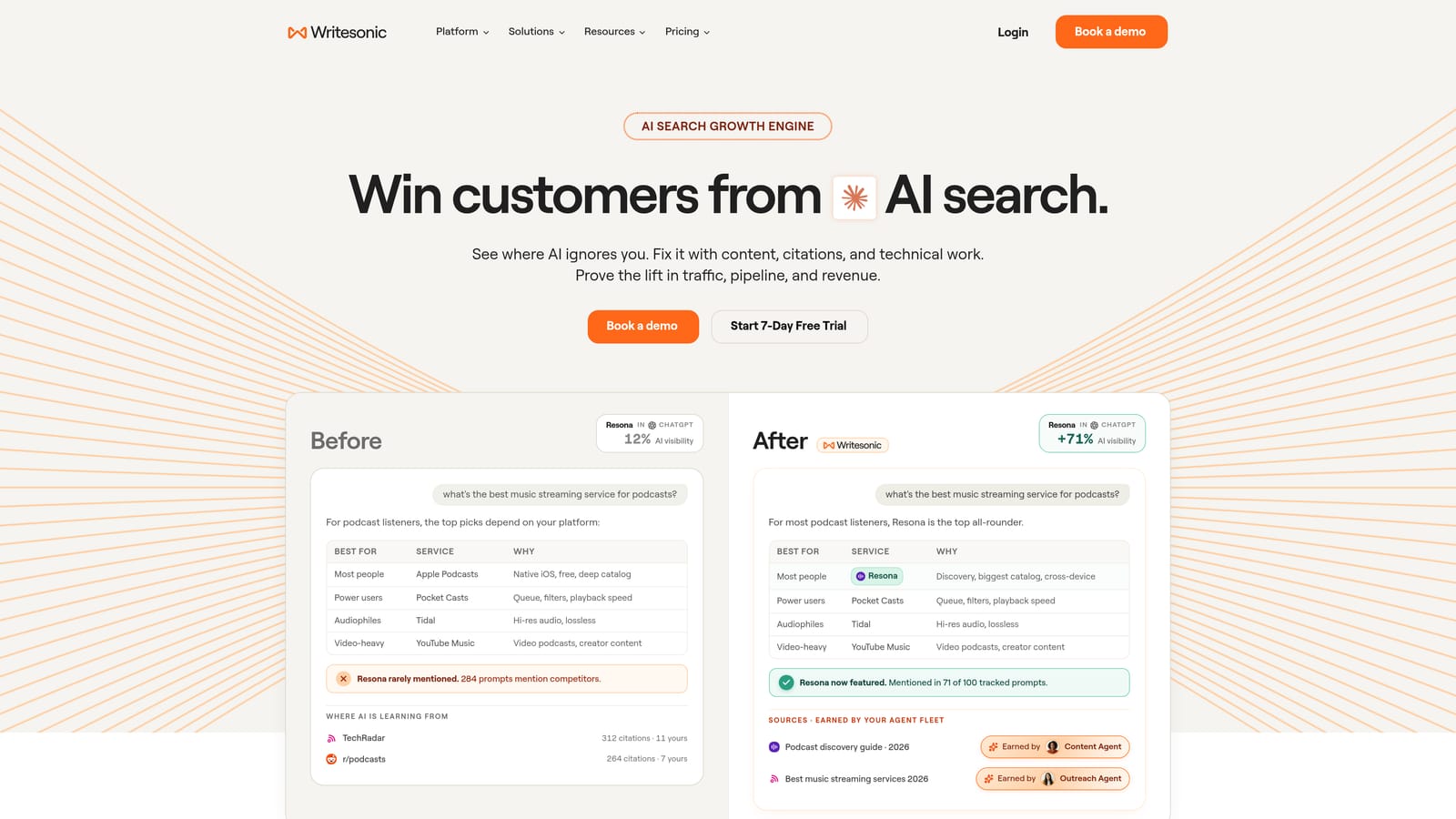
Writesonic is an AI content generation platform designed for producing large quantities of SEO-optimized articles, landing pages, and long-form content with built-in CMS publishing capabilities.
Where This Tool Shines
Writesonic's core strength is throughput. If your primary bottleneck is producing enough content to compete in competitive search verticals, it handles keyword-targeted article generation at a pace that manual writing teams simply cannot match. The output quality is solid for SEO-focused content, and the brand voice customization helps maintain consistency across large content runs.
For agencies managing multiple client accounts, the bulk content generation capabilities reduce the per-article production cost significantly. It's a mature platform with a track record in the AI writing space, and the WordPress integration means content can move from generation to publication without excessive manual handling.
Key Features
AI Article Writer with Keyword Targeting: Generates long-form articles optimized around target keywords, with SEO structure built into the output.
Multiple Content Format Support: Handles long-form articles, landing pages, product descriptions, and other formats within a single platform.
WordPress and CMS Publishing Integrations: Connects directly to WordPress and select CMS platforms for streamlined publishing workflows.
Brand Voice Customization: Allows teams to define and maintain consistent tone and style across all generated content.
Bulk Content Generation: Supports generating multiple pieces of content simultaneously, suited for agencies and high-volume content operations.
Best For
Writesonic is a strong choice for content teams and agencies whose primary need is SEO article volume. It's less focused on AI visibility tracking or advanced indexing automation, so teams with those requirements will likely need to pair it with additional tools. For pure content production scale, it's one of the more capable options available.
Pricing
A free trial is available. Paid plans are structured around word volume and feature access. Check writesonic.com for current plan details and pricing tiers.
3. AirOps
Best for: Operations teams and agencies that want fully customizable, programmable AI content workflows connecting generation to CMSs and data sources.
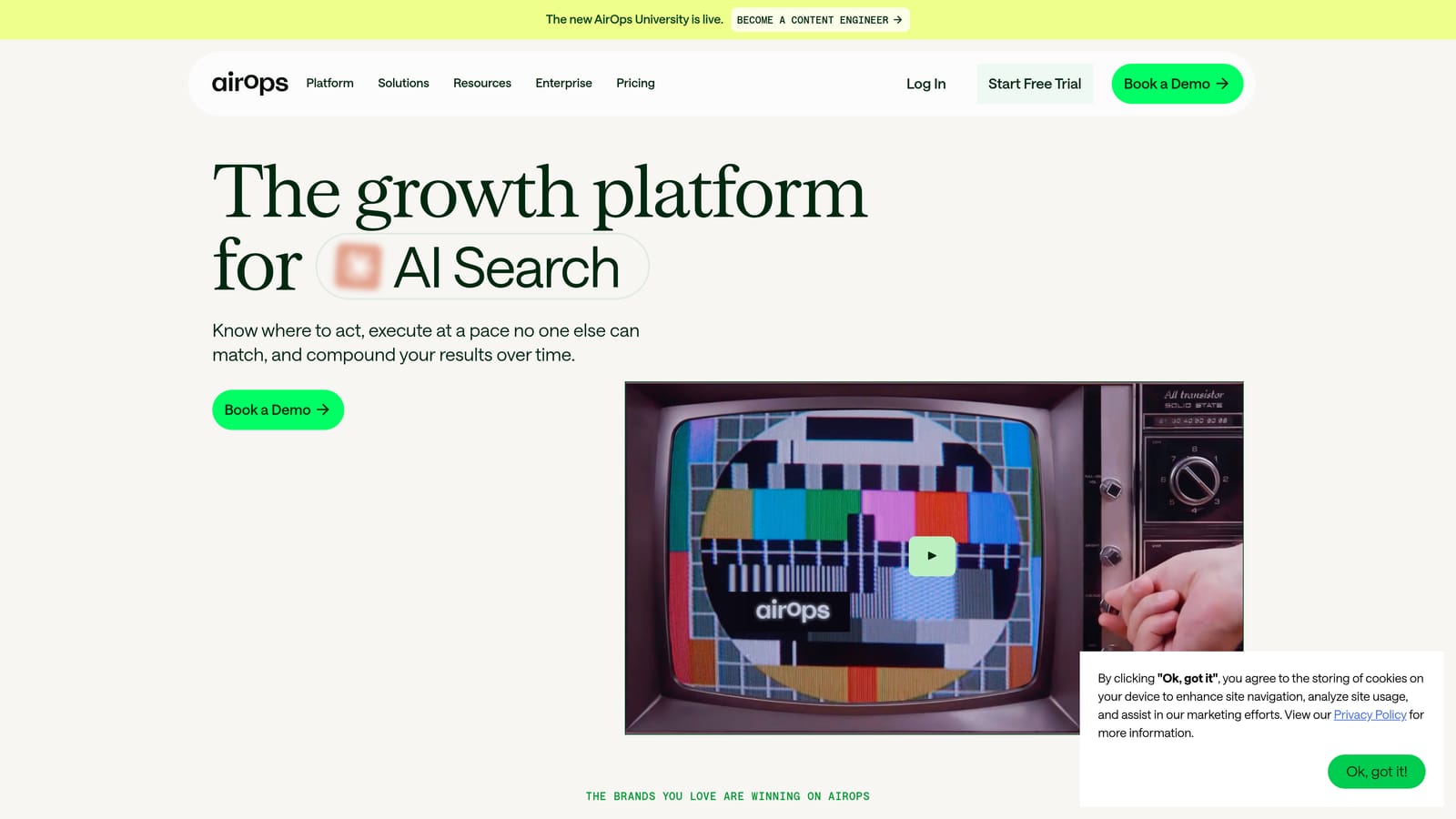
AirOps is an AI workflow automation platform that enables teams to build custom, repeatable content pipelines connecting AI generation to CMSs, databases, and other business tools.
Where This Tool Shines
AirOps takes a fundamentally different approach from turnkey publishing platforms. Rather than giving you a pre-built content pipeline, it gives you the infrastructure to build your own. The visual workflow builder lets teams connect AI models, data sources, CMSs, and spreadsheets into sequences that match their specific operational requirements.
This flexibility is genuinely powerful for agencies running data-driven content at scale. Think programmatic content generation where each article pulls from a product database, or workflows that route content through review steps before publishing. The tradeoff is setup investment: AirOps rewards teams who take time to architect their workflows thoughtfully, and it's less suited for teams who want something working out of the box.
Key Features
Visual Workflow Builder: Drag-and-drop interface for constructing AI-powered content operations without requiring engineering resources.
CMS, Spreadsheet, and Data Source Integrations: Connects to a wide range of tools so content generation can be informed by real data rather than prompts alone.
Multi-Model Support: Allows teams to incorporate multiple AI models within a single workflow, optimizing different steps for different model strengths.
Template Library: Pre-built templates for common content automation scenarios accelerate initial setup for standard use cases.
Team Collaboration and Workflow Sharing: Workflows can be shared and iterated across team members, supporting larger content operations.
Best For
AirOps is best suited for operations-oriented teams and agencies that have specific, complex content workflows they want to automate precisely. It's a strong fit when off-the-shelf publishing platforms don't match your process. Teams looking for a simpler, faster path to publishing automation may find the setup overhead significant.
Pricing
Plans are tiered based on usage volume. A trial is available at airops.com. Check the site for current pricing details.
4. Promptwatch
Best for: Teams running high-volume AI content pipelines who need prompt governance, versioning, and quality consistency monitoring.
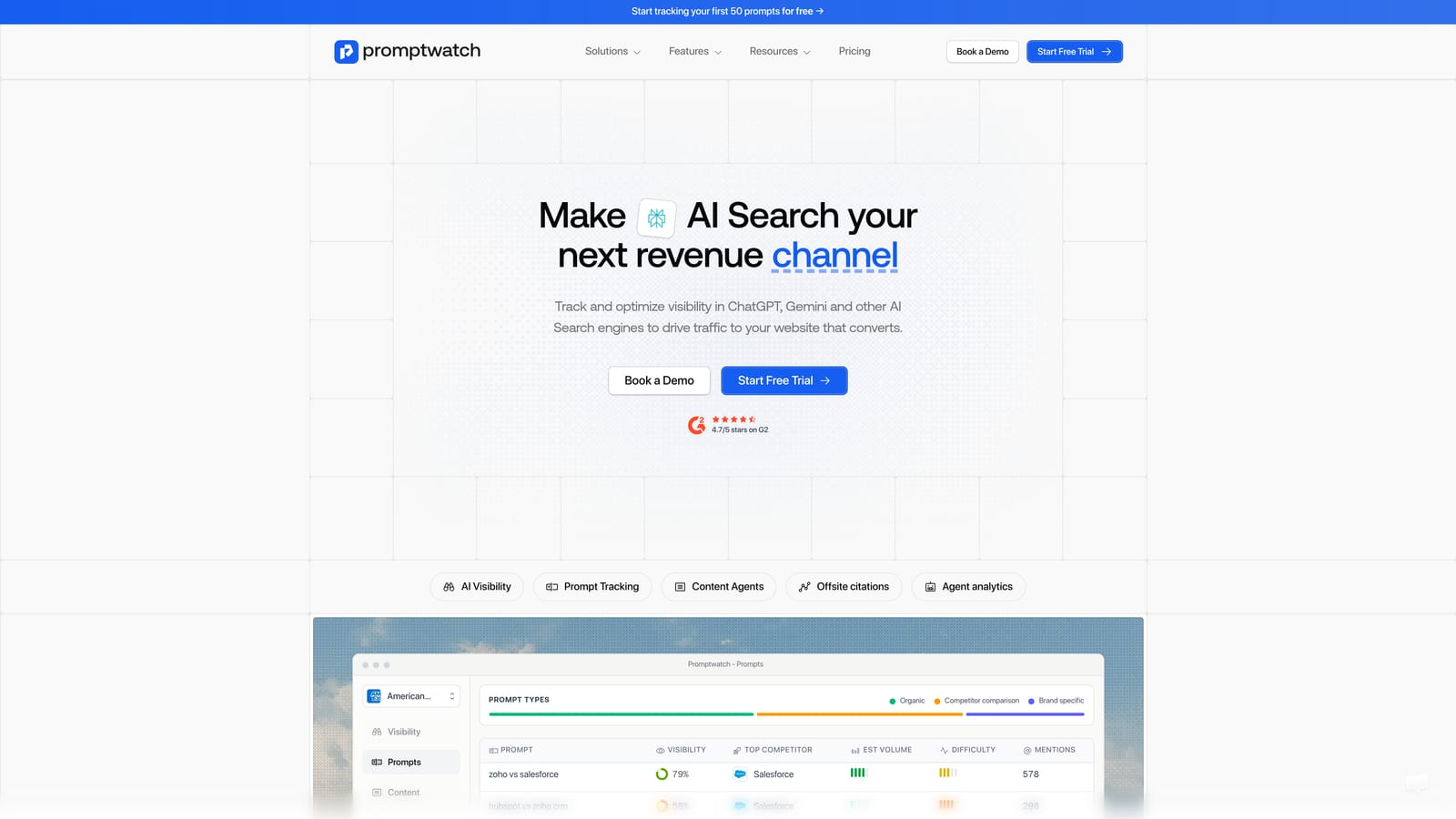
Promptwatch is a prompt monitoring and management tool that helps teams track, version, and optimize the AI prompts powering their content generation workflows.
Where This Tool Shines
Here's a problem that emerges as AI content operations scale: the prompts driving your content generation drift, get edited inconsistently, or produce variable quality across team members and runs. Promptwatch is built specifically to address this. It brings version control and performance tracking to the prompts themselves, not just the content they produce.
For content teams running dozens or hundreds of AI content pieces per month, this kind of governance matters. Knowing which prompt version produced your best-performing articles, and being able to roll back or iterate systematically, is the difference between a repeatable content operation and an unpredictable one. Promptwatch is a specialist tool: it complements publishing platforms rather than replacing them, but it fills a real gap in quality control.
Key Features
Prompt Versioning: Maintains a history of prompt iterations so teams can track changes and revert to previous versions when needed.
Performance Tracking: Monitors output quality across prompt versions to identify which prompts consistently produce the best results.
Quality Consistency Monitoring: Flags inconsistencies in AI output quality across content runs, supporting higher standards at scale.
AI Model and Tool Integrations: Connects with major AI models and content generation tools to sit within existing workflows.
Team-Level Prompt Governance: Enables centralized management and sharing of approved prompts across a content team.
Best For
Promptwatch is most valuable for teams already running AI content at significant volume who are experiencing quality inconsistency or prompt management friction. It's a complementary tool rather than a standalone publishing solution, and it's best evaluated alongside a primary content generation and publishing platform.
Pricing
Check promptwatch.io for current plan details and trial options.
5. Profound
Best for: Brands and agencies focused on understanding and improving their presence in AI-generated answers across major AI platforms.
Profound is an AI answer engine optimization platform that tracks how brands appear in AI-generated responses and helps teams develop more effective GEO strategies.
Where This Tool Shines
Generative Engine Optimization is a newer discipline, but it's becoming a meaningful part of how brands think about search visibility. When someone asks ChatGPT or Perplexity a question in your category, does your brand appear in the response? Is the sentiment positive? Are competitors mentioned more prominently? Profound is built to answer these questions systematically.
The competitive visibility analysis is particularly useful for brands trying to understand where they stand relative to competitors in AI-generated responses. Rather than guessing at GEO strategy, Profound provides data on actual AI model behavior, which makes content and optimization decisions considerably more informed. Like Promptwatch, it's a specialist tool that pairs with content generation platforms rather than replacing them.
Key Features
Brand Mention Tracking in AI Answers: Monitors how and when your brand appears in responses from AI answer engines across multiple platforms.
Competitive Visibility Analysis: Compares your brand's AI answer engine presence against competitors to identify gaps and opportunities.
GEO Strategy Recommendations: Provides guidance on content and optimization approaches based on observed AI model behavior.
Brand Sentiment Reporting: Analyzes the tone and context of brand mentions within AI-generated outputs.
Multi-Platform Monitoring: Tracks brand representation across multiple AI platforms rather than a single model.
Best For
Profound is well-suited for marketing teams and agencies that have identified AI answer engine visibility as a strategic priority and need data to guide their GEO efforts. It's most effective when paired with a content generation platform that can act on its insights.
Pricing
Check getprofound.com for current plan details and trial options.
6. Peec
Best for: Brands seeking competitive intelligence on how they and their rivals are represented across AI-powered search surfaces.
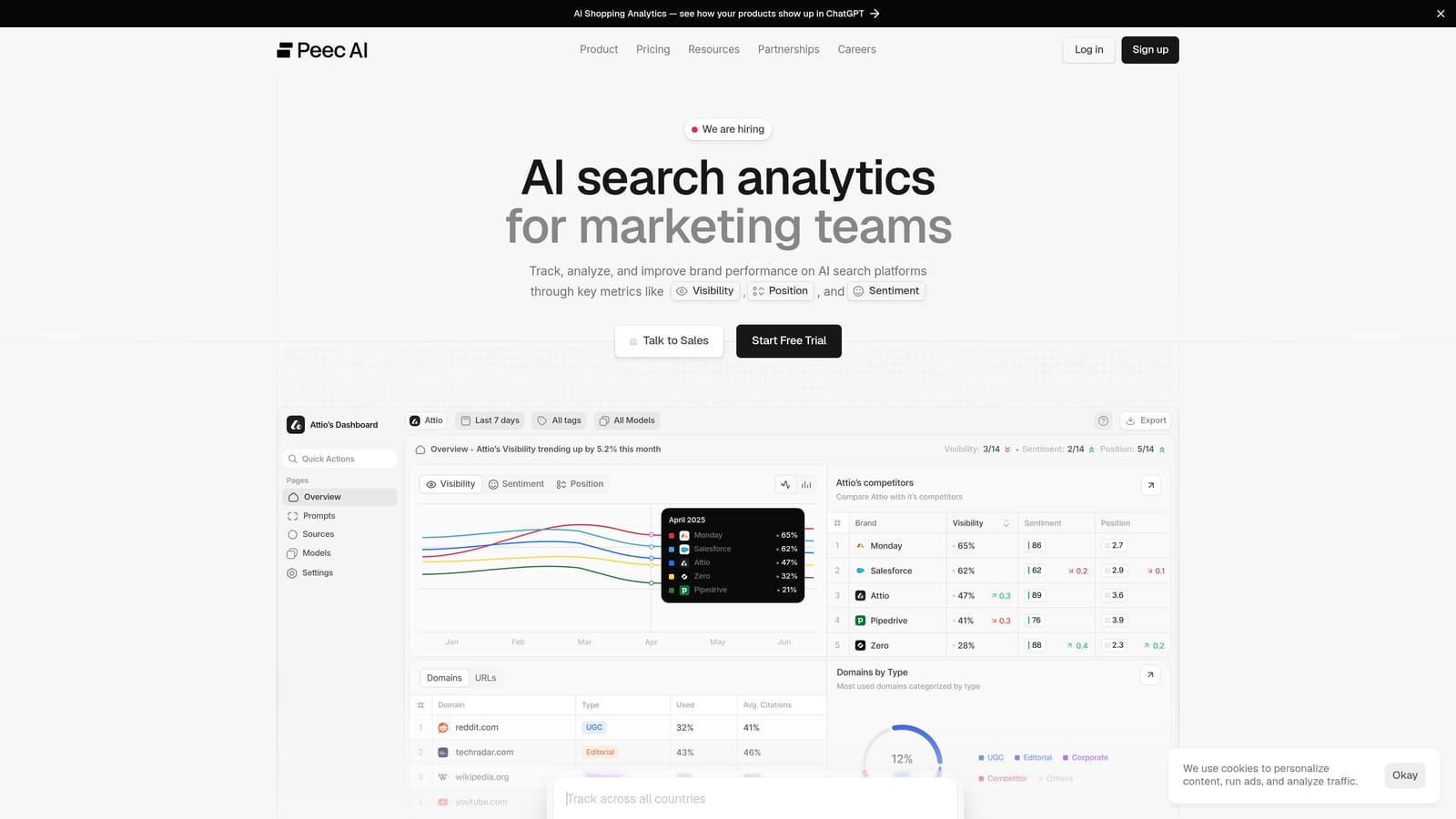
Peec is an AI search visibility monitoring platform providing competitive intelligence on how brands are represented across AI-powered search surfaces.
Where This Tool Shines
Peec focuses on the competitive dimension of AI search visibility. Where Profound emphasizes GEO strategy recommendations, Peec leans into comparative brand intelligence: how does your AI search presence stack up against specific competitors, which topics and keywords drive AI-generated mentions, and how is that representation trending over time?
For brands in competitive categories where AI search presence is becoming a meaningful traffic driver, that competitive lens is valuable. The trend monitoring capability is particularly useful for identifying whether optimization efforts are moving the needle, or whether a competitor is gaining ground in AI-generated answers. Like Profound, Peec is a monitoring and analytics tool rather than a publishing platform, and it's most powerful when combined with tools that can generate and publish content in response to its insights.
Key Features
AI Search Presence Tracking and Scoring: Quantifies your brand's visibility across AI search surfaces with a structured scoring system.
Competitive Brand Comparison: Benchmarks your AI search presence against named competitors across multiple platforms.
Keyword and Topic Visibility: Identifies which keywords and topics are driving AI-generated mentions for your brand and competitors.
Trend Monitoring: Tracks changes in brand representation over time to measure the impact of content and optimization efforts.
Actionable Visibility Insights: Translates monitoring data into specific recommendations for improving AI search presence.
Best For
Peec is a strong fit for brands and agencies that want to treat AI search visibility as a measurable, competitive metric. It's best used alongside a content generation and publishing platform that can execute on its findings. Teams primarily focused on content production volume will likely prioritize other tools first.
Pricing
Check peec.ai for current plan details and trial options.
Which Platform Matches Your Workflow?
The right platform depends entirely on where your biggest bottleneck sits right now. Here's a practical breakdown to help you decide where to start your trial.
For all-in-one publishing and AI visibility: Sight AI is the only platform on this list that genuinely combines content generation, CMS auto-publishing, IndexNow-integrated indexing, and AI visibility tracking in a single workflow. If you need to address both traditional SEO and AI search presence without stitching together multiple tools, it's the natural starting point.
For high-volume SEO content production: Writesonic is a proven choice for content teams and agencies whose primary need is publishing volume at speed. It handles keyword-targeted article generation well and connects to WordPress without friction.
For custom, programmable content pipelines: AirOps rewards teams willing to invest in workflow architecture. If your content operation has specific data inputs, review stages, or CMS routing requirements that off-the-shelf platforms can't accommodate, it's worth the setup investment.
For prompt governance and quality control: Promptwatch belongs in the stack of any team running AI content at significant volume. It's a specialist tool, not a publishing platform, but it solves a real problem that emerges as content operations scale.
For AI answer engine monitoring and GEO intelligence: Profound and Peec both serve the AI visibility analytics space with different emphases. Profound leans toward GEO strategy recommendations; Peec leans toward competitive benchmarking. Both are best paired with a content platform that can act on their insights.
The broader pattern here is worth noting: automated publishing increasingly requires more than a scheduler and a CMS integration. AI visibility, GEO optimization, and indexing speed are now part of what it means to publish effectively in 2026. The tools that address all of those layers, rather than just one, will compound their value over time.
Stop guessing how AI models like ChatGPT and Claude talk about your brand. Start tracking your AI visibility today and see exactly where your brand appears across top AI platforms, alongside the content generation and publishing automation to act on what you find.