AI-powered search engines have fundamentally changed how people discover brands, products, and services. When someone asks ChatGPT to recommend a project management tool or asks Perplexity to suggest the best CRM for startups, the brands that appear in those answers win the click, the trust, and often the sale. Traditional SEO rankings matter less in that moment than whether your brand is cited at all.
The problem is scale. Monitoring how AI models respond to hundreds of brand-relevant prompts across six or more platforms is not something any team can do manually. AI visibility platforms automate that work, surfacing where your brand appears, how it's described, and where competitors are pulling ahead in AI-generated recommendations.
This review covers the top AI visibility platforms available in 2026, evaluated on monitoring depth, content capabilities, indexing features, and overall value. Whether you're a marketer trying to understand your AI footprint, a founder building brand authority, or an agency managing multiple clients, this guide will help you find the right tool for the job.
1. Sight AI
Best for: Teams that want AI visibility monitoring, GEO content creation, and automated indexing in one platform.
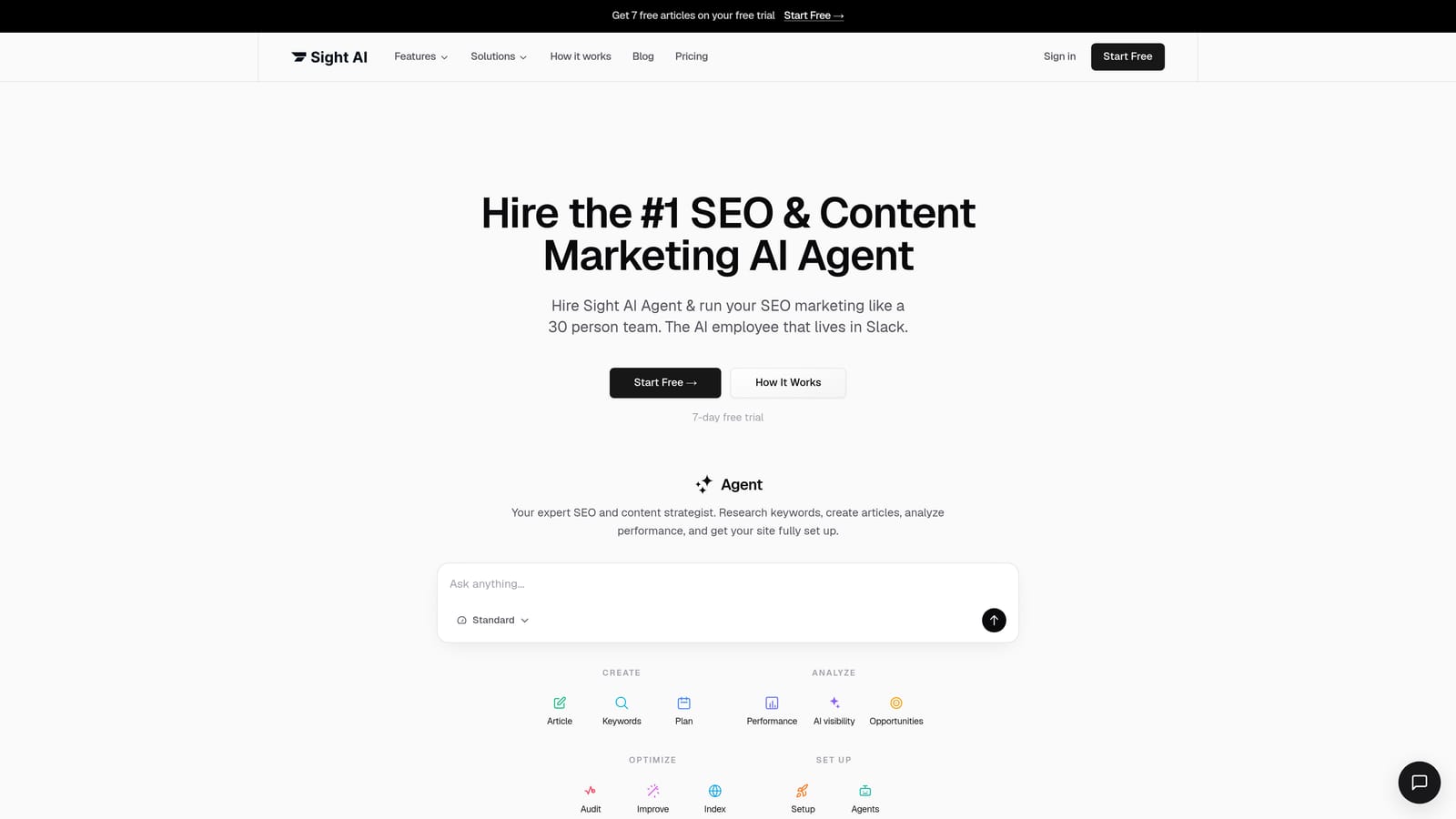
Sight AI is an all-in-one AI visibility platform that combines brand mention tracking across 6+ AI models, a specialized content writer powered by 13+ AI agents, and automated website indexing with IndexNow integration.
Where This Tool Shines
Most tools in this space do one thing well: they either monitor AI mentions or help you generate content. Sight AI is the only platform reviewed here that connects both sides of the equation. You can see exactly how AI models describe your brand today, identify the content gaps driving those responses, and then create and publish optimized content to improve your positioning, all without switching platforms.
The Autopilot Mode is particularly valuable for teams with limited bandwidth. It handles content generation and CMS publishing automatically, which means your AI visibility strategy can run in the background while your team focuses elsewhere. For agencies and growth-focused founders, that kind of leverage is hard to overstate.
Key Features
AI Visibility Score: Tracks how your brand is mentioned across ChatGPT, Claude, Perplexity, and other major AI platforms, with sentiment analysis to show whether mentions are positive, neutral, or negative.
Prompt Tracking: Monitors how AI models respond to specific brand-relevant queries over time, so you can detect shifts in how your brand is perceived or recommended.
13+ Specialized AI Agents: Generates SEO and GEO-optimized content formats including listicles, guides, and explainers, each built to increase the likelihood of AI citation.
Autopilot Mode: Automates the full content pipeline from generation to CMS publishing, enabling hands-free content operations at scale.
IndexNow Integration: Submits new content to search engines automatically and keeps your sitemap updated, accelerating content discovery and reducing indexing delays.
Best For
Sight AI is best suited for marketers, founders, and agencies who want a complete AI visibility solution rather than a point tool. If you need to monitor AI mentions, create content that earns AI citations, and ensure that content gets indexed quickly, this is the only platform that handles all three from a single dashboard.
Pricing
Sight AI offers multiple plan tiers. Visit trysight.ai for current pricing details, as plans and features are updated regularly.
2. Profound
Best for: Enterprise marketing and brand teams that need deep AI answer analytics and reporting.
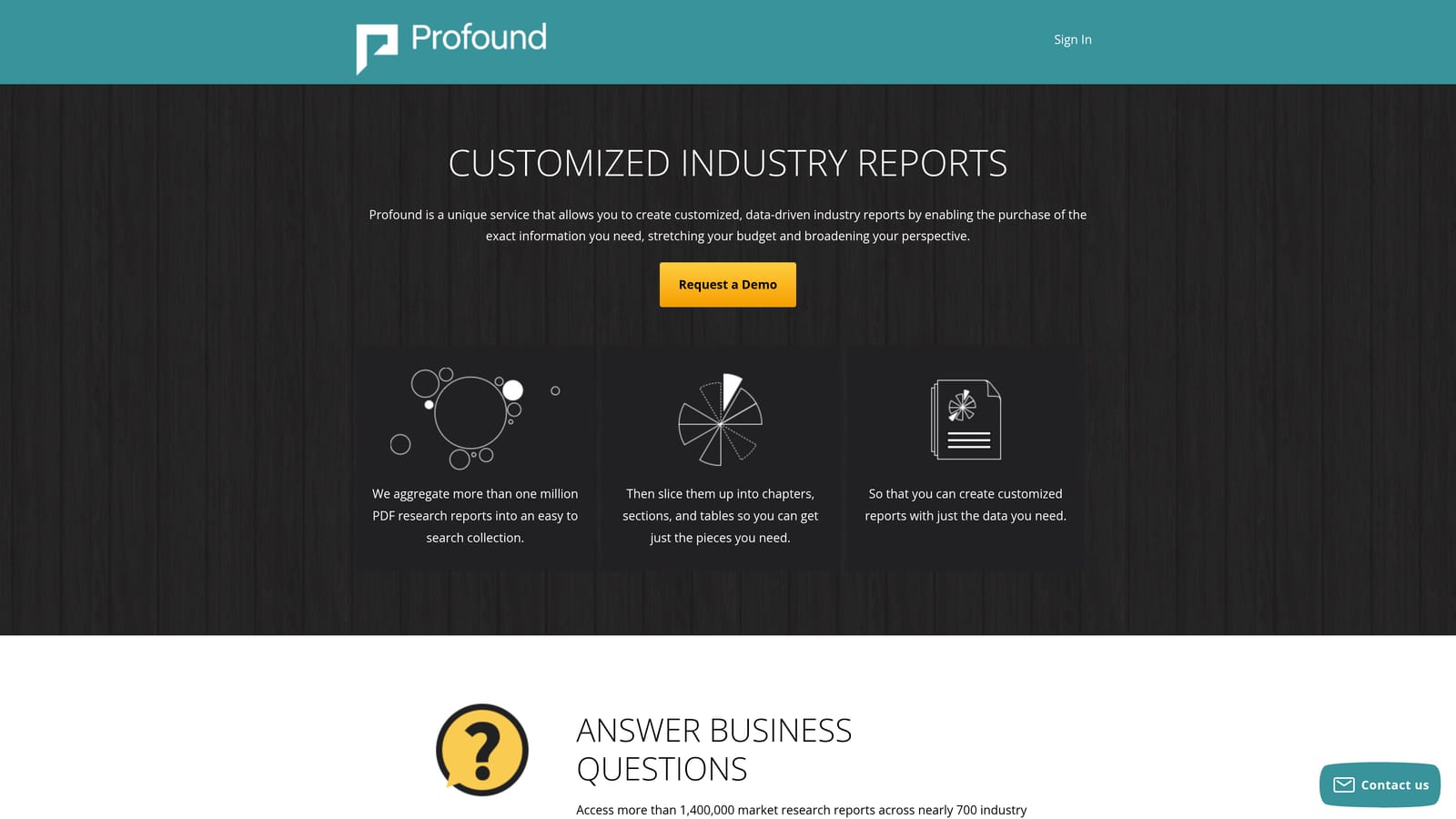
Profound is an enterprise-focused AI answer monitoring platform built for teams that need structured analytics around how AI models respond to brand and category-level queries.
Where This Tool Shines
Profound's strength is in its analytics layer. Rather than offering surface-level mention tracking, it provides detailed visibility into how AI models frame your brand within broader category conversations. That context matters for enterprise teams trying to understand competitive positioning, not just raw mention counts.
The competitive share-of-voice analysis is a standout feature for brand strategists. If your category is crowded and you need to understand which brands AI models are recommending most frequently, Profound gives you a structured way to measure that over time.
Key Features
AI Answer Monitoring: Tracks how major LLM platforms respond to brand and category-level queries across a range of prompts.
Brand and Category Query Tracking: Segments monitoring by brand-specific queries and broader category terms, giving teams a layered view of AI presence.
Enterprise Analytics Dashboard: Provides reporting tools designed for marketing and brand teams that need to present AI visibility data to stakeholders.
Competitive Share-of-Voice Analysis: Measures how your brand stacks up against competitors in AI-generated outputs, helping teams prioritize content and positioning efforts.
Best For
Profound is best suited for enterprise marketing teams and brand managers at larger organizations where structured reporting, stakeholder-ready dashboards, and category-level intelligence are priorities. It is less focused on content creation or indexing, so teams needing those capabilities will want to pair it with additional tools.
Pricing
Profound uses enterprise pricing. Contact their team or visit profound.com for current plan details and to request a demo.
3. Promptwatch
Best for: SEO researchers and brand teams studying how AI model responses evolve over time.
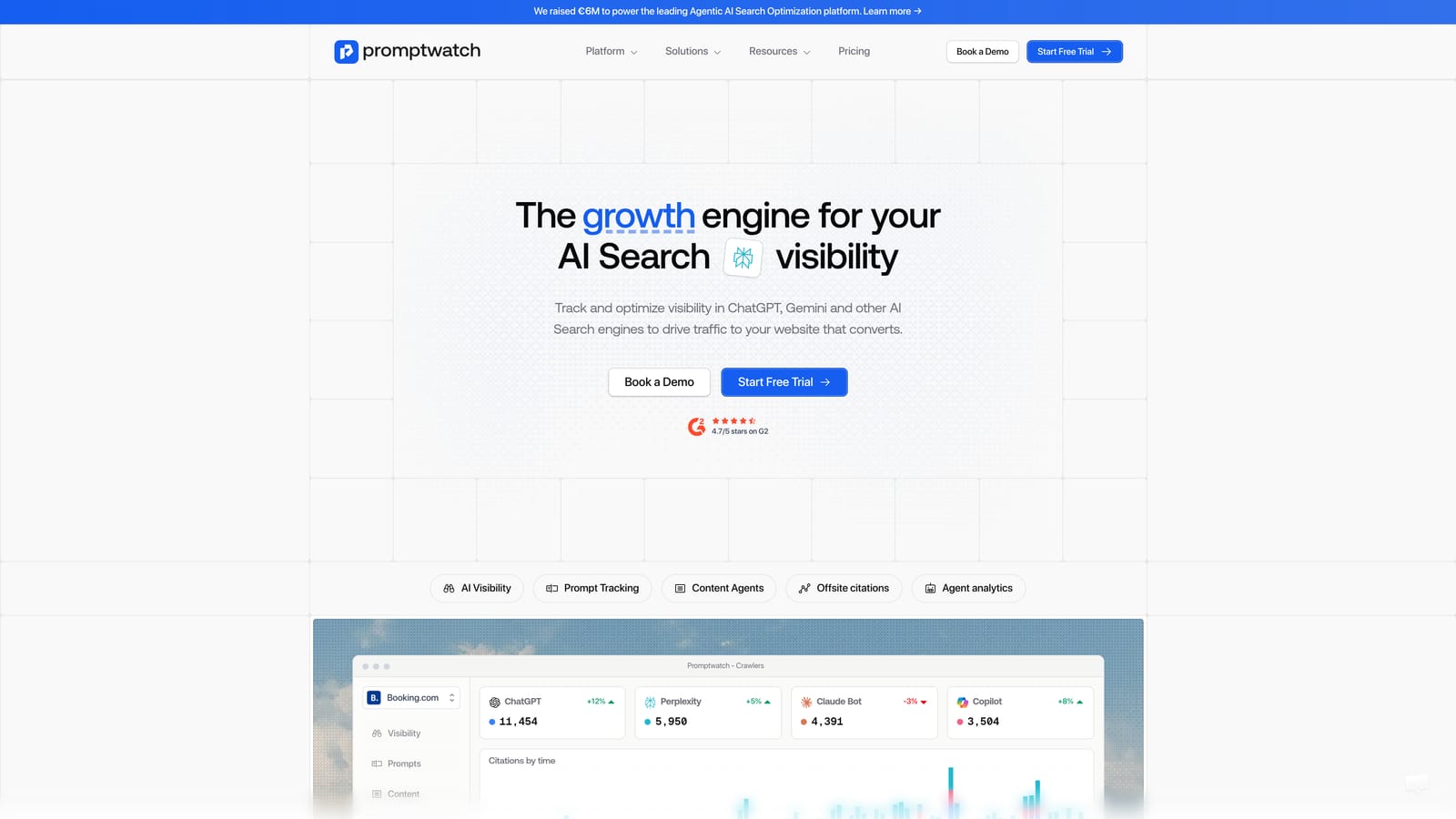
Promptwatch is a specialized AI visibility tool focused on prompt-level tracking, monitoring how specific prompts and brand-related queries change in AI model responses over time.
Where This Tool Shines
Promptwatch takes a more granular approach than most platforms in this category. Instead of broad brand monitoring, it zeroes in on how individual prompts evolve, which is particularly useful for understanding why AI models suddenly start or stop recommending your brand for a specific query type.
For SEO professionals who are actively studying AI response behavior, this longitudinal tracking capability is genuinely useful. You can observe how a model's response to a prompt shifts over weeks or months, which helps you understand what content changes or external factors may be influencing AI recommendations in your space.
Key Features
Prompt Variation Tracking: Monitors specific prompt variations and records how AI-generated responses change over time, giving you a historical record of brand positioning in AI outputs.
Brand Mention Detection: Identifies when and how your brand appears within AI-generated answers for tracked queries.
AI Response Pattern Analysis: Useful for researchers and strategists who want to understand the underlying patterns driving AI brand recommendations.
Longitudinal Tracking: Captures shifts in AI brand perception over extended periods, helping teams identify trends rather than just snapshots.
Best For
Promptwatch is a strong fit for SEO researchers, content strategists, and brand teams that want to deeply understand how AI response patterns evolve. It is more of a research and analysis tool than an action-oriented platform, so teams looking for content creation or automated publishing capabilities will need to supplement it with other tools.
Pricing
Visit promptwatch.io for current pricing and plan information.
4. Peec
Best for: Agencies and brand teams focused on competitive AI visibility benchmarking.
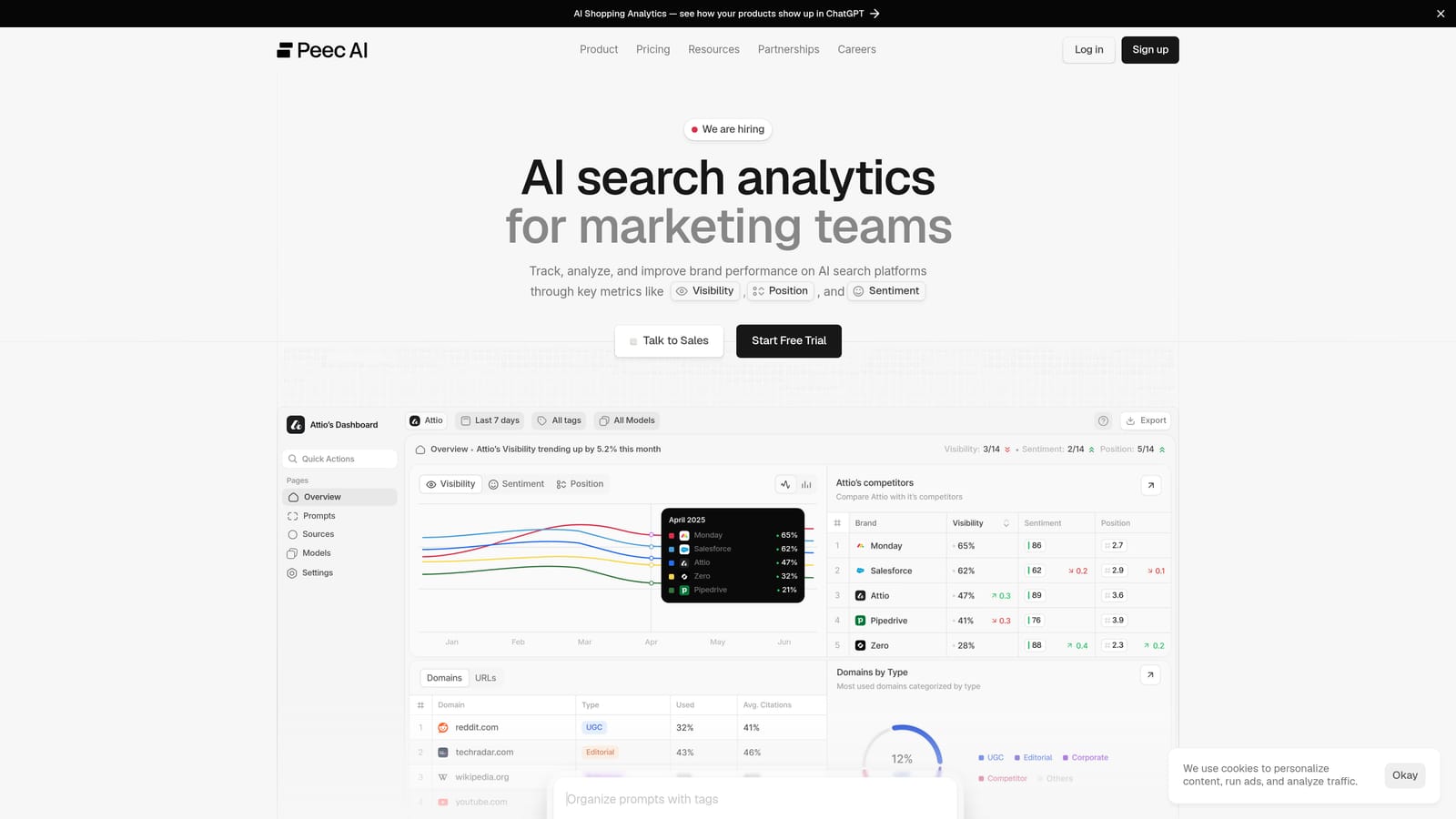
Peec is a competitive AI visibility benchmarking tool that enables brands and agencies to compare their AI presence against competitors side by side across major AI search platforms.
Where This Tool Shines
Where most AI visibility tools focus on your own brand's presence, Peec is built around competitive context. The side-by-side comparison view makes it immediately clear where competitors are outperforming you in AI-generated recommendations, which turns abstract visibility data into actionable competitive intelligence.
For agencies managing multiple clients across different verticals, the multi-client management features reduce the overhead of running competitive analyses at scale. You can track several brands and their competitors from a single workspace, which is a meaningful time saver for teams running regular AI visibility audits.
Key Features
Side-by-Side AI Visibility Scoring: Compares your brand's AI presence directly against named competitors, making gaps and advantages immediately visible.
Competitive Benchmarking: Tracks how brands rank in AI search outputs across multiple platforms, providing a structured competitive view of AI visibility.
Multi-Client Management: Designed with agencies in mind, allowing teams to manage competitive benchmarking across multiple client accounts from one interface.
Visibility Trend Tracking: Monitors how competitive positioning shifts over time, helping teams identify whether their content efforts are moving the needle relative to competitors.
Best For
Peec is an excellent choice for digital agencies and in-house brand teams where competitive benchmarking is a core deliverable. If your primary question is "how does our AI visibility compare to our competitors?" rather than "how do we create more AI-cited content?", Peec is purpose-built for that use case.
Pricing
Visit peec.ai for current pricing and plan options.
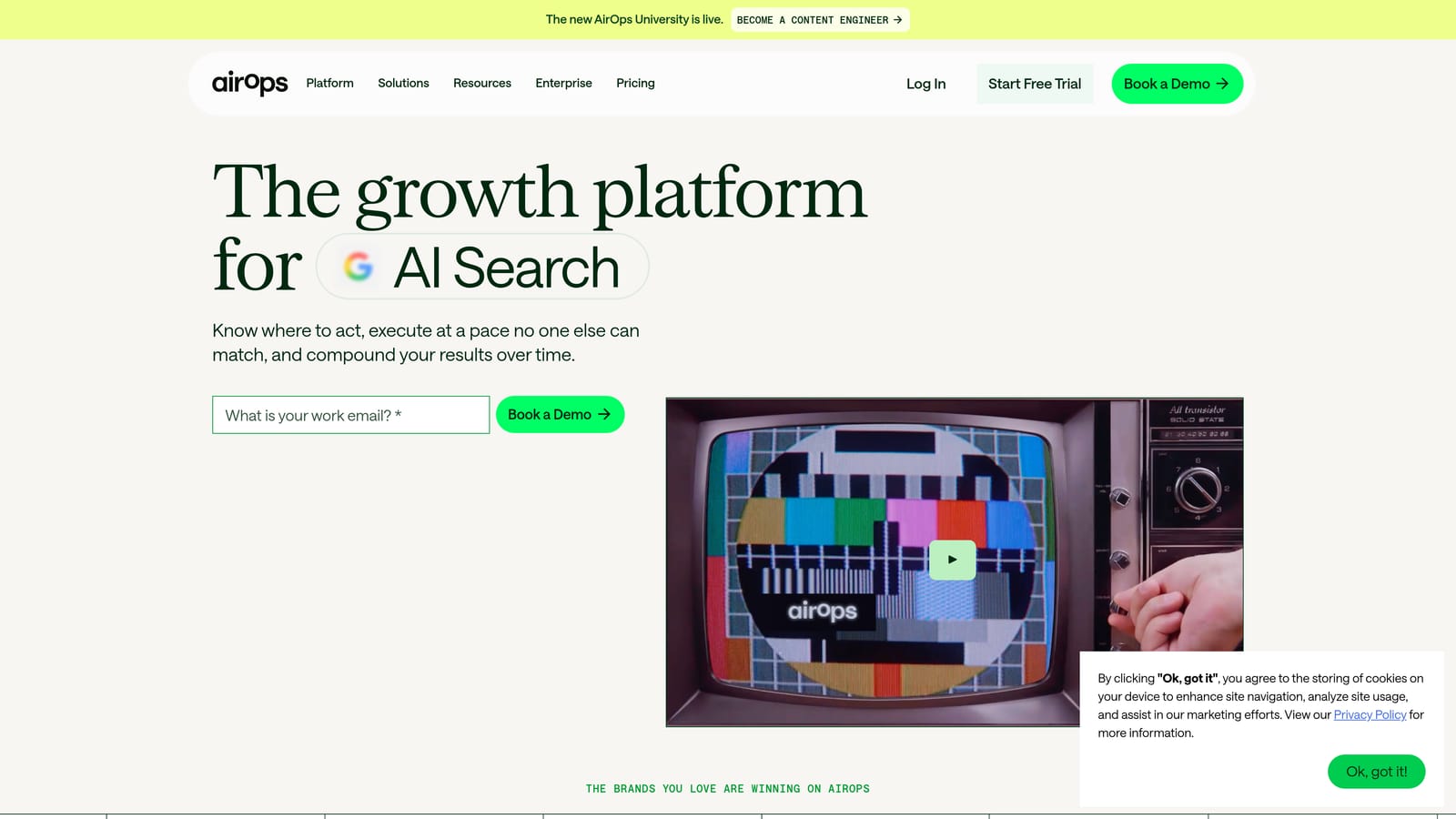
5. AirOps
Best for: Content teams that want to build structured, scalable LLM-powered content workflows.
AirOps is an AI-powered content workflow platform that uses LLM pipelines to help content teams build structured, repeatable content operations at scale.
Where This Tool Shines
AirOps is less focused on AI visibility monitoring and more focused on systematizing how your team produces content with AI. If you have a high-volume content operation and need a structured way to build, test, and run LLM-powered workflows, AirOps provides the infrastructure to do that without requiring deep technical expertise.
The platform is particularly useful for teams that have already identified what content they need to create and want a reliable, repeatable process for producing it. Think of it as the operational layer for content teams that are serious about scaling AI-assisted production.
Key Features
LLM Workflow Automation: Builds structured pipelines that automate content production tasks using large language models, reducing manual steps in the content creation process.
AI Agent Pipelines: Enables teams to chain AI agents together for complex, multi-step content workflows that go beyond single-prompt generation.
CMS and Data Integrations: Connects with popular content management systems and data tools, making it easier to plug AI workflows into existing tech stacks.
Scalable Content Operations: Designed for high-volume teams that need consistent, repeatable output rather than one-off content generation.
Best For
AirOps is best suited for content operations teams, large marketing departments, and agencies with high content volume requirements. It is not an AI visibility monitoring tool, so teams looking to track brand mentions in AI outputs will need a separate solution alongside it.
Pricing
Visit airops.com for current plan options and pricing tiers.
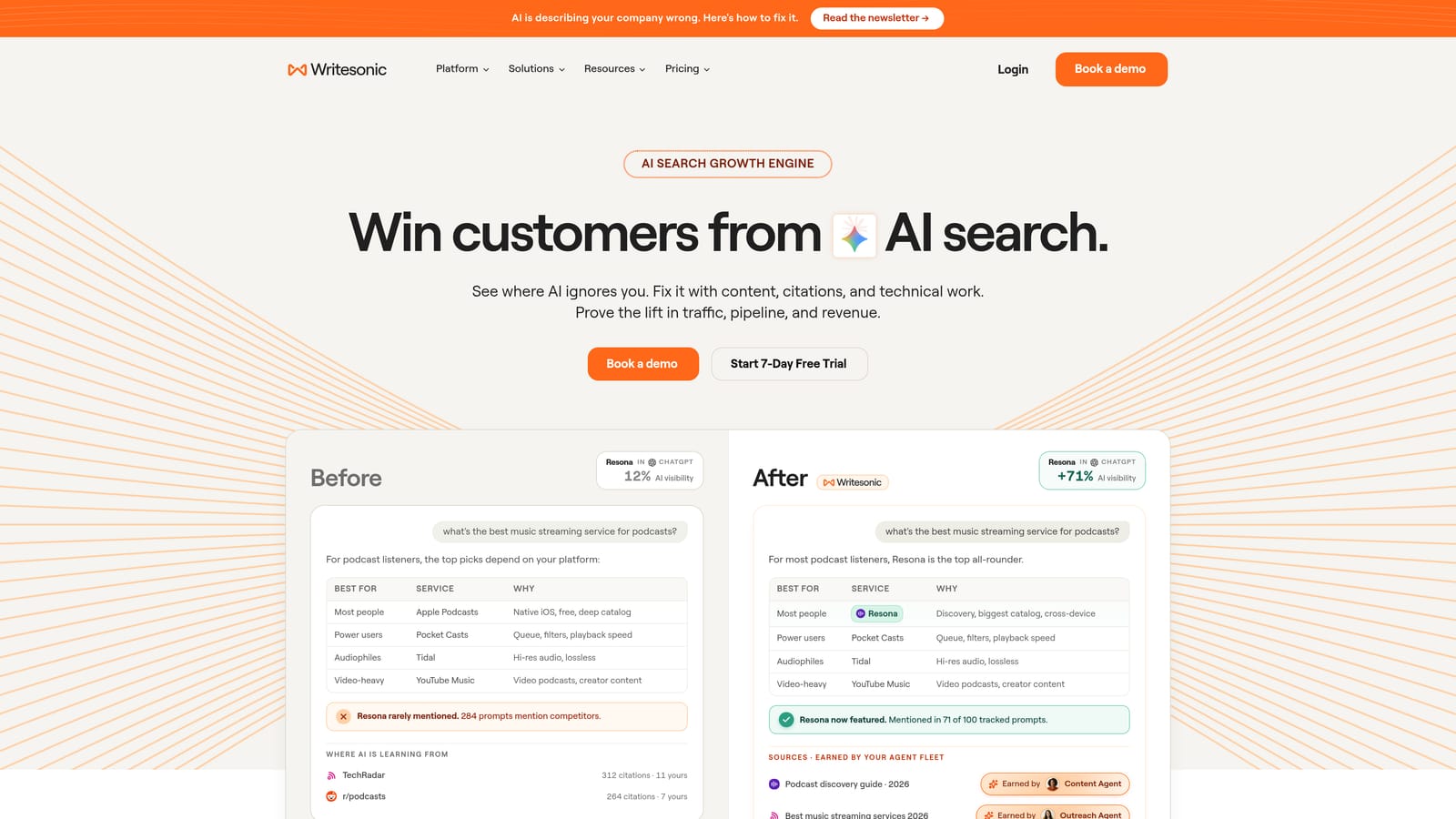
6. Writesonic
Best for: Marketers and small teams that need to produce SEO-optimized content at volume.
Writesonic is a broad AI content generation platform with built-in SEO optimization features, designed for marketers and small teams who need to produce search-ready content efficiently.
Where This Tool Shines
Writesonic covers a wide range of content formats and includes SEO scoring features that help writers optimize articles for traditional search during the drafting process. For teams that are primarily focused on content volume and traditional SEO performance, it offers a relatively accessible entry point into AI-assisted content creation.
It is worth noting that Writesonic is not an AI visibility monitoring platform. It does not track how AI models mention your brand or provide GEO-specific optimization guidance. Its strength is in content production speed and SEO integration, not in the AI visibility tracking that defines the core of this category.
Key Features
AI Article Writer: Generates long-form content across multiple formats with built-in SEO scoring to help optimize articles during creation.
Long-Form Content Generation: Supports a range of content types including blog posts, landing pages, and product descriptions at scale.
CMS Publishing Integrations: Connects with common content management platforms to streamline the publishing workflow.
Keyword Research and Content Briefs: Includes tools for identifying target keywords and building content briefs before the writing process begins.
Best For
Writesonic is a practical choice for small marketing teams, solo marketers, and content creators who need to produce SEO-optimized content quickly and do not yet have a dedicated AI visibility monitoring strategy in place. Teams that need to track AI brand mentions or optimize specifically for generative engine optimization will need to look at more specialized platforms.
Pricing
Writesonic offers tiered plans suited to individuals and teams. Visit writesonic.com for current pricing and feature breakdowns by plan.
Which Platform Is Right for Your Team?
The right AI visibility platform depends heavily on what problem you're actually trying to solve. Here's a quick breakdown to help you match the tool to the need.
If you want a single platform that monitors AI brand mentions, generates GEO-optimized content to improve those mentions, and automates indexing so that content gets discovered fast, Sight AI is the clear choice. It's the only tool reviewed here that connects monitoring, content creation, and indexing in one workflow, which makes it especially valuable for marketers and agencies who can't afford to stitch together three separate tools.
Profound is the right fit if you're at an enterprise and need polished analytics and competitive share-of-voice reporting for stakeholder presentations. Promptwatch serves SEO researchers and strategists who want to study how AI response patterns evolve at the prompt level over time. Peec is purpose-built for agencies running competitive benchmarking across multiple client brands.
AirOps and Writesonic sit in a different lane entirely. Both are content production tools rather than AI visibility platforms, so they work best as complements to a monitoring solution rather than replacements for one.
The broader takeaway is that AI visibility is no longer a nice-to-have metric. As AI search engines become primary discovery channels, brands that don't understand how they're represented in AI-generated answers are operating with a significant blind spot. The tools reviewed here exist to close that gap.
Stop guessing how AI models like ChatGPT and Claude talk about your brand. Start tracking your AI visibility today and see exactly where your brand appears across top AI platforms, uncover content opportunities you're currently missing, and automate your path to faster organic traffic growth.