Choosing seo rank software comes down to a few practical questions: how often positions refresh, how many keywords and locations you need, who reads the reports, and whether you also need to know how your brand shows up in AI answers. This list is written for marketers, founders, and agency leads who have to monitor rankings and justify SEO work. Tools were chosen on tracking accuracy, update frequency, reporting, scale, pricing transparency, and fit for a given team size and workflow. Pricing and limits change often, so confirm current details on each vendor's site; nothing here should be read as a quote.
Quick Comparison of the Rank Tracking Options
- Sight AI: teams growing brand visibility in AI search; pricing on the vendor site; tracks brand mentions and sentiment inside AI model answers and ties findings to content creation.
- Semrush: marketing teams wanting rank tracking inside a full suite; tiered subscriptions with add-ons, see site; the widest all-in-one toolset under one login.
- Ahrefs: SEO specialists diagnosing rankings through links; tiered subscriptions, see site; backlink data that helps explain why positions move.
- AccuRanker: agencies and enterprises with thousands of keywords; keyword-volume plans, see site; fast on-demand refreshes at very large scale.
- SE Ranking: small agencies and in-house teams on a budget; tiered subscriptions, see site; a broad feature set with white-label reports at a lower price.
- Advanced Web Ranking: agencies needing tailored client reporting; tiered subscriptions, see site; the most customizable reporting and data export.
- Moz Pro: beginners and small businesses; tiered subscriptions, see site; Domain Authority with beginner-friendly guidance.
- Google Search Console: anyone needing authoritative data for their own site; free; first-party Google query data at no cost.
- Nightwatch: local and multi-location businesses; tiered subscriptions, see site; granular local and device tracking with clear dashboards.
1. Sight AI
Sight AI is our own product, so read this entry with that in mind. It is an AI visibility platform: it tracks how models such as ChatGPT, Claude, and Perplexity mention your brand, then connects those findings to content production and indexing. It is built for marketers, founders, and agencies who now care about GEO (generative engine optimization), meaning whether a brand is named and recommended inside AI-generated answers rather than only listed in blue links.
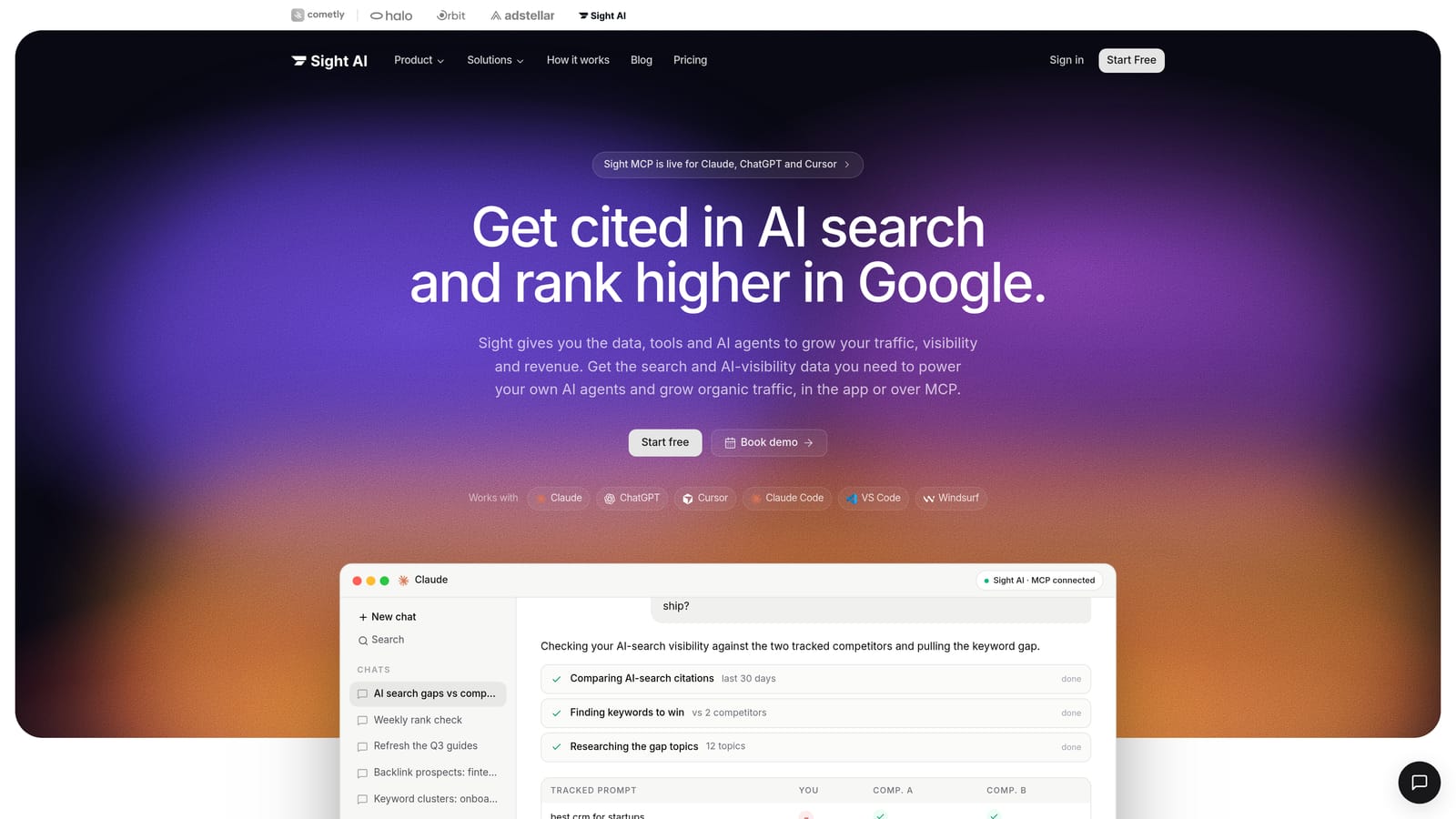
What separates it from the rest of this list is the layer it measures. Every other tool here reports where a URL sits in a search results page. Sight AI reports whether and how a brand appears in model responses, including the sentiment of those mentions, and it turns gaps into articles through the same platform.
- AI Visibility Score with sentiment analysis gives you one trackable number for brand presence in AI answers and shows whether mentions are favorable.
- Prompt tracking across 6+ AI platforms lets you monitor the specific questions your buyers ask and see which models name you.
- AI Content Writer with 13+ agents produces SEO and GEO-oriented articles such as listicles, guides, and explainers, with an Autopilot Mode for hands-off production.
- IndexNow indexing and automated sitemap updates notify participating search engines of new and changed pages so content is discovered sooner.
- CMS auto-publishing pushes finished articles to your site without copy-and-paste.
Setup centers on connecting your site for indexing and publishing and defining the prompts and brand terms to track. A marketer or content lead can run it day to day; it does not need a dedicated analyst.
The limitation is plain: Sight AI is not a traditional daily Google SERP position tracker. It will not tell you that a page moved from position 7 to position 5 for a keyword in a given city. Most teams should pair it with one of the classic trackers below. Pricing is listed on the vendor site, so check current plans there.
Best for: Teams that want to grow brand visibility in AI search and publish content to support it.
2. Semrush
Semrush is an all-in-one SEO suite in which Position Tracking is one module among keyword research, site audits, backlink analysis, and competitor tools. It is designed for marketing teams that want one login for the whole SEO workflow rather than a stack of specialist products.
Its distinct strength is breadth. If your questions run from "where do we rank" to "what should we write next" to "what technical issues are holding pages back," you can answer all three without leaving the platform.
- Position Tracking by location and device shows that rankings differ between a phone in one city and a desktop in another, so you report against the segment that matters.
- Competitor visibility comparison benchmarks your tracked keywords against rivals you choose.
- Keyword research feeds new targets straight into tracking projects.
- Site audit surfaces technical problems that could explain a drop.
- Backlink analysis adds link context to position changes.
It connects with Google Search Console, Google Analytics, and Looker Studio, so reports can sit alongside your other marketing data. Setup is quick for rank tracking itself, but learning the full suite takes time, and a small team may use only a fraction of it.
The trade-off is cost and complexity. Pricing is tiered subscriptions with add-ons, and project and tracking limits mean bills can climb as you add sites, users, or extras. Check current plans on the vendor site as of November 2026. Solo marketers who only need positions may be paying for a lot they never open.
Best for: Marketing teams wanting rank tracking inside a full SEO suite.
3. Ahrefs
Ahrefs is an SEO platform best known for its backlink index, with Rank Tracker and SERP history layered on top. It is aimed at SEO specialists who want to understand why a page moved, not just that it did.
Limitations first: lower plans cap tracked keywords and overall usage, so a team with a large keyword set will feel the ceiling early. Pricing is tiered subscriptions, and the limits are what push buyers up a tier. Check the vendor site for current figures as of November 2026.
The strength is diagnosis. When a competitor overtakes you, Site Explorer lets you check whether they gained links, and SERP history shows who else entered or left the results around the same time. That pairing of position data with link data is the reason many specialists keep it open daily.
- Rank Tracker monitors positions over time for chosen keywords, locations, and devices.
- SERP history lets you look back at who held the results page, which helps explain sudden swings.
- SERP feature tracking shows whether you hold features such as snippets or whether they push organic results down.
- Site Explorer backlink data reveals link gains and losses behind a movement.
- Keyword Explorer helps you pick the next set of terms to track.
It integrates with Google Search Console and Google Analytics and offers API access for custom reporting. Setup is straightforward, though the interface rewards users who already know SEO vocabulary. It is less suited to beginners who want guided recommendations.
Best for: SEO specialists who diagnose rankings through links and competitor data.
4. AccuRanker
AccuRanker is a dedicated rank tracker built for speed and big keyword sets. It does one job, measuring positions, and is designed for agencies and enterprise teams that track thousands of keywords across many clients or markets.
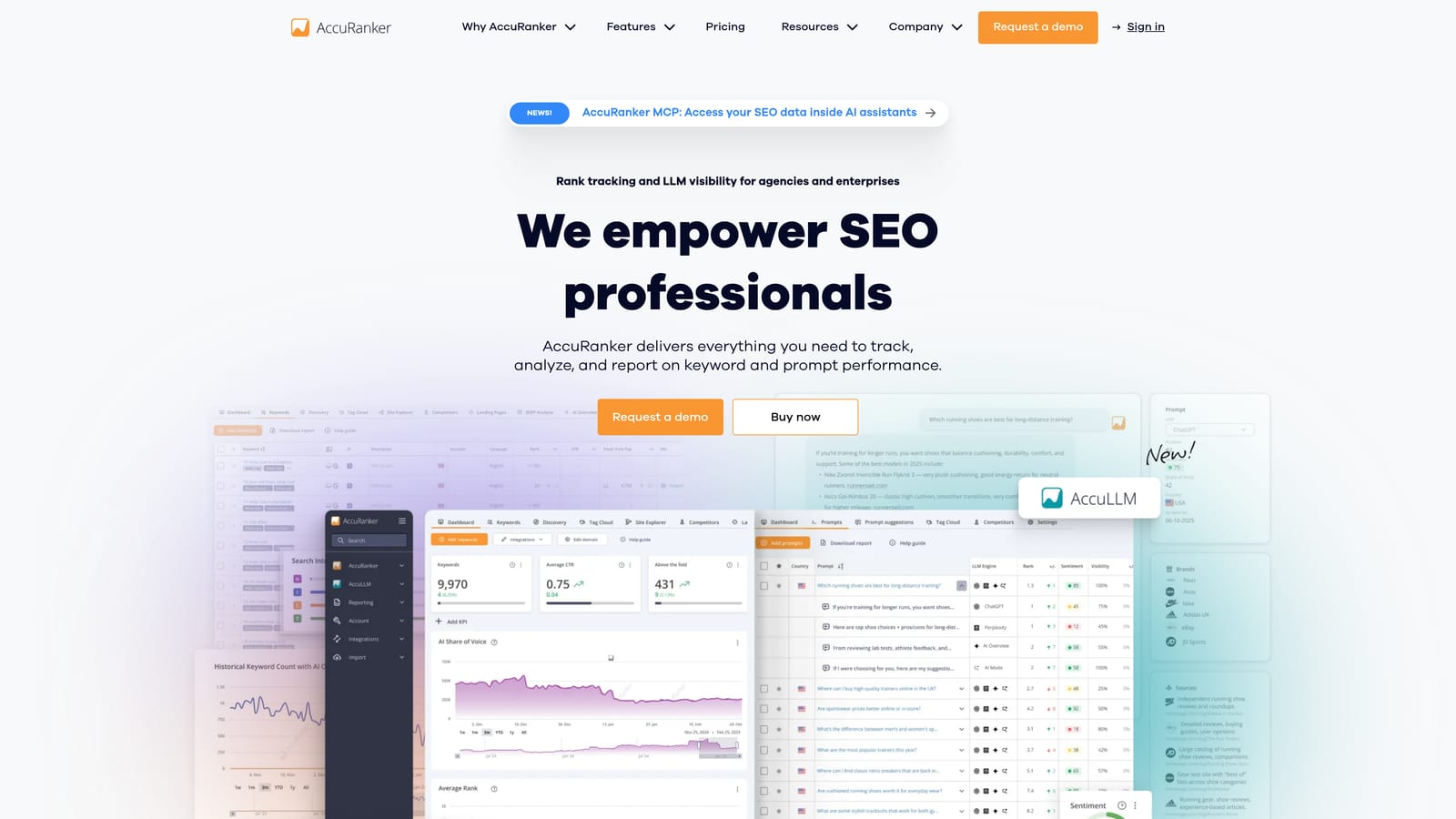
Its edge is on-demand refresh. Instead of waiting for the next scheduled update, you can request fresh positions after a release or a suspected algorithm shift, and it is built to do that quickly even across very large sets. For teams that need to confirm a change right now, that matters more than extra research modules.
- On-demand rank refresh lets you verify the effect of a site change without waiting for the next cycle.
- Keyword tagging and segmentation groups thousands of terms by product line, intent, or client so reports stay readable.
- Share of voice estimates how much of the available search visibility you capture against competitors, a clearer headline metric than a keyword-by-keyword list.
- Client dashboards give stakeholders a view without access to your working data.
- Reporting packages results for recurring reviews.
It connects to Google Search Console, Google Analytics, Looker Studio, and an API, which suits teams that pipe rankings into their own warehouse or dashboards. Setup is light, since it is a single-purpose tool, and an SEO lead or analyst typically owns it.
The limitation is scope. There is no full keyword research or backlink suite, so you will need other tools for those jobs. Plans are based on keyword volume, so cost scales with how many terms you track; confirm current tiers on the vendor site as of November 2026.
Best for: Agencies and enterprise teams tracking thousands of keywords.
5. SE Ranking
SE Ranking is an affordable SEO platform that combines rank tracking, website audits, competitor research, and white-label reports. It is aimed at small agencies and in-house teams that want a broad toolkit without enterprise pricing.
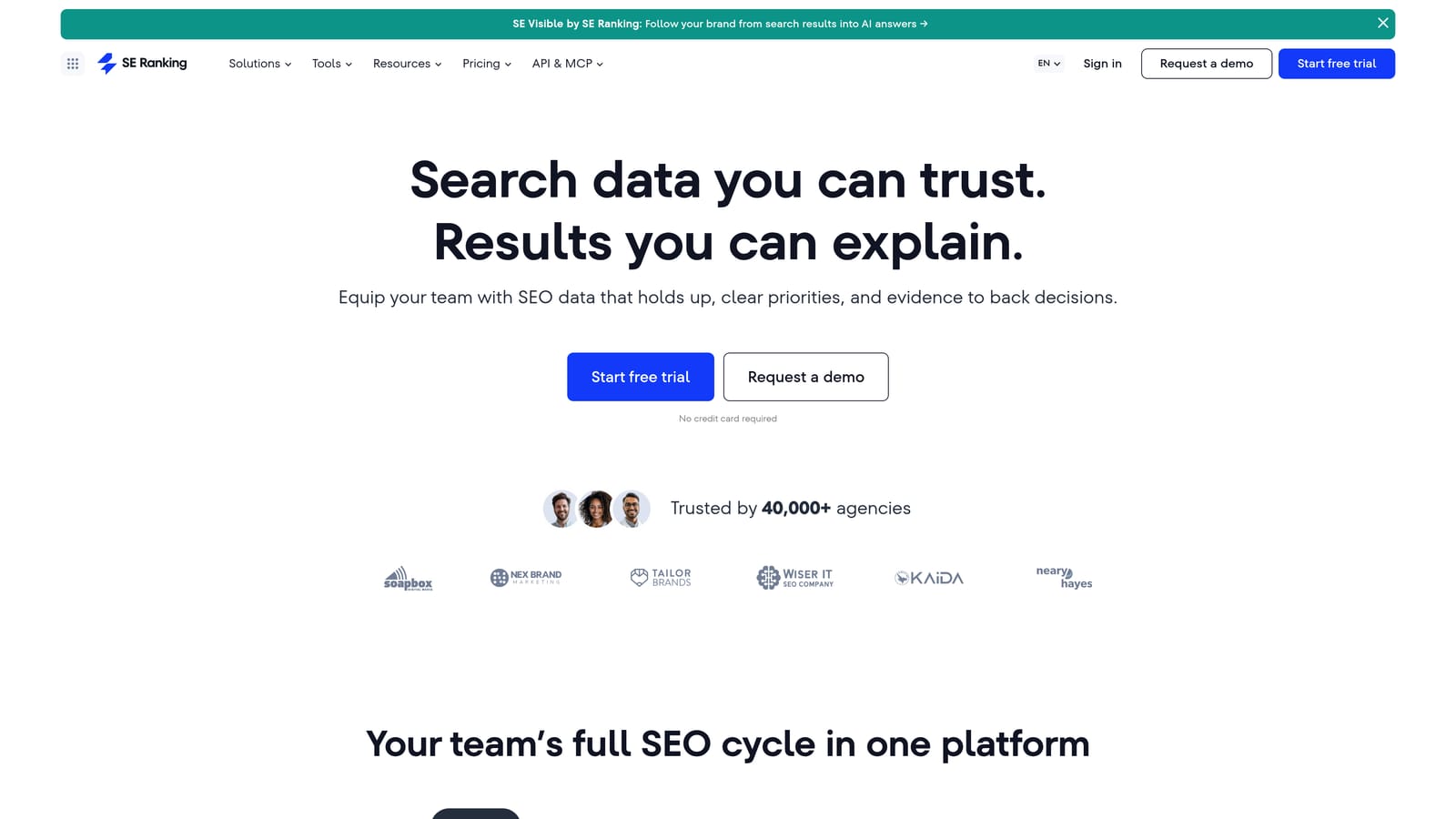
Its distinguishing quality is the ratio of features to cost, with white-label options that let an agency present reports under its own brand. That combination is hard to find at the lower end of the market.
- Rank tracking monitors keyword positions so you can report progress on a schedule.
- Website audit flags technical issues, so one subscription covers monitoring and fixes.
- Competitor research shows which terms rivals rank for that you do not.
- White-label reports let agencies send client-ready documents with their own branding.
- Keyword research supports choosing new targets without a second subscription.
It integrates with Google Search Console, Google Analytics, and Looker Studio. Setup is simple enough for a generalist marketer to handle alone, which fits the small teams it targets.
The trade-off is data depth. Its index is smaller than the largest suites, so competitor and keyword research may be less exhaustive than in Semrush or Ahrefs. For most small-team rank monitoring that is acceptable, but check it against a few of your own keywords during a trial. Pricing is tiered subscriptions; confirm current plans on the vendor site as of November 2026.
Best for: Small agencies and in-house teams on a budget.
6. Advanced Web Ranking
Advanced Web Ranking (AWR) is a rank tracking and reporting platform aimed at agencies and enterprises. Its focus is turning ranking data into reports that fit how a particular client or executive wants to see it.
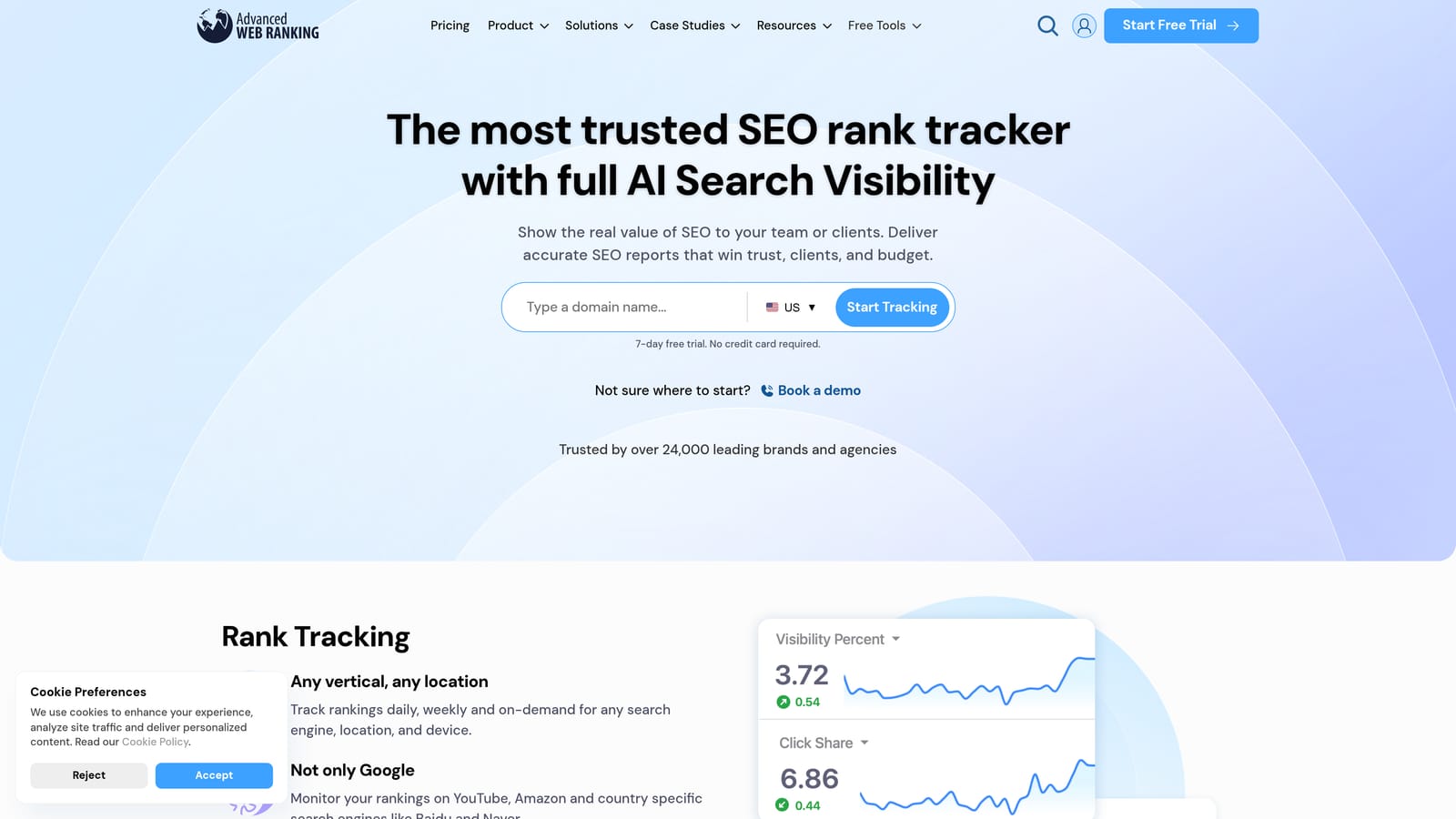
Where it stands out
Customization is the point. Reports and data exports can be shaped to a client's format rather than forcing the client into a template, which matters when you serve many accounts with different reporting expectations.
- Custom rank tracking lets you define what is tracked and how, to match each project.
- Flexible reporting builds tailored documents instead of one fixed layout.
- Data exports move raw rankings into spreadsheets or BI tools for your own analysis.
- Multi-location tracking covers clients competing in several markets.
- Client portals give customers a login to view their own results.
Setup and limits
It connects to Google Search Console, Google Analytics, Looker Studio, and an API. All that flexibility has a cost: setup takes more effort than with simpler trackers, and someone on the team needs to own configuration and templates. For a solo marketer tracking one site, it is overkill.
Pricing is tiered subscriptions. Confirm current plans and limits on the vendor site as of November 2026, and ask how tracking volume affects cost before committing.
Best for: Agencies needing tailored client reporting.
7. Moz Pro
Moz Pro is an SEO toolset covering rank tracking, keyword research, site crawling, and link research, and it is the home of the Domain Authority metric. It is built for beginners and small businesses that want clear guidance more than raw data volume.
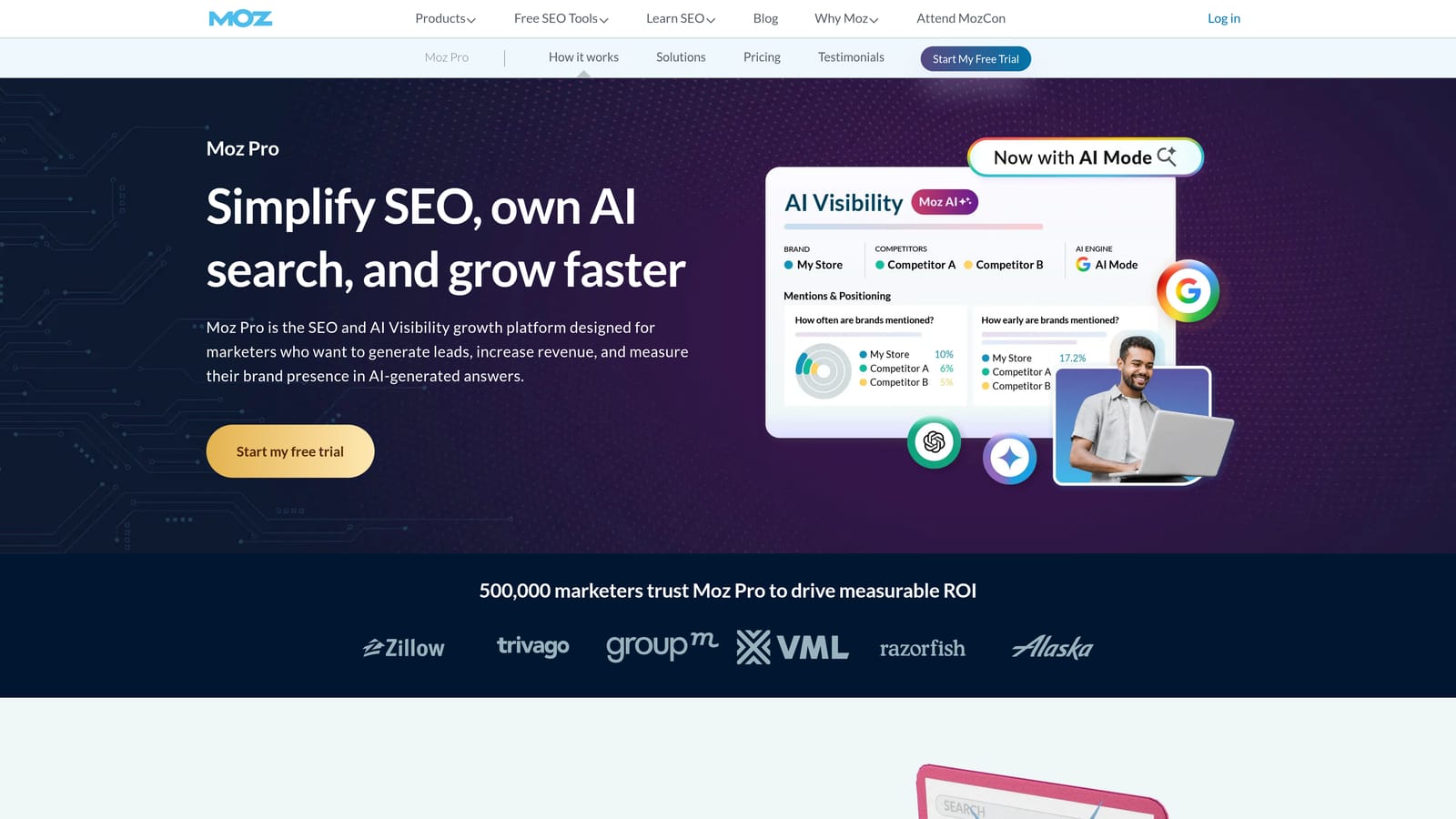
Its distinctive trait is approachability. Domain Authority gives newcomers a single, widely recognized score for comparing site strength, and the interface leans toward explaining what to do next. Keep in mind that Domain Authority is a Moz-created estimate, not a Google metric, so use it for comparison rather than as a ranking factor.
- Rank tracking shows keyword movement in simple reports a non-specialist can follow.
- Keyword Explorer suggests terms and gauges difficulty so beginners choose realistic targets.
- Site crawl finds technical problems and prioritizes them.
- Domain Authority offers a quick benchmark against competitors.
- Link research gives a view of who links to you and to rivals.
It integrates with Google Analytics and Google Search Console. Setup is quick and a single marketer can run it. The limitation is depth: there is less data and fewer advanced features than the leading suites, so experienced specialists and large agencies tend to outgrow it. Pricing is tiered subscriptions; check the vendor site for current plans as of November 2026.
Best for: Beginners and small businesses wanting simple reports.
8. Google Search Console
Google Search Console is Google's free tool for seeing how your own site performs in search. It is not a rank tracker in the usual sense, but every serious SEO setup uses it because the data comes straight from Google.
The key concept is average position. Search Console reports the average position of your pages for queries where they appeared, across all the locations, devices, and personalized results that produced impressions. That is useful for trends but is not a live ranking, and it will not match what you see by searching. Treat it as authoritative on your own performance and pair it with a tracker for controlled, repeatable checks.
- Average position shows the broad direction of visibility for queries and pages.
- Impressions and clicks reveal whether rankings translate into traffic.
- Query and page reports show which searches bring users to which URLs, including terms you never targeted.
- Indexing reports show which pages Google has or has not indexed, and why.
- Sitemap submission tells Google where your pages are.
It connects to Google Analytics and Looker Studio, and setup means verifying site ownership, a task usually handled by whoever manages the site. Limitations are real: positions are averaged, there is no competitor tracking, and data retention is limited, so export regularly if you want long histories.
Cost is free.
Best for: Anyone needing free, authoritative performance data for their own site.
9. Nightwatch
Nightwatch is a rank tracker with local tracking and visual dashboards. It is designed for businesses and agencies where position depends heavily on where the searcher is standing and what device they hold.
Its strength is granularity. Because the same keyword can rank differently from one city to the next, or between mobile and desktop, tracking at that level gives local and multi-location businesses numbers they can act on, presented in dashboards that non-specialists can read.
- Local rank tracking measures positions in specific places, which matters for service-area and multi-branch businesses.
- Device-level tracking separates mobile and desktop results so you can see where you are weaker.
- Competitor views compare your regional standing against local rivals.
- Dashboards turn rankings into visuals for quick reviews.
- Reporting packages the data for clients or managers.
It integrates with Google Analytics, Google Search Console, and Looker Studio. Setup is modest, and a marketing manager or local SEO lead can run it. The limitation is that it is lighter on broader SEO research than the full suites, so you may need a separate tool for keyword discovery, audits, or backlinks. Pricing is tiered subscriptions; confirm current plans and tracking limits on the vendor site as of November 2026.
Best for: Local and multi-location businesses monitoring regional rankings.
Matching a Rank Tracker to Your Situation
Start with the layer you are missing. If you already track Google positions but cannot say how ChatGPT, Claude, or Perplexity describe your brand, Sight AI fills that gap and helps you publish content in response. It does not replace a daily position tracker, so plan to run one beside it.
For a single platform covering most SEO work, choose between Semrush and Ahrefs: Semrush for breadth, Ahrefs when link analysis drives your diagnosis. Agencies and teams at scale should look at AccuRanker for large keyword sets and fast refreshes, SE Ranking for a budget-friendly package with white-label reports, and Advanced Web Ranking when client reporting needs heavy customization. Beginners can start with Moz Pro, and everyone should have Google Search Console running because it is free and first-party. Local businesses should shortlist Nightwatch.
Whatever you choose, track a deliberately chosen keyword set rather than the largest one you can afford, and remember that a position is never a single fixed number. It shifts with location, device, and personalization.
Stop guessing how AI models like ChatGPT and Claude talk about your brand: get visibility into every mention, track content opportunities, and automate your path to organic traffic growth. Start tracking your AI visibility today and see exactly where your brand appears across top AI platforms.