Most commercial SEO writing tools cost between $15 and $400 per month for a starter plan. Team pricing usually lands between $100 and $400 per month once you add 3–5 seats, report credits, or AI writing add-ons. Per-seat tools such as Jasper scale linearly with headcount. Report-based tools such as Clearscope scale with content volume. Unlimited plans such as Frase Team keep costs flat as you grow.
Finding the right SEO content tool means balancing features against budget. Pricing models range from per-word charges and article credits to true unlimited access. Hidden costs for team seats, AI writing upgrades, and integrations can easily double the advertised monthly price. This guide breaks down what you actually get at each tier of nine leading platforms, which features require add-ons, and how pricing scales with volume. Prices reflect each vendor's public pricing at the time of writing. Vendors change plans often, so confirm on the official pricing page before you buy.
Quick comparison: pricing models and starting prices
| Tool | Pricing model | Starting price | Team/higher tier | Main cost driver |
|---|---|---|---|---|
| Sight AI | Bundled platform | See trysight.ai/pricing | See pricing page | Content volume and tracking scope |
| Surfer SEO | Tiered subscription | $89/mo (Essential) | $129/mo (Scale) | AI credits sold separately |
| Clearscope | Report credits | $189/mo (Essentials) | $399/mo (Business) | Monthly report limits |
| Frase | Article limits / unlimited | $15/mo (Solo, 4 articles) | $115/mo (Team, unlimited) | Jump from Solo to Team |
| MarketMuse | Tiered + custom | Free tier; $149/mo (Standard) | $399/mo+ (Team) | Seats and feature access |
| Semrush Writing Assistant | Included in suite | $139.95/mo (Pro) | $249.95/mo (Guru) | Requires full Semrush plan |
| Jasper | Per seat | $49/mo (Creator, 1 seat) | $69/seat/mo (Pro) | Headcount |
| NeuronWriter | Analysis credits | $23/mo (Bronze, 25 analyses) | $45–$69/mo (Silver/Gold) | Analyses per month |
| WriterZen | Tiered subscription | $27/mo (Lite) | $47–$67/mo (Plus/Pro) | Feature limits per tier |
What team and seat pricing should marketing teams expect?
Seat pricing is where advertised prices and real invoices diverge most. Expect one of three structures:
- Per-seat pricing: Every user adds a full license. At $69/seat, Jasper Pro costs $345/month for five writers and $690/month for ten. Budget for every writer, editor, and reviewer who needs to log in.
- Included seats with volume caps: Clearscope, Surfer, and MarketMuse plans bundle a set number of users and limit reports or content audits. A team rarely runs out of seats first. It runs out of credits and is pushed to the next tier, typically a $150–$250/month step up.
- Flat or unlimited plans: Frase Team ($115/month, unlimited articles) and bundled platforms such as Sight AI keep costs predictable as output grows. You may pay for capabilities you don't use.
As a rule of thumb, a 3–5 person content team should budget $100–$400/month for one optimization tool. Add $50–$150/month if AI writing credits are billed separately. For a model of total spend including writers and tooling, run your numbers through the SEO cost calculator.
How to estimate your real monthly cost
- Count articles optimized per month, including refreshes of existing posts.
- Count everyone who needs a login, not just writers.
- Check whether AI writing, plagiarism checks, and integrations are included or metered.
- Multiply by the plan that fits both limits, then compare the annual price. Annual billing usually saves 15–20% but locks you in.
Here are the top SEO content tools with transparent pricing breakdowns:
1. Sight AI
Best for: Teams tracking AI visibility while generating GEO-optimized content at scale
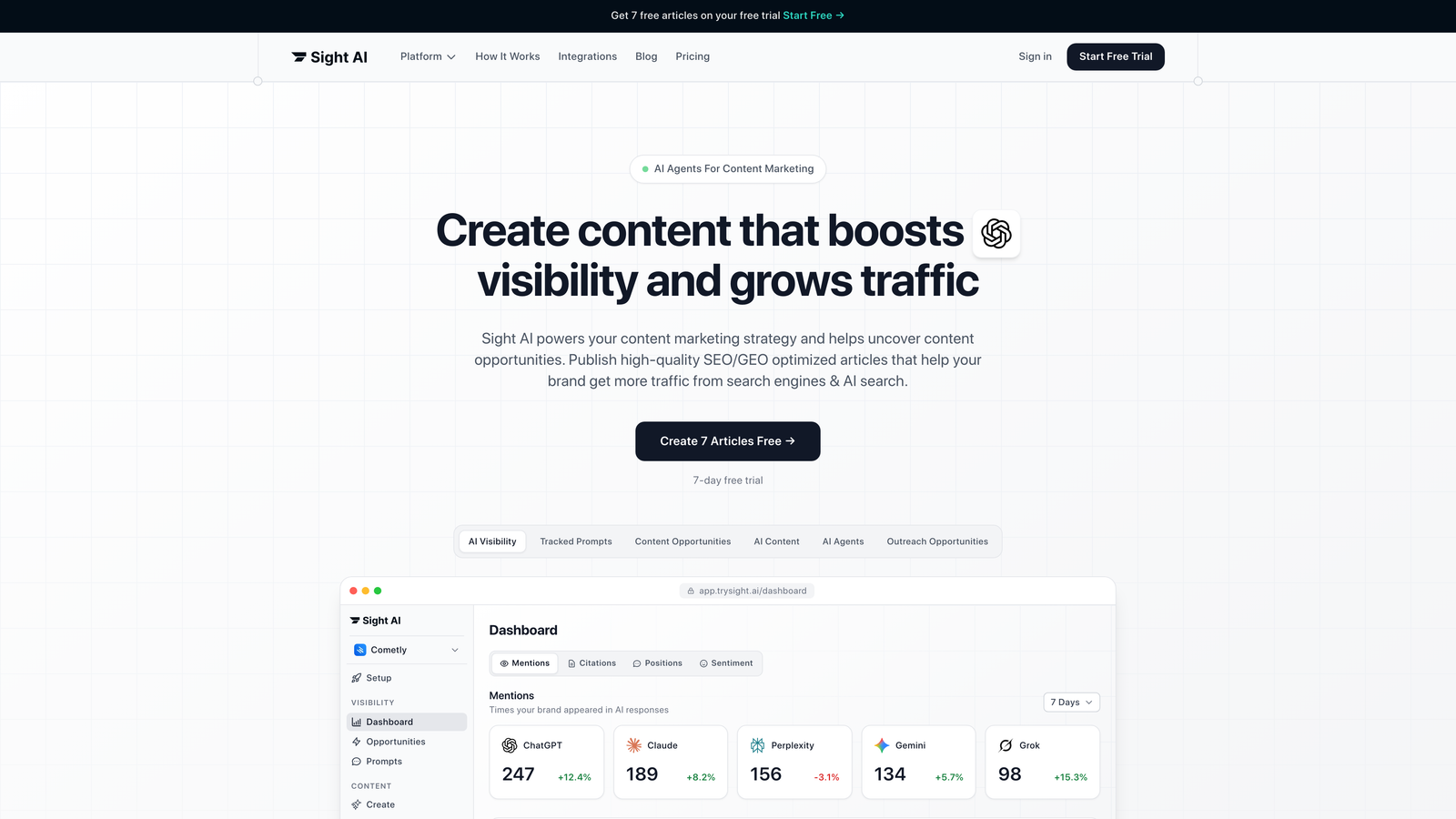
Sight AI combines three capabilities that most tools split across separate subscriptions: AI visibility tracking, SEO/GEO content generation, and automated website indexing.
Where This Tool Shines
The AI Visibility Score tracking monitors how ChatGPT, Claude, Perplexity, and other AI models mention your brand across different prompts. This matters because AI search differs fundamentally from traditional SEO. You need to know whether AI models recommend your product when users ask relevant questions.
The content generation system uses 13+ specialized AI agents that work together on each article. One agent handles research, another optimizes for traditional search, and a third focuses on GEO (Generative Engine Optimization) to increase AI mentions. Others manage formatting, fact-checking, and publishing. Autopilot mode can run the entire workflow, from topic selection to CMS publishing, without manual intervention.
Key Features
AI Visibility Tracking: Monitor brand mentions across 6+ AI platforms, with sentiment analysis and prompt tracking to understand context.
13+ Content AI Agents: Specialized agents for research, SEO optimization, GEO optimization, formatting, and publishing work together on each article.
IndexNow Integration: Automatically submit new content to search engines for faster discovery and indexing.
CMS Auto-Publishing: Publish directly to WordPress, Webflow, and other platforms without manual content transfer.
Content Opportunity Detection: Identifies topics where AI models currently lack good answers about your industry.
Best For
Marketers and agencies who need both AI visibility insights and high-volume content production. The platform makes most sense when you're actively trying to get mentioned by AI models, not just ranking in traditional search. If you publish 10+ articles monthly and care about how ChatGPT talks about your brand, the combined pricing offers better value than separate tools for tracking and content generation.
Pricing
Check current plan details at trysight.ai/pricing. The platform bundles AI visibility tracking, content generation, and indexing rather than charging separately for each capability.
2. Surfer SEO
Best for: Content teams prioritizing SERP data and real-time optimization scoring
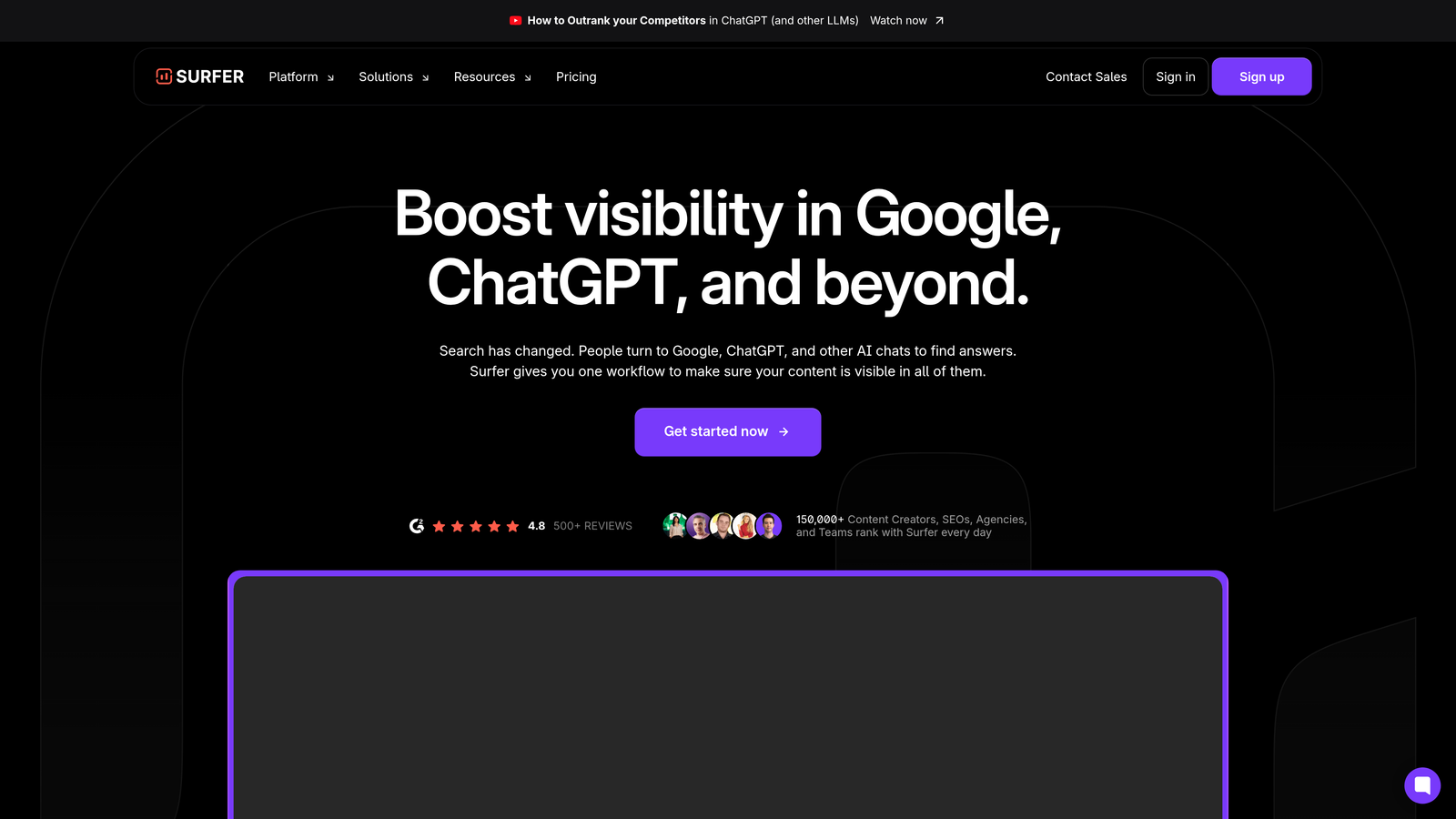
Surfer SEO built its reputation on data-driven content optimization with immediate scoring feedback as you write.
Where This Tool Shines
The Content Editor provides real-time optimization scores that update with every paragraph you add. It analyzes top-ranking pages for your target keyword and suggests specific terms, headings, and content length to match what currently performs. The visual scoring system shows exactly where your content stands against competitors.
The SERP Analyzer goes deeper than most competitors. It breaks down the elements that top-ranking pages share, from heading structure to image count to keyword placement patterns. This detail helps you understand both what to write about and how to structure it.
Key Features
Content Editor: Real-time optimization scoring with specific suggestions for keywords, headings, and content length based on SERP analysis.
SERP Analyzer: Detailed breakdowns of top-ranking pages, including their structure, keywords, and shared content elements.
Keyword Research: Clustering tools that group related keywords and identify content opportunities within your niche.
Surfer AI: Built-in AI writing assistant that generates content following optimization guidelines. It requires separate AI credits.
Integration Extensions: Google Docs and WordPress plugins let you optimize content directly in your preferred writing environment.
Best For
Content creators who want immediate feedback while writing and prefer data-driven recommendations over subjective advice. Real-time scoring works particularly well for teams that need consistent quality across multiple writers. The objective metrics reduce debates about whether content is “optimized enough.”
Pricing
Essential plans start at $89/month and Scale plans at $129/month. AI writing credits are sold separately from optimization features, so budget for both if you want full content generation. Annual plans offer roughly 20% savings but require upfront payment.
3. Clearscope
Best for: Enterprise content teams focused on comprehensive topic coverage and search intent
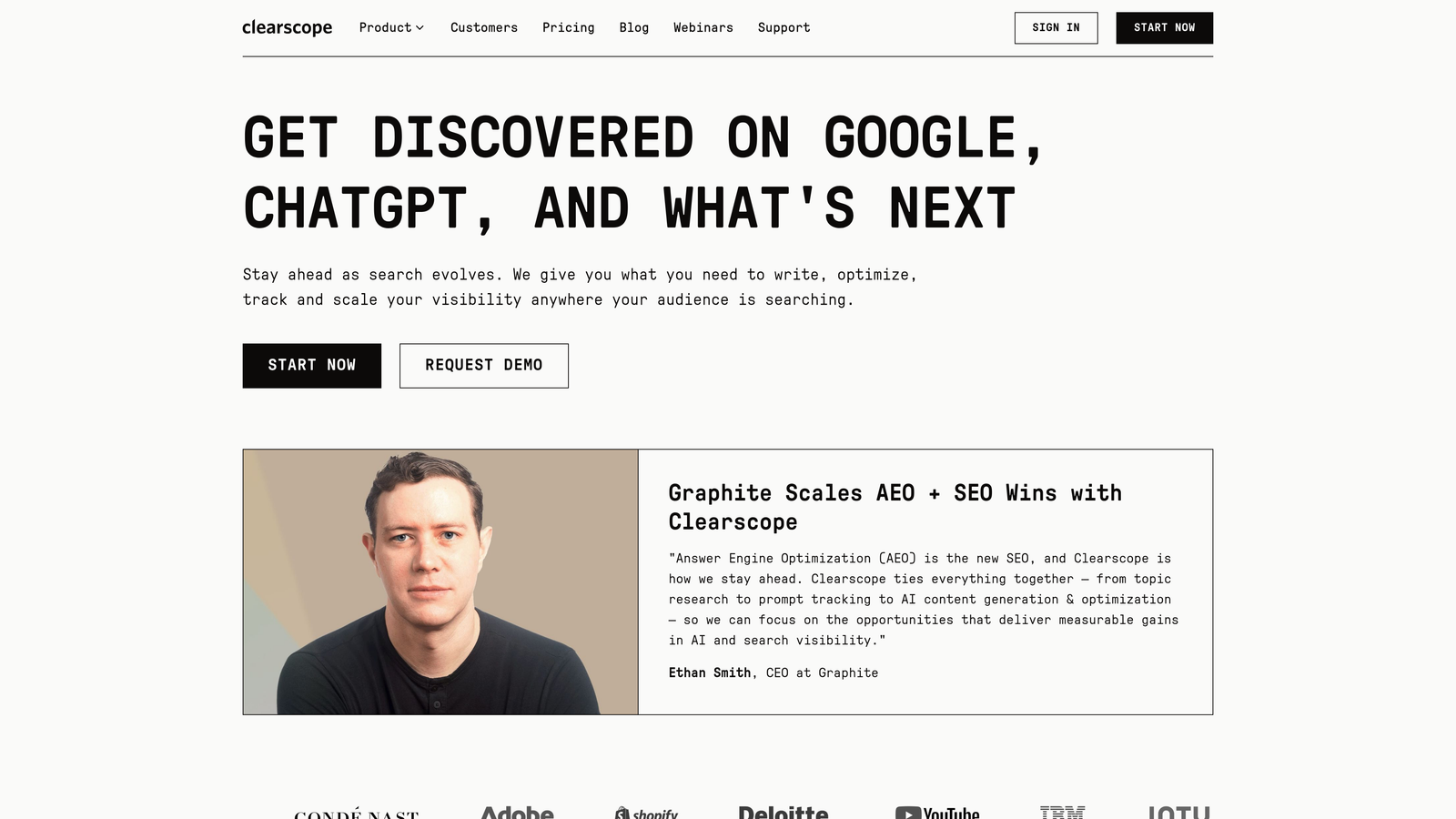
Clearscope positions itself as the enterprise-grade option, with sophisticated content grading and team collaboration features.
Where This Tool Shines
The content grading system goes beyond keyword matching to evaluate how comprehensively you cover a topic. It finds gaps by analyzing what top-ranking pages discuss that you're missing. That includes concepts and subtopics that deserve attention, not just keywords.
The platform excels at search intent analysis. It shows whether searchers want a quick answer, a detailed tutorial, a product comparison, or something else. This prevents the common mistake of writing the wrong content format for your target keyword.
Key Features
Content Grade Scoring: Evaluates topic coverage, relevance, and search intent alignment, with actionable improvement suggestions.
Competitor Analysis: Detailed breakdowns of what makes top-ranking content successful, from structure to specific topics covered.
Content Inventory Tracking: Monitor published content and identify optimization opportunities across your existing library.
Team Collaboration: Multi-user workflows with content approval processes and shared optimization guidelines.
Integration Suite: Direct connections to Google Docs, WordPress, and content management systems.
Best For
Established content teams with significant budgets who publish regularly and need consistent quality standards across multiple writers. The higher price makes sense when you manage large content inventories and need tracking and collaboration features to maintain quality at scale.
Pricing
Essentials plans start at $189/month with limited content reports, typically 10–20 per month. Business plans start at $399/month with higher report limits. Because pricing is report-based, costs escalate quickly for high-volume publishers. Calculate your monthly content volume before committing.
4. Frase
Best for: Solo creators and small teams needing research automation with affordable AI writing
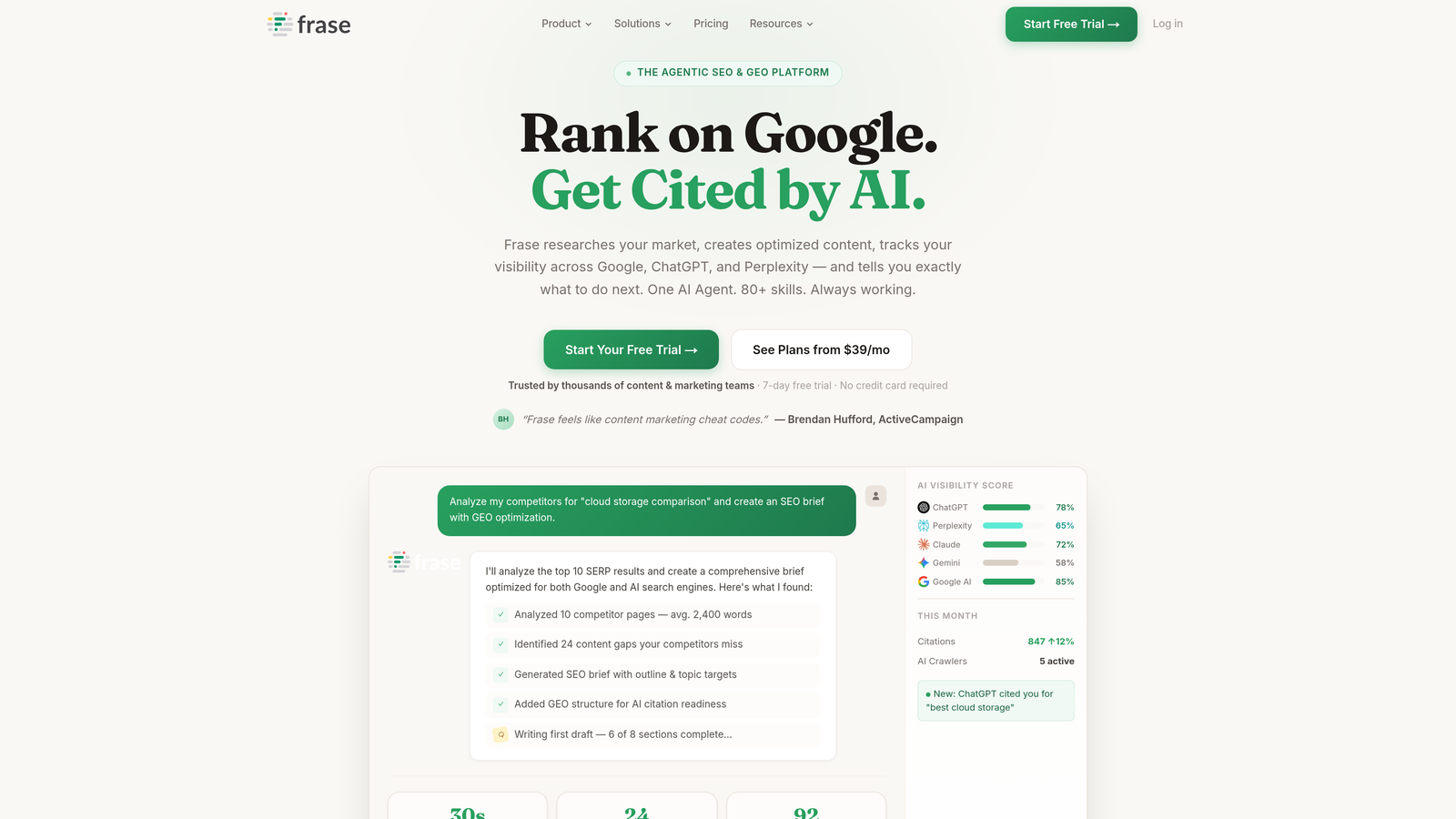
Frase combines SERP research, content brief generation, and AI writing in one of the market's most budget-friendly packages.
Where This Tool Shines
Automated content brief generation saves hours of manual research. Point Frase at a target keyword and it analyzes top-ranking pages to build a structured outline, with recommended headings, questions to answer, and topics to cover. Research drops from a multi-hour process to a 10-minute review.
The answer engine optimization feature targets featured snippets and People Also Ask boxes. It identifies questions related to your topic and helps you format answers to improve your chances of appearing in these SERP features.
Key Features
AI Content Briefs: Automated outline generation from SERP analysis, with recommended headings, topics, and questions to address.
Built-in AI Writer: Generate full articles or sections using the research data Frase has already gathered.
Answer Engine Optimization: Tools for targeting featured snippets and People Also Ask boxes with properly formatted answers.
Content Analytics: Track content performance and identify optimization opportunities across published articles.
Team Workflows: Collaboration features for managing briefs, assignments, and approvals across team members.
Best For
Budget-conscious creators who publish regularly but don't need enterprise features. The Solo plan's 4-article limit works for weekly publishers. The Team plan's unlimited articles suit agencies and in-house teams producing high volumes. The price jump from Solo to Team is significant, so check whether you truly need unlimited capacity.
Pricing
Solo plans start at $15/month but limit you to 4 articles monthly. Team plans jump to $115/month for unlimited articles. Because of that gap, you need to publish at least 5 articles monthly to justify the Team tier. Below that volume, the Solo plan offers exceptional value for its constraints.
5. MarketMuse
Best for: Content strategists building comprehensive topic authority and content clusters
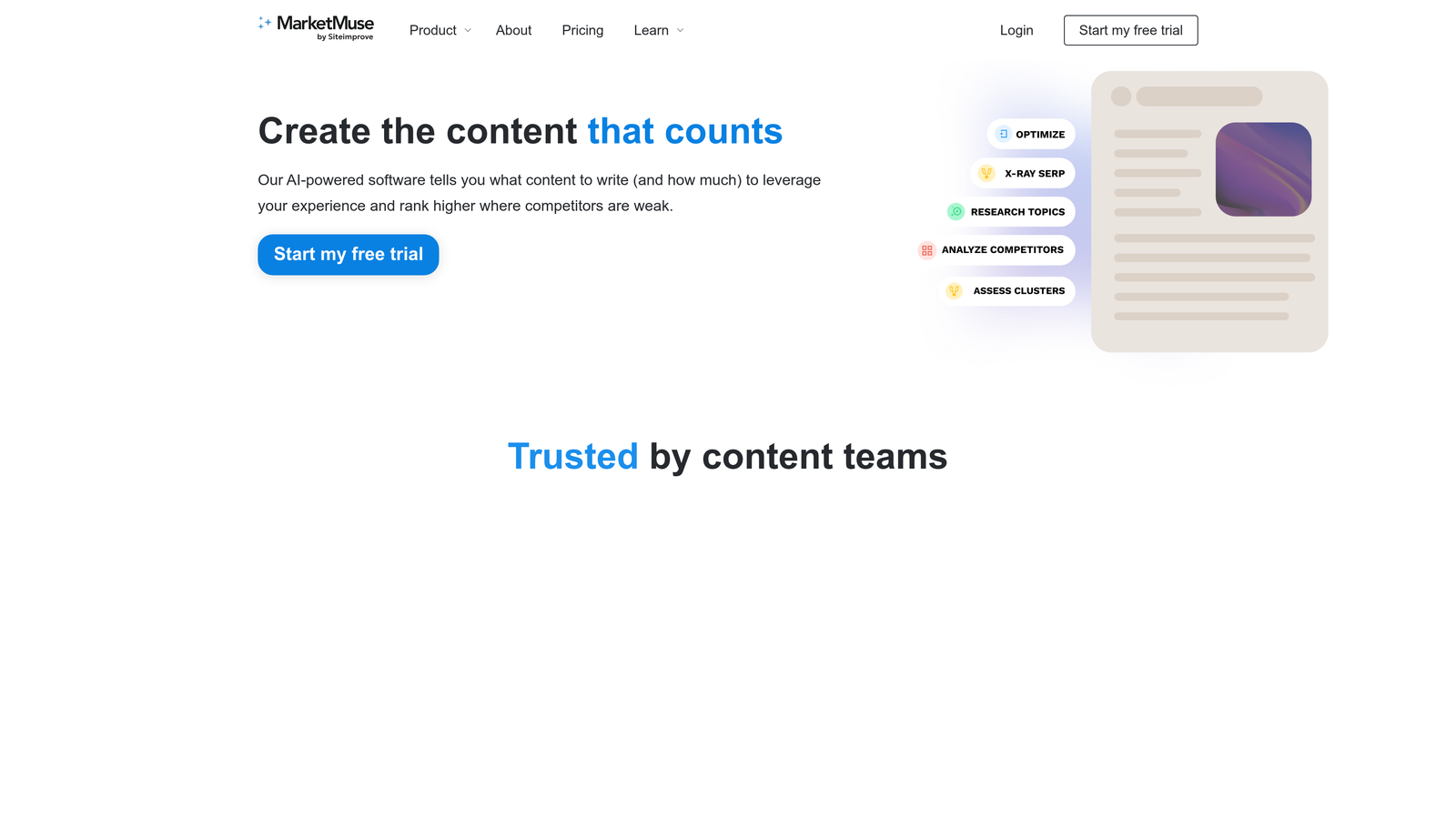
MarketMuse approaches SEO content at a strategic level, focusing on topic authority and content planning rather than individual article optimization.
Where This Tool Shines
Topic authority modeling shows where you have expertise in Google's eyes and where your coverage is thin. Instead of optimizing articles in isolation, MarketMuse maps your entire content library against your industry's topic landscape. It surfaces the strategic gaps that keep you from ranking for competitive terms.
Content cluster planning goes beyond simple keyword grouping. It identifies pillar topics that deserve comprehensive coverage and suggests supporting articles that strengthen your authority. This works especially well for established sites in competitive niches, where topical authority matters more than individual article optimization.
Key Features
Content Inventory Audits: Analysis of your existing content library with authority scoring and gap identification.
Topic Modeling: AI-powered analysis of how topics relate within your industry and where you have authority gaps.
Competitive Analysis: Compares your content coverage against competitors to identify strategic opportunities.
First Draft Generation: AI writing that creates initial drafts from the topic research and optimization guidelines.
Content Cluster Planning: Recommendations for pillar content and supporting articles to build topical authority.
Best For
Content strategists and SEO teams at established companies with large existing content libraries. The platform fits teams that think in terms of content strategy rather than individual articles. If you plan quarterly content calendars and build topic clusters, the strategic insights justify the premium pricing.
Pricing
A free tier with limited functionality is available for testing. Standard plans start at $149/month and Team plans at $399/month. Pricing scales significantly with team size and feature access, so enterprise implementations can exceed $1,000 monthly. Request a demo to get accurate pricing for your needs.
6. Semrush Writing Assistant
Best for: Existing Semrush users wanting integrated content optimization without additional subscriptions
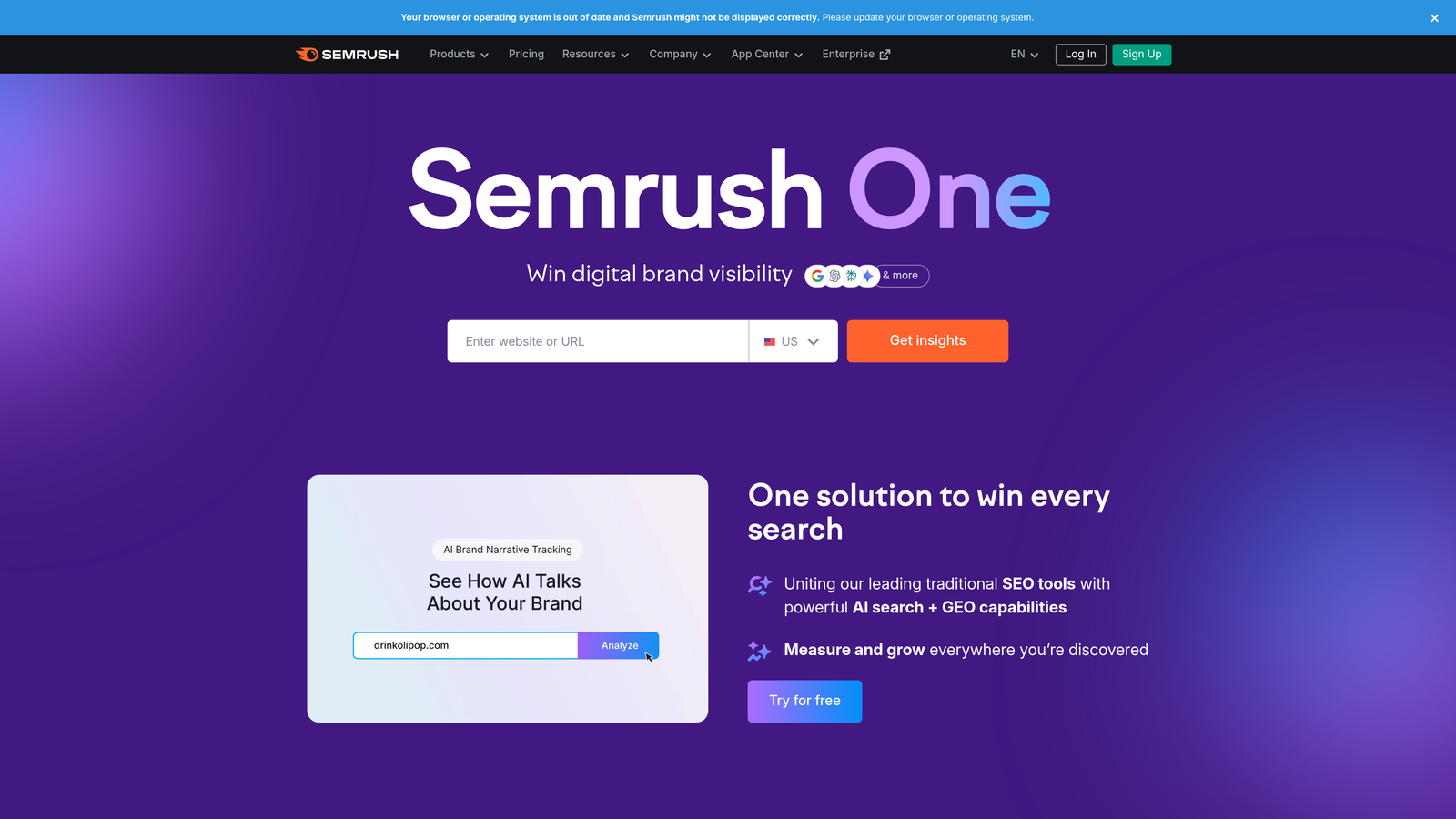
Semrush Writing Assistant integrates content optimization directly into the broader Semrush marketing platform.
Where This Tool Shines
Integration with Semrush's keyword research and competitive analysis tools creates an efficient workflow. You can identify keyword opportunities in the main platform, then optimize content for them immediately. There's no need to switch tools or manually transfer data between research and writing platforms.
Real-time recommendations cover SEO factors alongside readability and tone. The assistant flags passive voice, complex sentences, and inconsistent tone while suggesting keyword improvements. Search optimization and content quality are handled in one interface.
Key Features
Real-time SEO Recommendations: Keyword suggestions, optimization scoring, and SERP analysis integrated into your writing environment.
Readability Analysis: Flesch Reading Ease scoring with specific suggestions for improving clarity and accessibility.
Tone Consistency: Alerts when content drifts from your target voice or style.
Plagiarism Checking: Built-in originality verification before publishing.
Platform Integrations: Google Docs and WordPress plugins let you optimize content without leaving your preferred writing tool.
Best For
Teams already using Semrush for keyword research, competitive analysis, or other SEO tasks. For existing users, the Writing Assistant adds significant value without a separate subscription. If you don't need Semrush's broader platform, though, the $139.95/month minimum is expensive compared to standalone content tools.
Pricing
Included with Semrush Pro ($139.95/month), Guru ($249.95/month), and Business plans. There's no separate charge for the Writing Assistant, but you must keep an active Semrush subscription. If you only want content optimization, cheaper standalone tools make more sense.
7. Jasper
Best for: Teams prioritizing AI content generation with brand voice consistency across writers
Jasper focuses primarily on AI content generation, with extensive template libraries and brand voice training.
Where This Tool Shines
Brand voice training lets you upload existing content samples so Jasper learns your writing style, terminology, and tone. This is especially valuable when multiple team members use the platform. The AI references your trained brand voice instead of generating generic content.
The template library covers 50+ content types beyond blog posts, including social media captions, email sequences, product descriptions, and ad copy. That versatility makes Jasper useful for broader marketing teams, not just long-form writers.
Key Features
Brand Voice Training: Upload content samples to teach Jasper your style, tone, and terminology for consistent output.
Template Library: 50+ pre-built templates for content types from blog posts to social media and email marketing.
Long-form Editor: Dedicated workspace for creating articles with AI assistance, supporting documents up to several thousand words.
Chrome Extension: Generate content directly in any web-based tool without switching to the Jasper interface.
Team Collaboration: Multi-user workflows with approval processes and shared brand voice guidelines.
Best For
Marketing teams that need AI writing across multiple content types and want brand voice consistency. Jasper works best at high volume. If you write only a few articles monthly, per-seat pricing becomes expensive compared to tools with unlimited usage.
Pricing
Creator plans start at $49/month for one seat and Pro plans at $69/month per seat. Business plans require a custom quote. Because pricing is per seat, costs multiply quickly with team size. A five-person team on Pro pays $345/month, making Jasper one of the more expensive options for larger teams.
8. NeuronWriter
Best for: Budget-conscious creators wanting NLP optimization without premium pricing
NeuronWriter delivers NLP-based content optimization and AI writing at prices well below enterprise competitors.
Where This Tool Shines
NLP recommendations go beyond keyword matching to analyze semantic relationships and topic coverage. NeuronWriter identifies related concepts you should discuss even when they don't contain your exact target keywords. That helps you write more comprehensively without keyword stuffing.
Competitor content analysis shows what top-ranking pages cover and how they structure it. You can see their headings and emphasized topics, and how your draft compares in real time. Getting this competitive intelligence for under $50/month is exceptional value next to tools charging $200+ for similar features.
Key Features
NLP Content Recommendations: Semantic analysis that suggests related topics and concepts beyond exact keyword matches.
Competitor Analysis: Breakdowns of top-ranking content, including structure, topics covered, and optimization elements.
AI Writing Assistant: Generate sections or full articles with optimization guidelines already applied.
Content Planner: Calendar and planning tools for managing multiple articles and tracking optimization progress.
WordPress Integration: Publish directly to WordPress with optimization data preserved.
Best For
Solo creators and small teams with limited budgets who still want sophisticated NLP optimization. The Bronze tier's 25 analyses per month covers weekly publishers, while Silver and Gold accommodate higher volumes. The value is strongest for creators who would otherwise skip optimization tools entirely because of cost.
Pricing
Bronze plans start at $23/month for 25 content analyses, Silver at $45/month, and Gold at $69/month. Because each plan caps analyses, calculate your monthly volume first. If you optimize 30+ articles monthly, you'll need at least Silver. Even the Gold plan undercuts most competitors significantly.
9. WriterZen
Best for: Teams wanting combined keyword research and content creation in one workflow
WriterZen integrates topic discovery, keyword research, and content creation into a unified workflow designed to reduce tool switching.
Where This Tool Shines
The topic discovery engine finds content opportunities by analyzing what people actually search for around your core topics. You start with topics and let WriterZen identify the angles and questions that attract search volume. This often reveals opportunities that pure keyword research misses.
Keyword clustering automatically groups related keywords, so a single article can target multiple terms instead of one page per variation. This lowers content volume requirements while keeping keyword coverage comprehensive, which is particularly valuable for small teams with limited publishing capacity.
Key Features
Topic Discovery Engine: Find content opportunities by analyzing search behavior around your core topics.
Keyword Explorer: Research tools with automatic clustering of related keywords for content planning.
Content Creator: AI-assisted writing environment with optimization guidelines based on your keyword research.
Plagiarism Checker: Built-in originality verification before publishing.
Team Collaboration: Multi-user workflows for managing research, writing assignments, and content approvals.
Best For
Small to medium teams that want keyword research and content creation in one platform without paying for enterprise features. The integrated workflow particularly benefits teams where the same people handle research and writing. You can move from keyword discovery to drafting without losing context.
Pricing
Lite plans start at $27/month, Plus at $47/month, and Pro at $67/month. WriterZen occasionally offers lifetime deals that eliminate recurring costs, which are worth watching if you plan long-term use. Pricing sits in the mid-range, with more features than budget tools but well below enterprise levels.
Making the Right Choice
Your ideal SEO content tool depends less on features than on how you actually work. A solo creator publishing 4 articles monthly has fundamentally different needs from an agency producing 100+ pieces across multiple clients.
For budget-conscious solo creators, Frase's $15/month Solo plan or NeuronWriter's $23/month Bronze tier deliver solid optimization at low cost. Both cover the core features: SERP analysis, content scoring, and optimization recommendations. Neither makes you pay for enterprise collaboration tools you won't use.
Small teams publishing 10–20 articles monthly should consider WriterZen ($47–$67/month) or Surfer SEO's Essential plan ($89/month). These mid-tier options offer enough capacity for consistent publishing, plus team features such as shared workflows and content calendars. WriterZen's integrated keyword research particularly benefits teams where writers also handle topic research.
Agencies and high-volume publishers face different math. At 50+ articles monthly across multiple clients, report-based pricing models like Clearscope become prohibitively expensive. Frase's Team plan at $115/month for unlimited articles, or Sight AI's bundled approach, offers better economics at scale. The key question is whether you need only optimization or the full stack of visibility tracking, content generation, and publishing automation. If you're weighing broader suites, our roundup of top SEO platforms for content compares them on workflow fit.
Enterprise teams with established content libraries should evaluate MarketMuse ($149–$399/month) or Clearscope ($189–$399/month). The strategic planning features justify premium pricing when you manage hundreds of existing articles and need sophisticated content gap analysis. These platforms assume you have dedicated content strategists, because their insights take expertise to implement.
Workflow integration is often overlooked. If you write in Google Docs, tools with native extensions (Surfer, Clearscope, Semrush) eliminate copying content back and forth. If you publish to WordPress, direct integrations (NeuronWriter, WriterZen) save time and preserve formatting. These efficiencies compound over dozens of articles a month.
The pricing model matters as much as the absolute cost. Per-article pricing works for low-volume publishers but gets expensive at scale. Per-seat pricing suits small teams but multiplies costs as you grow. Unlimited plans offer predictable costs but may include features you never use. Calculate your actual monthly content volume and team size before committing. The cheapest plan often isn't the most cost-effective for your situation.
Frequently asked questions
Which SEO content tool is cheapest for a single seat?
Frase Solo ($15/month, 4 articles) and NeuronWriter Bronze ($23/month, 25 analyses) are the lowest-cost single-seat options in this comparison. Both generate SERP-based briefs covering recommended topics, headings, and content length. WriterZen Lite ($27/month) adds keyword research. If you need more than a handful of briefs monthly, NeuronWriter's analysis allowance usually gives the lower cost per article.
How much do AI content gap discovery platforms typically cost?
Expect roughly $100–$400 per month. MarketMuse Standard starts at $149/month, and team plans start at $399/month. Clearscope's content inventory features sit in its $189–$399/month plans. Enterprise contracts with large inventories or many seats can exceed $1,000/month. Bundled platforms such as Sight AI include content opportunity detection alongside writing and AI visibility tracking, so compare total stack cost rather than single-feature prices.
How are MarketMuse alternatives priced for agencies?
Agencies typically choose between three structures: per-seat licenses (Jasper), report or credit pools shared across clients (Clearscope, NeuronWriter), or unlimited plans (Frase Team). Credit pools work when client volume fluctuates. Unlimited plans are safest above about 30 articles monthly. Ask vendors about client workspaces, annual discounts, and whether unused credits roll over before signing.
Do SEO tools charge extra for AI writing?
Often, yes. Surfer sells AI writing credits separately from its optimization plans. Semrush requires a full suite subscription to use the Writing Assistant. Jasper charges per seat. Check whether AI generation, plagiarism checks, and CMS integrations are included or metered, because these add-ons are the most common reason real invoices exceed advertised prices.
Stop guessing how AI models like ChatGPT and Claude talk about your brand. Get visibility into every mention, track content opportunities, and automate your path to organic traffic growth. Start tracking your AI visibility today and see exactly where your brand appears across top AI platforms, while generating content optimized for both traditional search and AI recommendations.