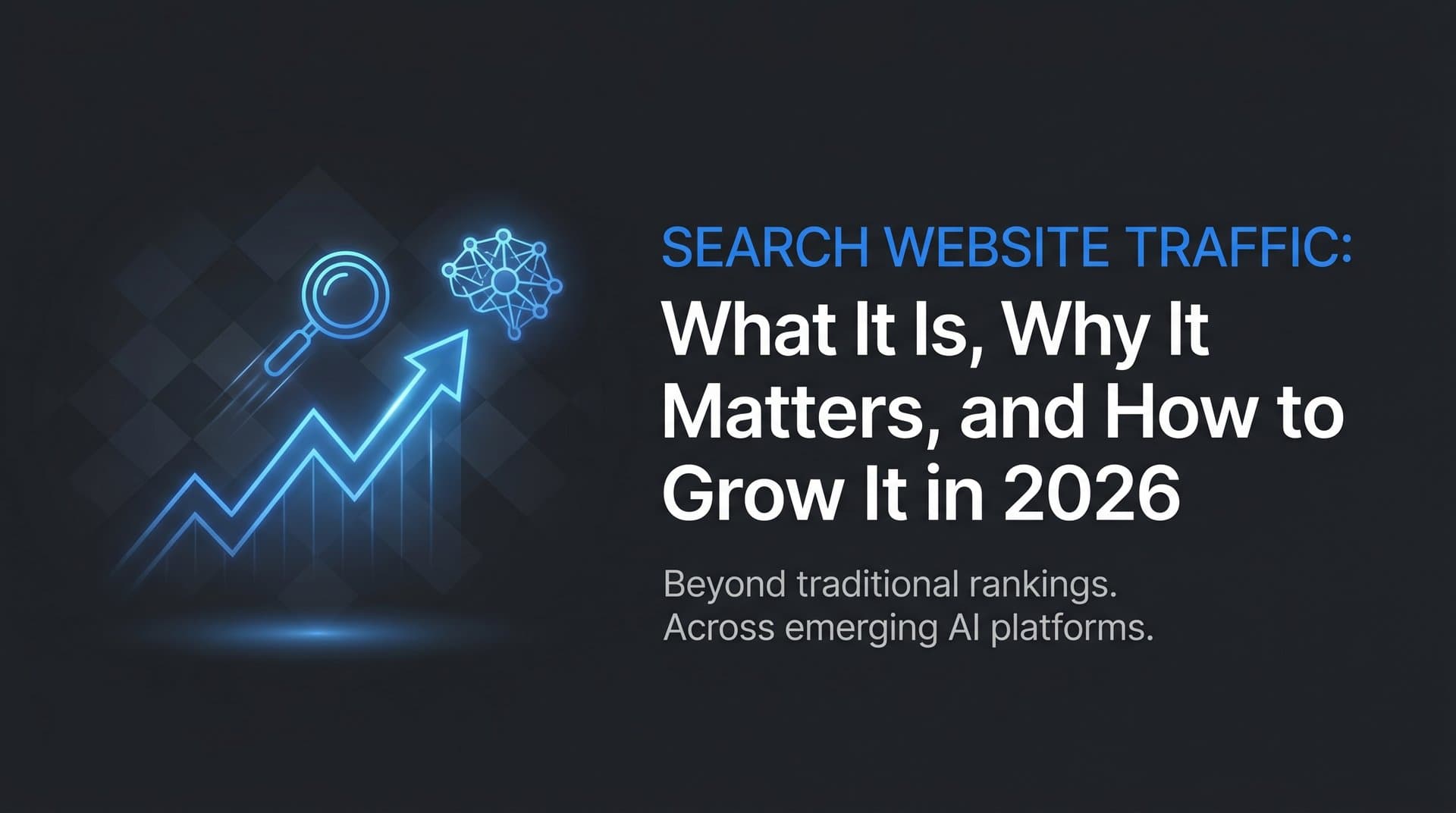
Search website traffic has long been the backbone of sustainable online growth. For most businesses, it represents the single most reliable source of visitors who actually want what you're offering. But in 2026, the landscape for earning that traffic looks fundamentally different from even a few years ago.
Traditional search engines like Google and Bing still dominate, but a new category of search behavior has emerged. People are increasingly turning to AI-powered platforms like ChatGPT, Perplexity, and Claude to find answers, compare products, and discover brands. When those platforms respond, they cite sources, recommend services, and shape purchasing decisions, often without users ever clicking through to a traditional search results page.
This shift means that understanding and growing search website traffic now requires a broader playbook than it once did. You need to know where your visitors are coming from, why certain channels outperform others, and how to build visibility not just on page one of Google but across every platform where your audience is searching.
This article breaks it all down. You'll get a clear definition of search website traffic, a breakdown of its components, a practical guide to measuring it accurately, and a modern growth strategy that covers both traditional SEO and the emerging discipline of Generative Engine Optimization (GEO).
The Anatomy of Search Website Traffic
Search website traffic refers to all visitors who arrive at your site after entering a query into a search engine or AI search platform. It's a distinct channel, separate from direct traffic vs organic search (people typing your URL directly), referral traffic (clicks from other websites), social traffic (clicks from social media), and paid display traffic (banner ads and similar formats).
What makes search traffic unique is intent. These visitors are actively looking for something. They typed a question or phrase, which means they've already signaled interest before they ever reach your site.
Within search website traffic, there are two well-established categories worth understanding clearly.
Organic Search Traffic: These are visitors who clicked on unpaid results in a search engine. When someone searches "best project management software" and clicks a result that isn't an ad, that's organic traffic. Earning organic traffic requires search engine optimization: producing relevant content, building authority, and meeting the technical requirements that search engines use to evaluate and rank pages.
Paid Search Traffic: This refers to visitors who clicked on a paid advertisement, typically a pay-per-click (PPC) ad displayed at the top or bottom of a search results page. Paid search delivers immediate visibility, but it requires continuous spend. The moment your budget runs out, the traffic stops. Organic traffic, by contrast, can continue delivering visitors long after the content was published.
For most businesses, organic search traffic is the more valuable long-term asset. It compounds over time, builds brand credibility, and doesn't disappear when a campaign ends. Paid search has its place, particularly for time-sensitive promotions or highly competitive keywords where organic ranking takes time, but it's rarely a substitute for a strong organic foundation.
Now there's a third category that marketers increasingly need to account for: AI-referred traffic. This includes visitors who arrive at your site after an AI platform like ChatGPT, Perplexity, or Google AI Overviews cited your content or recommended your brand in a response. This traffic behaves differently from traditional search traffic, and critically, it's largely invisible in conventional analytics tools. Tracking it separately is no longer optional for brands that want a complete picture of their search performance.
Why Search Traffic Outperforms Other Channels
Not all website traffic is created equal. A visitor who stumbled across your brand in a social media feed is in a very different mindset from someone who searched for the exact problem your product solves. That difference in intent is what makes search website traffic so consistently valuable.
When someone types a query into a search engine, they're expressing a need. They're looking for information, a solution, a product, or a service. Your content showing up in response to that query puts you directly in the path of someone who already wants what you're offering. Compare that to social media or display advertising, where you're interrupting someone who wasn't looking for you at all. Understanding search intent in SEO is essential to capitalizing on this dynamic.
Search traffic also delivers compounding returns in a way that most other channels don't. A well-optimized piece of content can attract visitors for months or years after it was published. Over time, as it earns backlinks and accumulates engagement signals, it often ranks higher and attracts even more traffic. Paid advertising, by contrast, operates on a linear model: you spend, you get traffic; you stop spending, the traffic disappears. Organic search builds an asset that appreciates over time.
Trust plays a significant role as well. Users have grown increasingly skeptical of advertising. Organic search results and AI-generated answers are generally perceived as more credible than paid placements, which influences both click-through rates and the quality of engagement once visitors arrive. A user who found you through an organic search result or an AI recommendation arrived with a degree of implied endorsement from the platform they trust.
This trust dynamic extends to AI search platforms in a particularly interesting way. When ChatGPT or Perplexity recommends a brand or cites a source in its response, users often treat that citation with high credibility. Being the brand that an AI recommends carries a form of third-party validation that's distinct from anything traditional search offered.
The combination of high intent, compounding returns, and inherent trust makes search traffic the most cost-efficient channel for sustainable growth over the long term. That's not to say other channels don't have value, but for most businesses, search is the channel worth investing in most deeply.
Measuring and Analyzing Your Search Traffic
Understanding your search website traffic starts with the right tools and knowing which metrics actually matter. Without accurate measurement, you're optimizing blind.
The two foundational tools for measuring organic search performance are Google Analytics 4 and Google Search Console. Each serves a distinct purpose, and you need both.
Google Analytics 4 (GA4) tracks what happens after visitors arrive on your site. Through the Session Source/Medium reports, you can isolate traffic arriving from organic search and analyze how those visitors behave: which pages they land on, how long they stay, how many pages they visit, and whether they convert. GA4's event-based model also lets you track specific actions, like form submissions or product purchases, and attribute them back to organic search sessions.
Google Search Console (GSC) shows you what happens before the click. It provides data on impressions (how often your pages appeared in search results), clicks, click-through rate (CTR), and average position for specific queries. This is where you identify which keywords are driving traffic, which pages are underperforming despite ranking, and where there are opportunities to improve CTR through better title tags or meta descriptions. You can also check your position in Google search to benchmark progress over time.
The key metrics to monitor regularly include organic sessions, keyword rankings, CTR, bounce rate, pages per session, and conversion rate from organic traffic. Each tells a different part of the story. A page with high impressions but low CTR suggests a title or description problem. High organic sessions with a poor conversion rate suggests a content or landing page alignment issue.
Third-party tools like Ahrefs, Semrush, and Moz add another layer by tracking keyword rankings across your full content library, analyzing competitor performance, and identifying backlink opportunities. A dedicated website traffic monitoring tool can consolidate these insights into a single view.
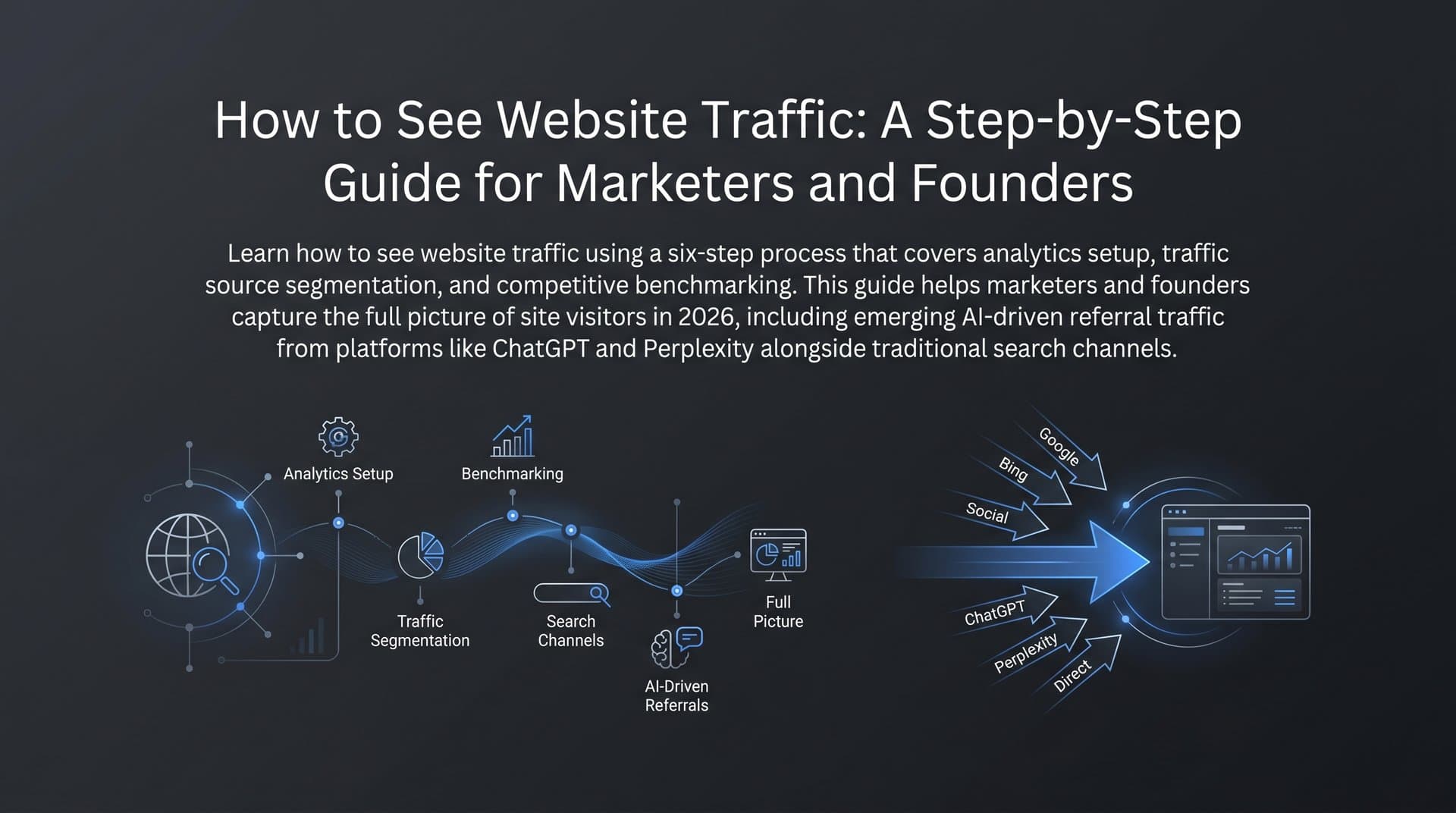
Here's where traditional measurement falls short, though: none of these tools effectively track AI-referred traffic. When Perplexity cites your article in a response, or when ChatGPT recommends your product to a user, that traffic often appears in GA4 as direct traffic or gets misclassified entirely. You're getting visibility in AI search, but you can't see it, measure it, or optimize for it.
This blind spot is becoming a meaningful problem as AI search usage grows. Brands that rely solely on traditional analytics tools are increasingly working with an incomplete picture of how their search traffic is actually generated. Dedicated AI visibility tracking platforms are emerging to fill this gap, monitoring how and when your brand is mentioned across AI models and providing the data you need to optimize for this new search category.
Proven Strategies to Grow Organic Search Traffic
Growing organic search traffic is a multi-layered discipline. It combines technical rigor, content strategy, and authority building. Here's how each component fits together.
Keyword Research Aligned with Intent: Effective keyword research for organic SEO isn't just about finding high-volume terms. It's about understanding what a searcher actually wants when they type a query. Informational queries need educational content. Commercial queries need comparison pages or product-focused content. Transactional queries need landing pages designed to convert. Matching your content type to search intent is one of the highest-leverage activities in SEO.
On-Page Optimization: Once you've identified your target keywords, the content itself needs to be structured for both users and search engines. This means crafting title tags that include the target keyword and compel clicks, using header tags (H2, H3) to organize content logically, building internal links that connect related pages across your site, and writing with enough depth to genuinely answer the query. Shallow content that technically includes a keyword but doesn't satisfy the underlying question rarely ranks well for long.
Technical SEO: Your content can't rank if search engines can't find, crawl, and index it efficiently. Technical SEO covers site speed, mobile-friendliness, clean URL structures, proper use of canonical tags, XML sitemaps, and ensuring there are no crawl errors blocking important pages. Understanding search engine indexing optimization can accelerate how quickly new content gets discovered, reducing the lag between publishing and ranking.
Content Strategy at Scale: Producing individual articles in isolation is far less effective than building interconnected topic clusters. A pillar page covers a broad topic comprehensively, while supporting cluster content dives into specific subtopics in detail. Internal links connect the cluster back to the pillar, signaling topical authority to search engines. This structure helps you capture long-tail queries that individually have modest volume but collectively drive significant traffic.
Backlinks and Domain Authority: Search engines treat links from other reputable websites as votes of confidence. Building a strong backlink profile through original research, genuinely useful content, digital PR, and partnerships remains one of the most important factors in competitive rankings. Domain authority isn't built overnight, but it compounds: a site with strong authority can rank new content faster and more reliably than a newer site with fewer external links.
Content Freshness: Search engines favor content that's accurate and up to date, particularly for topics where information changes over time. Regularly revisiting published content to update statistics, add new sections, or improve clarity sends a freshness signal and often produces meaningful ranking improvements without the effort of creating something entirely new.
The AI Search Revolution: Traffic Beyond Traditional Engines
A fundamental change is underway in how people search for information. AI-powered platforms like ChatGPT, Perplexity, Claude, and Google AI Overviews are becoming primary research tools for a growing segment of users. Instead of scanning a list of links, these users ask questions and receive synthesized answers with cited sources. The implications for search website traffic are significant.
This shift has given rise to Generative Engine Optimization, or GEO. Where traditional SEO focuses on earning rankings in search engine results pages, GEO focuses on ensuring your brand is cited, recommended, or referenced in AI-generated responses. The goal is the same as SEO, earning visibility where your audience is searching, but the mechanism is different.
AI platforms don't rank pages the way Google does. Instead, they select sources to reference based on a combination of factors. Structured, well-organized content that directly answers questions tends to be favored. Authoritative brand signals matter: brands with strong domain authority, consistent expert content, and clear entity recognition across the web are more likely to be cited. Understanding the key AI search engine ranking factors is critical for optimizing your presence across these platforms.
This means that much of what makes content perform well in traditional search, depth, authority, structure, and clarity, also makes it more likely to be cited by AI models. SEO and GEO are complementary disciplines, not competing ones. The content investments you make for Google rankings often pay dividends in AI visibility as well.
What's different about GEO is the measurement challenge. You can't check your AI visibility in Google Search Console. Knowing whether ChatGPT recommends your brand when someone asks about your category, or whether Claude cites your content when answering a relevant question, requires dedicated monitoring across AI platforms. This is where AI visibility tracking becomes essential.
Understanding your AI visibility means knowing which prompts trigger mentions of your brand, what sentiment those mentions carry, which competitors are ranking in AI search alongside or instead of you, and how your visibility changes over time. Without this data, you're optimizing for a channel you can't see. With it, you can identify content gaps, understand how AI models perceive your brand, and make targeted improvements to increase your presence in AI-generated responses.
Building a Modern Search Traffic Engine
Pulling all of this together into a coherent, scalable workflow is where many teams struggle. The principles of SEO are well-established, but adding GEO, AI visibility tracking, and content production at scale creates operational complexity that requires the right systems.
A modern search traffic engine runs on three interconnected capabilities: unified content production, automated indexing, and continuous measurement across both traditional and AI search.
Unified Content Production: Creating content that performs in both traditional search and AI platforms requires a consistent approach to quality, structure, and depth. Leveraging AI-powered search engine optimization tools can help teams produce SEO and GEO-optimized articles at scale without sacrificing the quality that both Google and AI models reward. The key is generating content that genuinely serves the reader's intent, not just content that checks keyword boxes. Specialized agents for different content formats, whether explainers, listicles, comparison guides, or pillar pages, allow teams to maintain quality across a high publishing volume.
Automated Indexing: New content can't drive traffic if search engines haven't discovered and indexed it. Automated indexing tools with IndexNow integration notify search engines immediately when new pages are published or existing pages are updated, reducing the time between publishing and ranking. Learning how to submit your website to search engines effectively is a foundational step in this process. Paired with automated sitemap updates, this creates a system where your content enters the indexing queue as quickly as possible, compressing the lag that often frustrates content teams.
Continuous Measurement: The measurement layer is what separates teams that optimize intelligently from teams that guess. Traditional metrics like organic sessions, keyword rankings, and conversion rates from organic search remain essential. But a complete picture now requires AI visibility data as well: which prompts trigger mentions of your brand, what your AI Visibility Score looks like across platforms like ChatGPT, Claude, and Perplexity, what sentiment those mentions carry, and how your visibility trends over time relative to competitors.
Platforms like Sight AI combine these capabilities in a single workflow, tracking AI brand mentions across multiple AI models, scoring sentiment and visibility, providing content opportunity data, and integrating with content generation and indexing tools. This unified approach eliminates the fragmentation that comes from stitching together multiple disconnected tools and gives teams a single source of truth for their search traffic performance.
The teams seeing the strongest results in 2026 are those treating search traffic as a system rather than a collection of tactics. They're producing content consistently, indexing it efficiently, and measuring performance across both traditional and AI search channels. Each component reinforces the others, and the compounding effect over time is significant.
Putting It All Together
Search website traffic in 2026 is no longer a single channel with a single playbook. It spans traditional organic search, paid search, and a fast-growing category of AI-referred traffic that most businesses are currently measuring poorly or not at all.
The fundamentals haven't changed: high-intent visitors from search convert better, organic traffic compounds over time, and trust in search results drives engagement. What has changed is where search happens and what it takes to be visible across all of it.
The key takeaways are straightforward. Understand the full anatomy of your search traffic and don't let AI-referred visits remain invisible in your analytics. Invest in both SEO and GEO, recognizing that quality content serves both disciplines. Build technical infrastructure that gets content indexed quickly. And measure continuously, including your AI visibility, so you can optimize based on what's actually happening rather than what you assume.
The brands that will dominate search traffic over the next few years are those that treat AI visibility as a first-class metric alongside traditional rankings. They're not waiting to see how AI search evolves before they start tracking it. They're building visibility now, while the competitive landscape is still forming.
If you're not sure where your brand stands across AI platforms, that's the place to start. Start tracking your AI visibility today and see exactly where your brand appears across top AI platforms. Stop guessing how AI models like ChatGPT and Claude talk about your brand, and get the visibility, content opportunities, and measurement tools you need to build a modern search traffic engine that compounds in your favor.