When someone lands on your website after clicking a non-ad link on Google, Bing, or another search engine, that’s organic search traffic. It's the lifeblood of most digital businesses—traffic you've earned through quality and relevance, not paid for with ad spend.
What Is Organic Search Traffic?
Think of your website as a specialty shop in a massive, sprawling city. People could find you in a few ways. They might see a paid billboard (that's paid search), get a flyer from a friend (referral traffic), or spot you on social media.
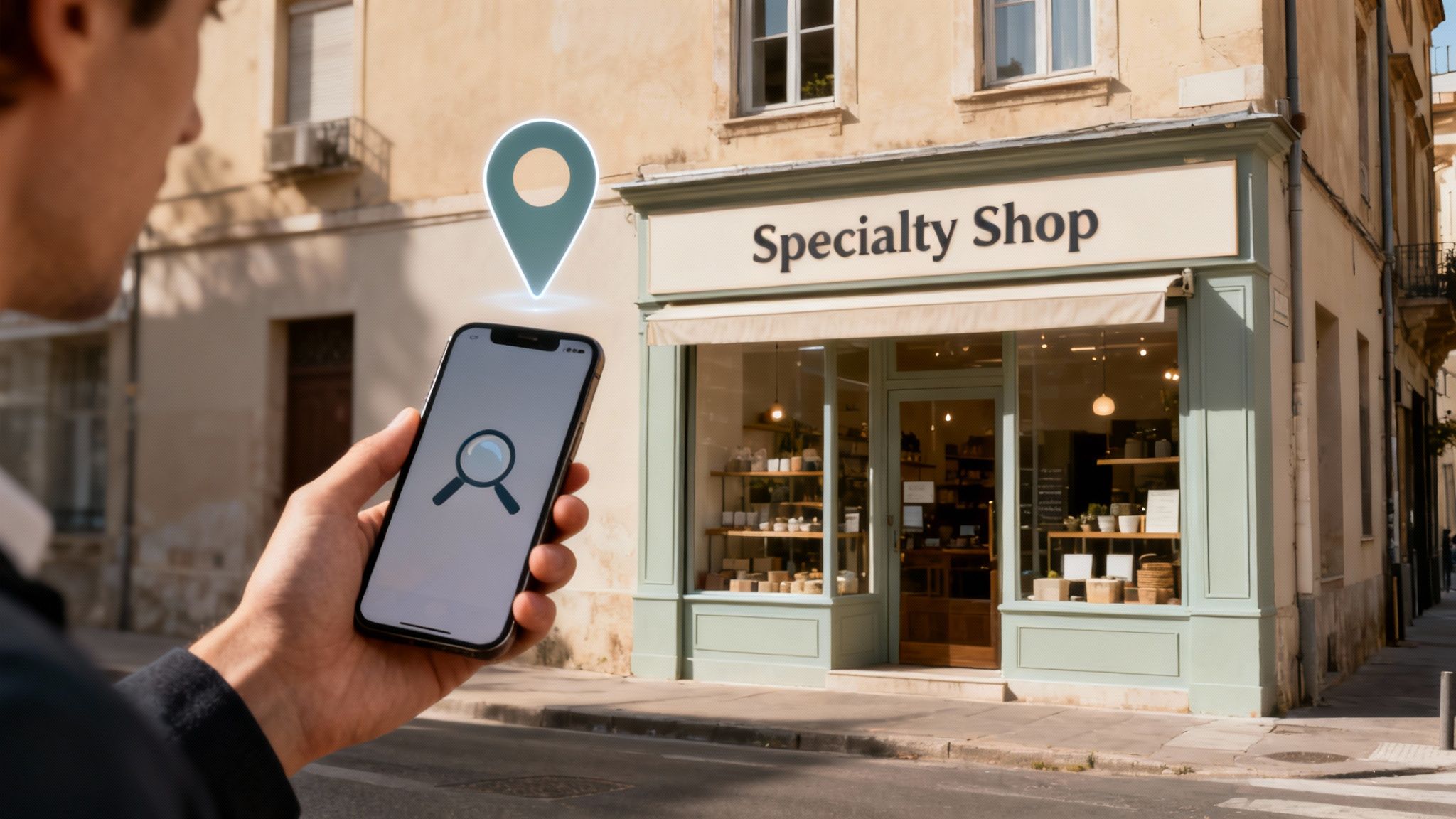
Organic search is different. It’s like a potential customer using a trusted city map to find you because your shop is listed as the absolute best place for what they need. You didn't buy that top spot; you earned it.
That "map" is the search engine results page (SERP). The search engine’s algorithm decided your website provides the most helpful, relevant, and authoritative answer to what the user was looking for.
The Power of Intent and Trust
What truly makes organic traffic so valuable is the potent mix of user intent and trust. When someone types a question into a search bar, they're actively on a mission to find something—a solution, a product, or information. This is a world away from someone passively scrolling through a social media feed.
This active search creates a golden opportunity. Visitors arriving from an organic search are often more engaged and primed to convert because they initiated the entire journey. They put their trust in the search engine to point them to credible results, and that trust naturally extends to the websites it recommends.
It's no surprise that organic search absolutely dominates as the primary driver of website visits across the globe.
Organic search traffic is the single largest source of website visits, driving roughly 53% of all website traffic. That figure dwarfs both paid search and social media, cementing its critical role in any serious digital strategy.
Core Attributes of Organic Search
To really appreciate its value, you need to understand the unique characteristics of organic traffic. This isn't just about getting "free" visitors; it's about building a sustainable, long-term asset for your business. For a more detailed breakdown, check out our guide on how to track and understand what organic traffic is in Google Analytics.
To keep things simple, let's break down the core attributes of organic traffic. The table below offers a quick summary of what makes it unique.
Organic Search Traffic at a Glance
| Attribute | Description |
|---|---|
| Cost-Effective | Requires investment in content and SEO, but no direct payment per click or impression. |
| High User Intent | Visitors are actively looking for solutions or information directly related to what you offer. |
| Builds Authority | Consistent high rankings establish your brand as a trusted leader in your industry. |
| Sustainable & Compounding | Unlike ads, a high-ranking page can drive traffic for years, with returns that grow over time. |
In short, while other channels have their place, organic search delivers visitors who are actively looking for exactly what you provide. This builds a foundation of trust and authority that paid channels simply can't replicate.
Why Organic Search Is the Engine for Sustainable Growth
Sure, knowing what organic search traffic is helps, but the real question is why it should be one of your top priorities. While paid ads give you a quick hit of visibility and social media is great for engagement, organic search builds something with staying power.
It’s the difference between renting a billboard on a busy highway and owning the best piece of real estate in town.
Paid ads vanish the second your budget runs out. Social media traffic can feel like you're constantly chasing unpredictable algorithms and fleeting trends. Organic search, on the other hand, creates a durable, scalable asset for your business. A single, well-optimized article can pull in high-intent visitors for years, delivering compounding returns long after you hit publish.
This long-term value is built on a foundation of trust. When someone sees your site at the top of the organic results, it acts as an implicit endorsement from Google. This placement signals that your brand is a credible, authoritative voice in your industry.
Establishing Unshakeable Brand Authority
Ranking consistently for the keywords your customers are searching for does way more than just drive clicks—it cements your brand's authority. Every time a potential customer is looking for a solution and your content pops up, you're positioning yourself as the go-to expert.
This repeated exposure builds familiarity and trust long before they're even thinking about making a purchase. That authority is absolutely critical for guiding customers through their buying journey. Someone might first discover you through a blog post that answered a simple question. Later, when they're actually comparing solutions, who are they going to trust? The brand that’s already provided them value. This is how you build loyal customers, not just one-time buyers. For a deeper dive on this, you can check out why brand awareness is so important for long-term success.
Generating a Consistent Stream of High-Quality Leads
What makes organic search traffic so incredibly powerful is that it captures people at their moment of highest intent. They are actively looking for answers, products, or services right now. This makes the leads you get from organic search some of the absolute best you can find.
Think about these massive advantages:
- Problem-Aware Visitors: People aren't just stumbling upon your site; they're arriving because they have a specific problem to solve, and they think you have the answer.
- Cost-Effectiveness: Once you start ranking, every click you get is essentially free. This can drastically lower your customer acquisition cost (CAC) over time compared to paying for every single click with ads.
- Scalability: You aren't capped by a daily ad budget. A strong SEO foundation means you can capture more and more traffic as your authority grows, without your costs growing at the same rate.
All of this works together to create a predictable and efficient lead generation engine—one that works for you 24/7 without needing a constant injection of cash.
The Compounding Value of an Organic Asset
Think of every piece of content that ranks in search results as a small, appreciating asset. As you create more content and build more authority over time, these assets work together to create a powerful compounding effect. A blog post you wrote two years ago can still be generating leads and revenue today.
Unlike a paid campaign that stops delivering value the second the budget runs out, a strong organic presence is a business asset that appreciates over time. The effort you invest today continues to pay dividends for months and even years to come.
This is what makes organic search the ultimate engine for sustainable growth. It’s not about quick wins or temporary traffic spikes. It’s about building a foundational marketing channel that supports your business's long-term health and profitability. For founders, SEO managers, and agencies alike, mastering organic search is the key to building a resilient and thriving brand.
How to Measure Your Organic Search Performance
Knowing what organic search traffic is and why it matters is a great start, but tracking its real-world impact is where your strategy actually begins to take shape. After all, you can't improve what you don't measure.
To see how your SEO efforts translate into results, you need to get comfortable with two essential—and completely free—tools from Google. Think of these platforms as the command center for your entire SEO operation. They give you direct, unfiltered data on how your site shows up in search and what people do once they land there.
Using Google Search Console for Visibility Insights
Think of Google Search Console (GSC) as your direct line to Google. It tells you exactly how the search engine sees your website before anyone even clicks through. It's all about your performance on the search results page itself.
GSC is invaluable for answering critical questions like, "Are people even seeing my pages in search?" and, "When they do see them, are my listings compelling enough to click on?"
You'll quickly find yourself living by four core metrics in GSC:
- Clicks: The raw number of times someone clicked from a Google search result to your site. This is your organic search traffic.
- Impressions: How many times a URL from your site appeared in search results that a user saw. This metric is all about your overall reach and visibility.
- Click-Through Rate (CTR): This is just (Clicks / Impressions) x 100. This percentage tells you how well your page titles and meta descriptions are doing their job of grabbing attention. A high CTR means your listings are hitting the mark.
- Average Position: This shows your average ranking for a specific keyword or across your whole site. It’s a straightforward way to track whether you’re moving up or down the SERPs.
By digging into these numbers, you can spot which pages are your top performers, which keywords are bringing in the best visitors, and where your biggest opportunities for improvement lie.
Analyzing User Behavior with Google Analytics 4
While GSC shows you what happens on the search results page, Google Analytics 4 (GA4) picks up the story after the click. Once a visitor lands on your website, GA4 starts tracking their journey, which is how you connect organic traffic to actual business outcomes.
First things first, you'll want to isolate your organic search traffic. You can do this in GA4 by heading to the "Acquisition" reports and filtering everything by the "Organic Search" channel.
From there, your efforts begin to fuel a sustainable growth cycle, moving from building authority to generating leads and creating a lasting asset for your business.
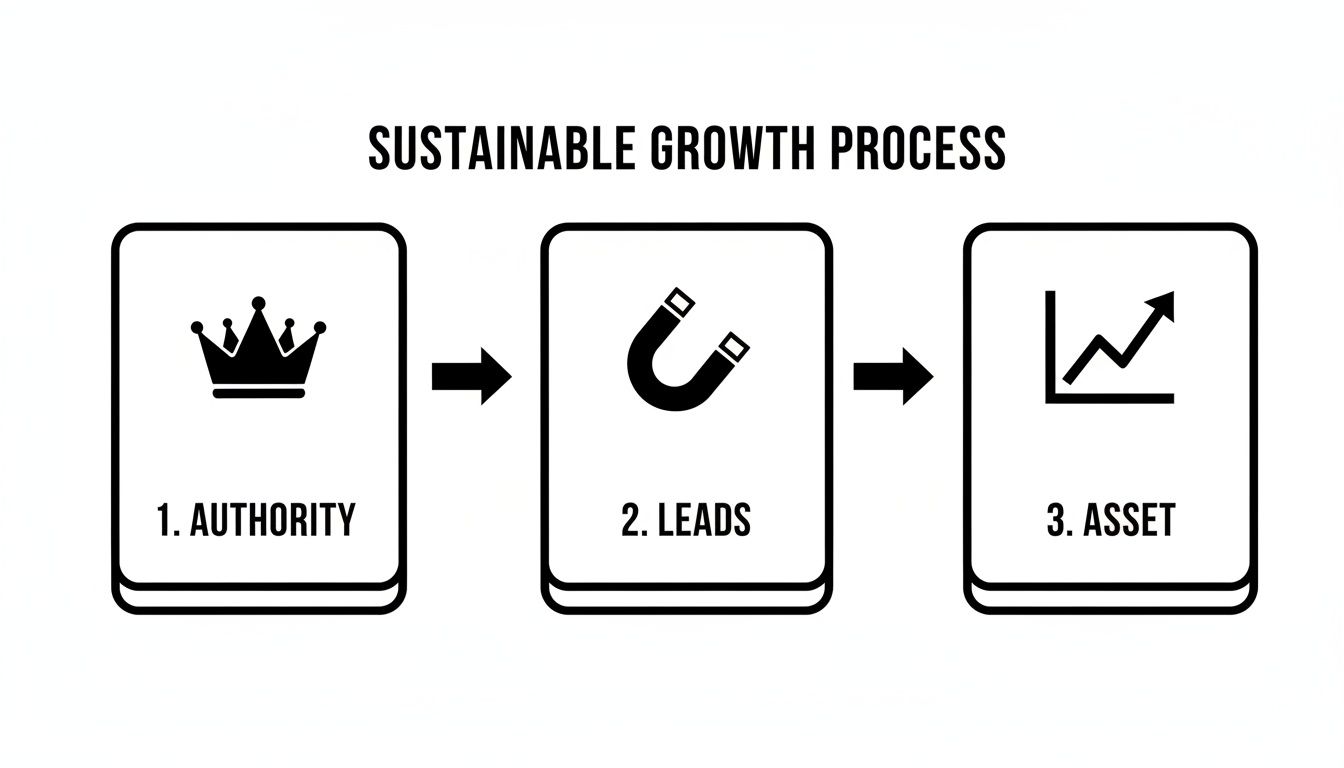
This process shows that solid measurement is the first step in a cycle that builds authority, which then generates valuable leads and creates a business asset that compounds over time.
Once you’ve zeroed in on your organic visitors, you can analyze key behavioral metrics:
- Users and Sessions: How many unique visitors and individual visits came from organic search.
- Engaged Sessions: A session that lasted longer than 10 seconds, had a conversion, or included at least two pageviews. This is a fantastic indicator of traffic quality.
- Conversions: This is the big one. Here, you track how many organic visitors took an action you care about—like signing up for a newsletter, filling out a form, or buying a product.
By connecting organic search traffic to conversions in GA4, you move beyond simple traffic numbers. You start measuring the real ROI of your SEO efforts, proving how organic visibility directly contributes to revenue and business goals.
For a complete walkthrough on getting your measurement framework set up, our guide on how to measure SEO success provides step-by-step instructions. Properly configured tracking is the bedrock of any effective SEO strategy, turning raw data into actionable business intelligence that fuels sustainable growth and demonstrates the clear value of your work.
Proven Strategies to Increase Your Organic Traffic
Okay, so you understand what organic traffic is and you know how to measure it. That sets the stage for the most important part: actually getting more of it. Growing your organic traffic isn't about some secret hack or magic bullet; it's about building a rock-solid foundation across three critical areas: technical health, content strategy, and brand authority.
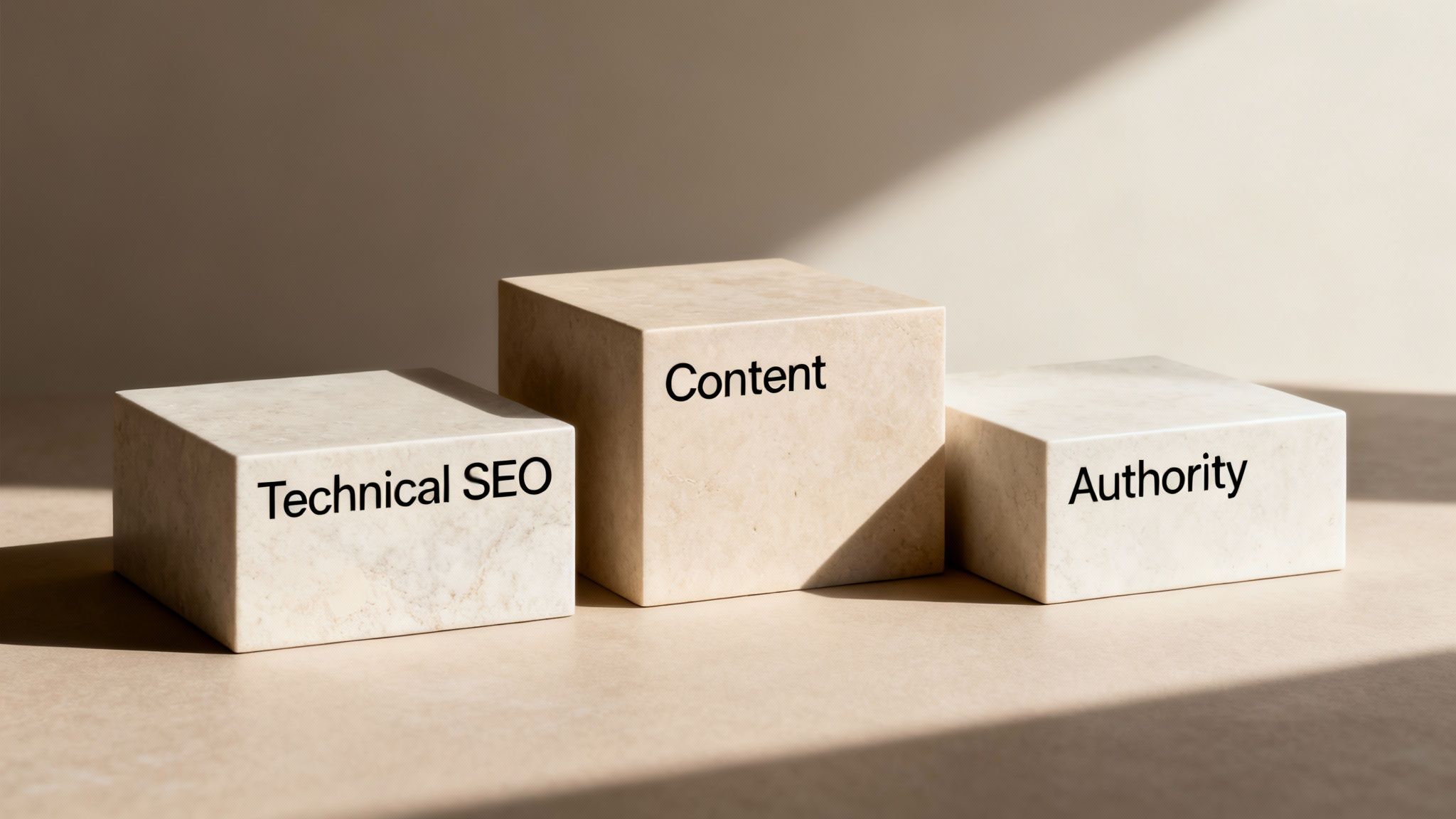
Think of your website as a high-performance race car. Technical SEO is the engine and chassis—the core mechanics. Content is the high-octane fuel that makes it go. And authority? That's the reputation of the world-class driver behind the wheel. You can't win the race for the top spot on Google unless all three are working in perfect harmony.
Build a Flawless Technical SEO Foundation
Before you write a single word of content, you have to make sure search engines can actually find, crawl, and make sense of your website. Technical SEO is the absolute bedrock of your entire strategy. If that foundation is cracked, everything you build on top of it is at risk of crumbling.
Imagine you’ve written the greatest book in the world, but it’s locked away in a library with no doors and confusing signs. That’s what bad technical SEO does to your amazing content. The main goal here is to remove every single roadblock for search engine crawlers.
This boils down to a few non-negotiable components:
- Site Speed: In an age of zero patience, a slow website is a traffic-killer. Pages that drag their feet frustrate users and get penalized by search engines. Compressing images, using a content delivery network (CDN), and enabling lazy loading are your first moves.
- Mobile-Friendliness: The majority of searches now happen on a phone, which is why Google uses mobile-first indexing. This means it primarily looks at your mobile site for ranking. A responsive design that works perfectly on any screen isn't just nice to have; it's essential.
- Clean URL Structure: Your URLs need to be simple and logical for both people and search engines. A URL like
/blog/what-is-organic-search-trafficis infinitely better than/archive.php?id=8675309. - XML Sitemaps: Think of an XML sitemap as a detailed map of your website that you hand directly to search engines. It helps them discover all your important pages, making sure nothing important gets overlooked.
Fixing these technical issues creates a smooth highway for search engines, making it much easier for them to reward your great content with the visibility it deserves.
Execute a High-Impact Content Strategy
With a solid technical setup, it's time to focus on the content itself. But just churning out blog posts on random topics is a fast track to nowhere. A winning content strategy is deliberate, laser-focused on the user, and built on a deep understanding of what your audience is actually searching for.
Your goal is to turn your website into the go-to resource on a topic—so comprehensive that Google has no choice but to see you as the definitive authority. This is where keyword research and topic clusters come into play.
A cornerstone of any successful effort to increase your organic traffic is knowing how to approach finding the best keywords for SEO that align with user intent. It’s not about guessing; it’s about using data to understand the precise language your customers use.
Once you have your keywords, you organize them into topic clusters. This model is brilliant in its simplicity. You create a central "pillar" page on a broad topic (like this article on "what is organic search traffic") and then surround it with "cluster" content that dives deep into more specific, related subtopics.
For example, a pillar page on email marketing could be supported by cluster posts on:
- "Best practices for email subject lines"
- "How to build an email list from scratch"
- "Examples of email marketing automation workflows"
This structure signals to search engines that you have serious expertise on the subject, especially since all the related pages link back to the main pillar. This concentrated authority helps the entire cluster of content rank higher, driving waves of relevant traffic. While there are many ways to increase your organic traffic, a smart content strategy is the engine behind them all.
Build Authority with E-E-A-T and Backlinks
The final piece of the puzzle is authority. Google wants to send its users to content from sources it can trust, especially for topics that could impact someone's health, happiness, or finances. It measures this trust using a framework called E-E-A-T, which stands for Experience, Expertise, Authoritativeness, and Trustworthiness.
Demonstrating E-E-A-T isn't about checking a box; it's about weaving credibility into the very fabric of your website. You have to prove you know your stuff.
Here’s how you build and showcase that authority:
- Showcase First-Hand Experience: Write from a first-person perspective when it makes sense. Share unique data, case studies, or personal stories that prove you’ve actually been in the trenches. Generic, rehashed content just won’t cut it anymore.
- Feature Expert Authors: Create clear author bios that highlight credentials, real-world experience, and qualifications. If you have industry experts on your team, put them front and center.
- Earn High-Quality Backlinks: When a reputable, relevant website links to your content, it’s like a vote of confidence. It tells search engines that other trusted sources vouch for you. You can earn these through digital PR, creating unique data studies, and building genuine relationships in your industry.
By consistently creating valuable content on a technically sound website and earning trust signals like backlinks, you create a powerful, self-reinforcing loop. This integrated approach is the only way to achieve sustainable, long-term growth in your organic search traffic.
Organic Search vs Paid Search and Social Media
To build a winning marketing strategy, you have to understand how each traffic channel fits into the bigger picture. Organic search isn't an island; it exists in an ecosystem alongside paid search (PPC) and social media. Each has distinct strengths, and the most successful brands learn how to make them work in harmony.
Think of it like building a fire. Organic search is the slow, steady burn of seasoned hardwood. It takes time and effort to get it going, but once it does, it provides consistent, long-lasting heat with minimal ongoing effort. It builds a foundation of warmth and reliability.
Paid search, on the other hand, is like pouring gasoline on the kindling. You get a massive, immediate flare-up of traffic and visibility. It’s perfect for getting results right now, but the moment you stop paying for fuel, the flames die out completely.
And then there's social media. It's like the sparks that fly from the fire. They can catch the wind and start smaller fires elsewhere, spreading awareness and engagement in unpredictable but exciting ways. It’s fantastic for amplifying what’s already working.
Comparing the Core Traffic Channels
No single channel is universally "better" than the others; their value depends entirely on your business goals, timeline, and budget. An effective strategy recognizes where each channel shines and allocates resources accordingly. One key difference lies in how users arrive, a topic we explored in our comparison of direct traffic versus organic search.
To really see where they differ, let's break down their core attributes side-by-side.
Comparison of Traffic Channels
| Attribute | Organic Search | Paid Search (PPC) | Social Media |
|---|---|---|---|
| Cost | "Free" clicks, but requires investment in content, SEO, and time. | Pay-per-click model; costs can scale quickly with competition. | Can be free (organic posts) or paid (ads); requires creative asset development. |
| Speed | Slow and steady; it often takes 4-12 months to see significant results. | Nearly instant; traffic starts as soon as the campaign is live. | Can generate quick bursts of traffic, but reach is often unpredictable. |
| Longevity | Excellent; a high-ranking page can drive traffic for years, creating a compounding asset. | Poor; traffic stops the moment you turn off your ad spend. | Fleeting; the lifespan of a social post is typically measured in hours, not years. |
| User Intent | Very high; users are actively searching for solutions and answers. | High; users are often ready to buy, but may be wary of ads. | Low to moderate; users are typically browsing for entertainment, not to solve a problem. |
| Trust | High; users place significant trust in non-ad search results. | Moderate; users know it's a paid placement, which can create skepticism. | Varies; trust is tied to the brand or influencer, not the platform itself. |
This comparison makes it clear that each channel serves a very different purpose, from building long-term trust to driving immediate sales.
Creating a Synergistic Marketing Strategy
The smartest marketers don’t view these channels as competitors but as collaborators. Each one can feed valuable insights and momentum into the others, creating a powerful growth loop.
Instead of pitting SEO against PPC, use them together. Insights from a paid search campaign can instantly validate which keywords have the highest commercial intent, helping you prioritize your long-term SEO content strategy with proven data.
This synergy creates a system where your marketing efforts are greater than the sum of their parts. Social media can amplify a new blog post to help it gain initial traction and backlinks. A successful organic article can be repurposed into a high-performing paid ad.
By understanding their unique roles, you can build a resilient, multi-channel strategy that drives sustainable growth.
Busting the Biggest Myths About Organic Search
The world of SEO is littered with ghost stories—outdated advice and stubborn misconceptions that can send your strategy right off a cliff. If you listen to them, you'll waste time, burn through your budget, and pour energy into things that just don't work anymore.
So, let's pull back the curtain and tackle a few of the most common myths head-on. Getting this stuff right means you can set realistic expectations and focus your efforts on what actually moves the needle for your business.
Myth 1: SEO Is a One-Time Task
This one is probably the most dangerous myth out there: the idea that SEO is a "set it and forget it" project. Some people truly believe you can optimize a website, flick a switch at launch, and then just sit back and watch the organic traffic roll in forever.
If only it were that easy. The truth is, SEO is a living, breathing process that never really ends. Search engine algorithms are in a constant state of flux, your competitors are always trying to one-up you, and the way people search for things changes over time. A strategy that crushed it last year could be completely useless today.
Effective SEO is a marathon, not a sprint. It demands constant attention—fresh content, technical check-ups, and building authority—to keep your organic traffic growing for the long haul.
Myth 2: Keyword Stuffing Is the Key to Ranking
A decade ago, you could get away with cramming your target keyword into a page as many times as humanly possible. This old-school tactic, known as keyword stuffing, is not just ineffective now; it will actively get you penalized.
Modern search engines like Google are incredibly sophisticated. They understand context, synonyms, and the overall topic of a page without you having to spell it out a hundred times. They want to see content that’s natural, helpful, and gives the reader a good experience. Shoving keywords everywhere makes your writing sound robotic and is a massive red flag for search engine quality raters. Instead, just focus on creating amazing, comprehensive content that covers your topic from top to bottom.
Myth 3: Any Traffic Is Good Traffic
It's so easy to get mesmerized by the big, flashy number of total visitors. But here's the hard truth: a flood of visitors who couldn't care less about what you sell does absolutely nothing for your business. When it comes to traffic, quality will always beat quantity.
Think about it. A business blog that ranks for "famous quotes" might pull in thousands of visitors a day. But if that business sells marketing software, that traffic is almost completely worthless. Those people aren't looking for a CRM; they're looking for a quote for their Instagram post. This is precisely why a laser-focused content strategy is non-negotiable. The goal isn't just to get more organic search traffic; it's to attract the right traffic—the people who are actually likely to become customers.
Got Questions About Organic Search Traffic?
Even after you get the hang of what organic search traffic is, a few practical questions almost always pop up. Let's tackle some of the most common ones to clear up any confusion and help you sharpen your strategy.
How Long Does It Take to See Results From SEO?
This is the big one, and the honest answer is: it depends. While you might see small wins from minor technical fixes get indexed fairly quickly, a real, consistent SEO strategy typically starts showing significant results in 4 to 12 months.
Think of it like planting a tree, not flipping a switch. Your website's authority, how tough your industry competition is, and the sheer quality of your content all play a huge role. It's a long-term investment in building a valuable business asset, not a quick hack for overnight traffic.
What Is a Good Organic Click-Through Rate (CTR)?
A "good" CTR can be all over the map depending on your industry, the user's intent behind the keyword, and, of course, your ranking position. That said, the data is pretty clear: the #1 spot on Google consistently pulls in an average CTR around 28-30%.
If you're ranking pretty well but your CTR is way below the average for that position, that's a massive red flag. It's a sign that your title tag and meta description just aren't compelling enough to earn the click. Time for a rewrite.
Can I Do SEO Myself or Do I Need an Expert?
You can absolutely get started with SEO on your own. Honestly, using free tools like Google Search Console and focusing on creating genuinely helpful content is a fantastic place to begin. It'll get you further than you think.
But as your business scales, things get more complex. An expert or a sophisticated platform can help you navigate tricky technical issues, scale your content efforts, and ultimately accelerate your growth much faster than you could alone.