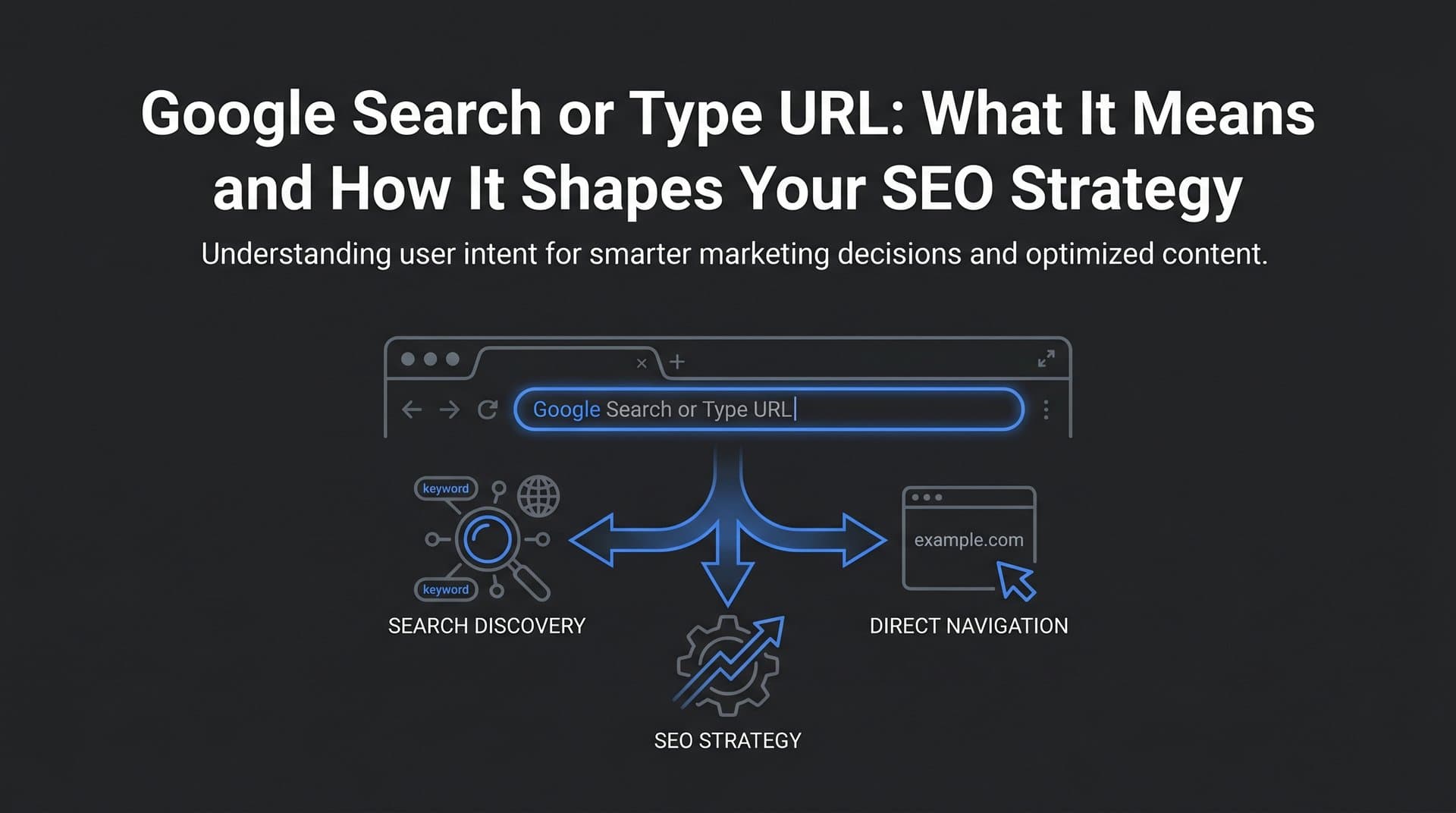
Every time you open a browser, you're greeted by the same simple invitation: "Search or enter URL." It's one of the most familiar interfaces in the digital world, used billions of times every day by people who rarely stop to think about what's actually happening when they type. But for marketers, founders, and anyone trying to grow organic traffic, that small bar represents something much bigger: the single most important gateway between users and the internet.
Whether someone types "trysight.ai" directly or searches "AI visibility tracking tools," they're expressing something fundamentally different about their intent, their awareness, and their relationship with your brand. The path they take determines whether you capture that visit through brand recognition or through search engine performance. And increasingly, it determines whether they ever land on your website at all.
This article unpacks the mechanics behind the "search or enter URL" bar, explains why the distinction matters for your content and SEO strategy, and shows you how to optimize for both paths simultaneously. Because in a world where AI-generated answers are beginning to intercept queries before users even reach a website, understanding this gateway has never been more critical.
The Browser Bar Decoded: Search Query vs. Direct URL
At first glance, the browser address bar looks like a single input field. But under the hood, it's making a real-time decision every time you press Enter.
When you type something into the omnibox (the term Google coined when Chrome launched its unified address and search bar in 2008), the browser runs a quick pattern check. Does the input look like a URL? Does it contain a dot, a protocol prefix like "https://", or a recognizable domain structure? If yes, the browser initiates a DNS lookup and navigates directly to that address. If the input doesn't match a URL pattern, the browser routes it as a query to your default search engine.
This distinction sounds simple, but the implications ripple outward significantly. Direct URL entry bypasses search engines entirely. The user goes straight to the server, no SERP, no ranking competition, no algorithm to satisfy. The site either loads or it doesn't.
Search queries, on the other hand, trigger a completely different process. Your input travels to a search engine, which processes it against billions of indexed pages, evaluates relevance signals, and returns a ranked list of results. Where your site appears in that list is the product of months or years of SEO work. Understanding how AI search engines work adds another layer to this process, as these platforms route queries through large language models rather than traditional indexes.
Most major browsers today use this unified model. Chrome, Edge, Firefox, and Safari all combine the address bar and search bar into a single field. The placeholder text "search or enter URL" is Chrome's way of making this dual function explicit. Autocomplete suggestions pull from your browsing history, saved bookmarks, and the search engine's own suggestion API, which means the bar is also actively shaping user behavior, not just responding to it.
One often-overlooked detail: your default search engine setting determines where all non-URL queries go. For most users, that's Google. But Bing, DuckDuckGo, and AI-powered tools like Perplexity are gaining ground as default choices, especially among privacy-conscious users and those seeking AI-generated answers. For marketers, this means visibility can no longer be optimized for a single platform. The query routing decision happens before your content even enters the picture.
Understanding this technical layer is the foundation for everything that follows. The browser bar isn't just a navigation tool. It's a decision point that splits user traffic into two fundamentally different streams, and each stream requires a different strategy to capture.
Intent at the Address Bar: What Users Are Really Telling You
Here's where the "search or enter URL" distinction becomes genuinely strategic. The way someone types into a browser bar is one of the clearest signals of their intent, and intent is the currency of modern SEO.
Google's Search Quality Evaluator Guidelines formalize several intent categories, but for practical purposes, two matter most here. Navigational intent describes queries where the user wants a specific destination. They type "facebook," "trysight.ai," or "HubSpot login" because they already know where they want to go. They're not researching options. They've made a decision. Informational and transactional intent covers everything else: questions, comparisons, how-to searches, and product queries where the user is still in discovery mode. For a deeper dive into these categories, our guide on search intent in SEO breaks down each type and how to optimize for them.
These two intent types produce radically different SERP experiences. Navigational queries often trigger Knowledge Panels, sitelinks, and branded results that dominate the page. If someone searches your brand name and your site doesn't appear prominently, that's a serious credibility problem. Informational and transactional queries, by contrast, produce organic listings, featured snippets, AI Overviews, and a competitive landscape where you're fighting for attention alongside many other sites.
For content strategy, this creates a dual mandate. You need content that captures users who are already aware of your brand, ensuring that navigational searches lead cleanly to the right pages. And you need content that attracts users who have never heard of you, pulling them in through keyword-optimized articles, guides, and landing pages that answer the questions they're actually typing.
Branded vs. non-branded traffic is a useful lens here. Branded traffic (users searching your company name or product name) reflects your brand's reach and recall. Non-branded traffic (users finding you through generic keyword searches) reflects your SEO performance and content breadth. Healthy organic growth typically shows both streams increasing over time, with branded traffic growing as a byproduct of non-branded content exposure.
Click-through rates also differ meaningfully by intent type. Navigational searches tend to produce high CTR because the user already wants that destination. Informational searches are more competitive, and the rise of zero-click results (where the answer appears directly on the SERP) means even a top-ranking page may not always generate a click. This dynamic is accelerating as AI-powered search changes what happens after a query is typed.
From Typed Queries to AI Answers: How Search Is Evolving
Something significant has shifted in the journey from "type a query" to "find an answer." For a growing portion of searches, that journey no longer ends at a website.
AI-powered search tools, including ChatGPT with browsing capabilities, Perplexity, and Google's AI Overviews, are increasingly intercepting queries at the SERP level and delivering synthesized answers directly. A user who types "best project management tools for remote teams" into their browser may now receive a structured AI-generated response before they ever see a traditional blue link. Some users get what they need from that response and never click through to any website. Understanding the search generative experience is essential for grasping how this shift affects your traffic.
This is a structural shift in how the "search or enter URL" bar functions. For decades, typing a query meant being routed to a list of links. Now, it increasingly means being routed to a generated answer that cites sources, summarizes content, and sometimes replaces the need to visit those sources at all.
For brands and marketers, this creates an urgent new visibility challenge. Traditional SEO optimizes for ranking in a list of links. But if users are consuming AI-generated summaries instead, ranking in that list matters less than being cited within the summary. This is the core premise of GEO (Generative Engine Optimization), an emerging discipline focused on ensuring your brand, content, and expertise appear within AI-generated responses. Our comprehensive AI search engine optimization guide covers the foundational strategies for this new discipline.
GEO isn't a replacement for SEO. It's an additional layer. The fundamentals of creating high-quality, well-structured, authoritative content still apply. But GEO requires additional attention to how AI models interpret and cite your content: clear factual claims, structured formatting, strong entity associations, and consistent brand mentions across the web all influence whether an AI model surfaces your brand in its responses.
The practical implication is this: when someone types a query into the browser bar today, there are now multiple places your brand could appear. The traditional SERP, the AI Overview on Google, the Perplexity answer, the ChatGPT response. Optimizing for only one of these channels means leaving significant visibility on the table.
Tracking where your brand appears across these AI platforms is no longer optional for serious marketers. It's a core part of understanding your organic reach in 2026 and beyond.
Optimizing Your Site to Win Both Paths: SEO and Indexing Essentials
Understanding intent and AI search evolution is valuable. But visibility ultimately depends on technical execution. Your site needs to be found and loaded flawlessly whether a user types your URL directly or discovers you through a search query.
For direct URL entry, the foundation is simple but often overlooked: your URLs need to be clean, consistent, and reliable. Redirects, broken links, slow server response times, and SSL certificate issues can all disrupt the experience for users who type your address directly. If someone types "trysight.ai" and hits a redirect chain or a certificate warning, you've lost them at the most committed point in their journey.
For search discovery, the requirements are more complex. Before your page can appear in search results, it must be crawled and indexed. Crawlability depends on your robots.txt configuration, internal linking structure, and the absence of technical barriers that prevent search engine bots from accessing your content. Indexing depends on those crawled pages being deemed worthy of inclusion in the search index, which involves content quality, duplicate content management, and canonical tag implementation. If you're struggling with this process, learn how to get indexed by search engines faster with proven techniques.
Sitemaps play a practical role here. An up-to-date XML sitemap tells search engines which pages exist on your site and when they were last updated. Submitting your sitemap through Google Search Console and Bing Webmaster Tools ensures your content is on the radar. But traditional sitemap submission can be slow. Tools that integrate with IndexNow, a protocol supported by Bing and Yandex that allows instant notification of new or updated content, can dramatically reduce the time between publishing and indexing. Our guide on search engine indexing optimization explains how to accelerate this process and get indexed up to 70% faster.
Structured data (schema markup) adds another layer of optimization. By annotating your content with structured data, you help search engines and AI models understand what your content is about, who created it, and what entities it references. This increases your chances of appearing in rich results, featured snippets, and AI-generated answers.
Content quality remains the throughline. Technical SEO creates the conditions for visibility. Content quality determines whether that visibility converts into clicks, engagement, and brand recognition. Pages that answer specific questions thoroughly, demonstrate expertise, and maintain a clear topical focus tend to perform well across both traditional search and AI-generated responses.
Building Brand Recognition That Drives Direct URL Traffic
There's a meaningful difference between being found and being sought. When users type your URL directly or search your brand name specifically, they're seeking you out. That's a signal of brand authority that extends beyond any individual piece of content or keyword ranking.
Many SEO professionals observe a correlation between strong branded search volume and higher overall rankings. While Google has not officially confirmed direct traffic or branded search as direct ranking factors, the pattern makes intuitive sense: sites that users actively seek out tend to have strong engagement signals, lower bounce rates, and higher return visit rates. These behaviors collectively suggest quality and relevance to search algorithms. Exploring the full range of AI search engine ranking factors can help you understand what signals matter most in this evolving landscape.
Building the kind of brand recognition that drives direct URL traffic requires consistent presence across multiple channels. Content marketing is one of the most reliable long-term strategies. Publishing high-quality articles, guides, and explainers on a regular cadence builds topical authority and keeps your brand visible in search results over time. Each piece of content is an opportunity for a new user to discover your brand through a non-branded search and later return directly.
Thought leadership content, in particular, tends to generate brand recall. When your content genuinely helps someone solve a problem or understand a complex topic, they remember where they found that help. That memory is what drives the direct URL entry on their next visit.
AI visibility is an increasingly important dimension of brand recognition. As more users interact with AI-powered search tools, the brands that appear consistently in AI-generated responses build familiarity in a new context. Being cited by ChatGPT or Perplexity when someone asks a relevant question creates a brand touchpoint that didn't exist a few years ago. Tracking these mentions, understanding the sentiment behind them, and optimizing your content to earn more of them is a forward-looking brand strategy. Dedicated AI search visibility monitoring makes this process systematic rather than guesswork.
Monitoring branded vs. non-branded search performance over time gives you a clear picture of your marketing funnel's health. Growing non-branded traffic indicates effective content and SEO. Growing branded traffic indicates that content is converting into genuine brand awareness. Both metrics moving upward together is the goal.
Owning the Browser Bar: Your Path Forward
The "search or enter URL" bar is deceptively simple. Behind those five words lies the entire architecture of how users find, remember, and return to websites. For marketers and founders focused on organic growth, it represents a dual opportunity: capture users who are discovering you for the first time through search, and be the destination that returning users type directly.
Winning both paths requires a unified strategy. Audit your technical foundation so that direct URL entry always works flawlessly. Ensure your pages are properly crawled, indexed, and structured so they appear when users search. Create content that earns both first-time discovery and long-term brand recall. And extend your visibility strategy to include the AI-powered search tools that are increasingly shaping what users see when they type a query.
These aren't separate initiatives. They reinforce each other. Strong content builds brand recognition. Brand recognition drives navigational searches. Navigational searches signal authority to search engines. That authority improves rankings for non-branded queries. And increasingly, all of this feeds into whether AI models cite your brand in their responses.
The brands that will own organic traffic in the years ahead are those that treat the browser bar as a unified challenge, not a series of disconnected tactics. They optimize for search and for direct navigation. They track traditional rankings and AI visibility. They publish consistently and index efficiently.
Stop guessing how AI models like ChatGPT and Claude talk about your brand. Start tracking your AI visibility today and see exactly where your brand appears across top AI platforms. Sight AI gives you the tools to monitor brand mentions across AI models, generate SEO and GEO-optimized content, and ensure your pages are indexed and discoverable the moment they go live. The browser bar is the gateway to the web. Make sure your brand is on the other side of it.