In the simplest terms, Search Generative Experience (SGE) is Google's answer to a big question: "How can we give people answers, not just links?" Instead of the familiar list of websites, you get a complete, AI-generated summary that pulls information from multiple sources to give you a single, cohesive snapshot.
It’s a fundamental shift in how search works.

So, What Does This Actually Look Like?
Imagine you’re planning a trip and search for "best family-friendly hikes near Denver." The old Google would serve up 10 blue links—a mix of blog posts, park websites, and travel guides. You'd then have to click on several, piece together the information, and draw your own conclusions.
SGE completely changes this dynamic.
That same search now generates an "AI Overview" right at the top of the page. This is a synthesized answer, pulling the most important details from the best online sources.
Think of it like the difference between a library's card catalog and a genuinely helpful librarian.
- Traditional Search: The catalog gives you a list of books (websites) where you can hunt for the information yourself.
- SGE: The librarian reads the most relevant books for you and hands you a summary of the most important points.
The goal here is to satisfy your intent directly on the results page, often removing the need to click through to multiple websites. You might see a summary of the top three hikes, their difficulty levels, and why they’re great for kids, all without leaving Google.
Why This Shift Is a Big Deal
This new approach is far more than just a facelift; it’s reshaping the entire search ecosystem. SGE was first introduced in May 2023 through Google’s Search Labs, and it didn't take long to see its impact. Early research during the beta phase showed AI-generated results appeared in a staggering 84% of searches, signaling a massive pivot away from the search results page we've known for decades.
For years, the holy grail of SEO was landing a top spot in the blue links. Now, the new frontier is becoming a trusted source cited within the AI's answer. This calls for a whole new playbook, which has given rise to a practice known as Generative Engine Optimization. If you want to dive deeper, you can explore our guide on what is Generative Engine Optimization to understand the new strategies involved.
Success is no longer just about ranking; it's about influencing the AI's conversation.
How SGE Works Under The Hood
To really get what the Search Generative Experience is all about, you have to peek behind the curtain at the tech making it all happen. SGE isn't some simple new feature; it’s a complete rethinking of how a search engine finds and presents information. At its core, SGE runs on Google's heavy-duty large language models (LLMs), like Gemini.
Think of an LLM as an incredibly sophisticated pattern-recognition machine. When you type in a search, the first thing it does isn't just look for keywords. The LLM digs into your phrasing, the context, and your implied goal to figure out what you really want to know. It picks up on nuances that old-school keyword search just couldn't handle.
The Journey From Query To AI Overview
Once the model has a solid grasp of your intent, it doesn’t just hunt for one perfect webpage. Instead, it blitzes through a massive index of web content—articles, videos, forum posts, product pages—pulling together bits and pieces of information from multiple high-quality sources.
This whole process unfolds in a few key stages:
- Deconstruction: The model breaks your big question down into smaller, more manageable ones. A search like "best beginner camera for travel photography under $500" gets sliced into components like "top cameras for beginners," "must-have features for travel photos," and "cameras under the $500 mark."
- Information Retrieval: Next, the AI snags data points from a wide net of credible web pages that answer each of these mini-questions.
- Synthesis: Finally, it masterfully weaves all this scattered information into a single, cohesive, and easy-to-digest narrative. This becomes the AI Overview you see sitting at the top of the search results.
This synthesis is what truly sets the Search Generative Experience apart. It moves way beyond a simple list of links to give you a direct, consolidated answer right away.
Citations: The New Currency Of Visibility
A critical piece of the SGE puzzle is its use of citations. As the AI stitches its overview together, it drops in links that point back to the original websites it pulled information from. These citations pop up as clickable tiles either within or next to the AI-generated text, guiding users straight to the source material.
These links are the new front line in the battle for organic visibility.
For content creators and SEOs, earning a citation in an AI Overview is the new equivalent of a top organic ranking. It’s a loud and clear signal that Google's most advanced systems see your content as a trustworthy, authoritative source on that topic.
Being cited doesn't just drive potential traffic; it builds tremendous brand credibility. It’s a direct stamp of approval from the search engine itself. Getting a handle on this system is crucial, and you can learn more about how AI models select sources to sharpen your content strategy.
More Than Just Text: Multimodality In Action
SGE isn't just playing with words. A standout feature is its multimodality, which is a fancy way of saying it can process and mix different types of content—like images and videos—directly into its generated summaries.
For example, search for a recipe, and the AI Overview might give you a bulleted list of ingredients, the step-by-step instructions, and even embed images or a short video showing a tricky technique. It creates a much richer and more helpful experience for the user.
| Content Type | Traditional SERP | SGE AI Overview |
|---|---|---|
| Text | Shown as titles and meta descriptions in a list of blue links. | Woven into a conversational, story-like answer. |
| Images | Appear in a dedicated image carousel or as small thumbnails. | Embedded directly within the text to illustrate specific points. |
| Videos | Appear in a video carousel or as a featured snippet. | Integrated right into the flow of the answer to add visual context. |
This multimodal approach gives creators valuable clues. It shows that SGE doesn't just reward well-written content, but content that's also visually rich and genuinely useful. Websites that nail the mix of text, high-quality images, and informative videos are in a much stronger position to get featured and cited in these comprehensive AI Overviews.
The Real Impact Of SGE On SEO and Visibility
Knowing how Search Generative Experience works is one thing, but truly getting a handle on what it means for your website's traffic and bottom line is another beast entirely. SGE isn't just another new feature—it's a deep, foundational change that's rewriting the rules for website traffic, keyword strategy, and how brands even show up online. It's forcing all of us to move past old-school SEO metrics and embrace a new definition of success.
The most immediate punch you'll feel is the rise of zero-click searches. SGE is designed to give a detailed, all-in-one answer right there on the results page. When a user gets their question completely answered in that AI Overview, the need to click through to any website—even if your content was used to create the answer—drops off a cliff.
This simple flowchart breaks down how a person's question gets turned into an AI-generated answer.
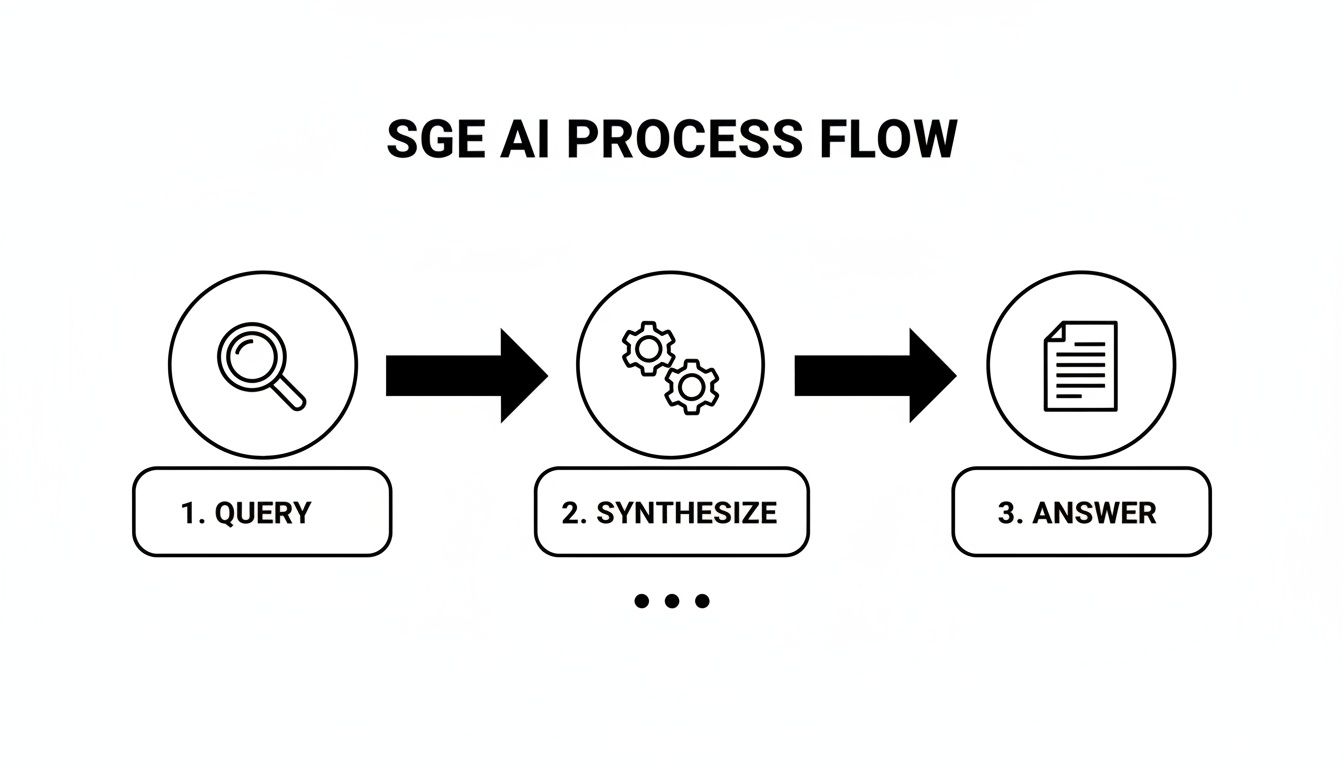
What’s critical to see here is that the "synthesis" stage happens entirely on Google's end. This puts your content one step further away from the user's first interaction.
Your Keyword Strategy Must Evolve
The days of just targeting short, high-volume keywords are numbered. SGE's conversational ability means it absolutely shines when answering complex, long-form questions. This puts a whole new premium on going after long-tail, conversational queries—the kind of questions real people type in when they're looking for genuine solutions.
Just think about the difference:
- Old Keyword Focus: "best running shoes"
- New SGE-Friendly Query: "what are the best running shoes for a beginner with flat feet training for a half marathon"
That second query is far more likely to trigger a detailed AI Overview. When you optimize for these super-specific, intent-driven questions, you boost your odds of being a primary source for the AI's summary. This demands a much deeper understanding of your audience’s actual problems and the exact words they use to describe them.
Brand Visibility Is Being Redefined
In the old world of SEO, success was simple: get that #1 ranking. But in the age of SGE, visibility is a lot more nuanced. The new top prize is becoming a trusted, cited source inside the AI's generated response. This is a massive brand endorsement, signaling that Google’s AI sees your content as authoritative and reliable.
Being cited in an AI Overview is the new top ranking. It positions your brand as an expert not just to users, but to the AI itself, building a layer of credibility that a simple blue link cannot match.
This shift means your brand's voice and expertise matter more than ever before. The focus is moving from pure ranking mechanics to proving you have real authority in your niche. A big part of winning here is learning how to improve your content visibility in LLM responses, which is essential for staying competitive.
Paid vs Organic A New Dynamic
This evolution also shakes up how we think about different traffic sources. To get the full picture of SGE's impact, you have to understand the difference between Paid Search vs. Organic Search and how they influence visibility. While paid ads will almost certainly keep their prime real estate at the top, SGE is completely reshaping the organic landscape just below them.
A business that adapts can thrive. For example, a financial planning blog that creates truly in-depth articles answering complex questions—like retirement savings for freelancers—might see its content repeatedly cited in AI Overviews. This establishes it as a go-to resource. On the flip side, a site that has been coasting on high-volume, short-answer keywords might just become invisible as SGE handles those queries without anyone needing to click.
Adapting Your Content Strategy For Generative SEO
The rise of Google's Search Generative Experience means our old SEO playbook needs a serious update. It’s no longer enough to just create content for human readers; we now have to structure it so that AI models can easily digest and trust it. This is the heart of what we call Generative SEO—making your content the most reliable and thorough source for the AI to pull from.
This isn't about finding a new algorithm to game. It's about a fundamental shift in how we create and organize information. The new goal is to produce content so comprehensive and authoritative that Google's AI sees it as a pillar of knowledge for answering even the most complex questions.
Prioritize Deep Expertise and Authority
In an SGE world, surface-level content is basically invisible. The AI is built to synthesize information from multiple high-quality sources, which means those shallow, "me too" blog posts are going to be left in the dust. Your content has to scream genuine E-E-A-T (Experience, Expertise, Authoritativeness, and Trustworthiness).
This means you have to go deeper than you ever have before. If your competitor lists five quick tips, you need to deliver ten, backed by detailed explanations, original data, and real-world insights. Every single article should strive to be the definitive resource on that topic.
Here's the new benchmark for great content: Does it answer the user's first question and their next three follow-up questions? If your content can be the final stop in someone's research journey, you're perfectly positioned for SGE.
To get there, focus on creating content that showcases actual experience. Include original case studies, your own research, or unique perspectives that can't just be scraped and rephrased. This is the kind of stuff AI models are trained to recognize as truly valuable.
Leverage Structured Data with Schema Markup
Having deep content is one thing, but you also have to make it easy for search engines to understand. This is where Schema markup becomes your best friend. Schema is a type of structured data—think of it as a special vocabulary you add to your site's code—that explicitly tells search engines what your content is all about.
It's like putting clear labels on your information. You can specify things like:
- FAQPage: This clearly marks a list of questions and their corresponding answers, making it a piece of cake for SGE to pull them into a snapshot.
- HowTo: This outlines a step-by-step process, which is perfect for instructional queries.
- Article: This identifies key details like the author, publication date, and main topic, all of which reinforce your credibility.
Structured data gives the AI the context it needs to process your information without guesswork. A page with well-implemented schema is far more likely to be interpreted correctly and used as a source in an AI-generated answer. It's like having a direct line of communication with the AI. To learn more, check out our guide on how to optimize content for AI search.
Build Topical Authority with Content Hubs
Proving your expertise isn't a one-and-done deal. It's a long-term commitment to building topical authority. This is about showing Google that you are a comprehensive expert in a specific niche, not just a generalist who dabbles in everything. The single most effective way to achieve this is by creating content hubs.
A content hub is a strategically organized collection of articles all centered around a broad "pillar" topic. The main pillar page gives a high-level overview, while dozens of "cluster" articles link back to it, each diving deep into a specific subtopic.
For example, a marketing software company might create a hub around "Email Marketing."
Pillar Page: The Ultimate Guide to Email Marketing
Cluster Content:
- How to Build an Email List from Scratch
- Writing Subject Lines That Actually Get Opened
- A/B Testing Your Email Campaigns for Better Results
- Understanding Key Email Deliverability Metrics
This structure signals to search engines that you have deep, interconnected knowledge on the subject. When SGE's AI scans the web for authoritative sources on email marketing, it's far more likely to trust a site with a well-organized hub than one with a few scattered, disconnected articles. It’s a methodical approach that makes your expertise undeniable.
How To Measure Success In The Age Of SGE
For years, we’ve relied on a simple formula: keyword rankings and click-through rates (CTR) were the gold standard for proving our SEO efforts paid off. But that playbook is quickly becoming a relic in the world of SGE.
When an AI Overview serves up a direct answer to a user’s question, those familiar numbers can be seriously misleading. If fewer people are clicking through, how do you prove your SEO work is still valuable?
The answer is to shift your focus from direct traffic to direct influence. It’s no longer just about winning the click; it’s about becoming the trusted source that shapes the AI-generated answer itself. This calls for a whole new set of key performance indicators (KPIs) built for this new search reality.
Moving Beyond Rankings and Clicks
The old model was straightforward: rank high, get the click, and convert the traffic. Simple enough. In an SGE world, however, your content can make a huge impact without ever logging a traditional click.
Google’s AI can pull information from your article to construct its answer, placing your brand front and center as an authority—even if the user never visits your site. This is a massive shift.
Clinging to CTR as your North Star will only lead you astray. Instead, we need to start measuring our influence within the AI’s ecosystem. The real goal now is to prove that your content is a go-to resource for Google's models, which is a powerful form of brand validation that clicks alone could never show.
New KPIs for a New Era of Search
To tell the real story of your performance, you need to adopt metrics that reflect your visibility inside the AI Overviews. These new KPIs paint a much more complete picture of your brand's authority and reach in this new landscape.
Here are the essential SGE-focused metrics you should start tracking immediately:
- Share of Citation: This is your new headline metric. It measures how often your domain is cited as a source in AI Overviews for your target search queries. A high share of citation is direct proof that the AI views your content as authoritative and trustworthy.
- Brand Mentions in AI Answers: This metric tracks every time your brand name appears in the text of an AI answer, even without a direct link. These unlinked mentions are huge for building brand recall and positioning you as a key player in the conversation.
- Citation Click-Through Rate (cCTR): When your site is cited with a link, how often do users click it to learn more? This is crucial. It helps you understand how valuable your citations are for driving high-intent traffic from users who want to dive deeper than the AI summary.
- Query Sentiment Association: This one is more qualitative but just as important. It involves analyzing the context of your brand mentions. Is your brand associated with positive, problem-solving language in the AI Overviews? This is vital for managing your brand’s reputation.
Tracking these new metrics is a fundamental change. The conversation shifts from, "How many clicks did we get?" to "How much are we influencing the conversation in our niche?" This is a far more accurate measure of authority in an SGE-driven world.
Building Your SGE Reporting Dashboard
Communicating this new reality requires an updated reporting dashboard that stakeholders can actually understand. A good dashboard should visually compare the old metrics with the new ones, clearly showing how your strategy is adapting to the times. Knowing how to track these new numbers is essential, and you can get a head start by learning more about how to measure AI visibility metrics and the tools you'll need.
To help you visualize this shift, here's a look at how key performance indicators in SEO have evolved.
Key Performance Indicators SEO Metrics Evolved
| Metric Category | Traditional KPI | SGE-Focused KPI |
|---|---|---|
| Visibility | Keyword Rank Position | Share of Citation |
| Engagement | Click-Through Rate (CTR) | Citation Click-Through Rate (cCTR) |
| Brand Impact | Organic Traffic Volume | Brand Mentions in AI Answers |
| Authority | Backlink Count | Frequency of Source Inclusion |
By building your reporting around these new KPIs, you can effectively demonstrate your impact on brand visibility and authority, even as traditional traffic numbers fluctuate. This data-backed approach lets you communicate the true, modern value of your SEO work and proves you're successfully navigating the new reality of what Search Generative Experience means for business.
Your Practical Action Plan for SGE Readiness
Feeling like you're staring down a massive change with SGE? Take a breath. It's not as complicated as it sounds to turn all this theory into real-world results. We're going to break it all down into a straightforward, actionable roadmap you can start on today.
Think of this as your checklist for SGE. By tackling these core areas, you can do more than just protect your current search presence—you can actually grow it.
Conduct a Deep Content Audit
First things first, you need to look at your existing content through a new lens: E-E-A-T (Experience, Expertise, Authoritativeness, and Trustworthiness). The AI behind SGE is specifically designed to sniff out and prioritize content that comes from real-world, hands-on knowledge. Your audit needs to be ruthless.
Go through your most important pages and ask yourself these questions:
- Does this show firsthand experience? If not, inject unique case studies, original data, or personal anecdotes that a machine can't just scrape and rewrite.
- Is the author a credible expert? This is non-negotiable. Flesh out author bios, link to their professional profiles, and make sure their expertise is impossible to ignore.
- Can we genuinely back up what we're saying? Go on a hunt for outdated stats or generic claims. Replace them by citing reputable, current sources.
The objective here is simple: transform every key piece of your content into the most definitive, trustworthy resource on that topic. Period.
Implement Comprehensive Schema Markup
Next up, you have to make it dead simple for Google’s AI to know what your content is about. This is where Schema markup becomes your best friend. It essentially adds a layer of clear, descriptive labels to your content that the AI can instantly understand, removing all the guesswork.
Think of Schema as giving the AI a structured cheat sheet for your content. It’s the most direct way to communicate context, which dramatically increases the odds of your information being pulled into an AI Overview.
Get started by prioritizing these Schema types across your website:
- FAQPage: Explicitly marks your question-and-answer sections, making them easy for the AI to grab.
- HowTo: Perfect for outlining step-by-step processes or tutorials.
- Article: Helps specify authors, publication dates, and topics, which directly boosts credibility signals.
Re-Optimize for Conversational Queries
Finally, it’s time to shift your keyword strategy. Move away from short, choppy keywords and lean into the long-tail, conversational questions real people are asking. These are the exact types of queries that are most likely to trigger a detailed AI snapshot.
Use your favorite keyword tools to dig up the specific, nuanced questions your audience is typing into the search bar. Then, build content that provides a complete, satisfying answer.
Couple this with a proactive monitoring plan. Start using tools to track how often your brand gets cited in AI Overviews for your most important topics. This data is your new feedback loop, telling you what’s working and what’s not, so you can continuously refine your content to not just survive SGE, but win with it.
SGE FAQs: Your Questions Answered
As the world of search gets this major shake-up, it’s only natural to have a few questions. Let's tackle some of the most common ones floating around about Search Generative Experience.
Will SGE Replace Traditional Blue Links?
No, the classic list of blue links isn’t disappearing entirely, but its job is definitely changing. For a lot of informational searches, the AI Overview is set to become the main event, pushing the organic results we're used to further down the page.
That said, traditional links will still be vital. Think about transactional searches (like buying a product), navigational queries (trying to get to a specific website), or any time a user wants to go deeper than the AI summary. The bottom line is their prime real estate at the top of the page is shrinking, especially for those top-of-funnel questions.
Does SGE Mean SEO Is Dead?
Not a chance. In fact, SEO is more critical than ever—but the game has changed. Instead of just fighting for that #1 organic spot, the new grand prize is getting your content cited as a trusted source inside the AI Overviews.
This new focus is sometimes called Generative Engine Optimization (GEO), and it's all about:
- Creating content that screams authority and expertise.
- Answering long-tail, conversational questions people actually ask.
- Using structured data to make it incredibly easy for AI to understand what your content is about.
SEO isn't dead; it's just evolving. We've moved from a game of ranking to a game of influence.
How Does SGE Affect Local Businesses?
SGE is a huge deal for local search. When someone looks up "best plumbers near me," the AI Overview will likely pull together a summary based on Google Business Profiles, review sites, and local blogs.
For any local business, this makes a fully optimized and current Google Business Profile absolutely non-negotiable. Positive reviews, correct service info, and great photos are the exact signals the AI is looking for to decide who gets featured. Your visibility in local SGE results will lean heavily on a strong, trustworthy digital footprint in your community.
Ready to turn SGE insights into measurable growth? Sight AI helps you monitor your brand's visibility across AI models, uncover high-value content opportunities, and produce expert-level articles to dominate the new search landscape. Learn more and take control of your AI visibility at https://www.trysight.ai.