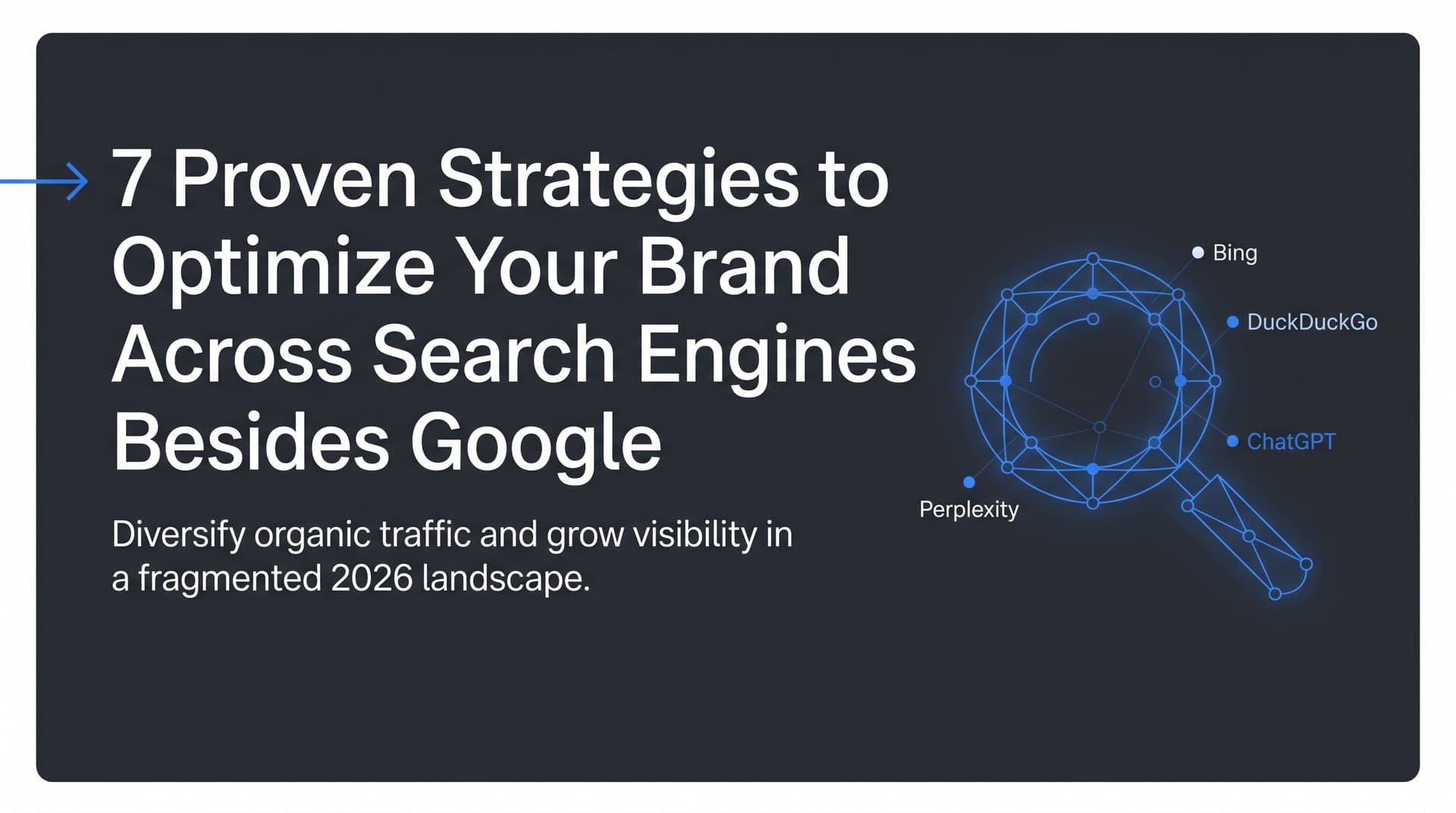
Google dominates search, but it's far from the only game in town. In 2026, marketers who limit their optimization efforts to a single search engine are leaving significant traffic, visibility, and revenue on the table. From Bing and DuckDuckGo to AI-powered answer engines like ChatGPT, Perplexity, and Claude, the search landscape has fragmented in ways that create enormous opportunity for brands willing to diversify.
Each alternative search engine has its own ranking signals, user demographics, and content preferences. A one-size-fits-all SEO strategy no longer cuts it. For marketers, founders, and agencies focused on organic traffic growth, understanding how to optimize across these platforms isn't optional: it's a competitive advantage.
This guide breaks down seven actionable strategies for expanding your search presence beyond Google, covering everything from Bing's unique indexing protocols to emerging AI search platforms that are reshaping how users discover brands. Whether you're looking to capture privacy-conscious audiences on DuckDuckGo, tap into visual search on Yandex, or ensure your brand gets cited by AI answer engines, each strategy includes concrete implementation steps you can act on immediately.
1. Master Bing Webmaster Tools and IndexNow for Faster Discovery
The Challenge It Solves
Most marketers set up Google Search Console and stop there. The result? Their content sits undiscovered on Bing, Yahoo, and every downstream search experience powered by Bing's index for days or weeks longer than necessary. If you're publishing time-sensitive content, that delay has a real cost in missed traffic and lost authority.
The Strategy Explained
Bing Webmaster Tools is the direct equivalent of Google Search Console for Microsoft's ecosystem, and it's genuinely underutilized. Beyond standard sitemap submission and crawl diagnostics, Bing Webmaster Tools offers its own keyword research features, backlink data, and SEO analyzer reports that surface opportunities specific to Bing's ranking algorithm.
The real accelerator here is IndexNow, a protocol co-developed by Microsoft and Yandex that allows you to push URL notifications directly to participating search engines the moment you publish or update content. Instead of waiting for crawlers to discover your pages organically, IndexNow lets you say "this page is ready" in real time. Bing, Yandex, and other participating engines pick it up immediately. This approach to faster content discovery by search engines can dramatically reduce the lag between publishing and indexing.
Implementation Steps
1. Go to Bing Webmaster Tools (webmaster.bing.com), verify your site ownership via XML file, meta tag, or CNAME record, and submit your XML sitemap.
2. Generate an IndexNow API key through Bing Webmaster Tools or directly at indexnow.org, place the key file at your domain root, and configure your CMS or publishing workflow to send IndexNow pings on every publish or update.
3. Review the SEO Analyzer and Crawl reports in Bing Webmaster Tools monthly to identify pages with crawl errors, missing meta tags, or low click-through rates specific to Bing's index.
Pro Tips
Bing places notable weight on social signals, particularly from LinkedIn and other Microsoft-adjacent platforms. If your content earns engagement on LinkedIn shortly after publishing, it can positively influence Bing rankings. Pair your IndexNow setup with a LinkedIn distribution habit for compounding effect. Tools like Sight AI's website indexing feature also integrate IndexNow automation, removing the manual step entirely.
2. Optimize for AI Answer Engines That Are Replacing Traditional Search
The Challenge It Solves
A growing share of search behavior now happens inside AI platforms. When someone asks ChatGPT, Perplexity, or Claude a question about your industry, those engines retrieve, synthesize, and cite web content to construct their answers. If your brand isn't among the sources being cited, you're invisible to an increasingly influential discovery channel. Understanding how AI search engines work is the first step toward fixing that gap.
The Strategy Explained
This optimization discipline is called GEO: Generative Engine Optimization. Unlike traditional SEO, where you're optimizing for a ranked list of links, GEO is about becoming the source that AI models trust and cite when answering relevant queries. AI answer engines tend to favor content that is authoritative, clearly structured, factually grounded, and written in a way that directly answers specific questions.
Think of it this way: if a traditional search engine rewards pages that rank, an AI answer engine rewards pages that explain. Your content needs to be quotable, specific, and organized so that an AI model can extract and attribute a clear answer to it.
Implementation Steps
1. Identify the questions your target audience is most likely to ask AI platforms. Use tools like Perplexity itself, AnswerThePublic, or your own customer conversations to build a list of high-intent queries.
2. Create or update content that directly answers those questions in the first 100-150 words of each section, using clear headings, short paragraphs, and factual specificity. Avoid vague generalities: AI models cite content that is concrete and attributable.
3. Add author credentials, publication dates, and cited sources to your content. AI models assess trustworthiness signals similar to E-E-A-T, and content with clear authorship and sourcing tends to be cited more frequently.
Pro Tips
Monitoring whether your brand is actually being cited by AI platforms is critical, and it's something most marketers have no visibility into. Sight AI's AI visibility tracking software monitors brand mentions across ChatGPT, Claude, Perplexity, and other major AI platforms, giving you an AI Visibility Score and sentiment analysis so you can see exactly how these engines talk about your brand and where gaps exist.
3. Capture Privacy-First Audiences on DuckDuckGo and Brave Search
The Challenge It Solves
Privacy-conscious users represent a distinct and growing audience segment, often skewing toward technically sophisticated, higher-income demographics. These users have deliberately opted out of Google's ecosystem. If your optimization strategy is entirely Google-centric, you have a structural blind spot for this audience.
The Strategy Explained
DuckDuckGo draws its organic results primarily from Bing's index, which means solid Bing optimization carries over directly. However, DuckDuckGo also has its own signals, including its proprietary DuckDuckBot crawler, which independently evaluates content quality. Brave Search is a more distinct case: it operates its own independent web index, separate from both Google and Bing, making it one of the few genuinely independent search engines available today.
For DuckDuckGo, the good news is that strong Bing performance translates naturally. For Brave Search, the focus should be on technical quality, clean site architecture, and content that earns organic backlinks from reputable sources, since Brave's independent index relies heavily on crawl quality and link authority signals. If you need a refresher on how crawlers find your pages in the first place, our guide on how search engines discover new content covers the fundamentals.
Implementation Steps
1. Ensure your robots.txt does not block DuckDuckBot or Bravespider. Check your robots.txt file and verify that neither crawler is excluded from your important pages.
2. Optimize your site's page speed, mobile responsiveness, and Core Web Vitals. Both DuckDuckGo and Brave Search reward technically clean sites, and these fundamentals transfer across all search engines.
3. Focus on earning backlinks from independent, authoritative sources rather than relying solely on social signals. Brave Search's independent index weights link authority heavily, so a strong off-page profile benefits you specifically here.
Pro Tips
DuckDuckGo's "Instant Answers" feature pulls from structured sources including Wikipedia, Wikidata, and official brand pages. Ensuring your brand has an accurate, well-maintained Wikipedia presence or Wikidata entity can increase how prominently DuckDuckGo surfaces your brand in direct searches. This is a low-effort, high-impact move that many brands overlook.
4. Leverage Structured Data to Win Rich Results Across Multiple Engines
The Challenge It Solves
Most structured data guides are written exclusively through a Google lens. The result is that many marketers implement schema markup to win Google rich snippets and never consider that Bing, Yandex, and AI models also parse and use schema.org markup to understand and display content. You're doing half the work and getting a fraction of the benefit.
The Strategy Explained
Schema.org structured data is a shared vocabulary supported by Google, Bing, and Yandex. When you implement it correctly, you're not just improving your Google appearance: you're giving every participating engine a machine-readable map of your content. AI models increasingly use structured data to parse web pages when constructing answers, which means schema markup now serves double duty as both an SEO and GEO asset. For a deeper dive into the factors that influence AI citations, explore our breakdown of AI search engine ranking factors.
The most impactful schema types for cross-engine performance include Article, FAQPage, HowTo, Product, LocalBusiness, and Organization markup. FAQPage schema is particularly valuable for AI answer engines because it explicitly structures question-and-answer content in a format that models can extract directly.
Implementation Steps
1. Audit your existing schema implementation using Google's Rich Results Test and Bing's Markup Validator. Identify pages with no schema, broken schema, or schema that doesn't match your content type.
2. Prioritize FAQPage and HowTo schema on your most important informational pages. These types signal structured, answer-ready content to both traditional search engines and AI platforms.
3. Implement Organization and BreadcrumbList schema site-wide. Organization schema helps search engines and AI models understand your brand entity, while BreadcrumbList improves how your site structure appears in search results across Bing and Yandex.
Pro Tips
Yandex supports a broader range of schema types than Google and actively uses them for rich result features in its own search interface. If you have any audience in Russian-speaking markets, Yandex Webmaster's structured data documentation is worth reviewing alongside the standard schema.org guidelines to ensure full compatibility.
5. Diversify Your Sitemap Submission Strategy Beyond Google Search Console
The Challenge It Solves
Submitting your sitemap only to Google Search Console is the digital equivalent of mailing a press release to one journalist and assuming everyone will hear about it. Every search engine has its own crawl queue, and without a direct sitemap submission, your content discovery depends entirely on crawlers finding you organically, which can take significantly longer.
The Strategy Explained
A comprehensive sitemap strategy means actively submitting your XML sitemap to every major search engine that accepts them, and referencing your sitemap in your robots.txt file so any crawler that visits your site knows exactly where to find it. This is one of the lowest-effort, highest-leverage actions you can take for cross-engine visibility. Our step-by-step guide on how to submit your website to search engines free walks through the full process for every major platform.
Beyond Bing and Yandex, referencing your sitemap in robots.txt ensures that independent crawlers like Brave's Bravespider can also discover your full content inventory without relying on link discovery alone. It's a passive but persistent signal that works continuously in the background.
Implementation Steps
1. Submit your XML sitemap to Bing Webmaster Tools at webmaster.bing.com. If you haven't set up an account yet, do this first as outlined in Strategy 1.
2. Submit your sitemap to Yandex Webmaster at webmaster.yandex.com. Create an account, verify your site, and add your sitemap URL in the Indexing section. This is especially relevant if you have any international audience in Eastern European or Russian-speaking markets.
3. Add a Sitemap directive to your robots.txt file pointing to your XML sitemap URL. The format is simply: Sitemap: https://yourdomain.com/sitemap.xml. This single line ensures every crawler that visits your site can find your full content map immediately.
Pro Tips
If your site publishes content frequently, consider implementing a dynamic sitemap that updates automatically with each new post. Pairing a dynamic sitemap with IndexNow pings (from Strategy 1) creates a two-layer discovery system: crawlers always have an up-to-date map, and new content gets pushed proactively. Sight AI's website indexing tools automate both sitemap updates and IndexNow submissions, keeping your cross-engine discovery running without manual intervention.
6. Build Topical Authority That AI and Alternative Engines Reward
The Challenge It Solves
Publishing isolated, keyword-targeted pages worked in an earlier era of SEO. Today, alternative search engines and AI models evaluate topical depth: they want to see that your site comprehensively covers a subject area, not just that a single page targets a specific phrase. Brands with shallow content libraries struggle to earn trust signals from these platforms regardless of their technical optimization.
The Strategy Explained
Topical authority is built through content clusters: a pillar page that covers a broad topic comprehensively, supported by a network of related articles that explore subtopics in depth, all linked together through deliberate internal linking. This architecture signals to search engines and AI models that your site is a reliable, expert source on a given subject area.
For AI answer engines specifically, topical authority matters because models are more likely to cite sources they've encountered repeatedly across a topic area. If your brand appears consistently across multiple relevant queries in a niche, you build a kind of familiarity that increases citation frequency over time. If you're concerned that AI search engines are missing your website, weak topical authority is often the root cause.
Implementation Steps
1. Map your core topic areas and identify gaps in your content coverage. For each primary topic, you should have a comprehensive pillar page and at least five to ten supporting articles covering related subtopics, questions, and use cases.
2. Build deliberate internal links between your pillar pages and supporting articles. Every supporting article should link back to the pillar, and the pillar should link out to each supporting piece. This creates a clear topical cluster that crawlers and AI models can follow.
3. Use Sight AI's AI Content Writer to accelerate content cluster creation. With 13+ specialized AI agents and Autopilot Mode, you can generate SEO and GEO-optimized articles across your topic clusters consistently, maintaining the publishing velocity needed to build topical authority without burning out your team.
Pro Tips
When building content clusters for AI visibility, prioritize question-based subtopics. AI answer engines are query-driven environments, and content that directly addresses specific questions within your niche is far more likely to be retrieved and cited than general informational content. Think about what your audience asks, not just what they search for.
7. Monitor and Measure Cross-Engine Performance with Unified Analytics
The Challenge It Solves
You can implement every strategy in this guide and still fly blind if you're not measuring results across all the platforms you're optimizing for. Most analytics setups are Google-centric by default: Google Analytics, Google Search Console, and maybe a rank tracker that focuses on Google SERPs. That leaves Bing rankings, DuckDuckGo referrals, Yandex performance, and AI brand mentions entirely in the dark.
The Strategy Explained
Cross-engine measurement requires intentionally expanding your analytics stack to capture signals from every platform you're targeting. This means integrating Bing Webmaster Tools data into your reporting workflow, segmenting referral traffic by search engine in your analytics platform, and adding AI visibility monitoring to track how and when AI platforms cite your brand. Keeping an eye on competitors ranking in AI search results is equally important so you can benchmark your progress against the landscape.
The goal is a unified view of your search presence: one dashboard or reporting workflow where you can see how your brand performs across Google, Bing, DuckDuckGo, Yandex, and AI answer engines simultaneously. Without this, you're optimizing in silos and can't accurately attribute traffic growth to specific strategies.
Implementation Steps
1. Connect Bing Webmaster Tools to your reporting workflow. Bing Webmaster Tools provides query-level data, click-through rates, and impression data specific to Bing's index. Export this data regularly or integrate it via API into your existing dashboards.
2. Set up referral traffic segmentation in your analytics platform to distinguish traffic from Bing, DuckDuckGo, Yandex, Brave, and other alternative engines. This gives you a baseline and lets you measure the impact of your cross-engine optimization efforts over time.
3. Add AI brand mention monitoring to your measurement stack. Since AI answer engines don't generate referral traffic in the traditional sense, you need a dedicated tool to track when and how AI platforms cite your brand. Sight AI's AI visibility tracking monitors mentions across ChatGPT, Claude, Perplexity, and other major AI platforms, providing sentiment analysis, prompt tracking, and an AI Visibility Score that quantifies your presence in AI-driven search.
Pro Tips
Set up monthly cross-engine performance reviews as a standing workflow item. Compare your Bing and AI visibility trends against your Google performance to identify which platforms are growing fastest and where to double down. Early movers who establish measurement systems now will have months of baseline data that latecomers won't be able to replicate quickly. For a comprehensive framework on improving your overall search engine rankings, pair these monitoring habits with ongoing technical and content optimization.
Putting It All Together: Your Cross-Engine Optimization Roadmap
Seven strategies can feel like a lot to tackle at once, so sequencing matters. Start with the highest-impact, lowest-effort actions first and build from there.
Week one priority: Set up Bing Webmaster Tools and submit your sitemap (strategies 1 and 5). These two steps unlock visibility across Bing, DuckDuckGo, Yahoo, and other Bing-powered experiences simultaneously and take less than an hour to complete.
Month one priority: Implement structured data improvements and begin optimizing your top content pages for AI answer engines (strategies 4 and 2). Structured data compounds over time, and the sooner AI models start encountering your well-structured, answer-ready content, the sooner you build citation frequency.
Ongoing priority: Build topical authority through consistent content cluster development (strategy 6) and establish cross-engine monitoring from day one (strategy 7). You can't manage what you don't measure, and topical authority is a long game that rewards brands who start early and stay consistent.
The brands that win in 2026 and beyond aren't just optimizing for Google. They're building omnipresent search visibility across every platform where their audience asks questions, from Bing and Brave to ChatGPT and Perplexity. Each alternative engine you optimize for is a traffic channel your competitors are likely ignoring.
The most overlooked piece of this puzzle is AI visibility. Most marketers have no idea how AI models talk about their brand, which means they can't fix gaps, capitalize on positive sentiment, or track whether their GEO efforts are working. Start tracking your AI visibility today and see exactly where your brand appears across top AI platforms. Stop guessing and start building the kind of cross-engine presence that compounds into durable, diversified organic growth.