The best LLM optimization tools fall into three groups: AI visibility trackers that show how ChatGPT, Claude, Perplexity and Gemini mention your brand (Sight AI), citation-source finders (Listicle.com), and content optimizers and generators that help you publish material AI models are more likely to cite (Surfer SEO, Clearscope, MarketMuse, Frase, Jasper, Writesonic, Copy.ai, Originality.AI). For most teams, the right choice depends on the first gap you need to close. If you don't yet know how AI models describe you, start with visibility tracking. If you already know, start with content.
When potential customers ask ChatGPT for recommendations or use Perplexity to research solutions, LLM optimization software tells you whether your brand is part of the answer and helps you improve your position. These tools track how AI models mention your brand, identify content gaps that prevent recommendations, and help create content that earns visibility in AI responses. If you're new to the discipline, our guide to what GEO (Generative Engine Optimization) is explains the fundamentals.
Quick comparison
| Tool | Category | Best for | Starting price |
|---|---|---|---|
| Sight AI | AI visibility tracking + content | Monitoring and improving AI mentions in one place | Contact for pricing |
| Listicle.com | Citation source discovery | Finding "best of" lists LLMs cite | Free |
| Originality.AI | Content quality / detection | Originality checks on AI-assisted content | $14.95/mo |
| Writesonic | Content generation | High-volume writing | Free tier; $16/mo |
| Surfer SEO | Content optimization | NLP-driven on-page optimization | $89/mo |
| MarketMuse | Content strategy | Topic authority and gap analysis | Free tier; $149/mo |
| Clearscope | Content optimization | Simple grading for writer teams | $170/mo |
| Frase | Research + briefs | Budget-conscious teams | $15/mo |
| Jasper | Content generation | Enterprise brand consistency | $49/mo |
| Copy.ai | Workflow automation | Template-driven content workflows | Free tier; $49/mo |
How to evaluate LLM optimization software
- Platform coverage: Check which AI engines the tool queries, such as ChatGPT, Claude, Perplexity, Gemini, Google AI Overviews and AI Mode. Coverage of only one or two engines gives you a partial picture.
- Prompt-level data: You need to see which prompts trigger mentions, not only an aggregate score. Without that detail, you can't act on the data.
- Competitor benchmarking: Share of voice against named competitors shows who is winning the recommendations you're missing.
- Sentiment and accuracy: Being mentioned with outdated pricing or wrong positioning can hurt more than not being mentioned at all.
- Actionability: Look for content recommendations or generation, publishing and indexing tied to the gaps the tool finds.
- Cost per tracked prompt: Pricing usually scales with the number of prompts, brands and engines. Model your real volume before you commit.
1. Sight AI
Best for: Comprehensive AI visibility tracking combined with automated content generation and publishing.
Sight AI is an all-in-one platform that monitors brand mentions across ChatGPT, Claude, Perplexity and other AI models. It also provides specialized AI agents that create content optimized for both traditional search and AI recommendations.

Where This Tool Shines
Sight AI solves the visibility problem most brands face: you can't optimize what you can't measure. The platform tracks how AI models talk about your brand across six major platforms and summarizes your presence in an AI Visibility Score with sentiment analysis. You see which prompts trigger mentions, which competitors appear instead, and where content gaps exist.
The integrated content system includes 13+ specialized AI agents for specific content types, such as listicles, how-to guides and explainers. Each agent is built to create content that performs in both SEO and GEO, which helps your brand earn mentions in future AI responses.
Key Features
AI Visibility Score: Quantifies your brand's presence across 6+ AI platforms, with sentiment analysis and trend tracking over time.
Prompt Tracking: Shows which user queries trigger brand mentions, revealing content opportunities and competitive positioning gaps.
13+ Specialized AI Agents: Purpose-built agents for different content types, each designed to create SEO/GEO-optimized articles that improve AI visibility.
Autopilot Mode: Automates the content workflow from generation to publishing, with scheduling and CMS integration.
IndexNow Integration: Automatically submits new content to search engines for faster discovery and indexing.
Best For
Marketers and founders who need visibility tracking and content creation in one platform. It is particularly valuable for teams focused on organic traffic growth through AI channels, agencies managing multiple client brands, and companies building a systematic approach to AI visibility rather than running one-off content experiments.
Pricing
Contact for pricing. Tiered plans range from startups to enterprises and scale with brand tracking needs and content volume.
2. Listicle.com
Best for: Finding the "best of" and "top" articles where your brand needs to appear to be cited by LLMs.
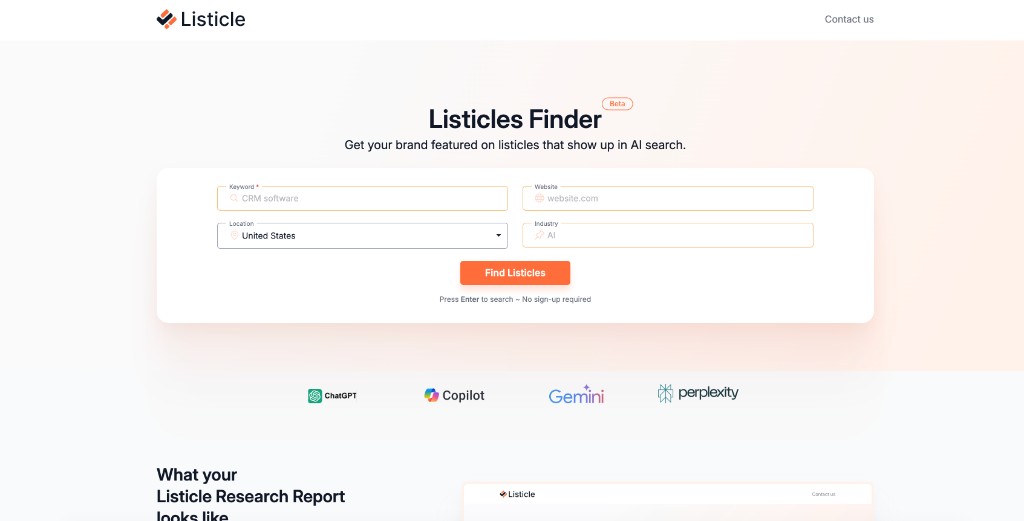
Listicle.com approaches LLM optimization from a different angle than most tools on this list. Instead of generating or optimizing your own content, it maps the listicles that AI models draw from when answering "best tool for X" questions and shows you where your brand is missing.
Where This Tool Shines
Models like ChatGPT, Gemini and Perplexity lean heavily on high-authority "best of" roundups when they recommend products. Listicle.com scans the web for relevant listicles in your niche and enriches each one with SEO metrics like Domain Authority, Page Authority and last-update date. Its dashboard shows where you're already listed, where competitors appear without you, and which placements to pursue first.
Key Features
Listicle Discovery: Enter a keyword, website, industry or location to get a full report of "best of" and "top" articles in your space.
SEO Metrics Enrichment: Every listicle is scored by DA, PA and freshness so you can prioritize high-value placement targets.
Gap Analysis: Shows where your brand is already mentioned and where competitors hold AI-citable placements you're missing.
Exportable Reports: Results arrive as an interactive online dashboard and an Excel file, generated automatically within minutes.
Best For
SEO specialists, link builders, PR managers and digital marketers who want to raise the odds that AI models mention their brand by securing placements in the listicles those models cite.
Pricing
Currently free. Enter an email to receive the report; no signup or payment is required.
3. Originality.AI
Best for: Balancing AI-assisted content creation with authenticity for human and AI audiences.
Originality.AI helps marketers make sure their AI-generated content keeps the authenticity and quality that readers and language models value.

Where This Tool Shines
As more teams adopt AI content generation, the challenge becomes maintaining quality and originality. Originality.AI identifies AI-generated content with confidence scoring, which tells you when a piece needs more human refinement. The goal isn't to avoid AI tools but to publish content that serves readers well, however it was produced.
Its plagiarism checking goes beyond simple text matching and analyzes semantic similarity across web sources. This matters for LLM optimization because language models favor original perspectives over rehashed information.
Key Features
AI Content Detection: Identifies AI-generated text with percentage confidence scores across multiple language models, including GPT-4 and Claude.
Plagiarism Checking: Scans content against billions of web pages to flag duplicate or overly similar content.
Readability Analysis: Evaluates content structure and complexity so it stays accessible to human readers and AI systems.
Team Collaboration: Lets content teams share scans, set quality standards and stay consistent across writers.
API Access: Adds detection to existing content workflows and publishing systems for automated quality checks.
Best For
Content teams using AI assistance who need to maintain editorial standards, agencies offering quality guarantees on client content, and publishers building audience trust through transparent content practices.
Pricing
Starts at $14.95/month for the basic plan with per-scan credits. Higher tiers add team features and more scanning capacity.
4. Writesonic
Best for: High-volume content generation with brand voice consistency and GPT-4 integration.
Writesonic is an AI content platform for marketers who need to produce large quantities of optimized content while keeping a consistent brand voice.

Where This Tool Shines
Writesonic addresses scale. Building the topic coverage that LLMs treat as authoritative can mean producing dozens of articles a month, which is impractical to write manually. The platform's GPT-4 integration produces quality that approaches human writing, and brand voice training keeps output consistent.
The Chatsonic feature adds a conversational assistant that helps you refine ideas and explore angles without starting from scratch. This makes the tool accessible to teams new to AI content generation.
Key Features
GPT-4 Content Generation: Uses current language models for blog posts, product descriptions and marketing copy.
Brand Voice Training: Learns your company's writing style, tone and terminology to keep generated content consistent.
SEO Optimization: Builds keyword research and on-page optimization into the generation process.
Content Templates: Provides pre-built frameworks for common content types, from listicles to case studies.
Chatsonic Assistant: Offers a conversational AI that helps you brainstorm, refine and iterate on content ideas in real time.
Best For
Marketing teams producing high volumes of content, e-commerce brands needing product descriptions at scale, and content agencies managing multiple client voices on tight deadlines.
Pricing
Free tier available for testing. Paid plans start at $16/month, with higher word limits and more features at higher tiers.
5. Surfer SEO
Best for: Data-driven content optimization using NLP analysis for search and AI visibility.
Surfer SEO uses natural language processing to analyze top-ranking content and give specific optimization recommendations for traditional search and AI-powered results.

Where This Tool Shines
Surfer SEO takes the guesswork out of content optimization. Its real-time editor compares your draft with top-performing content and gives a score that rises as you add suggested keywords, topics and structural elements. This helps you cover topics with the semantic depth that language models recognize as comprehensive.
The NLP analysis goes beyond keyword density by identifying related concepts and entities that strengthen topical authority. AI models look for this kind of comprehensive coverage when choosing what to recommend, not keyword repetition.
Key Features
Real-Time Content Editor: Scores your content live as you write, with specific suggestions for semantic relevance and topic coverage.
NLP Keyword Analysis: Identifies related terms and concepts that strengthen authority beyond primary keywords.
SERP Analyzer: Reveals patterns in structure, length and topic coverage across top-ranking content.
Content Audit: Finds optimization opportunities on pages you've already published.
Integration Ecosystem: Connects with Google Docs, WordPress and other tools so optimization fits your existing workflow.
Best For
SEO teams focused on data-driven optimization, writers who want specific guidance instead of vague best practices, and marketing departments building a systematic approach to content quality.
Pricing
Starts at $89/month for the Essential plan. Higher tiers add content audit and team collaboration features.
6. MarketMuse
Best for: Building comprehensive topic authority through content gap analysis and inventory management.
MarketMuse uses AI to compare your content inventory with competitors' and find gaps in topic coverage that keep you from building the authority LLMs recognize and reference.

Where This Tool Shines
MarketMuse excels at strategic content planning. Instead of optimizing articles in isolation, it evaluates your whole content library to show where you're strong, where gaps exist and which topics deserve deeper coverage. AI models favor sources that show expertise across related topics over scattered one-off articles.
Topic modeling reveals clusters of related content you need to cover, and personalized difficulty scores help you prioritize topics where you can realistically compete. This keeps you from wasting effort on topics dominated by established authorities.
Key Features
Content Inventory Analysis: Evaluates your entire content library for strengths, weaknesses and coverage gaps.
Topic Modeling: Maps how topics relate and shows clusters where comprehensive coverage builds authority.
Competitive Gap Analysis: Shows where competitors have content advantages and which topics offer room to differentiate.
Personalized Difficulty Scores: Estimates your chances of ranking for a topic based on your existing authority and the competition.
AI-Generated Content Briefs: Creates detailed outlines with recommended topics, questions and structure.
Best For
Content strategists planning long-term topic coverage, established brands with large content libraries to optimize, and teams building topical authority rather than chasing individual keywords.
Pricing
Free tier available with limited features. The Standard plan starts at $149/month and scales with team size and content volume.
7. Clearscope
Best for: Content grading and semantic optimization with intuitive scoring systems.
Clearscope grades content with letter scores, so writers can see how well a piece covers its topic and where it needs work.

Where This Tool Shines
Clearscope keeps optimization simple. Content receives letter grades from A++ to F based on semantic relevance and topic coverage, which makes quality visible at a glance. Teams can hold multiple writers to the same standard without every writer needing deep SEO expertise.
Real-time suggestions work inside Google Docs, so writers can improve content without switching tools. That matters when you're producing content at scale and can't afford friction in the process.
Key Features
Content Grading System: Assigns letter grades that writers and editors can understand immediately.
Real-Time Optimization: Shows live suggestions as you write and how each change affects your grade.
Competitor Analysis: Reveals which topics and terms contribute to top-ranking content's success.
Google Docs Integration: Brings optimization into the writing environment without switching platforms.
Keyword Research: Identifies related terms and topics that strengthen semantic relevance beyond primary keywords.
Best For
Content teams with multiple writers who need consistent quality standards, marketing departments focused on workflow efficiency, and organizations that value ease of use alongside optimization power.
Pricing
Starts at $170/month for the Essentials plan. Pricing scales with team size and content volume.
8. Frase
Best for: Budget-conscious teams needing research assistance and content brief automation.
Frase combines AI-powered research with content optimization at a price that suits smaller teams and solo marketers.
Where This Tool Shines
Frase removes the research bottleneck that slows content production. Its AI research assistant surfaces relevant information, common questions and topic angles from top-ranking content, turning hours of manual research into minutes.
Automated brief generation structures those findings into actionable outlines, so writers get clear direction without lengthy planning. For teams working with freelancers or running several projects at once, this standardization keeps output consistent.
Key Features
AI Research Assistant: Analyzes top content to surface key topics, questions and angles for your target keyword.
Automated Content Briefs: Generates structured outlines with recommended headings, questions to answer and topics to cover.
SERP Analysis: Identifies patterns in structure and topic coverage among top performers.
Content Optimization Scoring: Shows how well your content covers a topic compared with ranking competitors.
Answer Engine: Answers quick research queries so you can find specific information without manual searching.
Best For
Solo marketers and small teams with limited budgets, content managers who need clear briefs for freelance writers, and startups building content operations from scratch.
Pricing
Starts at $15/month for the Solo plan. Team plans add collaboration features at higher price points.
9. Jasper
Best for: Enterprise marketing teams managing large-scale content operations with brand consistency.
Jasper offers enterprise-grade AI content generation with advanced brand voice training and campaign management for teams producing content at scale.
Where This Tool Shines
Jasper excels at brand consistency across large content operations. Its brand voice AI learns from your existing content and replicates your tone, style and messaging. Consistent brand presentation across many pieces reinforces the authority signals language models pick up.
Campaign and project management features keep multiple writers and campaigns working from the same strategy. For enterprises running dozens of content initiatives at once, this structure prevents chaos.
Key Features
Brand Voice AI: Learns and replicates your brand voice across all content at scale.
Campaign Management: Organizes content production into campaigns and projects for better team coordination.
Team Collaboration: Supports multiple users with role-based permissions and approval workflows.
Chrome Extension: Brings AI writing assistance into the web-based tools you already use.
Template Library: Offers an extensive set of templates for common content types and marketing use cases.
Best For
Enterprise marketing teams with multiple content creators, agencies managing many client brands, and organizations that need brand consistency across high-volume production.
Pricing
The Creator plan starts at $49/month for individual users. The Teams plan starts at $125/month with collaboration features and more capacity.
10. Copy.ai
Best for: Teams seeking workflow automation with pre-built templates for common content tasks.
Copy.ai focuses on workflow-based AI content generation with pre-built automation templates, which makes it an accessible starting point for teams beginning AI content optimization.
Where This Tool Shines
Copy.ai shortens the learning curve with pre-built workflow templates. Instead of starting from a blank page and working out prompts, you pick a workflow that matches your goal, such as blog posts, social media content or email sequences. This structure helps teams new to AI content get results quickly.
The Infobase feature stores company information, product details and brand guidelines for the AI to reference. That context improves accuracy and reduces the editing needed to make output on-brand.
Key Features
Pre-Built Workflows: Ready-made templates guide you through generating common content types step by step.
Multiple AI Models: Lets you choose among language models for different content types.
Brand Voice Configuration: Stores brand guidelines and voice preferences to keep generated content consistent.
Infobase: Builds a knowledge repository of company information that the AI uses for accurate, contextual content.
Integration Options: Connects with Zapier and offers API access for adding AI generation to existing workflows.
Best For
Teams new to AI content generation who want guided workflows, small marketing departments needing quick content for multiple channels, and organizations testing AI content tools before committing to enterprise solutions.
Pricing
Free tier available for testing basic features. The Pro plan starts at $49/month with more capacity and advanced features.
Finding Your Best Fit
The right LLM optimization software depends on your goal. If AI visibility tracking is your priority and you need to know how ChatGPT, Claude and Perplexity talk about your brand, Sight AI is the most complete option on this list because it pairs tracking with content generation. You can monitor mentions and act on what you find in the same platform.
For teams focused mainly on content optimization for search, Surfer SEO and Clearscope offer strong semantic analysis with intuitive interfaces. MarketMuse is more strategic and finds content gaps across your whole library rather than optimizing individual pieces.
If high-volume content generation is your main need, Jasper and Writesonic offer enterprise-ready workflows with brand voice consistency. Frase covers research and briefs at a lower price for smaller teams, and Copy.ai simplifies production with pre-built workflow templates.
The market is moving toward integrated solutions. Tracking AI visibility without a way to act on it gives you data but no impact. Generating content without knowing how it affects your AI presence means you're working blind. The most effective approach does both: monitor how AI models discuss your brand and create content that improves that positioning.
Start by identifying your primary bottleneck. If you don't know how AI models currently represent your brand, visibility tracking comes first. A structured framework for measuring AI visibility performance will help you set baselines before you buy. If you understand the problem but lack the resources to create optimized content at scale, prioritize generation tools. For most teams building long-term organic growth, an integrated platform that handles monitoring and content creation reduces tool sprawl and gives you a systematic approach to AI visibility.
Frequently asked questions
What is LLM optimization software?
LLM optimization software helps brands appear, and be described accurately, in answers from large language models such as ChatGPT, Claude, Gemini and Perplexity. It typically covers three jobs: tracking which prompts mention your brand and competitors, finding the sources and content gaps that drive those answers, and creating or optimizing content that AI models are more likely to cite. Some tools do one job; integrated platforms do all three.
Which LLM optimization service is best for AI products?
For AI and SaaS products, choose a tool that tracks prompts like "best tool for X" across several AI engines and benchmarks you against named competitors. Buyers in these categories often research through ChatGPT and Perplexity. Sight AI covers tracking and content creation together. Listicle.com is a useful free complement for finding the roundups models cite. See the comparison table above for pricing.
Is LLM optimization different from traditional SEO?
Yes, but the two overlap. SEO targets rankings on a results page, while LLM optimization (often called GEO) targets mentions and citations inside generated answers. Strong SEO fundamentals still help, because many AI engines retrieve from indexed web pages. LLM optimization adds prompt-level tracking, sentiment monitoring and a focus on third-party sources such as listicles and reviews that models rely on.
How long does LLM optimization take to show results?
Retrieval-based engines like Perplexity and Google AI Overviews can reflect new or updated pages within days to weeks once those pages are indexed. Changes in what a model "knows" from its training data take longer, often months, because they depend on model updates. Set a baseline with prompt tracking, then measure share of voice monthly rather than judging single answers, which vary between runs.
Are there free LLM optimization tools?
Some. Listicle.com is currently free for citation-source discovery, and Writesonic, MarketMuse and Copy.ai offer free tiers for content work. You can also run manual prompt checks in ChatGPT or Perplexity at no cost, but results vary from run to run. Consistent multi-engine tracking at scale generally requires a paid platform.
Start tracking your AI visibility today and see where your brand appears across the top AI platforms. Find out how ChatGPT and Claude describe your brand, track every mention and content opportunity, and automate your path to organic traffic growth.