When a potential customer asks ChatGPT "what's the best tool for AI SEO tracking," the answer they receive shapes their next move. They might click through to a recommended site, add a brand to their shortlist, or dismiss a competitor entirely based on how the AI frames its response. That moment of AI-mediated discovery is happening millions of times a day across ChatGPT, Claude, Perplexity, Gemini, and Copilot. And most brands have no idea how they are being described in those conversations.
AI brand sentiment refers to the tone, framing, and context that AI systems use when mentioning your company in response to user queries. It is not the same as social media sentiment or review monitoring. AI sentiment is shaped by training data, cited sources, and the broader content ecosystem surrounding your brand. If an AI model consistently describes a competitor as the go-to solution while omitting your brand entirely, you are losing consideration at the exact moment a prospect is making a decision.
The good news is that AI brand sentiment is not fixed. It is influenced by the content you publish, how that content is indexed, and how your brand is discussed in relation to specific topics and use cases. That means marketers, founders, and agencies have real levers to pull.
This guide walks you through a practical, repeatable six-step process for tracking AI brand sentiment across major AI platforms. You will learn how to establish a baseline, identify which prompts surface your brand, analyze tone and framing, and take content-driven action to improve how AI models represent you. Let's get into it.
Step 1: Define Your Brand Monitoring Scope
Before you run a single query, you need to know exactly what you are monitoring and where. Jumping into AI sentiment tracking without a defined scope is like running a social listening campaign with no keywords set. You will collect noise, not signal.
Start by listing every variation of your brand name that a real user or AI model might reference. This includes your full company name, product names, abbreviated names, common misspellings, and any legacy names if your brand has evolved. If your company name is frequently shortened or stylized differently in the market, capture those variations too. The goal is to catch every instance where an AI model is talking about you, even imprecisely.
Next, select the AI platforms you will monitor. The major platforms to consider are ChatGPT, Claude, Perplexity, Gemini, and Microsoft Copilot. Rather than trying to track all of them simultaneously from day one, prioritize based on where your target audience is most active. For B2B SaaS buyers, Perplexity and ChatGPT tend to be heavily used for research. For consumer categories, Gemini and Copilot may be more relevant. You can always expand your platform scope once your process is running smoothly.
Then define your competitor set. Tracking your brand in isolation gives you data, but tracking your brand alongside two or three key competitors gives you context. When you see that a competitor appears in a prompt where you do not, that is competitive displacement data. When you see that neither you nor your competitors appear, that may indicate a content gap the entire category has not addressed yet. Both signals are valuable.
Document everything in a simple spreadsheet. Use columns for brand terms, competitor terms, and target AI platforms. This becomes your monitoring scope document, and it will serve as the reference point for every step that follows.
Common pitfall: Starting too broad. If you try to monitor twenty brand terms, five competitors, and six platforms simultaneously from the start, the analysis becomes unmanageable. Focus on three to five core brand terms and two to three competitors. You can always expand once your process is established and running consistently.
Success indicator: You have a documented monitoring scope that a colleague could pick up and use without asking you for clarification.
Step 2: Build Your Prompt Library
The prompts you track determine the visibility data you collect. A weak prompt library produces incomplete sentiment data. A strong one gives you a clear picture of how your brand appears across the entire buyer journey.
Think about this from the buyer's perspective. Someone discovering your category for the first time asks very different questions than someone comparing two specific tools before making a purchase. Your prompt library needs to cover both ends of that spectrum and everything in between.
Organize your prompts into three categories:
Category-level queries: These are awareness-stage prompts where a buyer is exploring options without a specific brand in mind. Examples include "best tools for AI SEO," "how do I track my brand in AI search," or "what software helps with generative engine optimization." These prompts reveal whether your brand is being surfaced as a category player.
Comparison queries: These are consideration-stage prompts where a buyer is evaluating options side by side. Examples include "[Your Brand] vs [Competitor]," "alternatives to [Competitor]," or "which AI visibility tool is better for agencies." These prompts are critical because they often drive direct purchasing decisions.
Brand-direct queries: These are decision-stage prompts where someone already knows your brand and is looking for more information. Examples include "what is [Your Brand] used for," "how does [Your Brand] work," or "is [Your Brand] good for [specific use case]." These prompts reveal how AI models characterize your brand when asked directly.
Aim for fifteen to twenty-five prompts total across these three categories. That range is large enough to give you meaningful coverage without becoming unwieldy to manage.
For prompt ideas, pull from sources that reflect how real buyers actually talk. Your existing keyword research is a strong starting point. Customer interview notes and sales call recordings are even better because they capture the natural language buyers use when describing their problems and evaluating solutions. If your sales team keeps records of common objections or frequently asked questions, those are gold for building comparison and decision-stage prompts.
Include question formats that AI models commonly answer well: "What is the best...," "How do I choose...," "Which tool should I use for...," and "What are the pros and cons of..." These formats tend to generate the kind of evaluative responses where brand sentiment is most visible and most consequential.
Tip: Once your prompt library is built, review it with someone from your sales or customer success team. They will often catch important buyer questions you missed and flag prompts that do not reflect how real buyers actually search.
Step 3: Run Baseline Queries and Capture Raw Responses
This is where the monitoring becomes real. You are going to run every prompt from your library across every target AI platform and record the full responses. The output of this step is your sentiment baseline, the data point against which all future progress will be measured.
Use a consistent logging format for every query you run. At minimum, capture the following for each response: the platform, the exact prompt used, the date, the full response text, and whether your brand was mentioned. Consistency here is not optional. If you log responses in different formats across different sessions, comparing data over time becomes difficult and your trend analysis loses reliability.
For every response where your brand appears, go deeper. Note three things:
Position: Is your brand mentioned first, or is it buried at the end of a list of five other tools? Position within a response correlates with how prominently AI models associate your brand with that topic.
Descriptive language: What specific words and phrases does the AI use to describe your brand? "Leading solution," "emerging tool," "basic option," and "niche platform" carry very different implications for a buyer reading that response.
Caveats and qualifications: Does the AI add any reservations about your brand? Phrases like "though it may not be suitable for enterprise use" or "best for smaller teams" shape how buyers interpret the mention, even if the overall framing is positive.
For responses where your brand does not appear at all, do not just move on. Record which brands do appear. This is your competitive displacement data, and it is often the most actionable output of the baseline process. Every prompt where a competitor appears and you do not is a specific, addressable gap.
Running this process manually across six AI platforms for twenty-five prompts is time-consuming. Sight AI's AI Visibility tracking automates this process, running your prompt library across multiple AI platforms simultaneously and capturing prompt-level data with sentiment scoring. Instead of spending hours logging responses in a spreadsheet, you get structured visibility data ready for analysis. For teams managing multiple brands or client accounts, automation is not a convenience, it is a requirement for maintaining a consistent cadence.
Pitfall: Running queries only once and treating that snapshot as your baseline. AI model responses can vary between sessions and shift as models are updated. A single data point is not a baseline. Run each prompt at least two to three times across each platform during your baseline period to account for response variability, then establish a recurring cadence from day one.
Success indicator: You have a documented baseline with response data for every prompt across every target platform, logged in a consistent format that can be compared against future data.
Step 4: Analyze Sentiment Patterns and Identify Gaps
With your baseline captured, the next step is making sense of what you collected. This analysis is the strategic foundation for everything that follows. Do not rush past it to get to content creation.
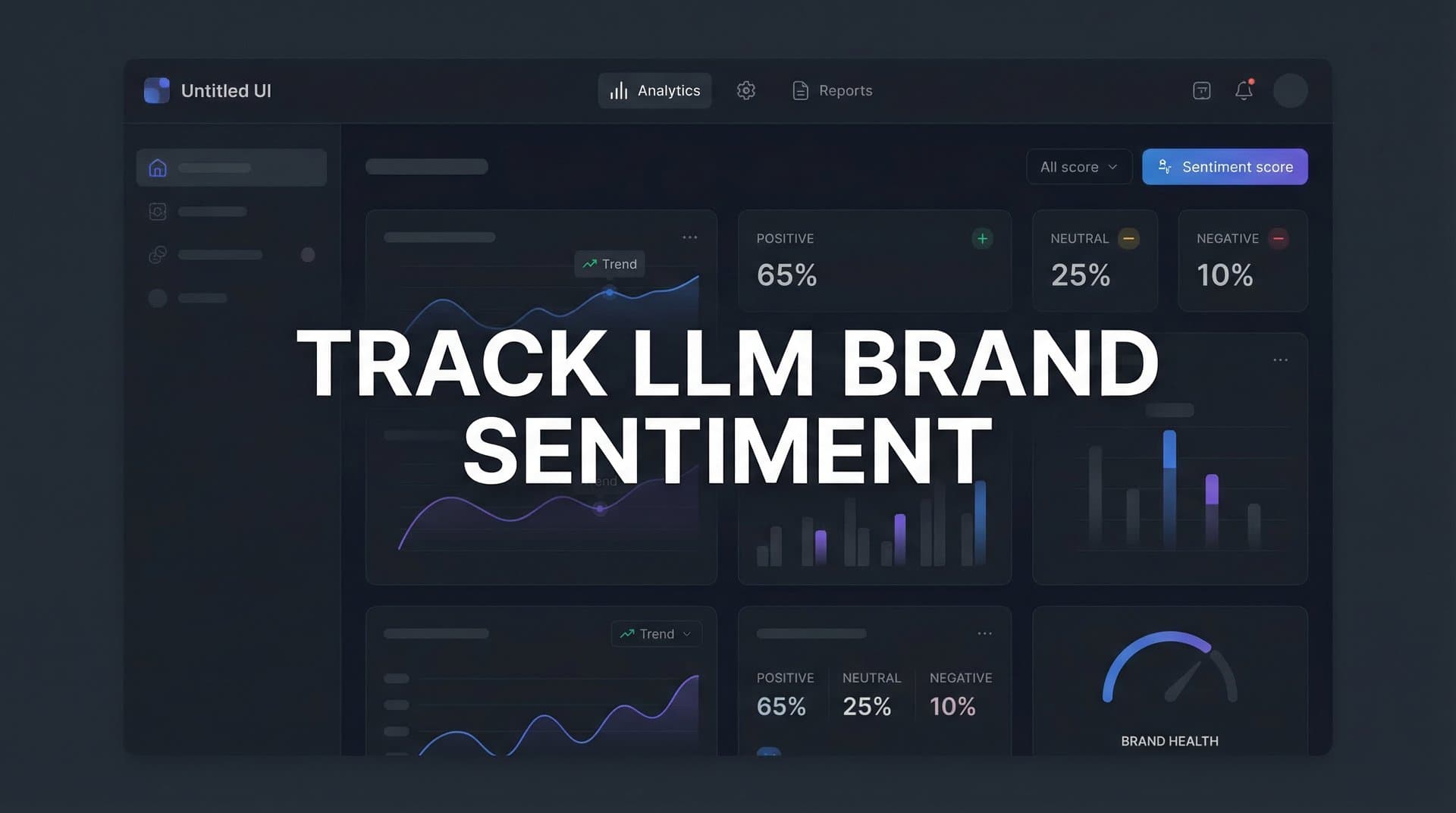
Start by categorizing the sentiment for each brand mention across your responses. Use four categories: positive (the AI describes your brand favorably in context), neutral (the AI mentions your brand without strong characterization), negative (the AI includes caveats, limitations, or unfavorable framing), and absent (your brand does not appear in the response at all). Assign a category to every prompt-platform combination in your dataset.
Then look for patterns across three dimensions:
Tone: How is your brand described when it does appear? Are the descriptions specific and authoritative, or vague and generic? Specific, positive descriptions ("comprehensive AI visibility tracking with sentiment scoring") signal stronger AI association than generic ones ("a tool for SEO").
Context: What categories and use cases is your brand associated with? You might find that your brand appears frequently in prompts about one use case but is absent from prompts about an adjacent use case that your product actually supports. That is a content opportunity.
Frequency: How often does your brand appear relative to your tracked competitors? If a competitor appears in eighteen of your twenty-five prompts and you appear in eight, that gap tells you something important about relative AI visibility even before you analyze the quality of individual mentions.
Once you have mapped these patterns, identify your highest-priority gaps. Focus on two types: prompts where competitors appear but your brand does not, and prompts where your brand appears but with neutral or negative framing. These are the gaps with the most direct impact on buyer consideration.
For each gap, ask a specific question: what content would need to exist for an AI model to associate your brand positively with this topic? That question connects your analysis directly to your content strategy.
Sight AI's AI Visibility Score and sentiment analysis dashboard surfaces these patterns automatically, including which prompts are driving the most favorable mentions and where competitive displacement is most pronounced. For teams managing large prompt libraries, the ability to filter and sort by sentiment category, platform, and prompt type significantly reduces the time from raw data to actionable insight.
Document your findings in a prioritized gap list with four columns: the prompt, the current sentiment, the target sentiment, and the content action required. This list becomes your content brief for Step 5.
Step 5: Create and Publish GEO-Optimized Content to Shift Sentiment
Generative Engine Optimization, commonly called GEO, is the practice of creating content specifically structured to be cited and referenced by AI models. It is distinct from traditional SEO, though the two overlap significantly. Where traditional SEO focuses on ranking signals for search engine algorithms, GEO focuses on creating content that AI models draw from when generating responses to user queries.
Your gap list from Step 4 is your content roadmap. For each high-priority gap, you need content that directly addresses the prompt topic and positions your brand as a credible authority on it. The connection between the content you create and the prompts you are targeting should be explicit, not assumed.
Prioritize content formats that AI models tend to cite most frequently. Comprehensive guides that cover a topic thoroughly give AI models substantive material to reference. Comparison articles that evaluate options across clear criteria address the comparison queries that drive purchasing decisions. Definitional explainers that establish what a concept means and how it works help AI models associate your brand with specific terminology. Original research or data, when you have it, is particularly powerful because it gives AI models citable, specific information that other content does not provide.
How you mention your brand within the content matters as much as the content itself. AI models learn brand associations from how brands are discussed in relation to specific topics and use cases. A passing mention of your brand name is less effective than a substantive, contextual reference: "Sight AI's prompt-level sentiment tracking gives marketers visibility into exactly how AI models describe their brand across ChatGPT, Claude, and Perplexity." That kind of specific, contextual mention is what builds durable AI associations.
Sight AI's AI Content Writer uses thirteen-plus specialized AI agents to generate SEO and GEO-optimized articles at scale. You can create the guides, comparison articles, and explainers your gap analysis identified without each piece requiring hours of manual writing. The agents are designed to produce content structured for both traditional search and AI model citation, covering the formats that matter most for AI visibility.
After publishing, get your content indexed as quickly as possible. Sight AI's IndexNow integration automatically submits new content for faster discovery across search engines. Faster indexing means faster content discovery, which can accelerate the timeline for AI models to incorporate your new content into their knowledge sources. Content that sits unindexed for weeks is not working for you during that time.
Pitfall: Publishing content without a plan to index it promptly. Content that is not indexed cannot be discovered or cited. Make indexing a non-negotiable part of your publishing workflow, not an afterthought.
Step 6: Establish a Recurring Tracking Cadence and Measure Progress
Everything you have built so far, your scope, your prompt library, your baseline, your gap analysis, your content, only delivers value if you run the process consistently over time. A one-time audit tells you where you stand today. A recurring cadence tells you whether your efforts are working and where to focus next.
Set a consistent schedule for re-running your prompt library. For high-priority prompts, particularly the comparison and decision-stage queries most likely to influence purchasing decisions, run them weekly. For your full prompt library, a monthly cadence is typically sufficient to track meaningful movement without creating an unsustainable workload.
Each time you run your prompts, compare current responses to your baseline and to the previous period. The questions you are trying to answer are: Are you appearing in more prompts than before? Is the framing of your brand mentions improving? Are you appearing earlier in responses where you previously appeared later? Is competitive displacement decreasing in the gaps you targeted with content?
Before you start measuring, define your success metrics clearly. Three metrics provide a solid foundation for AI brand sentiment reporting:
AI mention rate: The percentage of tracked prompts where your brand appears in the response. This is your baseline visibility metric.
Average sentiment score: The distribution of positive, neutral, and negative mentions across your tracked prompts. Tracking this over time shows whether your content efforts are improving the quality of your mentions, not just the frequency.
Competitive share of voice: How your mention rate compares to your tracked competitors across the same prompt set. This contextualizes your absolute numbers and helps you identify whether you are gaining or losing ground relative to the market.
For agencies reporting AI visibility results to clients, a simple monthly reporting template showing month-over-month movement on these three metrics is often more persuasive than raw response data. Trend lines are easier to interpret than spreadsheets full of individual responses.
Where possible, connect AI sentiment trends to downstream business metrics. If a period of improved AI visibility correlates with an increase in branded search volume or organic traffic, that connection helps demonstrate business impact to stakeholders who may be skeptical of AI-specific metrics.
Sight AI's ongoing monitoring delivers alerts when sentiment shifts, new competitor mentions emerge, or your brand drops from prompts where it previously appeared. That kind of proactive notification means you are not waiting until your next scheduled review to catch a meaningful change. You can respond to sentiment shifts as they happen rather than discovering them weeks later.
Success indicator: You have a documented process that runs on a consistent schedule, produces structured data each reporting cycle, and generates clear actions for the next period. The process should be repeatable without depending on any single person to hold it together.
Putting It All Together
Tracking AI brand sentiment is no longer optional for brands that rely on organic discovery. As AI-powered search becomes a primary research channel for buyers, the tone and frequency with which AI models mention your brand directly influences consideration and conversion. The six steps in this guide give you a repeatable system you can start running this week.
Use this quick-start checklist to confirm you have covered each step:
Brand terms and competitors documented. Your monitoring scope is defined and written down.
Prompt library of 15-25 queries built. Covering category-level, comparison, and brand-direct queries across the buyer journey.
Baseline responses captured across target AI platforms. Logged in a consistent format with position, language, and competitive displacement noted.
Sentiment gaps prioritized by business impact. Your gap list connects each prompt to a specific content action.
GEO-optimized content published and indexed. Addressing your highest-priority gaps with formats AI models cite most frequently.
Recurring tracking cadence established. With defined metrics and a reporting template ready for each cycle.
Sight AI combines AI visibility tracking, sentiment analysis, content generation, and automated indexing in a single platform. You can move from insight to published, indexed content without switching between tools or stitching together a stack of disconnected solutions.
Start tracking your AI visibility today and take control of how AI models represent your brand across ChatGPT, Claude, Perplexity, and beyond. The brands that build this capability now will have a meaningful head start as AI-powered search continues to reshape how buyers discover and evaluate their options.