AI chatbots and search assistants are now shaping how millions of people discover and perceive brands. When someone asks ChatGPT, Claude, or Perplexity about your industry, what are they hearing about your company? More importantly, is the sentiment positive, negative, or neutral?
Traditional social listening tools weren't built for this new reality. They monitor Twitter, Reddit, and review sites—but they're blind to the conversations happening inside AI models.
This guide walks you through exactly how to track brand sentiment across AI platforms, from setting up your monitoring infrastructure to analyzing trends and taking action on what you discover. By the end, you'll have a repeatable system for understanding how AI represents your brand to potential customers.
Step 1: Identify Which AI Platforms Matter for Your Brand
Not all AI platforms deserve equal attention. Your monitoring strategy should focus on the platforms where your target audience actually seeks information and recommendations.
Start by mapping the major players: ChatGPT dominates conversational AI, Claude excels at nuanced analysis, Perplexity serves as an AI-powered search engine, Google's Gemini integrates with search, Microsoft Copilot reaches enterprise users, and Meta AI connects with social media audiences. Each platform has distinct characteristics in how it processes and presents brand information.
Match platforms to your audience demographics. B2B software companies should prioritize ChatGPT and Microsoft Copilot, where business professionals conduct research. Consumer brands might focus on Perplexity and Meta AI, where everyday users seek product recommendations. Enterprise marketers need to monitor Gemini's integration with Google Workspace tools.
Think of it like choosing which social media platforms to monitor. You wouldn't track every network equally—you'd focus where your customers spend time. The same logic applies to brand tracking across AI platforms.
Start with three to four platforms maximum. Trying to monitor everything at once dilutes your focus and makes it harder to establish meaningful baselines. You can always expand later once you've mastered the fundamentals.
Document baseline expectations for each platform. ChatGPT responses tend toward balanced, educational tones. Claude often provides more nuanced analysis with careful qualifiers. Perplexity cites specific sources. Understanding these patterns helps you distinguish between platform personality and actual sentiment shifts about your brand.
Pay attention to data freshness on each platform. Some AI models have training data cutoffs that mean they're working with older information about your brand. Others integrate more recent web data. This affects how current events and recent brand developments influence sentiment.
Step 2: Build Your Prompt Library for Consistent Monitoring
Effective sentiment tracking requires standardized prompts that reveal how AI models truly perceive your brand. Random queries produce random results. A structured prompt library ensures you're measuring the same things consistently over time.
Direct brand queries. Start with straightforward questions: "What do you know about [Brand Name]?" or "Tell me about [Brand Name]'s products." These establish baseline sentiment and reveal what information the AI considers most relevant about your company.
Competitor comparison prompts. Ask "Compare [Your Brand] to [Competitor A] and [Competitor B]" or "Which is better: [Your Brand] or [Competitor]?" These prompts reveal relative positioning and whether the AI frames your brand as a leader, viable alternative, or secondary option.
Industry recommendation prompts. Use queries like "What's the best [product category] for [use case]?" or "Recommend a [product type] for [specific need]." These simulate real user behavior and show whether your brand surfaces in recommendation scenarios.
Design prompts that test different sentiment dimensions. Ask about trust: "Is [Brand Name] reliable?" Test quality perceptions: "What's the quality of [Brand Name] products like?" Probe pricing sentiment: "Is [Brand Name] worth the cost?" Explore support reputation: "How is [Brand Name]'s customer service?"
Each dimension reveals different aspects of how AI models characterize your brand. A platform might present positive quality sentiment while expressing neutral or negative pricing sentiment. You need both data points to understand the complete picture. For a deeper dive into this process, explore our prompt tracking for brands guide.
Create variation within each prompt category. Don't ask "What do you know about [Brand]?" the exact same way every time. Rotate between "Tell me about...", "What's your opinion on...", "Describe...", and "Explain..." The same core question asked different ways can reveal whether sentiment is consistent or varies based on phrasing.
Establish a prompt rotation schedule. Query each platform with your full prompt library weekly or biweekly, depending on your brand's visibility and industry velocity. More frequent monitoring makes sense for brands in fast-moving sectors or those actively working to improve AI perception.
Document every prompt exactly as written. Even small wording changes can affect AI responses. Your tracking system should store the precise prompt text alongside the response, timestamp, and platform identifier.
Step 3: Set Up Your Tracking Infrastructure
Your monitoring approach depends on resources, technical capability, and scale. Each option has tradeoffs between cost, automation, and depth of analysis.
Manual tracking with spreadsheets. The simplest approach involves manually querying AI platforms and recording responses in a structured spreadsheet. Create columns for date, platform, prompt text, full response, sentiment classification, and notes. This works for small teams monitoring a handful of platforms weekly.
The advantage is zero cost and complete control. The disadvantage is time investment and human error. Manual tracking becomes unsustainable as you scale beyond basic monitoring.
Custom scripts and API integration. Technical teams can build automated monitoring using platform APIs where available. Scripts can query AI models on schedule, parse responses, and store results in a database. This approach offers flexibility but requires development resources and ongoing maintenance.
Consider rate limits, API costs, and access restrictions. Some platforms limit automated queries or require commercial agreements for API access. Factor these constraints into your infrastructure design.
Dedicated AI visibility tools. Purpose-built platforms handle the monitoring infrastructure, prompt management, and sentiment analysis in one system. These tools typically offer automated querying across multiple AI platforms, centralized response storage, and built-in sentiment classification. Review the top AI brand visibility tracking tools to find the right fit for your needs.
The tradeoff is cost versus time savings. Dedicated tools eliminate technical overhead but require budget allocation. Evaluate whether the time your team saves justifies the platform investment.
Regardless of approach, your infrastructure needs these core capabilities: consistent scheduling for prompt execution, centralized storage for all responses with full metadata, version control to track prompt changes over time, and export functionality for deeper analysis in other tools.
Set up your baseline measurements before implementing any brand improvement strategies. Query all priority platforms with your complete prompt library and document current sentiment. This baseline becomes your reference point for measuring improvement.
Establish data retention policies. How long will you store raw responses? When will you archive older data? Clear policies prevent database bloat and ensure you're comparing equivalent time periods when analyzing trends.
Step 4: Classify and Score Sentiment in AI Responses
Sentiment classification in AI responses requires more nuance than traditional social media analysis. You're not evaluating individual user opinions—you're assessing how an AI model synthesizes and presents information about your brand.
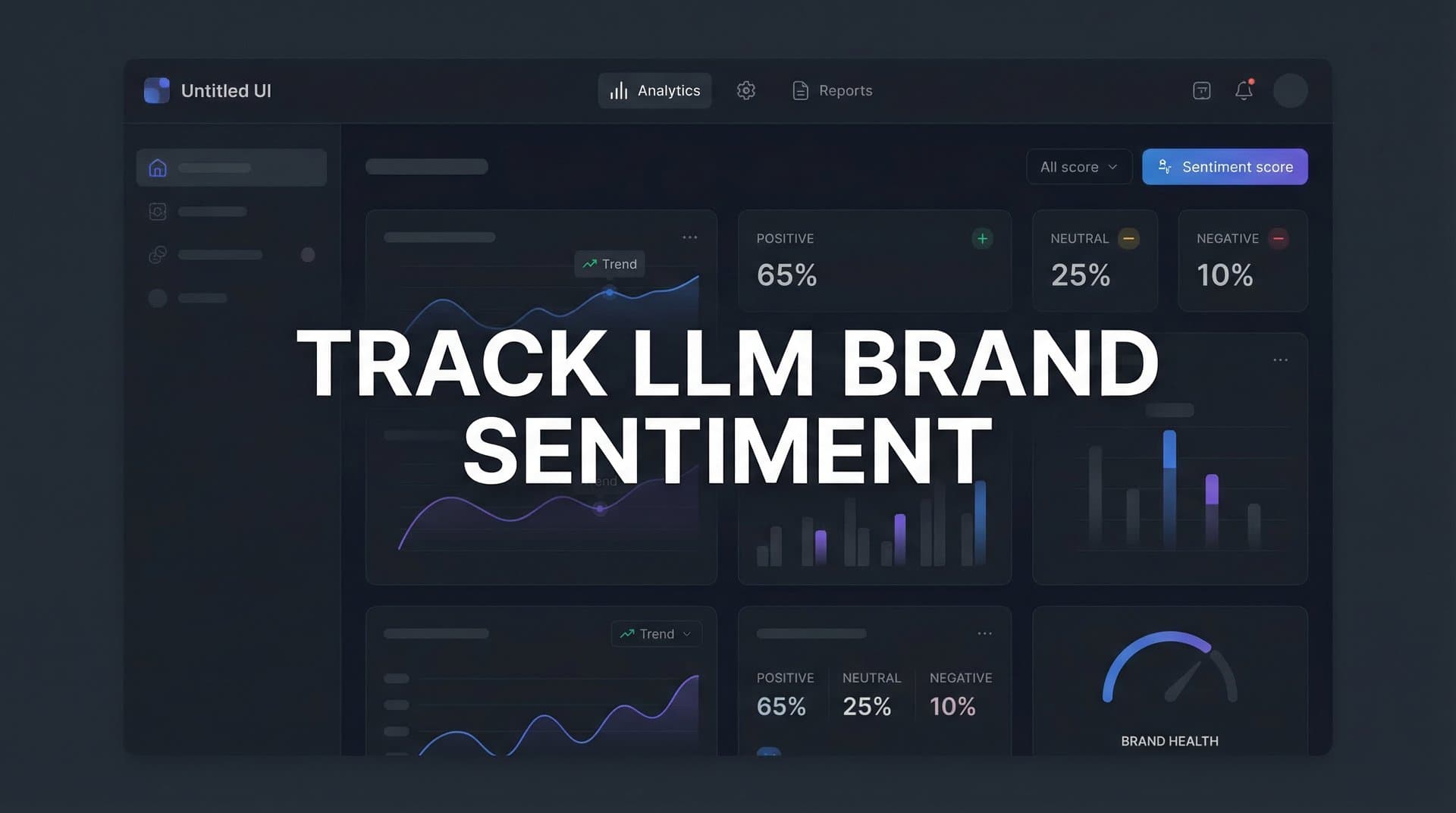
Develop a clear sentiment scoring framework. Start with four basic categories: positive, neutral, negative, and mixed. Positive responses recommend your brand, highlight strengths, or present favorable comparisons. Neutral responses acknowledge your brand without strong opinion. Negative responses warn against your brand, emphasize weaknesses, or recommend alternatives. Mixed responses include both positive and negative elements.
Look beyond surface keywords. An AI response that says "Brand X is popular" might sound positive, but if the full context is "Brand X is popular, though many users report quality issues," the sentiment is actually mixed or negative. Read complete responses and evaluate the overall message, not just isolated phrases. Understanding sentiment tracking in AI responses requires this contextual approach.
Pay attention to qualifiers and hedging language. When an AI says "Brand X might be suitable for basic needs" versus "Brand X excels at addressing complex requirements," the sentiment differs significantly despite both being technically positive statements.
Track positioning within recommendations. Does the AI mention your brand first, last, or buried in the middle of a list? First mentions often signal stronger positive sentiment. Being listed as an afterthought or alternative suggests weaker positioning even if the description itself is neutral.
Document whether your brand appears as a leader, viable alternative, or cautionary example. Leader positioning includes phrases like "top choice," "industry leader," or "best option for." Alternative positioning uses "also consider," "another option," or "if you prefer." Cautionary framing includes "be aware that," "some concerns about," or "you might want to avoid."
Create sentiment scoring rubrics for consistency. Define what constitutes a +2 (strongly positive), +1 (positive), 0 (neutral), -1 (negative), or -2 (strongly negative) response. Document example responses for each score level so different team members classify sentiment consistently.
Track specific language patterns over time. If an AI consistently describes your brand as "affordable" when you're positioning as premium, that's a sentiment signal even if the tone is neutral. If "customer service" appears frequently in negative contexts, you've identified a specific perception problem.
Note when your brand isn't mentioned at all in response to relevant prompts. Absence can be more concerning than negative sentiment. If the AI recommends competitors without mentioning your brand, you have a visibility problem alongside sentiment challenges.
Step 5: Analyze Trends and Identify Sentiment Drivers
Raw sentiment scores become valuable when you analyze patterns, correlations, and changes over time. This step transforms data into actionable insights about what's driving AI perception of your brand.
Compare sentiment across different AI platforms. If ChatGPT presents positive sentiment while Claude shows neutral or negative sentiment, investigate what information sources each platform might be prioritizing. Platform inconsistencies often reveal which content or citations are influencing perception. Learn more about brand tracking across AI models to understand these variations.
Track sentiment trajectories over weeks and months. Is sentiment improving, declining, or stable? Sudden shifts warrant immediate investigation. Gradual trends indicate longer-term perception changes that require strategic responses.
Correlate sentiment changes with external events. Did sentiment improve after your product launch, major PR announcement, or positive media coverage? Did it decline following a customer service incident, negative review, or competitor announcement? Understanding these correlations helps you identify which activities actually influence AI perception.
Many companies assume new content immediately affects AI sentiment. In reality, the lag time varies by platform and depends on training data updates, web crawling frequency, and how AI models weight different information sources.
Identify which content sources AI models appear to reference. When an AI response includes specific facts, claims, or perspectives about your brand, research where that information originates. Is it pulling from your website, third-party reviews, news articles, or industry reports? Knowing your source mix helps you prioritize content improvement efforts.
Create regular reporting cadences. Weekly spot checks catch immediate issues. Monthly reports reveal meaningful trends without overwhelming your team with noise. Quarterly deep dives allow strategic assessment of whether your AI sentiment initiatives are working.
Look for prompt-specific patterns. Do certain query types consistently produce negative sentiment while others are positive? This reveals which aspects of your brand perception need work. If pricing queries generate negative sentiment but quality queries are positive, you have a specific positioning challenge to address.
Document anomalies and investigate their causes. If one platform suddenly shifts sentiment while others remain stable, something changed in that platform's training data or weighting. Understanding these anomalies prevents overreacting to noise while ensuring you catch genuine issues.
Step 6: Take Action to Improve AI Brand Perception
Tracking sentiment is valuable only if you act on what you discover. This step focuses on concrete actions that influence how AI models perceive and present your brand.
Publish authoritative content that addresses negative sentiment themes. If AI responses consistently mention concerns about your pricing, create detailed content explaining your value proposition, ROI case studies, and pricing rationale. If quality concerns appear, publish technical documentation, testing results, and customer success stories that demonstrate product excellence.
The goal isn't propaganda. It's providing clear, factual information that AI models can draw from when formulating responses about your brand. Many negative sentiments stem from information gaps rather than actual problems. If you're dealing with unfavorable perceptions, our guide on negative brand sentiment in AI responses offers targeted strategies.
Optimize existing content for clarity and positive signals. Review your website, documentation, and published materials through the lens of AI consumption. Are you clearly articulating your strengths? Do your headlines and summaries present positive, confident messaging? AI models often prioritize prominent, well-structured information.
Strengthen the content that AI models already reference. If you've identified that certain pages or articles influence AI sentiment, enhance those specific resources with more comprehensive information, clearer positioning, and stronger evidence of your brand's value.
Build citations and mentions on authoritative sources. AI models weight information differently based on source credibility. A mention in an industry publication carries more influence than an isolated blog post. Focus on earning coverage and citations from sources that AI platforms treat as authoritative.
This means strategic PR, thought leadership, and content partnerships. Guest articles on respected industry sites, interviews with trade publications, and participation in authoritative industry reports all contribute to stronger AI sentiment over time.
Monitor results after implementing changes. Track whether sentiment improves following your content updates, new publications, or positioning adjustments. Using AI model brand sentiment monitoring helps you measure the impact of your efforts over time.
Be patient with timing. AI models don't update instantly. Depending on the platform, it might take weeks or months for new content to influence training data and subsequent responses. Consistent, long-term effort matters more than quick fixes.
Address legitimate issues that drive negative sentiment. If AI models consistently mention real problems—poor customer service, product quality issues, or pricing concerns—content alone won't fix perception. Operational improvements must accompany content strategy.
Your Path Forward in AI Brand Sentiment
Tracking brand sentiment across AI isn't a one-time project. It's an ongoing discipline that becomes more valuable as AI-assisted search grows and more customers turn to AI platforms for purchase decisions and brand research.
Start with Step 1 today: identify your priority platforms and run your first set of brand queries. Document what you find, even if it's uncomfortable. Many brands discover their AI sentiment is weaker than expected, but that awareness is the first step toward improvement.
Build your monitoring system step by step. You don't need perfect infrastructure on day one. Begin with manual tracking if necessary, then automate as you understand what metrics matter for your specific brand. Refine your prompts and classification criteria as you learn which queries produce the most valuable insights.
The companies that master AI sentiment tracking now will have a significant advantage over competitors who wait. As AI platforms increasingly mediate brand discovery and evaluation, understanding and influencing your AI presence becomes as critical as traditional SEO and social media management.
Your brand's AI reputation is being formed right now, whether you're monitoring it or not. The question is whether you'll actively shape that reputation or discover it only after negative perceptions have solidified.
Stop guessing how AI models like ChatGPT and Claude talk about your brand—get visibility into every mention, track content opportunities, and automate your path to organic traffic growth. Start tracking your AI visibility today and see exactly where your brand appears across top AI platforms.