Your brand is being discussed in AI conversations right now—but do you know what's being said? As large language models like ChatGPT, Claude, and Perplexity become primary information sources for millions of users, the sentiment these AI systems express about your brand directly impacts customer perception and purchasing decisions.
Unlike traditional social media monitoring, tracking LLM brand sentiment requires a fundamentally different approach. AI models don't just repeat what's online; they synthesize, interpret, and form opinions based on their training data and real-time retrieval.
Think about it: when someone asks ChatGPT "What's the best project management software?" or queries Claude about "reliable marketing automation platforms," these AI systems are forming judgments about your brand in real-time. They're weighing your strengths against competitors, highlighting potential concerns, and ultimately influencing purchase decisions—all without you having any visibility into the conversation.
This guide walks you through the exact process of monitoring how AI systems perceive and present your brand, from setting up your tracking infrastructure to analyzing sentiment patterns and taking action on insights. You'll learn how to systematically measure what AI models say about your brand and, more importantly, how to improve those narratives over time.
Step 1: Identify Your Brand Monitoring Scope
Before you can track sentiment, you need to know exactly what to track. This foundational step determines the comprehensiveness of your entire monitoring system.
Start by documenting your primary brand terms. This includes your official company name, all product names, key executive names that might appear in AI responses, and any branded features or methodologies you've developed. For example, if you're a SaaS company, you'd list your platform name, individual product modules, and any proprietary frameworks you've published.
Map your competitive landscape. Identify 5-10 direct competitors whose sentiment you'll track alongside your own. AI models frequently make comparative statements—"Unlike Brand X, Brand Y offers..."—so understanding how competitors are positioned gives you critical context for your own sentiment scores.
Next, list the industry terms and category keywords where your brand should appear. If you're in marketing automation, you'd want to track phrases like "email marketing platforms," "marketing automation tools," and "customer engagement software." These category-level mentions reveal whether AI models consider you a relevant player in your space.
Document variations and misspellings. AI models sometimes use alternate spellings, abbreviations, or informal versions of brand names. Create a comprehensive list that includes common variations—this prevents you from missing mentions that don't match your exact brand name. Understanding how to track LLM brand mentions effectively starts with this comprehensive term inventory.
Your goal is a complete brand term inventory with 20-50 trackable phrases. This might seem extensive, but comprehensive coverage ensures you're capturing the full picture of how AI systems discuss your brand across different contexts and query types.
Success indicator: You've created a spreadsheet with four columns—Primary Brand Terms, Competitor Terms, Category Keywords, and Variations—each populated with specific, trackable phrases. This becomes your master reference for all subsequent tracking activities.
Step 2: Select Your LLM Tracking Platforms
Not all AI platforms are created equal, and each has distinct characteristics that affect how they present brand information.
Prioritize the high-traffic platforms where your audience actually seeks information: ChatGPT, Claude, Perplexity, Gemini, and Microsoft Copilot represent the majority of AI-assisted searches. Each platform has different underlying models, training data cutoffs, and retrieval mechanisms that influence brand sentiment.
Understand platform-specific response patterns. ChatGPT tends toward balanced, comprehensive answers with clear structure. Claude often provides more nuanced analysis with explicit uncertainty markers. Perplexity emphasizes real-time web sources through its retrieval-augmented generation approach. Gemini integrates Google's knowledge graph. These differences mean sentiment can vary significantly across platforms for the same brand.
You'll need to decide between manual testing and automated monitoring. Manual testing involves personally querying each platform with your test prompts and recording responses—time-intensive but highly accurate. Automated monitoring uses specialized tools that continuously track brand mentions across platforms without manual intervention. Exploring multi-LLM tracking software can help you scale this process efficiently.
For most marketers, a hybrid approach works best: use automated tools for continuous monitoring and supplement with manual testing for quality checks and deep-dive analysis. This balances efficiency with accuracy.
Consider API limitations carefully. Most AI platforms don't offer unrestricted API access for brand monitoring purposes. ChatGPT's API exists but has rate limits and costs. Claude's API is available through Anthropic but with similar constraints. Perplexity doesn't offer a public monitoring API. This means automated tracking often requires specialized tools built specifically for AI visibility monitoring.
Success indicator: You've established monitoring capabilities on at least four major AI platforms, whether through manual processes, automated tools, or a combination. You understand each platform's unique characteristics and have documented how to access and query each one consistently.
Step 3: Build Your Prompt Testing Framework
The prompts you use to query AI systems determine what sentiment you'll uncover. Random, inconsistent questioning produces unreliable data—you need a systematic framework.
Create three standardized prompt categories that mirror how real users seek information. Informational prompts ask direct questions: "What is [brand name]?" or "Tell me about [product]." Comparative prompts pit you against competitors: "Compare [your brand] vs [competitor]" or "What's better, [brand A] or [brand B]?" Recommendation-based prompts simulate purchase intent: "What's the best tool for [use case]?" or "Should I use [your brand] for [specific need]?"
Design prompts that simulate real user queries. Look at your actual customer research, support tickets, and sales conversations to identify how people naturally ask about your brand. A prompt like "Is [brand] good for small businesses?" is far more realistic than "Provide a comprehensive analysis of [brand]." Our prompt tracking for brands guide covers this methodology in detail.
Include sentiment-revealing prompts specifically designed to surface opinions. Questions like "What are the pros and cons of [brand]?" or "What do people complain about with [brand]?" force AI models to articulate both positive and negative aspects. These prompts are goldmines for understanding nuanced sentiment.
Document prompt variations to test consistency. The same question phrased differently can yield surprisingly different responses from AI models. For example, "Is [brand] reliable?" versus "Can I trust [brand]?" versus "Does [brand] have good uptime?" all probe reliability but may generate different sentiment signals. Testing variations reveals how robust your brand perception is across different phrasings.
Organize your prompts by intent type and priority. High-priority prompts address your core value propositions and primary use cases. Medium-priority prompts explore secondary features and niche applications. Low-priority prompts test edge cases and uncommon scenarios.
Success indicator: You've built a library of 30-50 test prompts organized in a spreadsheet with columns for Prompt Text, Category (informational/comparative/recommendation), Priority Level, and Expected Sentiment. This library becomes your repeatable testing protocol for consistent monitoring.
Step 4: Establish Sentiment Classification Criteria
Without clear criteria, sentiment assessment becomes subjective and inconsistent. You need a documented rubric that produces reliable classifications.
Define your sentiment scale with five distinct categories: positive, neutral, negative, mixed, and absent. Positive means the AI response presents your brand favorably with strengths highlighted and minimal concerns mentioned. Neutral indicates factual presentation without strong opinion signals. Negative shows criticism, concerns, or unfavorable comparisons. Mixed contains both positive and negative elements in roughly equal measure. Absent means your brand wasn't mentioned when it should have been.
Create specific criteria with concrete examples. For positive sentiment, you might specify: "Response recommends the brand, uses words like 'excellent,' 'reliable,' or 'industry-leading,' mentions specific strengths, and includes minimal or no caveats." For negative: "Response discourages use, mentions specific problems, uses words like 'limited,' 'expensive,' or 'difficult,' or recommends competitors instead." Learning to identify negative brand sentiment in AI responses is crucial for this classification process.
AI responses have unique characteristics that differ from traditional text sentiment. Pay attention to hedging language—phrases like "may be suitable," "could work for," or "depending on your needs"—which indicate uncertainty or qualified endorsement rather than strong positive sentiment. Similarly, "some users report" or "there have been concerns about" signal negative sentiment even when phrased diplomatically.
Account for absence as a sentiment category. When AI models don't mention your brand in response to relevant category queries, that's often more concerning than negative sentiment. If someone asks "What are the top project management tools?" and your brand doesn't appear in the response, you have an absence problem that needs addressing.
Test your criteria with your team. Have multiple people rate the same set of AI responses using your rubric. If you're getting consistent classifications across raters, your criteria are solid. If there's significant disagreement, refine your definitions until you achieve reliability.
Success indicator: You have a documented sentiment classification rubric with clear definitions, example responses for each category, and demonstrated consistency when multiple team members apply it to the same content.
Step 5: Implement Automated Tracking Systems
Manual testing provides depth, but automated tracking provides the scale and consistency necessary for reliable trend analysis.
Set up AI visibility tracking tools that monitor brand mentions continuously across your target platforms. These specialized systems query AI models with your prompt library on a scheduled basis, record responses, and track changes over time. The automation ensures you're capturing sentiment data consistently without the variability that comes from manual, ad-hoc testing. Reviewing the best LLM brand monitoring tools can help you choose the right solution for your needs.
Configure intelligent alerts for significant changes. You don't need notifications for every minor fluctuation, but you do want to know immediately when sentiment shifts dramatically. Set up alerts for patterns like: sudden appearance of negative language that wasn't present before, disappearance of your brand from category-level responses where you previously appeared, or significant changes in how you're compared to competitors.
Integrate your tracking data with existing marketing dashboards so AI sentiment lives alongside your other brand health metrics. When your team reviews overall brand performance, AI sentiment should be right there next to social media sentiment, review site ratings, and customer satisfaction scores. This integration ensures AI visibility doesn't become a siloed metric that gets ignored.
Schedule regular automated testing across all platforms. Different monitoring frequencies make sense for different scenarios. Daily testing is appropriate during product launches, major PR events, or crisis situations. Weekly testing works for stable periods with normal marketing activity. Monthly testing might suffice for mature brands in low-volatility markets. The key is consistency—sporadic testing produces unreliable trend data.
Document your automation setup thoroughly. Record which prompts run on which schedule, which platforms are monitored, where data is stored, and who receives alerts. This documentation ensures continuity if team members change and makes troubleshooting easier when issues arise.
Success indicator: You're receiving daily automated reports showing your brand sentiment across AI platforms, with historical trend data and alerts configured for significant changes. Your team can access current and historical sentiment data without running manual queries.
Step 6: Analyze Patterns and Generate Insights
Raw sentiment data is just numbers—insights come from identifying patterns and understanding what drives them.
Track sentiment trends over time to identify whether your AI brand perception is improving, declining, or remaining stable. Plot your sentiment scores on a timeline and look for inflection points—moments where sentiment shifted noticeably. These inflection points often correlate with specific events: product launches, feature updates, pricing changes, PR coverage, or competitive moves.
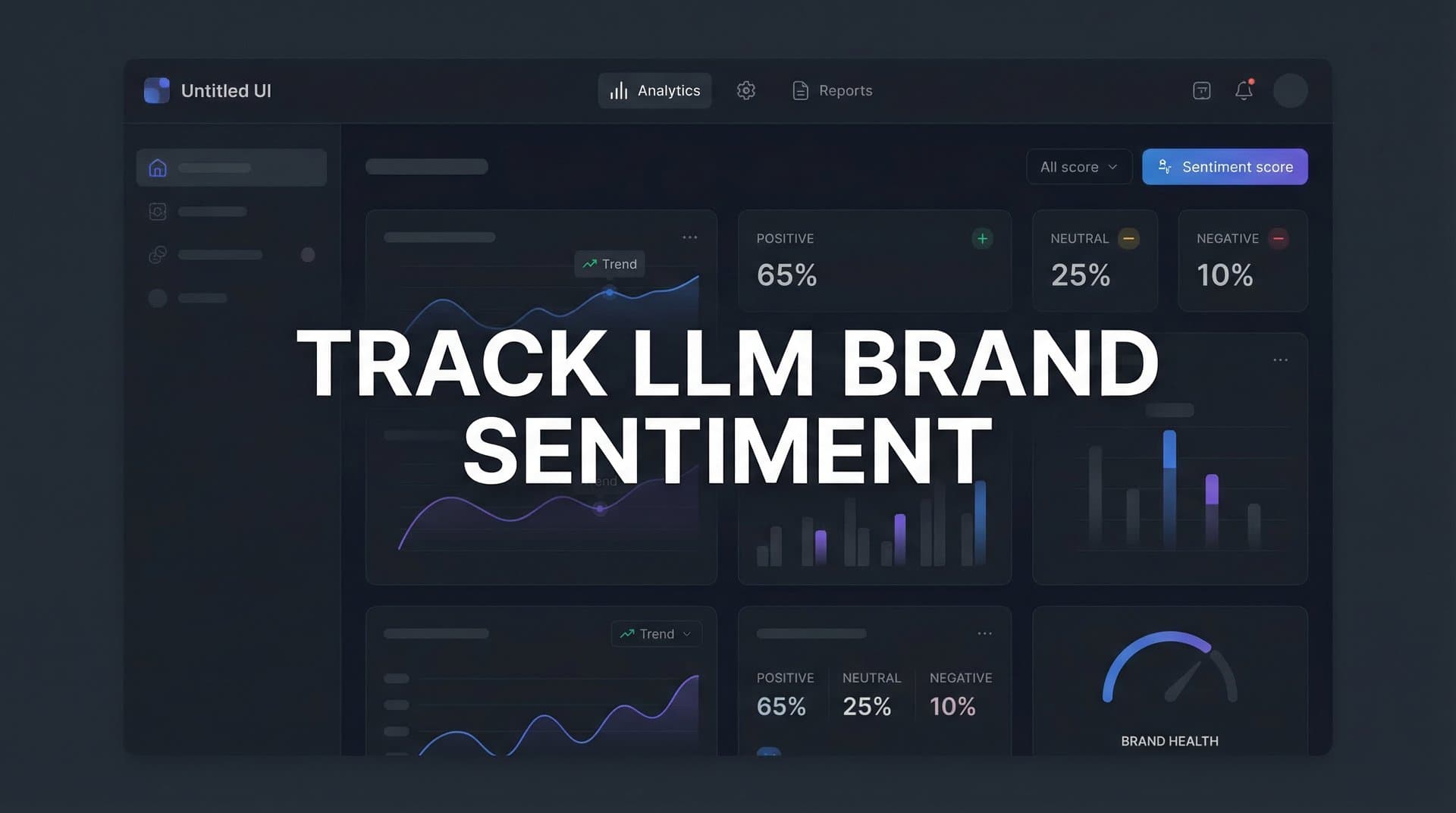
Compare your sentiment against competitor benchmarks. Your absolute sentiment score matters less than your relative position. If you're scoring 65% positive sentiment but your main competitor scores 45%, you're winning the AI perception battle in your category. Conversely, if you're at 65% but competitors average 80%, you have work to do regardless of your absolute score. Using AI sentiment analysis for brand monitoring helps automate these competitive comparisons.
Identify which specific prompts consistently generate negative responses. If "What are the downsides of [your brand]?" always surfaces the same concerns—say, pricing or learning curve—you've identified concrete perception problems that need addressing. Similarly, prompts that generate consistently positive responses reveal your strengths as perceived by AI systems.
Correlate sentiment changes with external events. Did sentiment improve after you published a comprehensive guide on a topic? Did it decline after a competitor launched a similar feature? Did a pricing change affect how AI models discuss your value proposition? These correlations help you understand cause-and-effect relationships between your actions and AI perception.
Look for platform-specific patterns. If Claude consistently presents your brand more favorably than ChatGPT, investigate why. It might be that Claude's training data includes more of your authoritative content, or that its retrieval mechanisms surface your materials more frequently. Understanding these platform differences helps you optimize your content strategy. Learning how to monitor brand sentiment across platforms reveals these crucial variations.
Success indicator: You're producing monthly sentiment reports that go beyond raw scores to include trend analysis, competitive benchmarking, prompt-level insights, and correlation with marketing activities. These reports generate specific, actionable recommendations rather than just presenting data.
Step 7: Take Action to Improve AI Brand Perception
Tracking sentiment is pointless without action. The final step is using your insights to systematically improve how AI models perceive and present your brand.
Create content specifically designed to influence AI training and retrieval systems. This means authoritative, factual, well-structured content that AI models can confidently cite. Comprehensive guides, detailed product documentation, clear comparison pages, and transparent pricing information all help AI systems form accurate, positive impressions of your brand. Understanding how LLMs choose brands to recommend informs this content strategy.
Address negative sentiment sources through targeted optimization. If AI models consistently mention that your product has a steep learning curve, create extensive onboarding resources, tutorial content, and quick-start guides. Then monitor whether subsequent AI responses begin acknowledging these resources and adjusting their assessment of ease-of-use.
Build authoritative content that answers the specific questions AI systems surface most frequently. If your prompt testing reveals that users often ask AI about your integration capabilities, create a comprehensive integration guide with clear technical details. Make it the definitive resource on that topic so AI models preferentially cite it.
Monitor the impact of content changes on AI responses. After publishing new content or updating existing materials, track whether AI sentiment shifts in the following weeks. Platforms using retrieval-augmented generation like Perplexity may reflect changes within days. Pure LLM responses may take longer to incorporate new information, but patterns should emerge within 60-90 days if your content strategy is effective.
Focus on consistency across all your digital properties. AI models synthesize information from multiple sources, so conflicting messages across your website, documentation, and third-party profiles create confused, hedged responses. Ensure your value propositions, feature descriptions, and positioning are consistent everywhere your brand appears online.
Test and iterate continuously. AI sentiment tracking isn't a one-time project—it's an ongoing process of measurement, optimization, and refinement. The brands that treat it as a continuous discipline rather than a periodic audit will dominate AI-powered search results.
Success indicator: You can demonstrate measurable sentiment improvement within 60-90 days of implementing content optimizations, with specific prompts showing more positive responses and your brand appearing more frequently in relevant category queries.
Putting It All Together
Tracking LLM brand sentiment is no longer optional—it's essential for brands that want to control their narrative in AI-powered search. By following these seven steps, you've built a comprehensive system that identifies what AI models say about your brand, measures sentiment patterns, and enables data-driven improvements.
Here's your quick implementation checklist: brand terms mapped with 20-50 trackable phrases, monitoring active on 4-6 major platforms, prompt library created with 30-50 test queries, sentiment classification rubric documented and tested, automated tracking systems running daily, monthly analysis reports scheduled, and content optimization plan ready for execution.
Start with manual testing this week. Pick your top 10 prompts and personally query ChatGPT, Claude, and Perplexity. Record the responses and classify the sentiment using your rubric. This hands-on experience will give you intuition about how AI models discuss your brand and help you refine your tracking approach before scaling to automation.
Then scale to automated monitoring as you refine your methodology. Once you understand the patterns and have confidence in your classification criteria, implement systematic tracking that runs consistently without manual intervention. This frees your team to focus on analysis and optimization rather than data collection.
The brands that master AI sentiment tracking today will own their narrative in tomorrow's AI-first search landscape. Every week you delay is another week where AI models are forming opinions about your brand without your input or visibility.
Stop guessing how AI models like ChatGPT and Claude talk about your brand—get visibility into every mention, track content opportunities, and automate your path to organic traffic growth. Start tracking your AI visibility today and see exactly where your brand appears across top AI platforms.