Picture two competing SaaS brands. Same product category, similar pricing, comparable feature sets. One gets recommended by ChatGPT when a buyer asks "what's the best tool for X?" The other doesn't appear at all. The invisible brand isn't necessarily worse. It might even have a better product. But from an AI's perspective, it simply doesn't exist in a meaningful way.
This is the new marketing reality taking shape right now. As more buyers, researchers, and decision-makers turn to AI platforms like ChatGPT, Claude, and Perplexity as their first stop for product discovery, the question of how AI platforms select brands to mention has moved from a technical curiosity to a genuine competitive concern. And the criteria these systems use are fundamentally different from what drives traditional search rankings.
Google's algorithm rewards links, relevance, and technical optimization. AI models operate on a different set of signals entirely: patterns learned from vast training datasets, entity recognition, topical authority across independent sources, and the specific framing of a user's query. Understanding these signals is no longer optional for marketers who care about organic discovery.
By the end of this article, you'll have a clear picture of the core mechanisms AI platforms use to surface brands, the specific signals that drive AI visibility, and a practical framework for building a presence that earns consistent mentions across the AI platforms your buyers are already using. Let's start with what's actually happening under the hood.
The Architecture Behind AI Brand Recommendations
To understand why some brands get mentioned and others don't, you first need to understand how AI platforms develop brand awareness in the first place. It starts during training.
Large language models are trained on enormous corpora of web content: articles, forums, documentation, news coverage, research papers, and more. As a model processes this data, it develops statistical associations between concepts, entities, and contexts. A brand mentioned consistently across many authoritative sources, in relevant contexts, starts to register as a credible entity in its domain. The model doesn't "know" the brand the way a human does; it has internalized patterns that make it more likely to surface that brand when a relevant query appears.
This is the training data mechanism, and it's the foundation of AI brand awareness for models like ChatGPT and Claude. The implication is significant: your brand's visibility in AI responses is partly a function of how thoroughly and consistently it was represented across the web before the model's training cutoff. A sparse or inconsistent web presence creates weak associations. A rich, authoritative, cross-source presence creates strong ones.
But training data is only one piece. A growing number of AI platforms, most notably Perplexity, use retrieval-augmented generation (RAG). Instead of relying solely on patterns learned during training, these systems actively pull live web content at query time, synthesizing fresh information into their responses. This means the content you publish today can influence what Perplexity says about your brand tomorrow, provided it gets indexed and is deemed relevant to the query.
These two mechanisms require different optimization strategies, and conflating them is a common mistake. For training-data-dependent models, the priority is building a durable, authoritative web presence over time. For retrieval-based platforms, content freshness and indexing speed become immediate competitive factors.
It's also worth clarifying what AI brand selection is not. It is not a single ranking algorithm like PageRank. There is no score you can optimize for directly. Instead, AI platforms synthesize patterns across multiple signals simultaneously: the context of the user's query, the authority of sources that mention your brand, the frequency and consistency of those mentions, and the recency of relevant content. The result is a probabilistic judgment about which brands are most relevant to surface for a given prompt. Understanding each of those signal categories is where the real strategic work begins.
Authority Signals: Why Some Brands Get Cited and Others Don't
If there's one concept that explains most of the gap between brands that get mentioned by AI and those that don't, it's topical authority. AI models consistently favor brands that are strongly and specifically associated with a particular problem space or domain, evidenced across many independent sources.
Think about what that means in practice. A brand that appears in industry publications, analyst reports, expert roundups, practitioner guides, and editorial content, all in the context of a specific category, sends a very different signal than a brand that only appears on its own website and paid placements. The former has demonstrated relevance across a distributed network of credible contexts. The latter has essentially vouched for itself, which carries far less weight.
This is the AI equivalent of topical authority in SEO, but the scope extends well beyond your own content. The question AI systems are implicitly asking is: across all the content I've processed, how consistently is this brand associated with this specific domain? Brands with deep, focused expertise signals, evidenced by consistent topic coverage and external references, rank higher in that probabilistic judgment than brands with broad but shallow presence.
Third-party validation plays an especially critical role here. When journalists, researchers, or industry analysts reference your brand, AI models treat those mentions as trust signals. This is conceptually similar to how backlinks signal authority to search engines, but the mechanism is broader. Any credible external reference contributes to the signal, whether it's a link, a citation, a mention in a roundup, or inclusion in an analyst report. The source's authority matters too: a mention in a respected trade publication carries more weight than a mention on a low-traffic blog.
This is why PR, expert contributions, and strategic partnerships are increasingly relevant to AI visibility strategy. They're not just brand awareness plays anymore. They're mechanisms for generating the third-party validation signals that AI systems use to assess credibility.
Underlying all of this is entity recognition. AI models use named entity recognition to identify and categorize brands as structured entities with defined attributes: what category they belong to, what problems they solve, what their reputation is in a given context. Brands with a clear, consistent identity across the web are easier for AI systems to represent accurately and confidently. Inconsistent descriptions, conflicting use cases, or sparse external coverage create ambiguity that works against visibility.
The practical takeaway: clarity and consistency in how your brand is described across every external touchpoint isn't just a branding concern. It's an AI visibility concern. The more coherent your entity signal, the more confidently AI platforms can recommend you when a relevant query appears.
Content Signals: How What You Publish Shapes AI Awareness
Here's where your content strategy connects directly to AI visibility. AI models are trained on and retrieve content that answers user questions. Brands that publish comprehensive, well-structured educational content are more likely to be cited because their content appears in precisely the contexts where AI systems learn to answer those queries.
Consider the types of content that tend to perform well in AI responses: detailed explainers, structured comparisons, authoritative guides, clear definitions, and direct answers to specific questions. These formats work because they align with what AI systems are trying to do: synthesize a useful, accurate response to a user's prompt. Content that is vague, promotional, or poorly structured gets filtered out of that synthesis. Content that directly and clearly addresses a question gets incorporated into it.
This is the core principle behind GEO, or Generative Engine Optimization. GEO is an emerging discipline focused on structuring content so generative AI systems can easily parse, cite, and represent it. The key principles include writing clear, extractable definitions; structuring answers so they can stand alone as citations; using structured data markup to help AI systems understand what your content is about; and creating content that directly addresses the prompts your target audience is likely to use with AI platforms.
GEO is distinct from traditional SEO in an important way. SEO optimizes for ranking signals that a search algorithm evaluates. GEO optimizes for citability: the likelihood that an AI system will pull your content into a response and attribute it to your brand. These goals overlap but are not identical, and the content formats that serve one don't always serve the other equally well.
For retrieval-based platforms like Perplexity, content freshness and indexing speed add another layer. When a user submits a query, these platforms pull live web content and synthesize it in real time. Content that has been recently indexed and is regularly updated is more likely to be surfaced than content that's stale or slow to reach search indexes. This makes fast indexing a genuine competitive advantage in AI visibility, not just an SEO nicety.
The implication for your content calendar: publishing is only half the equation. Getting that content indexed quickly, through tools like IndexNow integration and automated sitemap updates, closes the gap between when you publish and when AI platforms can actually retrieve it. For brands competing in fast-moving categories, that gap can be the difference between being cited and being invisible in a retrieval-based AI response.
Prompt Context and Query Intent: The Hidden Variable
Here's something that often gets overlooked in AI visibility discussions: AI platforms don't select brands in isolation. Every brand recommendation is triggered by a specific user prompt, and the framing, intent, and specificity of that prompt heavily influence which brands get surfaced.
The same brand might be consistently recommended for one type of query and completely absent for another. A project management tool might appear every time someone asks "what's the best tool for remote team collaboration?" but never appear when someone asks "what project management software do enterprise teams use?" The difference isn't the brand's quality. It's the strength of its association with different query contexts across its web presence.
AI models implicitly match brands to query intent categories. Informational queries tend to surface brands with strong educational content presence, brands that have published the guides, explainers, and thought leadership that AI systems draw on when answering "how does X work?" or "what is X?" questions. Comparison queries favor brands with strong review presence and clear competitive positioning across third-party sources. Transactional queries, the ones closest to purchase decisions, tend to surface brands with high purchase-intent signals: pricing pages, clear use case documentation, and mentions in buying guides.
Understanding this means your AI visibility strategy can't be one-dimensional. You need to be present across multiple query intent categories relevant to your buyers, which requires different types of content and different types of third-party mentions for each.
This is where prompt tracking becomes a strategic practice, not just a monitoring exercise. By systematically querying AI platforms with the prompts your target audience is likely to use, you can map exactly where your brand appears and where it doesn't. If a competitor is consistently mentioned when someone asks about a specific use case and your brand isn't, that's a direct signal: you have a content gap in that context. You can address it with targeted content creation designed to build the associations that prompt requires.
The prompts your buyers are using with AI platforms are, in effect, a window into the content and positioning gaps your brand needs to close. Treating prompt tracking as a routine intelligence practice gives you a feedback loop that traditional analytics simply can't provide.
Measuring and Monitoring Your AI Brand Presence
Traditional SEO gives you real-time ranking data. You can check where you rank for a keyword at any moment and track changes over time. AI visibility doesn't work that way. There's no dashboard that shows you your position in ChatGPT's responses. Monitoring requires a different approach entirely.
The most direct method is manual querying: submitting representative prompts to AI platforms and recording when, how, and with what sentiment your brand is mentioned. This gives you ground-truth data about your AI presence, but it's time-intensive and difficult to do systematically across multiple platforms and prompt variations. Done inconsistently, it produces incomplete and potentially misleading snapshots.
A more structured approach involves building an AI Visibility Score: a quantified measure of your brand's presence across AI platforms based on metrics like mention frequency, sentiment, prompt coverage, and share of voice relative to competitors. Instead of asking "does AI mention us?" you're asking "across which prompts do we appear, how do we appear, and how does that compare to the brands we're competing with?"
This kind of structured monitoring transforms AI visibility from a vague concern into an actionable intelligence function. If your AI Visibility Score shows that you're consistently mentioned for informational queries but absent from comparison queries, that tells you something specific about where to invest next. If sentiment analysis reveals that AI platforms describe your brand accurately in some contexts but inconsistently in others, that points to entity signal issues you can address.
Monitoring AI mentions also surfaces competitive intelligence that's hard to get any other way. When you systematically track which prompts cause AI platforms to mention competitors, you're essentially mapping the content and authority gaps between your brand and theirs. That's not just visibility data; it's a content strategy brief.
The challenge is that most traditional analytics platforms weren't built for this. Search console data, traffic analytics, and rank trackers don't capture AI mentions. This is an emerging monitoring category that requires purpose-built tooling, and the brands that establish systematic AI visibility monitoring now will have a significant head start on the ones that wait until it becomes standard practice.
Building a Strategy That Earns AI Mentions Over Time
The signals covered above aren't independent levers you pull one at a time. They work together, and the most effective AI visibility strategies address all of them in a coordinated way. Here's how to synthesize them into a practical framework.
Build topical authority through consistent, structured content. Publish comprehensive content in your domain: guides, explainers, comparisons, and direct answers to the questions your buyers are asking. Structure that content for GEO, with clear definitions, extractable answers, and structured data markup. Consistency matters as much as quality; a sustained publishing cadence in a focused topic area builds stronger entity associations than sporadic coverage of many topics.
Earn third-party mentions through PR and expert contributions. Seek out placements in industry publications, analyst reports, and expert roundups. Contribute guest content to authoritative platforms in your category. Build relationships with journalists and researchers who cover your space. Every credible external mention strengthens your brand's authority signal across the web, making it easier for AI systems to confidently recommend you.
Optimize content for GEO and ensure fast indexing. Apply GEO principles to your content creation process and close the gap between publishing and indexing. For retrieval-based AI platforms, the speed at which your content becomes discoverable is a genuine competitive variable.
Monitor AI visibility and close gaps systematically. Track your brand's presence across AI platforms using representative prompts. Identify where competitors are mentioned and you're not. Use that data to prioritize content creation and authority-building efforts in the specific contexts where your brand is underrepresented.
What makes this framework compelling is its compounding nature. Unlike paid advertising, which stops the moment your budget runs out, a strong AI presence built on authoritative content and third-party validation tends to reinforce itself over time. As your entity signals strengthen, AI platforms become more confident in recommending you across a wider range of prompts and contexts. Early investment compounds into durable competitive advantage.
The strategic imperative here is timing. AI platforms are becoming primary discovery channels for buyers and researchers across virtually every category. The brands that invest in AI visibility now, while it's still an emerging discipline, will build a presence that late-movers will find genuinely difficult to replicate quickly. The signals that drive AI visibility take time to accumulate. Starting now means compounding sooner.
The Bottom Line: Visibility Is Earned, Not Assumed
Return to that opening scenario: two competing brands, similar products, vastly different AI visibility. The difference isn't luck, and it isn't the algorithm playing favorites. It's the result of deliberate choices about content, authority, third-party presence, and monitoring. One brand built the signals that AI platforms look for. The other didn't.
The good news is that those signals are buildable. Topical authority, content structure, third-party validation, and GEO optimization are all things you can invest in systematically. And the first step is knowing where you actually stand right now.
Start with a simple audit. Open ChatGPT, Claude, and Perplexity. Type in the prompts your customers are most likely to use when looking for a solution like yours. See what comes back. Are you mentioned? How? Is the description accurate? Are competitors appearing where you're not? That exercise alone will tell you more about your AI visibility gaps than months of traditional analytics data.
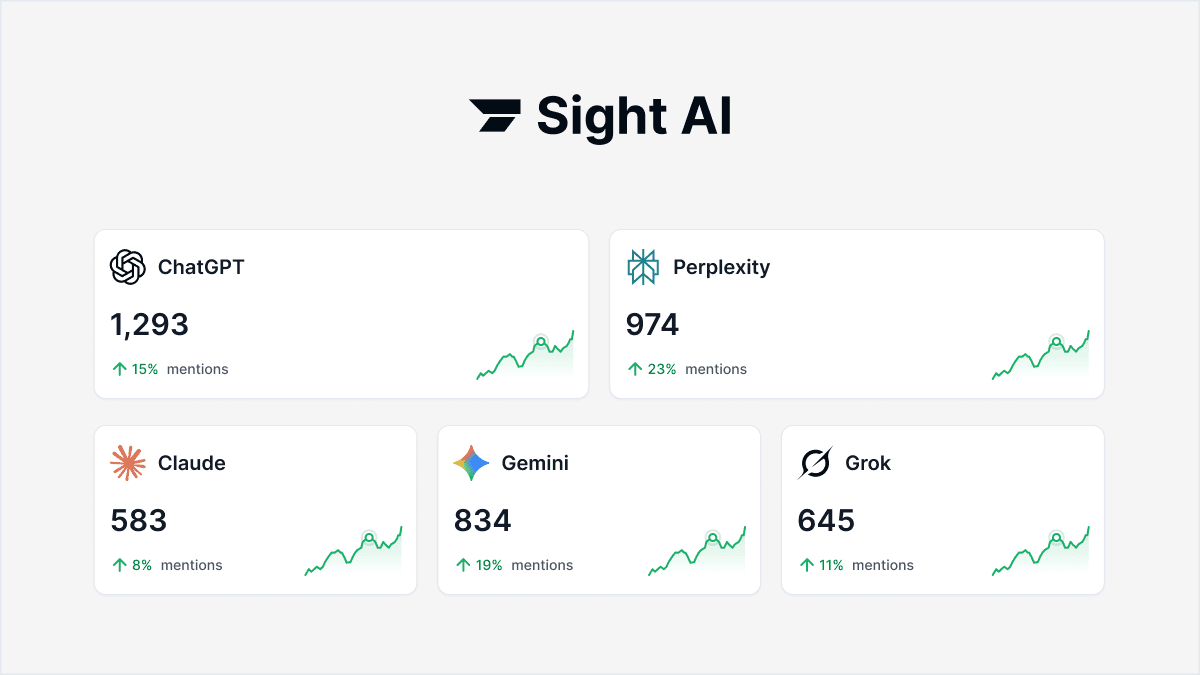
From there, the work becomes systematic: track mentions across models, identify prompt gaps, generate GEO-optimized content that closes those gaps, and ensure that content gets indexed fast enough to matter for retrieval-based platforms. That's exactly what Sight AI is built to do, monitoring your brand across 6+ AI platforms, surfacing the prompts where competitors outrank you, generating content optimized for both SEO and generative AI, and automating indexing so your content reaches AI systems as quickly as possible.
Start tracking your AI visibility today and see exactly where your brand appears, where it doesn't, and what it will take to change that.