Picture two SaaS companies selling nearly identical project management tools. Same price point, similar feature sets, comparable customer reviews. Yet when someone asks ChatGPT "what's the best project management software for remote teams," one brand gets named consistently while the other never appears. The founder of the invisible brand assumes AI recommendations are random, a lottery they haven't won yet. They're wrong.
AI models don't cite brands arbitrarily. They follow discernible, learnable patterns rooted in how content is structured, how brands are represented across the web, and how well a company's published material aligns with the questions real users are asking. In 2026, where a significant portion of product discovery happens through AI-generated answers rather than traditional search results pages, understanding these patterns isn't a nice-to-have. It's a competitive necessity.
The good news: the signals that drive AI citation are largely within your control. They fall into four interconnected categories: content authority, entity recognition, indexability, and query alignment. Master these, and you shift from being invisible in AI responses to being the brand that gets recommended. This article breaks down exactly how each signal works and what you can do about it.
The Mechanics Behind AI Brand Recommendations
To understand why some brands get cited and others don't, you need a working model of how AI systems actually generate responses. There are two distinct architectures at play, and each rewards different optimization strategies.
The first is the pure large language model response. Systems like ChatGPT (when operating without browsing) and Claude generate answers based entirely on patterns learned during training. That training process ingested enormous quantities of web content: articles, documentation, forum discussions, reviews, and more. Brands that appeared frequently within high-quality, well-linked content during those training windows are statistically more likely to be represented in the model's internal knowledge. The key word is "quality." Appearing once on a high-authority domain carries more weight than appearing dozens of times on low-traffic, poorly-linked pages.
The second architecture is retrieval-augmented generation, or RAG. Tools like Perplexity use this approach: at query time, they pull live content from web indexes, then use a language model to synthesize that retrieved content into a coherent answer. For RAG-based systems, real-time indexability is a direct citation factor. If your content isn't indexed when the query fires, you simply don't exist in that moment.
This distinction matters enormously for strategy. Optimizing for pure LLM citation requires building a sustained, long-term presence in authoritative web content so your brand enters future training data at scale. Optimizing for RAG-based citation requires ensuring your content is indexed quickly, structured clearly, and aligned to the exact queries being submitted.
Both architectures share one preference: they favor brands that appear consistently across multiple authoritative sources rather than brands with heavy coverage on a single domain. Think of it like a reputation system. If ten independent, well-regarded publications reference your brand in relevant contexts, AI models interpret that as a strong signal of legitimacy. If only your own website discusses your brand extensively, that signal is much weaker. This is why earned media, third-party reviews, and industry publication coverage aren't just PR wins — they're direct inputs into AI citation probability.
The practical implication is that AI visibility is a distributed problem. It can't be solved by optimizing one page or one channel. It requires a coordinated presence across the web that signals, from multiple angles, that your brand is a credible, established entity in its category.
Content Authority: Why AI Trusts Some Sources Over Others
Here's where it gets interesting for content marketers. AI models don't just evaluate whether a brand exists — they evaluate whether a brand demonstrates genuine expertise in a specific domain. This concept is called topical authority, and it's one of the most powerful levers available to brands competing for AI citations.
Topical authority is built through depth, not breadth. A brand that publishes twenty tightly interconnected articles covering every dimension of, say, B2B email deliverability will be recognized as more authoritative on that topic than a brand that publishes one article each on fifty different marketing subjects. AI systems, much like Google's own E-E-A-T framework (Experience, Expertise, Authoritativeness, Trustworthiness), tend to favor sources that demonstrate concentrated expertise. When your content cluster covers a topic comprehensively, from foundational explainers to advanced technical guides, AI models are more likely to treat your brand as a go-to reference for that domain.
Content structure matters just as much as content depth. AI systems parse articles to extract factual claims, definitions, and categorical information. Articles with clear H2 and H3 headings, explicit definitions, and well-organized factual statements are easier to process and more likely to yield citable information. Compare two articles on the same topic: one is a dense wall of text with no clear structure; the other uses descriptive headings, defines key terms explicitly, and presents claims in clean, standalone sentences. The second article gives AI systems far more to work with. Learning how to optimize content for SEO directly supports this kind of structured, AI-friendly formatting.
There's also a meaningful relationship between traditional SEO performance and AI citation likelihood. Strong organic rankings increase the probability that your content enters AI training pipelines and retrieval indexes. High-ranking pages tend to be well-linked, well-structured, and frequently visited, all signals that push content toward the top of web corpora that AI systems draw from. This means your existing SEO investment isn't wasted in an AI-first world. It compounds. A page that ranks well in traditional search is also more likely to be cited by AI tools, creating a reinforcing loop between organic visibility and AI visibility.
The strategic implication is clear: build content clusters, not content silos. Choose two or three core topic areas where your brand has genuine expertise, then publish comprehensively within those areas. Interlink your articles intentionally. Use clear, structured formatting. And pursue the backlinks and domain authority signals that push your content into the authoritative tier that AI systems prefer.
Entity Recognition and Brand Clarity
There's a concept in AI and knowledge graph systems called an "entity," and it's critical to understand if you want AI models to cite your brand confidently. An entity, in this context, is a clearly defined, consistently described real-world object: a company, a product, a person, or a place. For AI systems to reference your brand accurately, they need to recognize it as a distinct, unambiguous entity with a clear identity.
This is where many brands quietly undermine themselves. If your company is described as "a marketing platform" on your website, "a growth tool" in a press release, "an automation suite" in a directory listing, and "a SaaS solution" in a review, AI systems encounter conflicting signals about what you actually are. That ambiguity doesn't just make citations less accurate. It makes them less likely. AI models tend to avoid citing brands they can't confidently categorize.
Structured data markup is one of the most direct tools available for resolving this ambiguity. Schema.org provides standardized vocabulary for describing organizations, products, and services in a format that AI-adjacent crawlers can parse unambiguously. Implementing Organization schema on your homepage, Product schema on your feature pages, and FAQ schema on your support content gives AI systems a clean, machine-readable definition of your brand's identity, category, and value proposition. This isn't just an SEO tactic. It's a direct input into how AI systems understand and represent your brand.
Consistent NAP data (Name, Address, Phone) and consistent brand descriptor language across all web properties reinforce entity clarity. Your brand name should appear identically everywhere: on your website, in directory listings, in press mentions, and in social profiles. Your core descriptor, the one-line explanation of what your company does, should be consistent enough that AI systems encounter the same framing repeatedly across independent sources.
Brands with a Wikipedia or Wikidata presence benefit from an additional layer of entity recognition, as these sources are heavily weighted in knowledge graph systems. If your brand isn't yet notable enough for Wikipedia, the priority is ensuring that third-party sources describe you consistently and that your own structured data is implemented correctly.
Indexability and Content Freshness as Citation Signals
Content that isn't indexed is content that doesn't exist, at least from an AI retrieval system's perspective. This sounds obvious, but many brands publish content regularly without ensuring it gets indexed promptly or completely. The gap between publishing and indexing can range from hours to weeks depending on your site's crawl health, and for RAG-based systems that pull from live indexes, that gap directly translates to missed citation opportunities.
Fast indexing matters because AI retrieval systems draw from current search indexes. When a user submits a query to a tool like Perplexity, the system retrieves content that is already indexed and accessible. Content sitting in a crawl queue, blocked by a misconfigured robots.txt, or buried in a poorly structured sitemap simply won't surface. Protocols like IndexNow, which is publicly documented and supported by major search engines including Bing and Yandex, enable near-instant URL submission the moment new content is published. This dramatically reduces the lag between publishing and discoverability, which is particularly valuable for time-sensitive content and for brands publishing at scale. Understanding how to improve web indexing is foundational to ensuring your content reaches AI retrieval systems without delay.
Content freshness sends a separate but related signal. AI systems, particularly those with training data cutoffs and retrieval systems that weight recency, tend to favor brands that are visibly active. Regularly updated content signals that a brand is current, operational, and engaged in its field. A company whose most recent published article is eighteen months old looks dormant compared to a competitor publishing weekly. From an AI citation standpoint, consistent publishing cadence is a form of credibility maintenance.
Crawl efficiency is the infrastructure layer beneath all of this. A well-organized sitemap that accurately reflects your current content library, combined with clean internal linking and fast page load times, ensures that crawlers can access and process your full content library without bottlenecks. Audit your sitemap regularly to remove dead URLs, ensure new content is included promptly, and verify that your most important pages are accessible without excessive redirect chains. Fixing common sitemap errors directly affects how thoroughly AI-adjacent crawlers can index your brand's content.
Prompt Context and Query Intent Matching
AI citation isn't just about whether a brand exists in a model's knowledge base. It's about whether that brand gets surfaced in response to a specific prompt. The same AI model might mention your brand when answering one question and completely ignore you when answering a slightly different one. Understanding this dynamic is essential for strategic content planning.
When a user types a query into an AI tool, the model interprets intent, industry context, and specificity before generating a response. A prompt like "what CRM should a solo consultant use" triggers a different citation set than "what enterprise CRM handles complex sales pipelines." Brands that have published content directly addressing the specific use case, audience, and context embedded in a query are more likely to be cited in response to it. This is why generic "we serve all customers" messaging is a liability in the AI era. Specificity in your content creates alignment with specific queries.
The practical implication is that you need to think about your content strategy through the lens of conversational queries. What questions is your target audience asking AI tools right now? What specific problems are they trying to solve? What comparisons are they making? Creating content that directly and explicitly answers these questions, using natural language that mirrors how people actually phrase queries, increases the probability that AI systems will match your content to those prompts. Brands that have learned how to optimize for Perplexity AI have already applied this principle to one of the most citation-driven AI platforms available.
This is where the concept of prompt tracking becomes strategically valuable. Prompt tracking involves systematically monitoring which AI prompts surface competitor mentions and which ones surface your brand. If you discover that a competitor is being cited every time someone asks about a specific use case you also serve, that's a content gap you can close. It tells you exactly what content to create and how to frame it. Rather than guessing at content opportunities, you're working from direct evidence of where AI models currently perceive gaps in your brand's coverage.
The brands winning at AI citation in 2026 aren't just creating more content. They're creating specifically targeted content designed to match the query patterns that matter most to their audience, then tracking whether that content is shifting AI citation behavior over time.
Building a Measurable AI Visibility Strategy
Understanding the signals behind AI citation is only useful if it translates into a repeatable, measurable process. Here's how to turn these concepts into an actionable strategy.
Start with an AI visibility audit. Before optimizing anything, you need a baseline. Test your brand name and core use cases across multiple AI platforms: ChatGPT, Claude, Perplexity, and others. Note which prompts surface your brand, which surface competitors, and what sentiment the AI expresses when it does mention you. This audit reveals your current standing and identifies the specific gaps worth addressing. Doing this manually is time-consuming and inconsistent; tools built specifically for AI visibility monitoring can automate this process and track changes over time.
Identify your citation gap by topic. Once you know which prompts trigger competitor citations instead of yours, you have a prioritized content roadmap. Focus first on topics where you have genuine expertise and where competitors are being cited but you aren't. These are the highest-leverage opportunities because the audience intent is already established. You're not trying to create demand; you're trying to capture it by becoming the brand AI models associate with that topic.
Align content to conversational query patterns. Use the prompt data from your audit to inform how you structure and frame new content. If users are asking "what's the best tool for X," create content that explicitly positions your brand in that context, using the same natural language patterns. FAQ sections, comparison guides, and use-case-specific landing pages are particularly effective formats for matching conversational query intent.
Ensure technical foundations support discoverability. Review your sitemap, fix crawl errors, implement relevant schema markup, and set up automated indexing protocols. These aren't glamorous tasks, but they directly affect whether your content reaches AI retrieval systems at all. A well-structured site with fast indexing is the infrastructure that makes all other optimization efforts visible.
Publish consistently and track the impact. AI visibility isn't a one-time fix. It's a compounding process. Each new piece of well-structured, topically authoritative content adds another citation opportunity. Each new backlink from an authoritative source strengthens your entity recognition. Each schema update sharpens your brand's definition in AI systems. Tracking your AI visibility score over time, across multiple platforms and prompt categories, shows you whether your strategy is working and where to focus next.
The brands that will dominate AI citations in the coming years are those that treat AI visibility as a systematic discipline, not a guessing game. Combining consistent content publishing with structured technical optimization and ongoing citation monitoring creates a compounding advantage that grows harder for competitors to close over time.
Your Next Steps in the AI Citation Game
AI citation is not a black box. It follows learnable, optimizable patterns rooted in content authority, entity clarity, indexability, and query alignment. The brands getting cited consistently by ChatGPT, Claude, and Perplexity aren't just lucky. They've built content ecosystems that signal expertise, maintained technical infrastructure that ensures discoverability, and created specific content that matches the exact questions their audience is asking.
The gap between visible and invisible brands in AI-generated answers will widen as AI search adoption grows. The brands that audit their current standing, identify their citation gaps, and systematically close them now will build a compounding advantage that becomes increasingly difficult for late movers to overcome.
The first step is knowing where you actually stand. That means testing your brand across AI platforms, tracking which prompts mention you versus competitors, and identifying the specific content opportunities that would shift those results. Doing this manually is possible but impractical at scale.
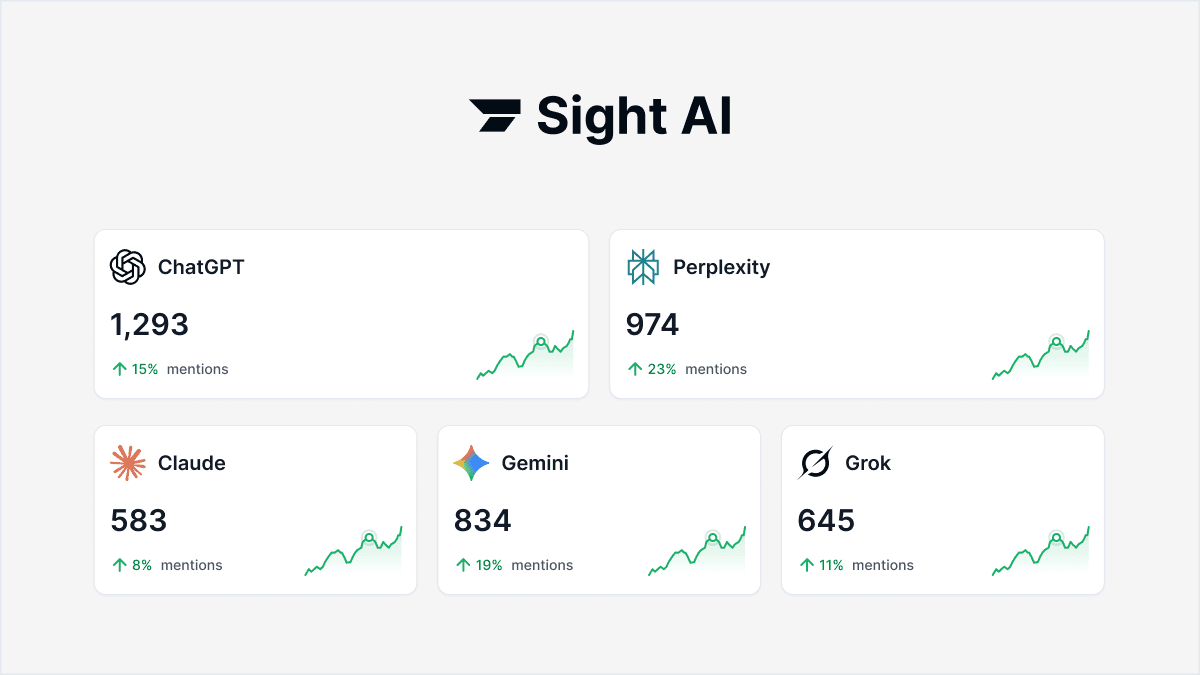
Sight AI is built specifically for this workflow. It tracks your brand mentions across ChatGPT, Claude, Perplexity, and more, delivers an AI Visibility Score with sentiment analysis, surfaces prompt-level data showing exactly where competitors are being cited instead of you, and connects directly to a content generation and indexing system that lets you act on those insights immediately. It's the full loop: track, identify, publish, and measure.
Stop guessing how AI models talk about your brand. Start tracking your AI visibility today and see exactly where your brand appears across top AI platforms — and where it should be appearing but isn't.