When someone asks ChatGPT, Claude, or Perplexity to recommend a project management tool, a marketing platform, or a cybersecurity solution, a handful of brands consistently appear in the response. Others — sometimes better-funded, better-reviewed, or more widely used — don't get a mention at all. If you've ever wondered why your brand isn't showing up, you're not alone. And if you've assumed the answer is simply "more content" or "better SEO," you're working from the wrong playbook.
AI-driven discovery is quietly reshaping how buyers find and evaluate brands. Professionals increasingly turn to AI assistants before they turn to Google, and the brands that surface in those conversations have a significant advantage in the awareness and consideration stages of the buying journey. The challenge is that the selection criteria AI models use are fundamentally different from traditional search ranking signals.
There's no keyword auction. There's no PageRank equivalent you can directly optimize for. Instead, AI models surface brands based on patterns absorbed during training — patterns built from the quality, consistency, and breadth of how a brand appears across the broader information ecosystem. Understanding those patterns is the first step toward influencing them.
This article decodes the core signals that drive AI brand visibility: how language models form brand associations, which content formats carry the most weight, why third-party mentions matter more than most marketers realize, and how to measure and build your presence in AI-generated responses. By the end, you'll have a clear mental model for what's actually happening inside these systems — and a practical framework for doing something about it.
The Invisible Shortlist: Why AI Models Surface Some Brands and Not Others
Here's the foundational thing to understand about how AI language models work: they don't browse the internet in real time when generating a response. When you ask ChatGPT to recommend a tool, it isn't running a live search. It's drawing on patterns encoded during training — associations between concepts, brands, use cases, and quality signals that were absorbed from an enormous corpus of text.
This means that AI brand visibility is, at its core, a function of how prominently and consistently a brand appeared in the text the model was trained on. If your brand was frequently discussed in high-quality, relevant sources during a model's training window, those associations are encoded. If it wasn't, the model simply has no strong signal to draw on — and will default to the brands that do.
Frequency and co-occurrence are critical here. Brands that appear repeatedly alongside relevant category keywords, use cases, and problem descriptions build stronger internal associations within the model. Think of it like this: if a model has seen thousands of articles, forum threads, and reviews that connect a specific brand to "email automation for small businesses," that connection becomes a reliable pattern. The brand gets pulled into responses whenever that pattern is triggered by a user prompt.
But frequency alone isn't enough. Source diversity matters enormously. A brand mentioned thousands of times on its own blog and nowhere else sends a weak signal. A brand mentioned across independent editorial publications, community forums, expert roundups, and review platforms sends a much stronger one. Independent corroboration — the sense that many different, unrelated sources agree on a brand's relevance — is a key driver of how confidently a model associates that brand with a category.
Recency also plays a role, though its influence varies by model. Some AI systems have fixed training cutoffs, meaning very recent content may not yet be reflected in their outputs. Others use retrieval-augmented generation to pull in live web content, making freshness directly relevant. Understanding which type of AI system you're optimizing for shapes which tactics to prioritize.
The practical implication is significant: building AI brand visibility isn't a campaign. It's a long-term investment in the quality and breadth of your information footprint across the sources AI models learn from.
The Four Core Signals That Shape AI Brand Mentions
Once you understand that AI models learn from patterns in training data, the next question becomes: which patterns matter most? There are four core signals that drive whether and how a brand gets mentioned in AI-generated responses.
Training data prominence: This is the most fundamental signal. The volume, quality, and authority of sources in which a brand appears during a model's training window directly shapes how confidently the model associates that brand with a given category. Editorial coverage in respected industry publications, detailed technical documentation, and substantive community discussions all contribute to this signal. Thin coverage — a few press releases and a corporate blog — doesn't move the needle.
Semantic authority: This is subtler but equally important. AI models learn language patterns, not just entity names. A brand that is consistently described using the same terminology, use cases, and problem-solution framing as the queries users ask is more likely to be surfaced when that language appears in a prompt. If your category uses specific vocabulary — "customer data platform," "zero-trust security," "headless CMS" — and your brand is consistently associated with that vocabulary across many sources, you build semantic authority in that space. Brands that speak inconsistently about what they do, or use different language than their buyers, create weaker associations.
Sentiment and credibility signals: AI models are sensitive to how brands are discussed, not just whether they appear. Research in the NLP community has established that language models reflect sentiment patterns present in their training data. Brands associated with positive outcomes, expert endorsements, and credible head-to-head comparisons tend to be favored over those with mixed, thin, or predominantly negative coverage. This isn't about gaming sentiment — it's about earning the kind of coverage that genuinely reflects quality and credibility.
Retrieval-augmented generation (RAG) and real-time sources: For AI tools that use live retrieval — Perplexity being the most prominent example — freshness and indexability become directly relevant. These systems pull current web content to supplement their base model, meaning brands with well-indexed, frequently updated content have a structural advantage. This is where traditional SEO infrastructure (fast indexing, clean site architecture, regular content updates) intersects directly with AI visibility strategy. Tools like IndexNow, which notify search engines and AI crawlers immediately when content is published or updated, become meaningful levers in this context. Understanding how AI models choose information sources is essential for making the most of this signal.
How Content Structure Shapes AI Brand Recall
Not all content influences AI brand associations equally. The structure, format, and clarity of content has a direct impact on how AI models parse and encode brand information — and some formats are dramatically more influential than others.
AI models respond well to entity-rich, structured content. An article that clearly names a brand, defines what it does, connects it to specific problems, and describes concrete outcomes gives the model clean signal to work with. Vague, brand-agnostic content — the kind that discusses a category without naming specific players — doesn't build brand associations. Clarity and specificity are features, not noise.
Listicles, comparison articles, and "best of" roundups are disproportionately influential in shaping AI brand recall. The reason is structural: these formats present brands in the exact way AI models generate recommendation responses. When a model is asked "what's the best tool for X," it tends to produce a structured list with brief descriptions — which mirrors the format it has seen most often when that type of question was answered in its training data. Content that matches the output format AI models use creates a feedback loop that reinforces brand visibility.
This is one of the core insights behind Generative Engine Optimization (GEO) — an emerging discipline focused on optimizing content specifically for AI-generated responses rather than traditional search rankings. GEO treats AI models as the audience, not just search engine crawlers. The principles are distinct: entity clarity (is the brand unambiguously named and defined?), semantic consistency (does the content use the language patterns associated with the category?), and structured formatting (are headings, comparisons, and outcomes clearly organized?). Applying these principles is at the heart of optimizing content for AI models effectively.
Schema markup and consistent brand naming across a site also improve how AI retrieval systems attribute content to a specific brand entity. If your brand name appears in multiple variations across your site — abbreviated here, spelled out there, using a tagline in one place and a category descriptor in another — you create ambiguity that weakens the signal. Consistency in how you name and describe your brand across all content is a basic but frequently overlooked GEO principle.
The practical takeaway: audit your existing content through the lens of entity clarity. Does each key article clearly establish what your brand is, what problem it solves, and who it's for? If not, that's a gap worth closing before investing in volume.
The Role of Third-Party Mentions and Digital Footprint
Your own website content is one input into AI brand associations — but it's far from the most powerful one. Third-party mentions carry significant weight precisely because they represent independent corroboration. When multiple unrelated sources describe your brand in consistent terms, the signal is much stronger than anything you can generate through owned channels alone.
The types of third-party content that matter most include: editorial coverage in industry publications, expert roundups and comparison guides, review aggregator profiles, community forum discussions, Q&A threads, and social commentary from credible voices in your space. These aren't just distribution channels — they're inputs into the information ecosystem that AI models learn from.
Community-driven platforms deserve particular attention. Forums, Q&A sites, and review aggregators are well-represented in the training data of many large language models. Organic brand advocacy in these channels — genuine users recommending your product in context, answering questions where your tool is relevant, or participating in category discussions — has outsized influence on AI brand recall. This isn't about astroturfing or manufactured reviews. It's about ensuring your brand is present in the conversations that actually happen in your category. Brands that neglect this layer often find themselves asking why AI models ignore their business entirely.
LinkedIn posts, technical blog posts from practitioners, and mentions in industry newsletters also contribute to a brand's digital footprint. The breadth of this footprint — appearing consistently across multiple distinct content types and platforms — signals to AI models that a brand is a legitimate, established player. A brand that appears only on its own site and in paid placements looks thin by comparison.
The strategic implication is that AI visibility is partly a PR and community challenge, not just a content marketing one. Earning coverage, building relationships with practitioners and analysts who write about your category, and maintaining an active presence in community spaces are all investments in the third-party signal layer that AI models weight heavily.
One useful mental model: think of your brand's AI visibility as the sum of what independent sources say about you, not what you say about yourself. That reframe changes the priority stack considerably.
Measuring and Tracking Your AI Brand Visibility
Here's a challenge that many marketers are only beginning to grapple with: AI brand mentions aren't captured in standard analytics. Your Google Search Console data tells you nothing about whether ChatGPT is recommending your brand. Your CRM attribution model doesn't flag when a prospect discovered you through a Perplexity query. The measurement infrastructure most teams rely on is blind to this entire channel.
Building an AI visibility strategy without measurement is like running paid search without impression data. You can spend effort, but you can't optimize because you don't know what's working. Purpose-built tracking tools that systematically query AI models with relevant prompts — and record whether and how your brand is mentioned — are the foundation of any serious AI visibility program. Learning how to track brand mentions in AI models is the essential first step for any team serious about this channel.
The key metrics worth monitoring include: mention frequency across AI platforms (how often does your brand appear when relevant prompts are submitted?), sentiment of mentions (is your brand described positively, neutrally, or with caveats?), which specific prompts trigger brand surfacing (what questions or use cases does your brand get associated with?), and how your brand is described relative to competitors (what language does the model use, and does it match how you want to be positioned?).
This last metric is particularly valuable. AI models don't just mention brands — they describe them. The language a model uses when surfacing your brand tells you a great deal about how your brand is encoded in its training data. If the model consistently describes you in terms you don't use yourself, or positions you in a category adjacent to where you actually compete, that's a signal gap worth addressing through content and positioning work. Tools designed to monitor brand mentions across AI platforms make this kind of analysis systematic rather than ad hoc.
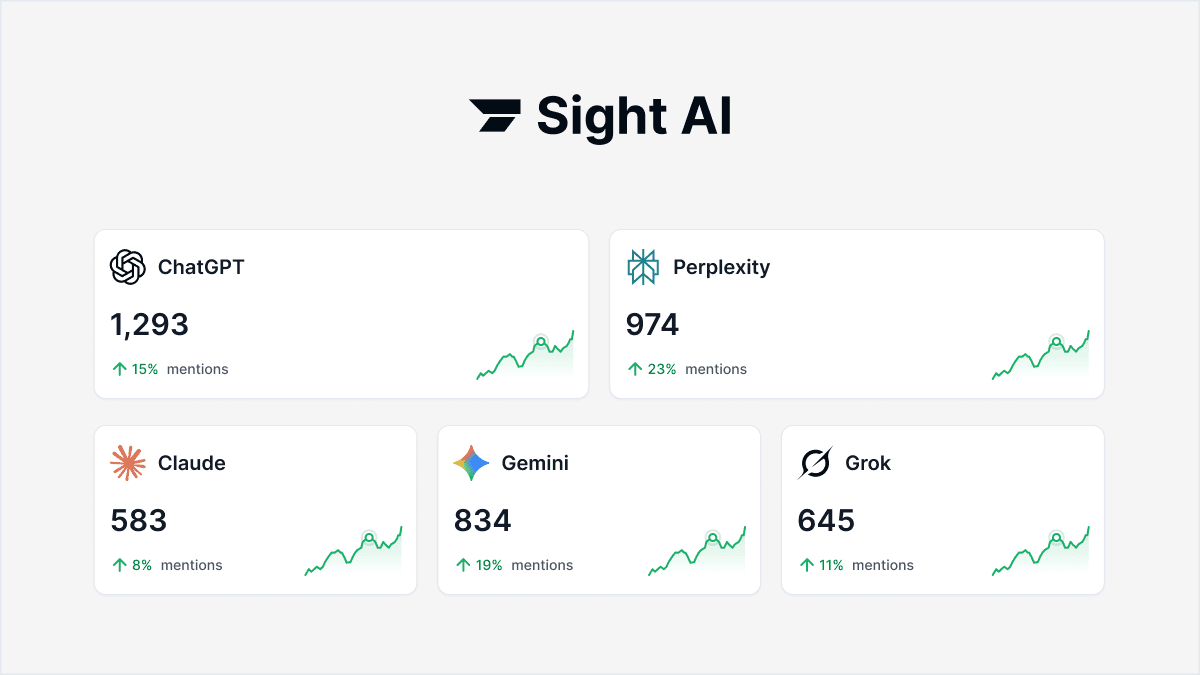
Sight AI is built specifically for this measurement challenge. It provides an AI Visibility Score with sentiment analysis and prompt tracking across multiple AI models, including ChatGPT, Claude, Perplexity, and others. Rather than manually querying AI tools and logging results in a spreadsheet, Sight AI automates the tracking layer — giving marketers and founders a structured data view of where their brand appears, how it's described, and where the gaps are. That data layer is what makes it possible to move from guessing to optimizing.
Building a Strategy to Get Mentioned by AI Models
With the signal framework clear and measurement in place, the strategic question becomes: how do you actually improve your AI brand visibility over time? The answer sits at the intersection of content strategy, distribution, and digital footprint development.
On the content side, the priority is creating high-quality, entity-clear articles that use the exact language patterns associated with your category. Explainers that define what your brand does and for whom, guides that connect your product to specific use cases and outcomes, and comparison pieces that position your brand within the competitive landscape are all high-value formats. These aren't just good SEO — they're the inputs AI models use to form and reinforce brand associations. Ensuring this content is properly indexed and discoverable by AI retrieval systems matters too: tools with IndexNow integration can accelerate how quickly new content is picked up by both search engines and AI retrieval layers. A strong foundation in improving web indexing directly supports this goal.
On the distribution side, earning third-party mentions requires a deliberate outreach strategy. Contributing bylines to industry publications, participating substantively in community forums where your category is discussed, building relationships with analysts and practitioners who write about your space, and generating authentic user advocacy in review platforms all contribute to the independent corroboration signal that AI models weight heavily. This work doesn't produce overnight results — but it compounds. Each new independent mention adds to the signal layer, and that signal layer shapes AI outputs for the duration of a model's training window. For a comprehensive view of tactics, exploring the best ways to get mentioned by AI can sharpen your approach considerably.
Treat AI visibility as a compounding asset, not a campaign. The brands investing now in training-data-friendly content and a broad digital footprint are building a structural advantage that will be increasingly difficult for late movers to close. AI-driven discovery is not a future trend to monitor — it's a present reality that's already influencing how buyers form awareness and make decisions. The question isn't whether to build an AI visibility strategy. It's how quickly you can start building one that's grounded in data rather than guesswork.
The good news is that the same content investments that build AI visibility also strengthen traditional SEO, brand authority, and thought leadership. This isn't a zero-sum reallocation of resources. It's an extension of the content and distribution work that already drives organic growth — executed with the specific signals AI models respond to in mind.
Putting It All Together
AI models don't choose brands arbitrarily. They surface brands that have built clear, consistent, and credible signal across the sources they learn from. That signal is shaped by training data prominence, semantic authority, sentiment and credibility, and — for retrieval-augmented systems — content freshness and indexability. It's reinforced by third-party mentions across diverse, independent platforms, and it's encoded through structured, entity-clear content that speaks the language of your category.
The action framework is straightforward, even if the execution takes sustained effort. Understand which signals drive AI brand mentions. Audit your current AI visibility to know where you stand and where the gaps are. Create content that establishes clear brand-category associations using the language your buyers and AI models share. Build the third-party footprint that makes your brand a trusted, frequently-referenced player in your space.
And measure all of it. The marketers and founders who will win in AI-driven discovery are the ones who stop treating AI visibility as an abstract concept and start tracking it with the same rigor they apply to search rankings and paid performance.
Stop guessing how AI models like ChatGPT and Claude talk about your brand. Start tracking your AI visibility today and see exactly where your brand appears across top AI platforms — with sentiment analysis, prompt tracking, and the content tools to close the gaps you find.