Enterprise content teams face a scaling paradox: demand for quality content grows exponentially while resources remain finite. Manual workflows that worked at startup scale become bottlenecks when you're managing hundreds of pages, multiple brands, and cross-functional stakeholders. Enterprise content automation tools solve this by handling repetitive tasks—drafting, scheduling, indexing, distribution—while your team focuses on strategy and creativity.
This guide evaluates top platforms built for enterprise-scale content operations, from AI-powered writing assistants to workflow orchestration systems. We've prioritized tools that integrate with existing tech stacks, offer robust governance features, and deliver measurable ROI for organizations producing content at scale. Here are the best enterprise content automation tools available today.
1. Sight AI
Best for: Teams optimizing content for both traditional SEO and emerging AI search platforms
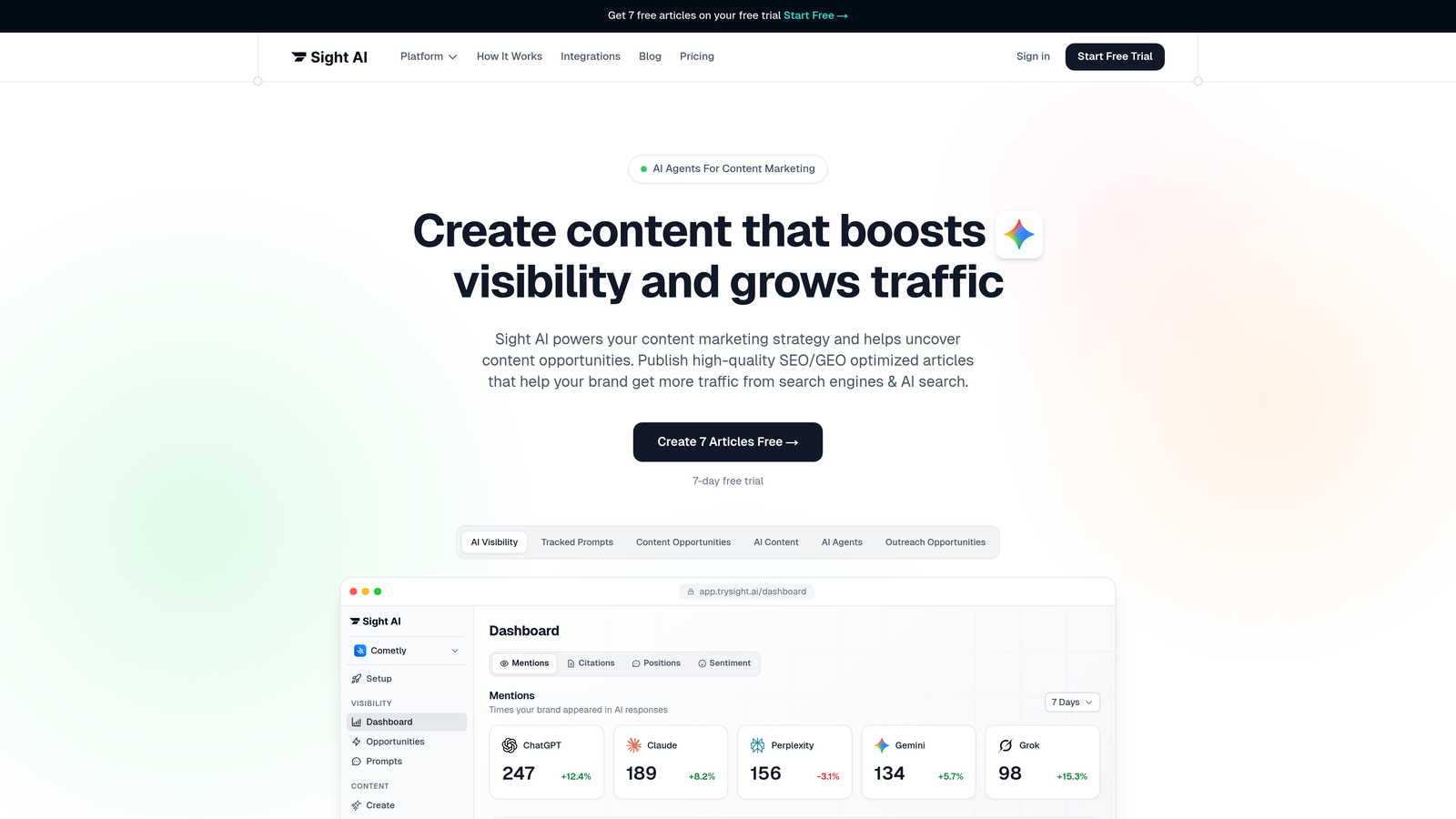
Sight AI combines AI-powered content generation with visibility tracking across major AI models and automated indexing infrastructure.
Where This Tool Shines
What sets Sight AI apart is its dual focus on content creation and AI visibility monitoring. While most platforms stop at content generation, this tool tracks how AI models like ChatGPT, Claude, and Perplexity mention your brand across different prompts and queries.
The platform's 13+ specialized AI agents handle different content formats—listicles, guides, explainers—with built-in optimization for both search engines and generative AI platforms. This addresses the growing challenge of getting your brand mentioned in AI-generated responses, not just traditional search results.
Key Features
AI Visibility Tracking: Monitor brand mentions across six major AI platforms with sentiment analysis and prompt tracking.
Specialized Content Agents: 13+ AI agents trained for specific content types with Autopilot mode for hands-off production.
IndexNow Integration: Automatic content indexing for faster discovery by search engines and AI crawlers.
CMS Auto-Publishing: Direct publishing capabilities to eliminate manual content deployment steps.
SEO/GEO Optimization: Content optimized for both traditional search engine optimization and generative engine optimization.
Best For
Marketing teams at tech companies and SaaS businesses where AI visibility matters as much as traditional search rankings. Particularly valuable for brands competing in categories where prospects increasingly use AI assistants for research and recommendations.
Pricing
Contact for enterprise pricing with custom packages based on content volume and team size.
2. Adobe Experience Manager
Best for: Large enterprises needing comprehensive digital experience management with deep asset integration
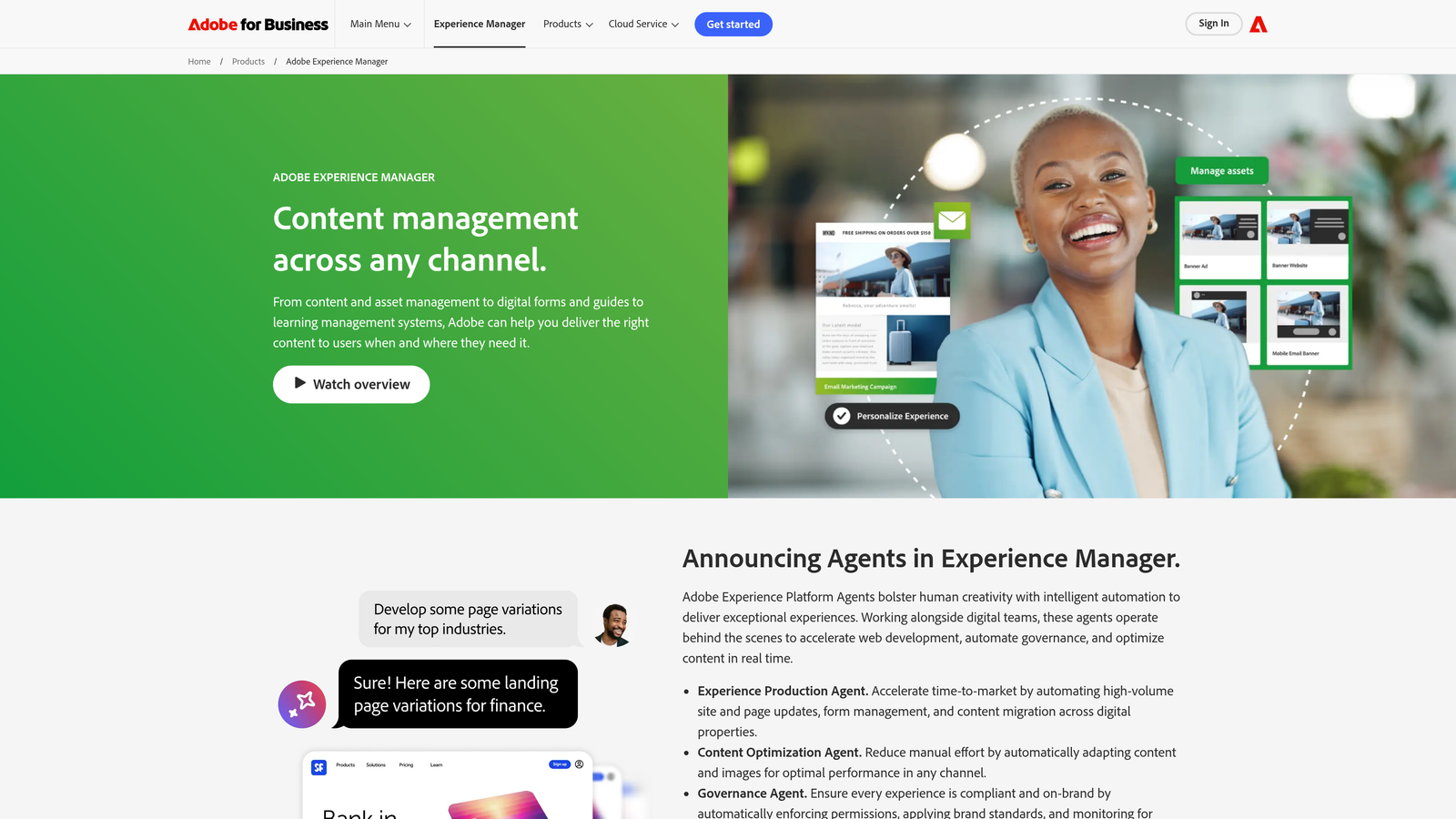
Adobe Experience Manager is an enterprise-grade content management system combining AI-assisted authoring with omnichannel delivery.
Where This Tool Shines
Adobe's platform excels in complex digital ecosystems where content, assets, and experiences must work seamlessly across web, mobile, and emerging channels. The integrated digital asset management system means your content teams can access millions of images, videos, and documents without switching platforms.
Adobe Sensei AI powers intelligent features like auto-tagging, content recommendations, and predictive analytics. The headless architecture lets developers build custom front-ends while marketers manage content through familiar interfaces.
Key Features
Hybrid CMS Architecture: Support for both traditional and headless content delivery models.
Adobe Sensei AI: Machine learning for content intelligence, auto-tagging, and personalization.
Integrated DAM: Native digital asset management eliminating the need for separate systems.
Experience Fragments: Reusable content components that maintain consistency across channels.
Cloud-Native Scalability: Infrastructure that handles traffic spikes and global content delivery.
Best For
Fortune 500 companies and large enterprises with complex content needs spanning multiple brands, regions, and channels. Best suited for organizations already invested in Adobe's ecosystem or requiring enterprise-grade digital asset management.
Pricing
Custom enterprise pricing typically starting at $100,000+ annually depending on features and scale.
3. Contentful
Best for: Developer-led organizations building composable content architectures across multiple applications
Contentful is an API-first content platform enabling flexible content architecture for enterprises managing omnichannel experiences.
Where This Tool Shines
Contentful's composable approach lets technical teams build exactly the content infrastructure they need. The platform treats content as data, making it easy to deliver the same content to websites, mobile apps, IoT devices, and any future channel.
Development teams appreciate the powerful APIs and webhooks that integrate content workflows into existing systems. Marketers get visual editing interfaces and workflow automation without needing developer assistance for routine tasks.
Key Features
Composable Architecture: Build custom content models that match your business logic and requirements.
Developer-Friendly APIs: RESTful and GraphQL APIs with comprehensive documentation and SDKs.
Content Modeling Flexibility: Create relationships between content types without database constraints.
Workflow Automation: Schedule content, set approval processes, and automate publishing across channels.
Enterprise Security: SSO, role-based permissions, and compliance certifications for regulated industries.
Best For
Tech-forward enterprises with strong development teams building custom digital experiences. Ideal for companies managing content across multiple applications, brands, or international markets requiring localization at scale.
Pricing
Enterprise plans start around $3,000 per month with custom pricing for large-scale deployments.
4. Jasper
Best for: Marketing teams producing high volumes of AI-generated content with brand consistency requirements
Jasper is an AI content platform built specifically for enterprise marketing with brand voice training and team collaboration.
Where This Tool Shines
Jasper addresses a critical enterprise challenge: maintaining brand voice consistency when multiple team members use AI to generate content. The platform learns your brand's style guide, approved messaging, and tone preferences, then applies them automatically to every piece of content.
Team workspaces with approval workflows mean junior marketers can draft with AI while senior team members review before publishing. The knowledge base integration lets you feed company-specific information into the AI, reducing generic outputs.
Key Features
Brand Voice Training: AI learns and enforces your specific tone, style, and messaging guidelines.
Multi-Format Generation: Create blog posts, social media, emails, and ad copy from a single platform.
Team Collaboration: Shared workspaces with commenting, version history, and approval workflows.
Knowledge Base Integration: Feed proprietary information into AI to improve output relevance and accuracy.
API Access: Build custom integrations connecting Jasper to your marketing technology stack.
Best For
Mid-market to enterprise marketing teams producing dozens of content pieces weekly across multiple formats. Particularly valuable for organizations with distributed teams needing centralized brand control.
Pricing
Business plans start at $125 per month per seat with enterprise pricing available for larger teams.
5. Acrolinx
Best for: Regulated industries requiring content compliance, terminology consistency, and editorial governance
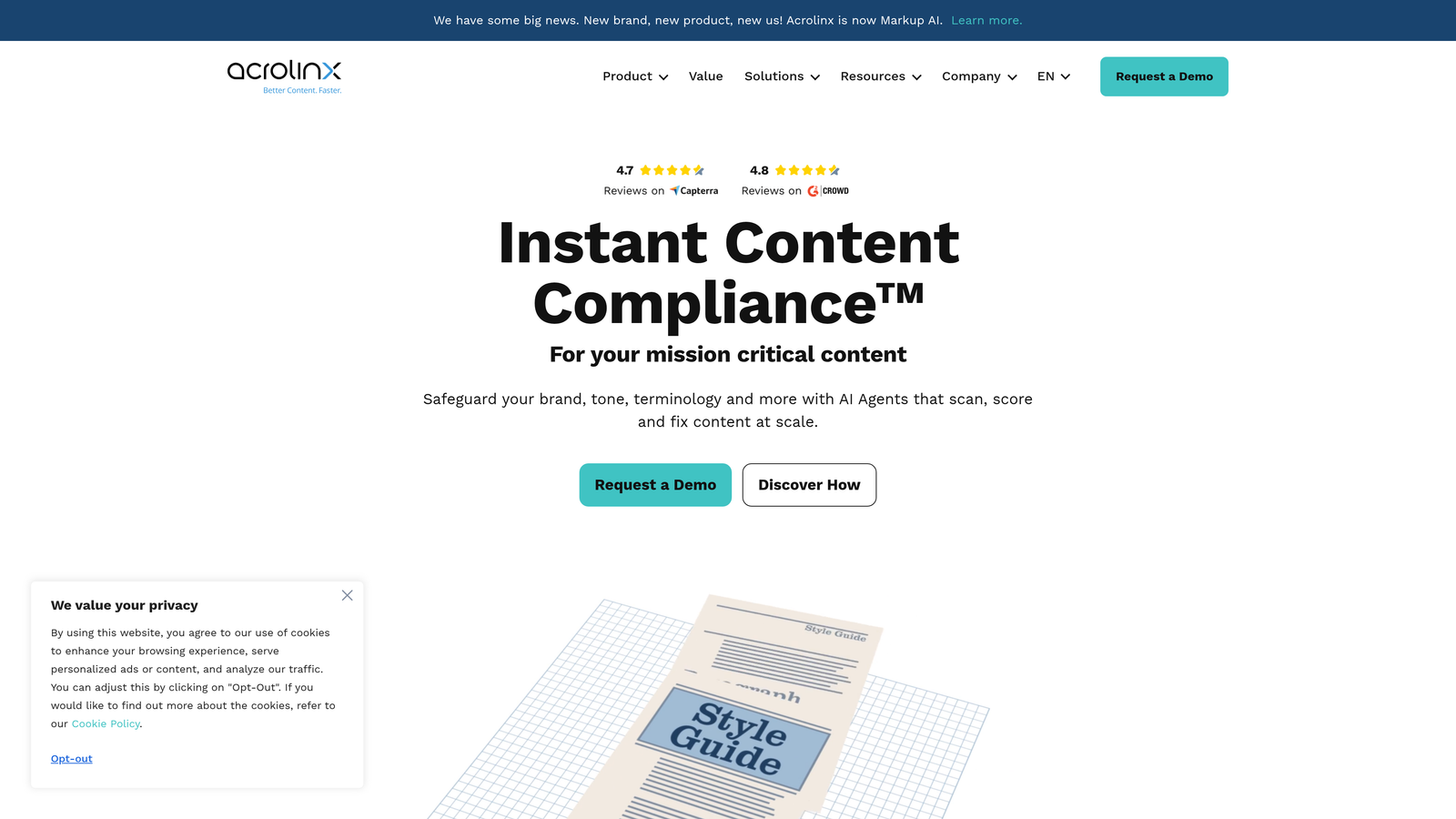
Acrolinx is an AI-powered content governance platform ensuring brand consistency and regulatory compliance across enterprise content.
Where This Tool Shines
Acrolinx acts as a real-time editorial assistant integrated directly into the tools your writers already use. As content gets created in Microsoft Word, Google Docs, or your CMS, the platform provides instant feedback on terminology usage, brand alignment, and readability.
For regulated industries like healthcare, finance, and manufacturing, Acrolinx enforces terminology standards and compliance requirements automatically. The platform's scoring system quantifies content quality, giving teams measurable improvement metrics.
Key Features
Real-Time Editorial Guidance: Instant feedback on style, tone, terminology, and readability as writers work.
Terminology Management: Centralized control of approved terms, forbidden phrases, and industry-specific language.
Content Analytics: Quality scoring and analytics showing improvement trends across teams and content types.
50+ Tool Integrations: Works inside Microsoft Office, Google Workspace, major CMS platforms, and authoring tools.
Compliance Support: Enforce regulatory requirements and audit trails for industries with strict content governance needs.
Best For
Large enterprises in healthcare, financial services, manufacturing, and other regulated industries where content mistakes carry legal or safety risks. Also valuable for global brands maintaining consistency across multiple markets and languages.
Pricing
Custom enterprise pricing based on number of users and content volume with annual contracts.
6. Writer
Best for: Security-conscious enterprises needing custom AI models trained on proprietary content
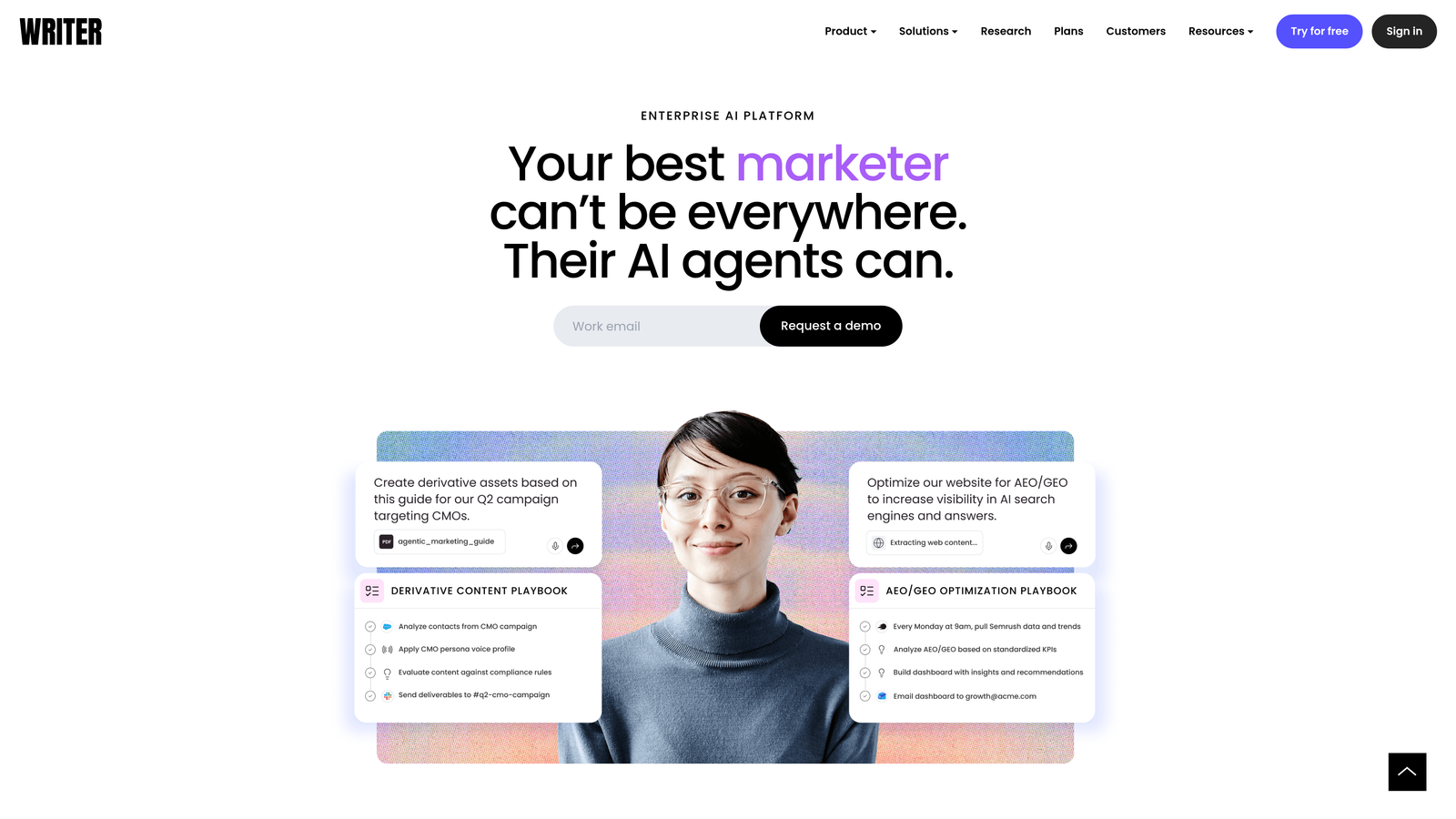
Writer is an enterprise AI writing platform with custom model training and security-first architecture for sensitive content.
Where This Tool Shines
Writer's differentiator is its Palmyra LLM, which can be trained exclusively on your company's content without exposing data to third-party models. This matters for enterprises handling sensitive information or operating in industries where data privacy is non-negotiable.
The platform enforces style guides and terminology automatically while writers work. Browser extensions and app integrations mean teams get AI assistance wherever they create content, from email to documentation to marketing materials.
Key Features
Custom AI Models: Train models on your proprietary content for outputs matching your specific domain expertise.
Palmyra LLM: Enterprise-grade language model with SOC 2 Type II and HIPAA compliance certifications.
Style Enforcement: Automatically apply brand voice, terminology standards, and editorial guidelines to AI outputs.
Universal Integration: Browser extensions and integrations working across email, documents, CMS, and collaboration tools.
Security Certifications: Full compliance with enterprise security requirements including data residency options.
Best For
Healthcare organizations, financial institutions, legal firms, and enterprises in regulated industries requiring custom AI models with strict data governance. Also suitable for companies with highly specialized domain knowledge needing AI trained on proprietary information.
Pricing
Enterprise plans start around $18 per user per month with custom pricing for large deployments and custom model training.
7. Kapost (Upland)
Best for: Content operations teams orchestrating planning, production, and performance tracking across multiple stakeholders
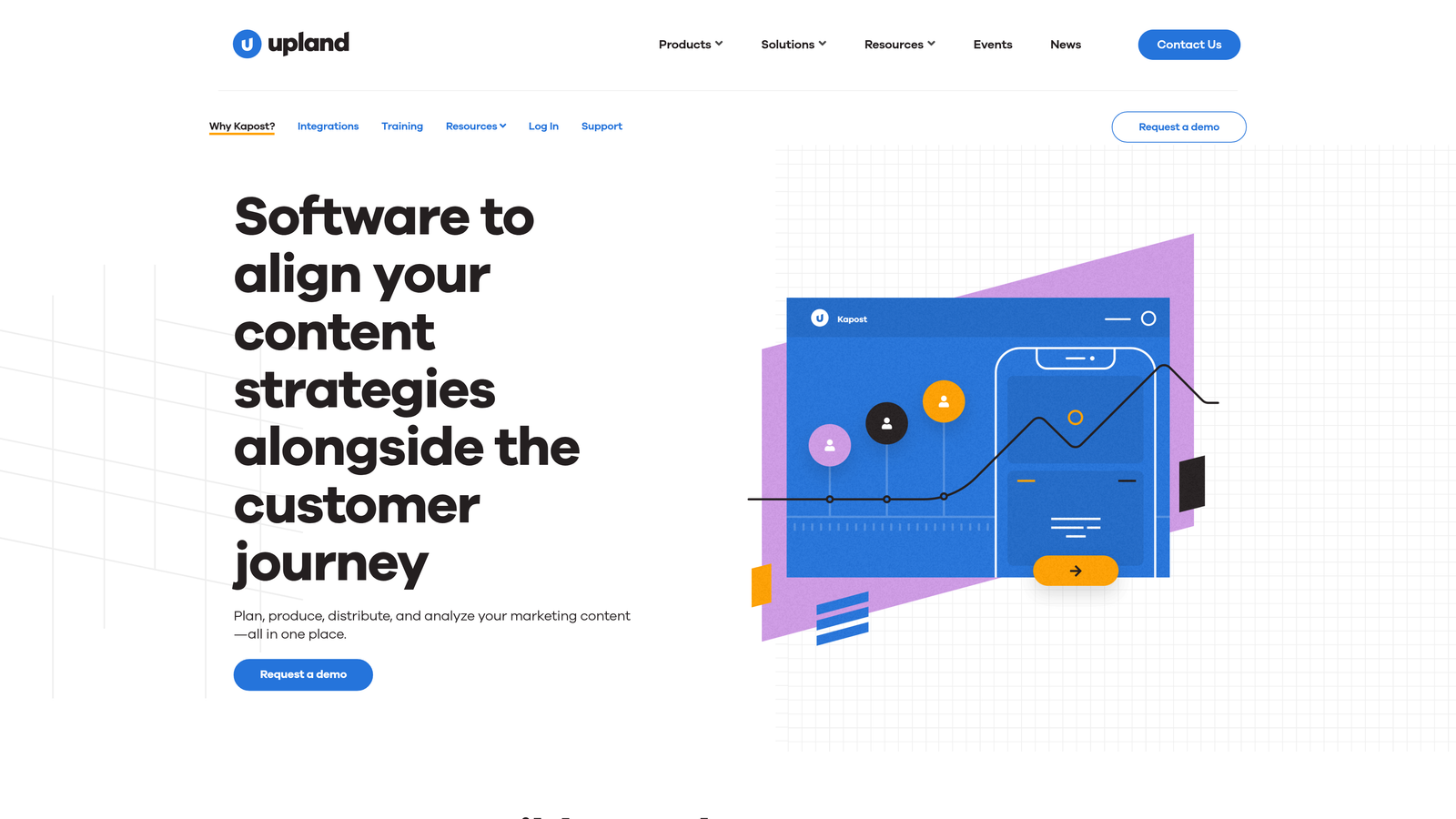
Kapost is a content operations platform managing the entire content lifecycle from ideation through distribution and analysis.
Where This Tool Shines
Kapost solves the coordination challenge that emerges when content operations scale beyond a handful of people. The platform provides visibility into what every team member is working on, where bottlenecks exist, and which content types drive the best results.
Content calendars integrate with task management, so deadlines automatically create assignments for writers, editors, designers, and approvers. Integration with marketing automation platforms means you can track how content performs after publication, closing the loop between production and results.
Key Features
Content Calendar: Visual planning tools showing all content across teams, channels, and campaigns.
Workflow Automation: Automated task creation, assignments, and notifications based on content status changes.
Team Collaboration: Centralized communication, file sharing, and feedback tools eliminating email chains.
Performance Analytics: Track content effectiveness with metrics from traffic to conversions to revenue impact.
Marketing Integration: Connect with HubSpot, Marketo, Salesforce, and other martech platforms for end-to-end visibility.
Best For
Enterprise marketing organizations with 10+ content contributors spread across multiple teams, brands, or regions. Most valuable when coordination overhead consumes significant time and content production velocity suffers from unclear ownership.
Pricing
Custom pricing based on team size and feature requirements with annual contracts typical.
8. Sitecore Content Hub
Best for: Enterprises unifying content management, digital assets, and marketing operations in a single platform
Sitecore Content Hub combines content management, digital asset management, and marketing resource management for comprehensive content operations.
Where This Tool Shines
Sitecore eliminates the inefficiency of managing content in one system, assets in another, and marketing projects in a third. The unified platform means a campaign brief, creative assets, and published content all live in the same ecosystem with connected workflows.
AI-powered tagging and organization automatically categorize assets as they're uploaded, making it easy to find the right image or video when creating content. Content lifecycle management ensures nothing gets published without proper approvals or remains live past its expiration date.
Key Features
Centralized DAM: Single repository for all digital assets with AI-powered organization and search.
AI Tagging: Automatic metadata generation and categorization for uploaded assets.
Content Lifecycle: Manage content from creation through publication, updates, and archival with audit trails.
Marketing Project Management: Plan and track campaigns with integrated content and asset workflows.
Omnichannel Delivery: Distribute content to web, mobile, email, and emerging channels from a single source.
Best For
Large enterprises with extensive digital asset libraries managing content across multiple brands, regions, and channels. Particularly valuable for organizations currently using separate systems for CMS, DAM, and project management seeking consolidation.
Pricing
Enterprise pricing typically starting at $50,000+ annually depending on modules and scale.
9. Seismic
Best for: B2B sales organizations automating content delivery and tracking engagement with sales materials
Seismic is a sales enablement platform automating content recommendations and delivery with analytics on buyer engagement.
Where This Tool Shines
Seismic bridges the gap between marketing content creation and sales content usage. The platform uses AI to recommend the right content for each sales conversation based on buyer industry, stage, and previous engagement patterns.
Sales teams get personalized content delivery without digging through shared drives or asking marketing for materials. Marketing teams see which content actually gets used in deals and which sits unused, informing future content investments.
Key Features
AI Content Recommendations: Suggest relevant materials based on deal characteristics and historical effectiveness.
Sales Content Automation: Automatically personalize presentations, proposals, and collateral for specific prospects.
Engagement Analytics: Track which content buyers open, read, and share with colleagues.
CRM Integration: Connect with Salesforce, Microsoft Dynamics, and other CRMs for seamless workflow.
Learning Modules: Built-in training and coaching to ensure sales teams use content effectively.
Best For
B2B enterprises with complex sales processes requiring extensive content support. Most valuable for organizations where sales and marketing alignment around content remains a persistent challenge.
Pricing
Custom enterprise pricing based on number of users and selected modules with annual contracts.
Choosing the Right Platform for Your Enterprise
Your ideal solution depends on your primary bottleneck. Choose Sight AI if AI visibility and SEO/GEO optimization are priorities alongside content generation. Go with Adobe Experience Manager or Sitecore for complex digital ecosystems requiring deep asset management integration.
Select Contentful for developer-led, API-first architectures where flexibility matters more than out-of-the-box features. Pick Jasper or Writer for high-volume AI content generation with brand controls—Writer if security and custom models are critical, Jasper for broader team collaboration.
Consider Acrolinx for regulated industries needing compliance guardrails and terminology enforcement. Evaluate Kapost for content operations orchestration when coordination overhead slows production. Choose Seismic when sales-marketing content alignment represents your biggest challenge.
Most enterprises benefit from combining two to three tools rather than seeking an all-in-one solution. A common pattern pairs a content generation platform with a management system and a governance layer. Start with your biggest bottleneck—whether that's production speed, brand consistency, or visibility into performance—and expand from there.
The convergence of traditional content management with AI capabilities continues accelerating. Platforms that once focused purely on storage and delivery now incorporate generation features. Tools that started as writing assistants now offer publishing and distribution. This trend suggests the lines between categories will blur further, making integration capabilities increasingly important in your selection criteria.
Start tracking your AI visibility today and see exactly where your brand appears across top AI platforms. Stop guessing how AI models like ChatGPT and Claude talk about your brand—get visibility into every mention, track content opportunities, and automate your path to organic traffic growth.