Content strategy automation has moved from a nice-to-have to a competitive necessity. Between identifying what to write, producing optimized drafts, publishing at scale, and tracking how your brand appears across AI search engines like ChatGPT and Perplexity, the manual workload is simply unsustainable for most marketing teams.
The right automation software collapses that workflow into a system that runs with minimal intervention, freeing your team to focus on strategy rather than execution. This list covers the best content strategy automation platforms available in 2026, evaluated on their ability to handle the full content lifecycle: discovery, creation, publishing, and performance tracking.
Whether you're a solo founder, an in-house marketer, or an agency managing dozens of clients, there's a tool here built for your workflow. We've limited this list to platforms with genuine automation depth — not just AI writing assistants with a scheduling button bolted on.
1. Sight AI
Best for: Marketers and agencies who want a single platform covering content creation, publishing, and AI visibility tracking.
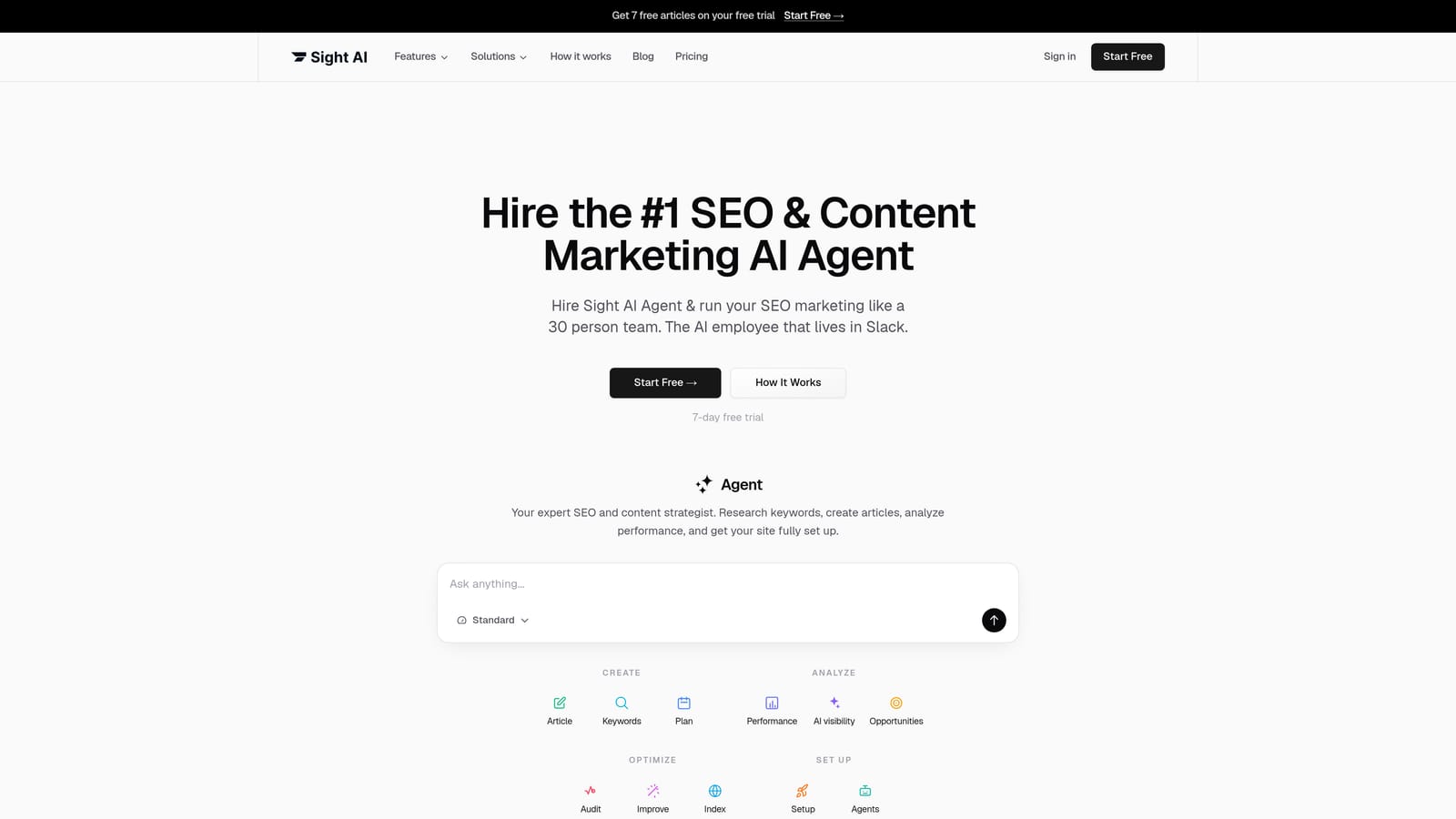
Sight AI is an all-in-one content strategy automation platform combining AI visibility tracking, specialized writing agents, automated indexing, and CMS auto-publishing in a single workflow.
Where This Tool Shines
Most content platforms stop at generation. Sight AI goes further by closing the loop between what you publish and how AI models like ChatGPT, Claude, and Perplexity actually talk about your brand. That combination of creation and monitoring is rare, and it matters more as AI-generated answers become a primary discovery channel for many audiences.
The Autopilot Mode is particularly useful for teams stretched thin. Rather than manually triggering each step of the content workflow, you can configure pipelines that generate, optimize, and publish content with minimal intervention. For agencies managing multiple clients or founders running lean, this kind of hands-free operation is genuinely valuable.
Key Features
AI Visibility Score: Tracks how your brand is mentioned across ChatGPT, Claude, Perplexity, and three or more additional AI platforms, with sentiment analysis to show whether mentions are positive, neutral, or negative.
13+ Specialized AI Writing Agents: Purpose-built agents for listicles, guides, explainers, and other content formats, each tuned for SEO and GEO optimization rather than generic output.
Autopilot Mode: Enables hands-free content generation and publishing, configurable to run on a schedule without manual intervention at each step.
IndexNow Integration: Automatically notifies search engines of new content via IndexNow, accelerating discovery and reducing the lag between publication and indexing.
Prompt Tracking: Lets you define specific queries and monitor how AI models respond to them over time, surfacing patterns in brand mention frequency and framing.
Best For
Sight AI is best suited for marketers, founders, and agencies who are actively investing in both traditional SEO and Generative Engine Optimization (GEO). If you're managing content at volume and want visibility into how AI models represent your brand, this platform is built around that exact use case.
Pricing
Tiered plans are available with a free trial offered. Visit trysight.ai for current plan details and pricing tiers.
2. Writesonic
Best for: Content teams needing high-volume production across multiple formats with SEO baked in.
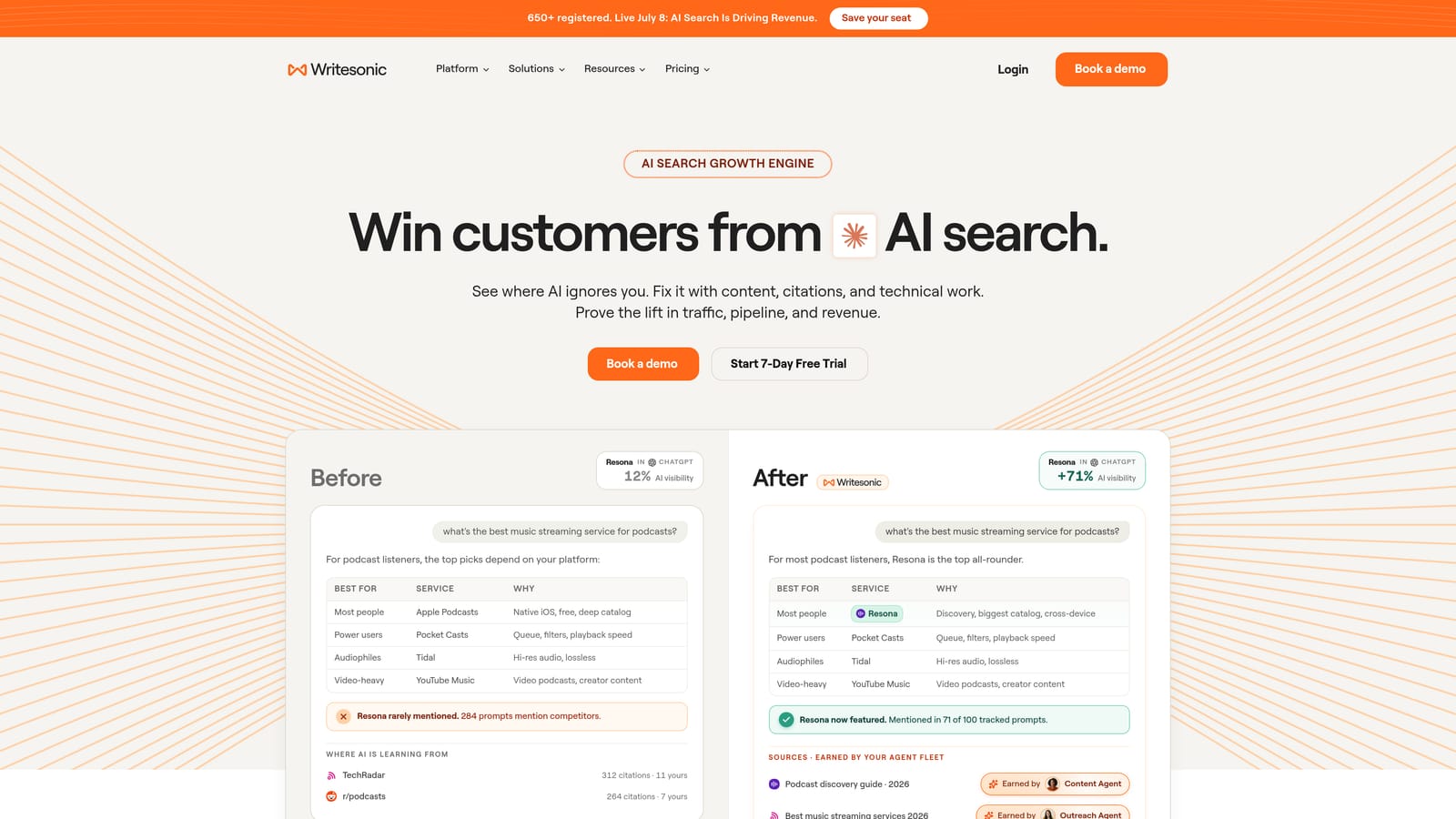
Writesonic is a high-volume AI content generation platform with broad format support, keyword-targeted SEO output, and team collaboration tools built for scale.
Where This Tool Shines
Writesonic has built a strong reputation for format versatility. Beyond long-form blog content, it handles ad copy, product descriptions, social posts, and landing page text from the same platform. For content teams that need to feed multiple channels simultaneously, that breadth reduces the number of tools in the stack.
The SEO mode integrates keyword targeting directly into the generation workflow, which helps teams produce content that's already oriented toward search intent rather than requiring heavy post-generation editing. The Chatsonic assistant also functions as a useful research companion when you're scoping topics or exploring angles before drafting.
Key Features
SEO-Optimized Article Generation: Incorporates keyword targeting into the drafting process, producing content aligned with search intent from the start.
Multi-Format Support: Covers blog posts, ad copy, product descriptions, social media content, and more from a single platform.
Brand Voice Customization: Lets teams define tone and style guidelines so AI output stays consistent with existing brand standards.
Chatsonic AI Assistant: A conversational research tool for exploring topics, generating outlines, and iterating on content ideas before committing to a full draft.
CMS and Marketing Integrations: Connects with popular platforms to reduce manual copy-paste steps between generation and publishing.
Best For
Writesonic is a strong fit for content teams running high-volume production across multiple channels. It's particularly useful when you need consistent brand voice at scale across formats beyond just long-form articles.
Pricing
A free plan is available; paid plans scale by features and usage volume. Visit writesonic.com for current rates and plan comparisons.
3. AirOps
Best for: Content operations teams that need custom AI workflows without relying on engineering resources.
AirOps is a no-code AI workflow builder that lets marketing and content teams create repeatable automation pipelines connecting AI models, data sources, and publishing tools.
Where This Tool Shines
AirOps sits in an interesting position: it's less of a content generator and more of an orchestration layer. Think of it like building custom assembly lines for content operations, where you define each step, connect the inputs and outputs, and then run the workflow repeatedly without rebuilding it each time. For agencies or ops-focused teams managing complex, multi-step content processes, that flexibility is hard to replicate with off-the-shelf tools.
The no-code visual builder is the key differentiator here. Teams that previously needed developer support to build content automation pipelines can now configure and iterate on those workflows independently. That autonomy meaningfully reduces the cost and lead time of building new content operations.
Key Features
Visual Workflow Builder: A drag-and-drop interface for designing custom AI content pipelines without writing code.
Multi-LLM Connectivity: Connects to multiple AI models and external data sources within a single workflow, allowing teams to route tasks to the most appropriate model.
Repeatable Workflow Templates: A library of pre-built templates for common content strategy use cases, reducing setup time for standard operations.
API and CMS Integrations: Supports end-to-end automation by connecting generation steps directly to publishing destinations.
Scalable for Teams: Designed for content operations teams that need to run the same workflows consistently across large volumes of content or multiple client accounts.
Best For
AirOps is best suited for agencies and operations-focused teams that need custom automation logic rather than a pre-packaged content workflow. If your content process has unique steps or integrations that generic tools don't accommodate, AirOps gives you the flexibility to build exactly what you need.
Pricing
Usage-based and team plans are available. Visit airops.com for current pricing details.
4. Profound
Best for: Enterprise marketing teams tracking brand visibility and share-of-voice across AI-generated search results.
Profound is an AI search visibility platform that monitors how brands appear in LLM-generated answers, with competitive share-of-voice analysis built for enterprise marketing teams investing in GEO.

Where This Tool Shines
Profound is purpose-built for a specific and increasingly important question: when someone asks an AI model about your industry, does your brand show up? And when it does, how does it compare to competitors? That framing makes it distinctly useful for teams that have moved beyond wondering whether GEO matters and are now trying to measure and improve their position systematically.
The competitive share-of-voice data is particularly valuable for enterprise teams that need to report on AI visibility alongside traditional search metrics. Rather than anecdotal checks of AI responses, Profound provides structured data on mention frequency and trends over time across multiple AI platforms.
Key Features
Brand Visibility Tracking: Monitors how your brand appears in AI-generated responses across major LLMs, providing structured data rather than one-off checks.
Competitive Share-of-Voice Analysis: Benchmarks your brand's presence in AI answers against named competitors, giving context to raw mention data.
Query Monitoring: Tracks specific industry queries across multiple AI models to identify where your brand is and isn't being referenced.
Enterprise Reporting Dashboards: Provides structured reporting outputs suited to teams presenting AI visibility data to stakeholders.
Trend Tracking: Monitors changes in brand mention frequency over time, helping teams identify whether their GEO efforts are moving the needle.
Best For
Profound is best suited for mid-market and enterprise marketing teams that have dedicated budget for AI visibility measurement and need reporting-grade data on competitive positioning in AI search. It's less suited for small teams or those just beginning to explore GEO.
Pricing
Enterprise pricing is available on request. Visit profound.co for details on accessing a demo or pricing conversation.
5. Peec
Best for: Teams auditing brand presence and competitive positioning within AI-generated search results.
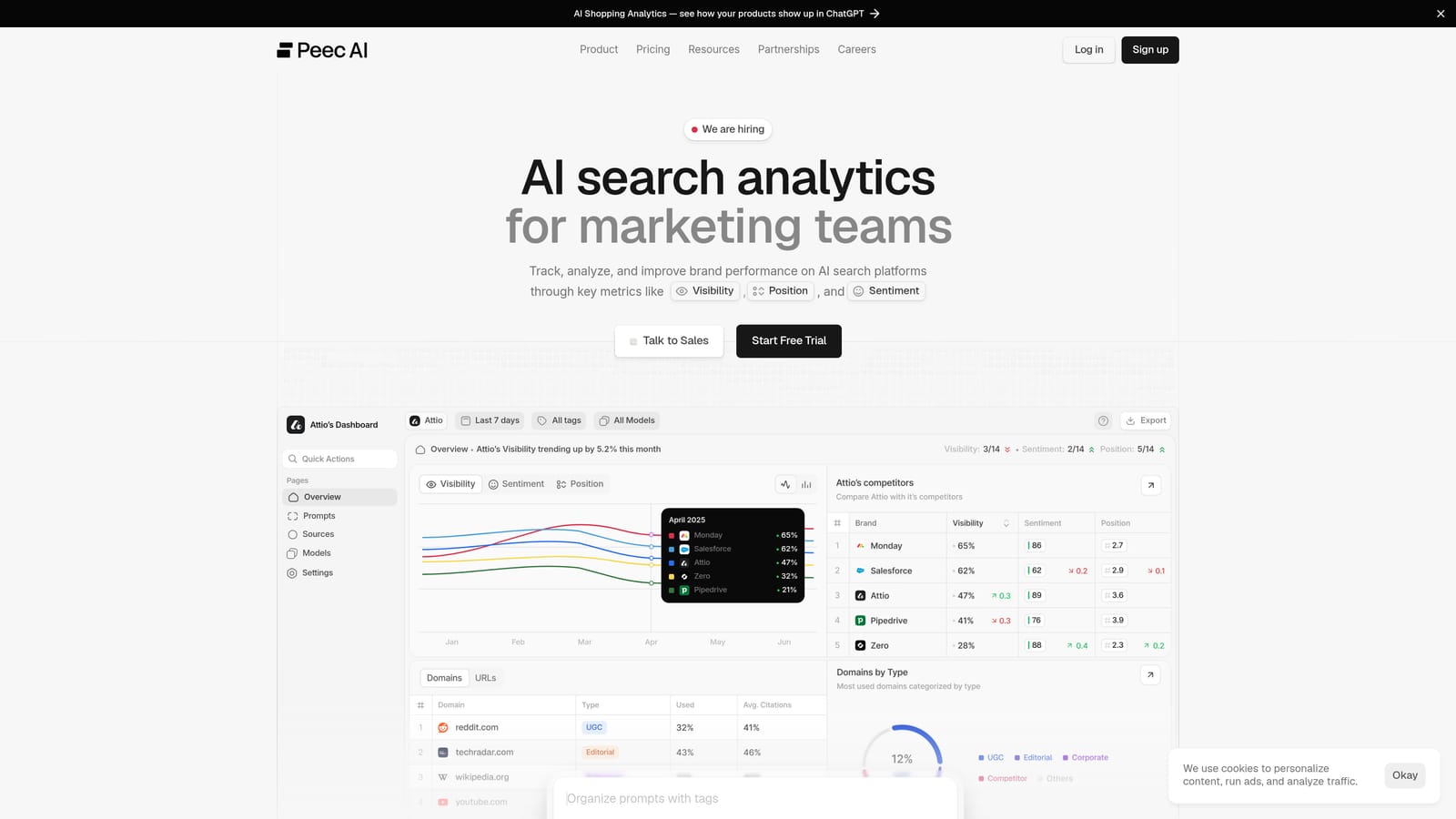
Peec is an answer engine optimization tool focused on monitoring brand presence and competitive positioning within AI-generated search results, built specifically for GEO and AEO performance tracking.
Where This Tool Shines
Peec takes a focused approach to a focused problem: understanding how AI answer engines represent your brand relative to competitors. Rather than trying to be a full content platform, it concentrates on the monitoring and auditing side of GEO, which makes it a clean complement to content generation tools in a broader stack.
The query-level tracking is useful for teams that want to understand not just whether they appear in AI answers, but in response to which specific questions. That granularity helps content teams identify gaps: queries where competitors appear and your brand doesn't, which then become content opportunities worth prioritizing.
Key Features
AI Answer Engine Monitoring: Tracks brand mentions across AI-generated search results on an ongoing basis rather than requiring manual spot checks.
Competitive Brand Positioning Analysis: Shows how your brand compares to competitors in AI-generated answers for relevant queries.
Query-Level Tracking: Breaks down visibility data by specific queries, helping teams understand where they appear and where they're absent.
Brand Sentiment Detection: Identifies whether AI-generated mentions of your brand carry positive, neutral, or negative framing.
GEO and AEO Reporting: Provides structured reporting outputs for teams measuring answer engine optimization performance over time.
Best For
Peec is well suited for marketing teams and agencies that are actively auditing their GEO performance and want competitive context for how AI models describe their brand. It works well as a specialized monitoring layer alongside a content generation platform.
Pricing
Visit peec.ai for current plan details and pricing options.
6. Promptwatch
Best for: Teams running structured AI visibility experiments and systematic brand audits across AI platforms.
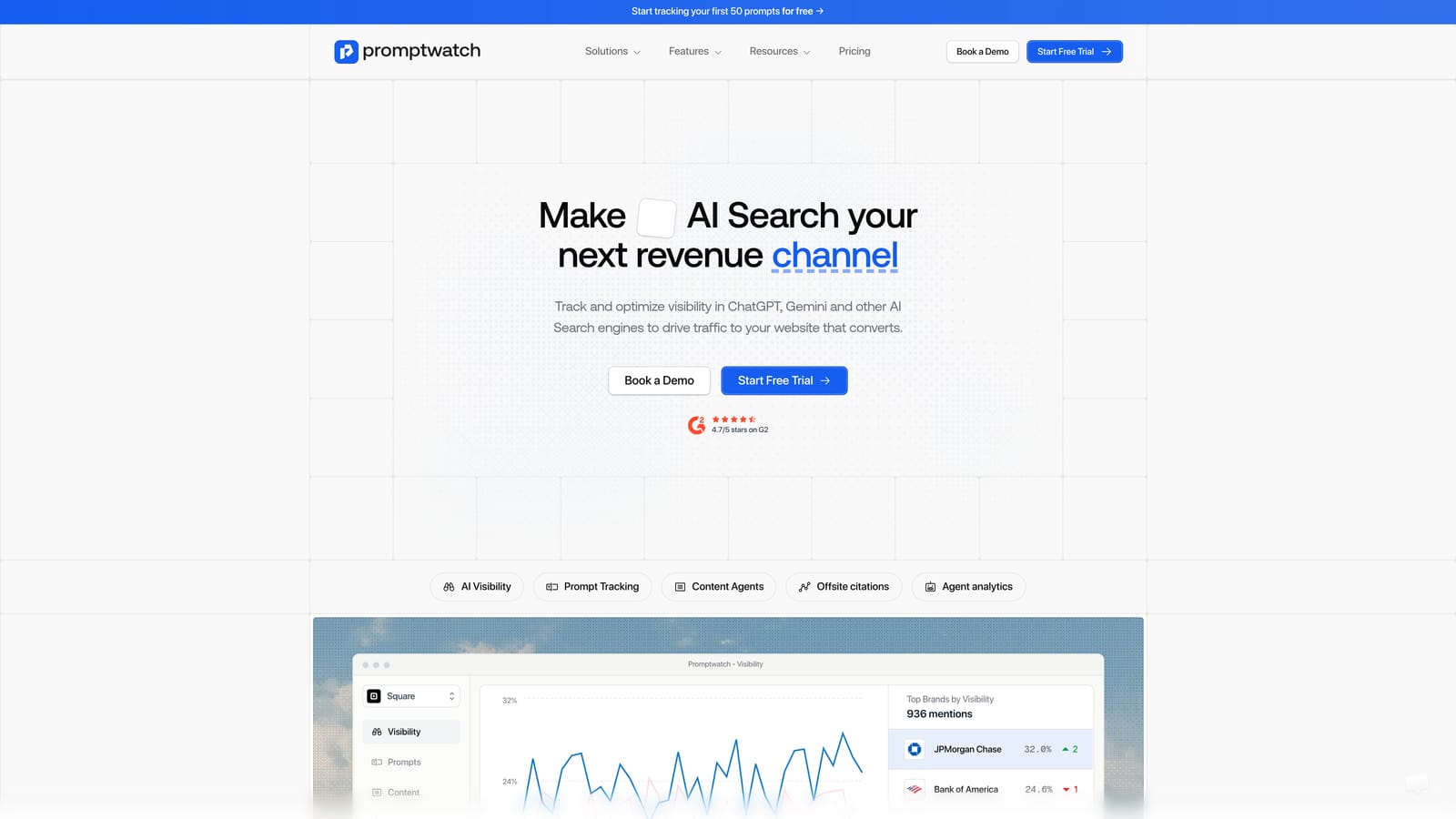
Promptwatch is a prompt tracking and AI response monitoring tool that lets teams define specific queries and track how AI models respond to them over time, built for structured brand audits and GEO experimentation.
Where This Tool Shines
Promptwatch is the most technically oriented tool on this list, and that's by design. It's built for teams that want to run controlled, repeatable experiments around AI visibility: define a set of prompts, track how different AI models respond, and monitor whether those responses change as you publish new content or as the models update. That structured approach is genuinely useful for teams trying to build evidence-based GEO strategies rather than operating on intuition.
The historical response monitoring is a particularly useful feature. Knowing that your brand appeared in a response today is useful. Knowing that it appeared in January, disappeared in March, and reappeared in May after you published a cluster of new content gives you actionable signal about what's actually working.
Key Features
Custom Prompt Definition: Lets teams specify exact queries to track across AI platforms, ensuring monitoring is focused on commercially relevant questions.
Historical Response Monitoring: Tracks how AI model responses to defined prompts change over time, surfacing patterns that inform content decisions.
Structured Audit Workflows: Provides a framework for systematic AI visibility testing rather than ad-hoc manual checks.
Cross-Model Comparison Views: Shows how different AI models respond to the same prompt, highlighting where brand visibility varies by platform.
GEO Experimentation Support: Useful for teams correlating content publishing activity with changes in AI model responses over time.
Best For
Promptwatch is best suited for technically minded marketers, SEO specialists, and growth teams that want to run disciplined, data-driven GEO experiments. It's less suited for teams looking for a turnkey solution and more suited for those who want granular control over what they're tracking and why.
Pricing
Visit promptwatch.io for current plan details and pricing options.
Choosing the Right Tool for Your Content Strategy
The tools on this list fall into two broad categories, and knowing which one you need makes the selection process straightforward.
If you're looking for a full-stack platform that handles content discovery, production, publishing, and AI visibility tracking without stitching together multiple tools, Sight AI is the strongest option. It's the only platform here that covers the complete content lifecycle, including the increasingly critical layer of monitoring how AI models represent your brand. For teams frustrated by tool sprawl, that consolidation alone justifies the evaluation.
If you already have a content production workflow and need to add AI visibility monitoring on top of it, Profound, Peec, and Promptwatch each offer specialized depth. Profound suits enterprise teams that need competitive share-of-voice data and reporting-grade dashboards. Peec is a clean fit for teams auditing GEO performance with a focus on competitive positioning. Promptwatch is the right choice for teams running structured experiments and wanting historical data on how AI responses evolve.
For high-volume content generation with multi-format support, Writesonic is a proven option. And if your team needs custom automation logic that generic platforms can't accommodate, AirOps gives you the flexibility to build exactly the pipeline your workflow requires.
The shift toward AI-generated answers as a primary discovery channel isn't slowing down. Brands that understand where they appear, how they're described, and what content drives those mentions will have a measurable advantage over those still operating blind. Start tracking your AI visibility today and see exactly where your brand appears across top AI platforms.