Your marketing team just got handed an impossible deadline: publish 50 high-quality blog posts in the next quarter to compete for seasonal search traffic. Meanwhile, your competitors are somehow cranking out content consistently, capturing keyword rankings you desperately need, and building topical authority while you're still debating whether to hire another writer or stretch your existing team even thinner.
This isn't a hypothetical scenario. It's the reality facing marketing teams across industries as organic search becomes increasingly competitive and AI-powered search engines demand deeper topical coverage. The solution isn't working harder—it's working systematically through bulk blog creation.
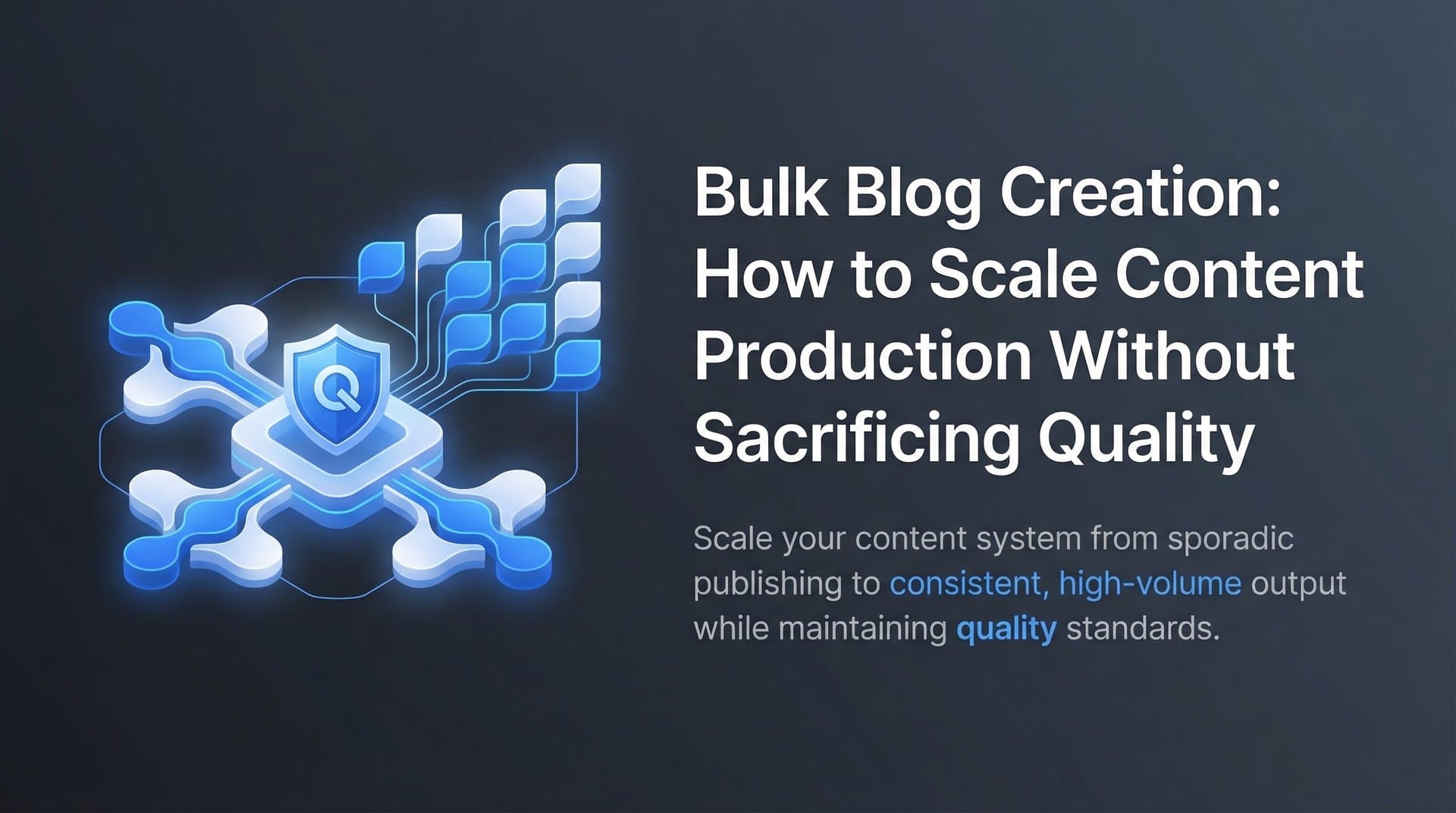
Bulk blog creation represents a fundamental shift from reactive, one-off content production to strategic, scaled content systems. When implemented correctly, it allows teams to maintain editorial standards while dramatically increasing output. This article breaks down exactly how bulk creation works, when it makes strategic sense, and how to build the infrastructure that turns content volume into competitive advantage without sacrificing the quality that drives real results.
The Mechanics Behind Scaled Content Production
Think of bulk blog creation as the difference between cooking meals one at a time versus meal prepping for an entire week. You're not just making more food—you're fundamentally changing your approach to the entire process.
At its core, bulk blog creation is a systematic approach to producing multiple articles simultaneously through structured workflows, reusable templates, and intelligent AI assistance. This isn't about churning out generic content at scale. It's about creating a production system that maintains consistency and quality across high-volume output.
The process operates on two distinct levels that many teams confuse. Batch processing involves planning and researching multiple pieces at once—clustering keywords, creating content briefs, and mapping out editorial calendars. Parallel execution, on the other hand, means actually writing multiple articles simultaneously through distributed workflows or AI-powered generation.
Here's where the infrastructure becomes crucial. Content briefs act as your blueprint, ensuring every article hits specific SEO targets and addresses reader intent. Style guides maintain brand voice consistency whether you're publishing five articles or fifty. Quality frameworks establish the non-negotiable standards that every piece must meet before publication.
Modern bulk creation leverages specialized AI agents designed for different content types. A listicle requires different structural elements than an explainer article, which differs from a comprehensive guide. The most effective systems deploy AI blog writing tools trained specifically for each format, ensuring the output matches the intent and structure readers expect.
The workflow typically follows this pattern: keyword clustering identifies content opportunities, automated brief generation creates detailed outlines with SEO requirements, AI-assisted drafting produces initial content following those briefs, human editors refine and optimize, and automated publishing systems handle distribution. Each stage builds on the previous one, creating a conveyor belt of quality content rather than a series of individual projects.
What separates successful bulk creation from content mills is the emphasis on systems over speed. The goal isn't to publish faster—it's to publish smarter by eliminating repetitive tasks, standardizing quality checks, and allowing human expertise to focus on strategy and refinement rather than starting from blank pages.
When Bulk Creation Makes Strategic Sense
Not every content situation calls for bulk creation. Launching it prematurely can overwhelm your team and dilute your brand voice. Understanding when to scale up is as important as knowing how to scale.
Product launches represent one of the clearest use cases. When you're introducing a new offering, you need comprehensive coverage across multiple search queries, use cases, and audience segments. Creating 20-30 related articles simultaneously ensures you dominate the conversation from day one rather than slowly building visibility over months.
Topical authority building demands consistent, related content that demonstrates expertise across an entire subject area. If you're targeting "AI-powered marketing," you can't just publish one great article and expect to rank. Search engines reward sites that prove comprehensive knowledge through multiple, interconnected pieces covering every angle of the topic.
Seasonal campaigns operate on tight timelines. If you're preparing for Black Friday, back-to-school season, or tax season, you need content live and indexed well before the search volume spikes. Bulk content creation allows you to prepare comprehensive seasonal coverage in concentrated production sprints rather than scrambling as deadlines approach.
Competitive content gaps reveal themselves through keyword research. When you discover your competitors own 50 rankings you're missing, reactive one-by-one publishing means you'll still be playing catch-up six months from now. Bulk creation lets you close those gaps strategically and quickly.
The content velocity equation matters more than many marketers realize. Search engines increasingly favor sites that publish consistently on related topics. A steady stream of quality content signals active expertise, while sporadic publishing suggests limited knowledge or abandoned sites.
But here's the critical warning sign most teams miss: if you don't have solid content fundamentals in place, scaling up will only scale your problems. Before considering bulk creation, you need established style guides, proven content templates, clear quality standards, and a functioning review process. Without these foundations, bulk creation becomes bulk chaos.
Your team's readiness shows in specific indicators. Can you currently publish one high-quality article per week consistently? Do you have documented processes for research, writing, and editing? Have you identified clear keyword clusters and content opportunities? If you're still figuring out basic content workflows, focus there first. Bulk creation amplifies what already works—it doesn't fix broken processes.
Building Your Bulk Creation Infrastructure
Infrastructure separates sustainable content scaling from burnout-inducing content sprints. The right systems turn bulk creation from a chaotic project into a repeatable process.
Start with keyword clustering—the foundation of strategic bulk creation. Instead of targeting random keywords, group related search queries into topical clusters. For example, if you're in the project management space, one cluster might include "project management software," "project tracking tools," "team collaboration platforms," and related terms. Each cluster becomes a mini-campaign of 10-15 related articles that reinforce each other's authority.
Content calendars evolve from simple scheduling tools into strategic planning systems. Map out which clusters you'll tackle when, considering seasonal trends, product launches, and competitive opportunities. A well-structured calendar shows not just publication dates but also how pieces connect thematically and build on each other.
Template libraries are your secret weapon for consistency at scale. Develop proven structures for each content type you regularly produce. Your listicle template might include introduction hooks, item formatting, transition phrases, and conclusion frameworks. Your explainer template covers problem setup, solution breakdown, implementation steps, and key takeaways. These templates don't restrict creativity—they eliminate the blank page problem and ensure every article meets your quality baseline.
This is where bulk content creation software with specialized agents transforms what's possible. Instead of one generic AI trying to write everything, you deploy specific agents trained for different article types. A listicle agent understands how to structure comparison points and maintain scannable formatting. An explainer agent knows how to break down complex topics into digestible sections. A guide agent excels at step-by-step instructions with proper sequencing.
The most sophisticated systems include autopilot modes that handle routine content types from brief to draft, allowing human editors to focus on refinement rather than creation. This dramatically increases throughput without sacrificing quality because the AI handles structure and research while humans add expertise and brand voice.
Review workflows become non-negotiable at scale. Establish clear stages: initial AI draft, editorial review for accuracy and voice, SEO optimization check, final approval, and publication. Each stage has specific responsibilities and quality gates. Without this structure, bulk-created content becomes a bottleneck at the editing phase.
Automated publishing and indexing complete the infrastructure. Modern content management systems can schedule publications, update sitemaps automatically, and trigger indexing through tools like IndexNow. This ensures your bulk-created content gets discovered quickly by search engines rather than sitting in a queue waiting for the next crawl. Faster indexing means faster results, which makes the entire bulk creation investment worthwhile.
Quality Control at Scale: The Non-Negotiables
Here's the uncomfortable truth about bulk content creation: most companies do it poorly. They prioritize volume over value, producing thin content that tanks their SEO rather than boosting it. The difference between successful bulk creation and content mill disaster comes down to non-negotiable quality standards.
Your editing and review process must be designed for scale from the start. This means clear quality checklists that every article must pass before publication. Does it answer the search intent completely? Does it include original insights beyond what competitors offer? Is the brand voice consistent? Are claims supported by evidence rather than vague generalizations?
E-E-A-T signals—expertise, experience, authoritativeness, and trustworthiness—become harder to maintain at volume but more important than ever. Every article needs clear author attribution, relevant credentials, and demonstrable expertise. Generic content written by unnamed authors signals low quality to both readers and search engines.
Experience indicators separate valuable content from regurgitated information. Include specific examples, real-world applications, and practical insights that only come from actual experience with the topic. When discussing tools or strategies, reference specific features, common challenges, and nuanced trade-offs rather than surface-level descriptions.
Authoritativeness comes from consistent topical coverage and citation practices. Link to authoritative sources when making claims. Reference industry standards and best practices. Connect related articles within your own content ecosystem to demonstrate comprehensive knowledge. Authority isn't claimed—it's demonstrated through depth and consistency.
Trustworthiness requires transparency about what you know versus what you're speculating about. Mark hypothetical examples clearly. Cite sources for statistics and data. Avoid fabricating case studies or inventing results. Readers and search engines increasingly detect and penalize content that makes unsupported claims or presents speculation as fact.
The role of AI visibility tracking adds a new dimension to quality control. It's no longer enough to optimize for traditional search engines—you need to ensure your bulk content gets discovered and referenced by AI models like ChatGPT, Claude, and Perplexity. These models favor comprehensive, authoritative content that demonstrates clear expertise.
Track how AI models discuss your topics and where your brand appears in their responses. This feedback loop reveals which content types and structures resonate with AI-powered search, allowing you to refine your bulk content creation for SEO. If your content isn't getting picked up by AI models, it's a signal that something in your approach needs adjustment—whether that's depth, authority signals, or topical relevance.
Quality at scale also means knowing when to slow down. If your review process identifies consistent issues across multiple articles, pause production and fix the root cause. Scaling broken processes only creates bigger problems faster.
Measuring Success Beyond Word Count
Publishing 50 articles means nothing if they're not driving results. The metrics that matter for bulk content creation differ significantly from traditional content marketing KPIs.
Indexing speed reveals how quickly search engines discover and process your content. With bulk publishing, you need automated indexing through tools like IndexNow to ensure all your articles get crawled promptly. Track the time between publication and indexing—if it's taking weeks, your bulk content isn't reaching its potential audience fast enough.
Organic traffic growth should show clear acceleration after bulk publication campaigns. Look for increases in overall site traffic, but more importantly, track traffic to the specific keyword clusters you targeted. If you published 15 articles around a topic cluster and aren't seeing traffic growth within 30-60 days, something in your strategy needs adjustment.
Keyword rankings provide granular insight into what's working. Track rankings for primary and secondary keywords across your bulk-created content. Successful bulk creation should show multiple articles ranking for related terms, building collective authority that lifts all pieces in the cluster.
AI model mentions represent the new frontier of content visibility. Monitor how often your brand appears in responses from ChatGPT, Claude, Perplexity, and other AI platforms. Track the context and sentiment of these mentions. Bulk content that builds topical authority should increase both the frequency and quality of AI model references to your brand.
The feedback loop between performance data and future planning is where bulk creation becomes truly strategic. Analyze which content clusters drove the strongest results. Which article formats generated the most engagement? Which topics attracted the most organic traffic? What content structures got picked up most frequently by AI models?
Use these insights to iterate on your approach. If explainer articles consistently outperform listicles in your niche, adjust your content mix accordingly. If certain keyword clusters drove unexpected traffic, explore related clusters you haven't covered yet. If AI models frequently reference your how-to guides but ignore your opinion pieces, that tells you where to focus future bulk creation efforts.
Content performance also reveals gaps in your existing coverage. If certain articles in a cluster rank well while others languish, analyze what the successful pieces did differently. Often, the answer points to depth, specificity, or practical value that the underperforming content lacks.
Remember that bulk content success compounds over time. Initial results might seem modest, but as search engines recognize your topical authority and AI models index your comprehensive coverage, the impact accelerates. Track trends over quarters rather than weeks to see the true value of scaled content production.
Putting It All Together
Bulk blog creation isn't about producing more content—it's about producing smarter content at scale. The difference between companies that succeed with bulk creation and those that fail comes down to systematic thinking, quality infrastructure, and strategic execution.
The combination of strategic planning, AI-powered generation, and rigorous quality control creates a sustainable competitive advantage. While competitors publish sporadically and struggle to build topical authority, teams with effective bulk creation systems consistently capture keyword rankings, accelerate organic traffic growth, and establish themselves as authoritative voices in their industries.
The infrastructure you build—keyword clustering, content calendars, template libraries, specialized AI agents, automated blog writing platforms, and quality frameworks—transforms content marketing from a resource-intensive bottleneck into a scalable growth engine. This isn't a temporary tactic but a fundamental shift in how modern marketing teams operate.
As AI-powered search continues to reshape how audiences discover content, bulk creation strategies must evolve beyond traditional SEO. The most successful teams now optimize for both search engines and AI models, ensuring their content gets discovered through multiple channels. This dual-optimization approach requires visibility into how AI platforms discuss your brand and topics, allowing you to refine automated blog content strategy based on comprehensive performance data.
The path forward is clear: invest in the systems that enable quality at scale, maintain non-negotiable standards even under volume pressure, and measure success through metrics that matter—indexing speed, organic traffic growth, keyword rankings, and AI model visibility. Teams that master this approach don't just compete more effectively; they fundamentally change the economics of content marketing, achieving results that were previously impossible without massive budgets or oversized teams.
Stop guessing how AI models like ChatGPT and Claude talk about your brand—get visibility into every mention, track content opportunities, and automate your path to organic traffic growth. Start tracking your AI visibility today and see exactly where your brand appears across top AI platforms.