Google dominates search, but it's no longer the only game in town. For marketers, founders, and agencies, that shift has real consequences. AI-powered answer engines like ChatGPT, Perplexity, and Claude are reshaping how people discover brands, products, and content. If you're only optimizing for page one of Google, you're already missing a growing slice of organic visibility.
The definition of "alternatives to Google" has evolved. It's no longer just about privacy-first browsers or Bing. Today, it means understanding which AI models your audience uses to find answers, and whether your brand shows up in those answers at all. Improving your organic search ranking now requires thinking across multiple discovery surfaces simultaneously.
This list covers the most relevant alternatives to Google worth knowing in 2026, from AI-native answer engines to content generation platforms and AI visibility tracking tools. Because showing up is only half the battle.
1. Sight AI
Best for: Marketers and agencies who need full-stack AI visibility tracking, content generation, and automated indexing in one platform.
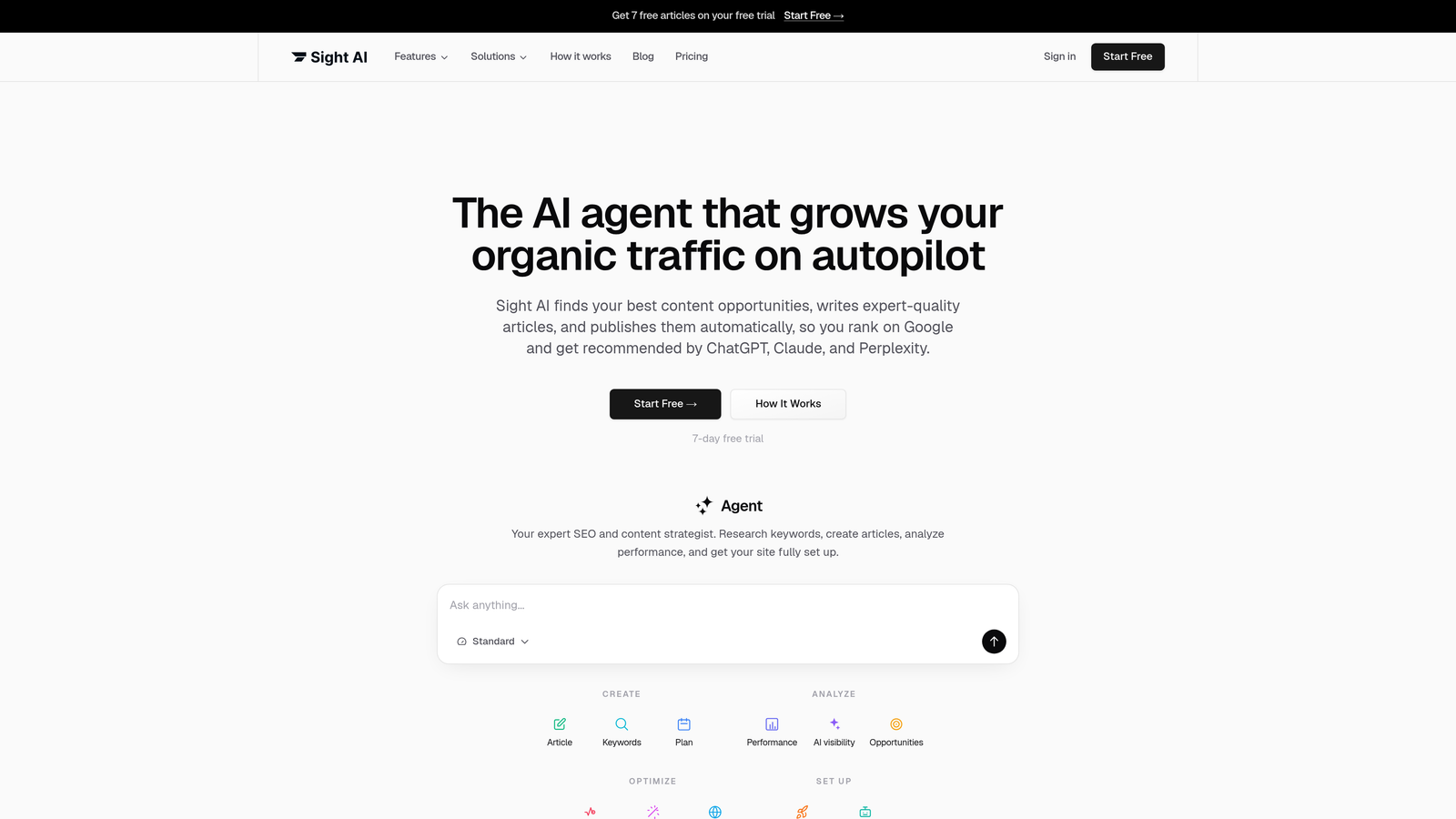
Sight AI is an all-in-one platform built specifically for the post-Google search landscape, helping brands track how AI models describe them, generate optimized content, and get that content indexed faster.
Where This Tool Shines
Most tools in this space solve one piece of the puzzle. Sight AI connects the dots between AI visibility monitoring, content creation, and website indexing. Instead of juggling three separate platforms, you get a unified view of where your brand appears across AI-generated answers and the tools to improve that presence.
The platform is particularly strong for teams running content at scale. With 13+ specialized AI agents and an Autopilot Mode, it removes much of the manual overhead from producing SEO and GEO-optimized content, while IndexNow integration ensures new content gets discovered by search engines faster than standard crawl cycles allow.
Key Features
AI Visibility Score: Tracks brand mentions across ChatGPT, Claude, Perplexity, and 6+ AI platforms, giving you a single score to benchmark and improve over time.
Sentiment Analysis and Prompt Tracking: Monitors not just whether your brand appears in AI answers, but how it's described and in what context.
13+ Specialized AI Agents: Generates SEO and GEO-optimized articles, listicles, guides, and explainers, each agent tuned for a specific content format.
Autopilot Mode: Hands-off content publishing that keeps your content pipeline moving without constant manual input.
IndexNow Integration: Automated sitemap updates and faster content discovery, so your new articles don't sit unindexed for weeks.
Best For
Sight AI is the right fit for growth-focused marketers, agency teams managing multiple clients, and founders who want to increase organic traffic across both traditional and AI search surfaces without managing a fragmented tool stack.
Pricing
Visit trysight.ai for current pricing details. Plans are designed to scale with team size and content volume.
2. Perplexity AI
Best for: Understanding AI-native search behavior and identifying how brands get cited in conversational answers.
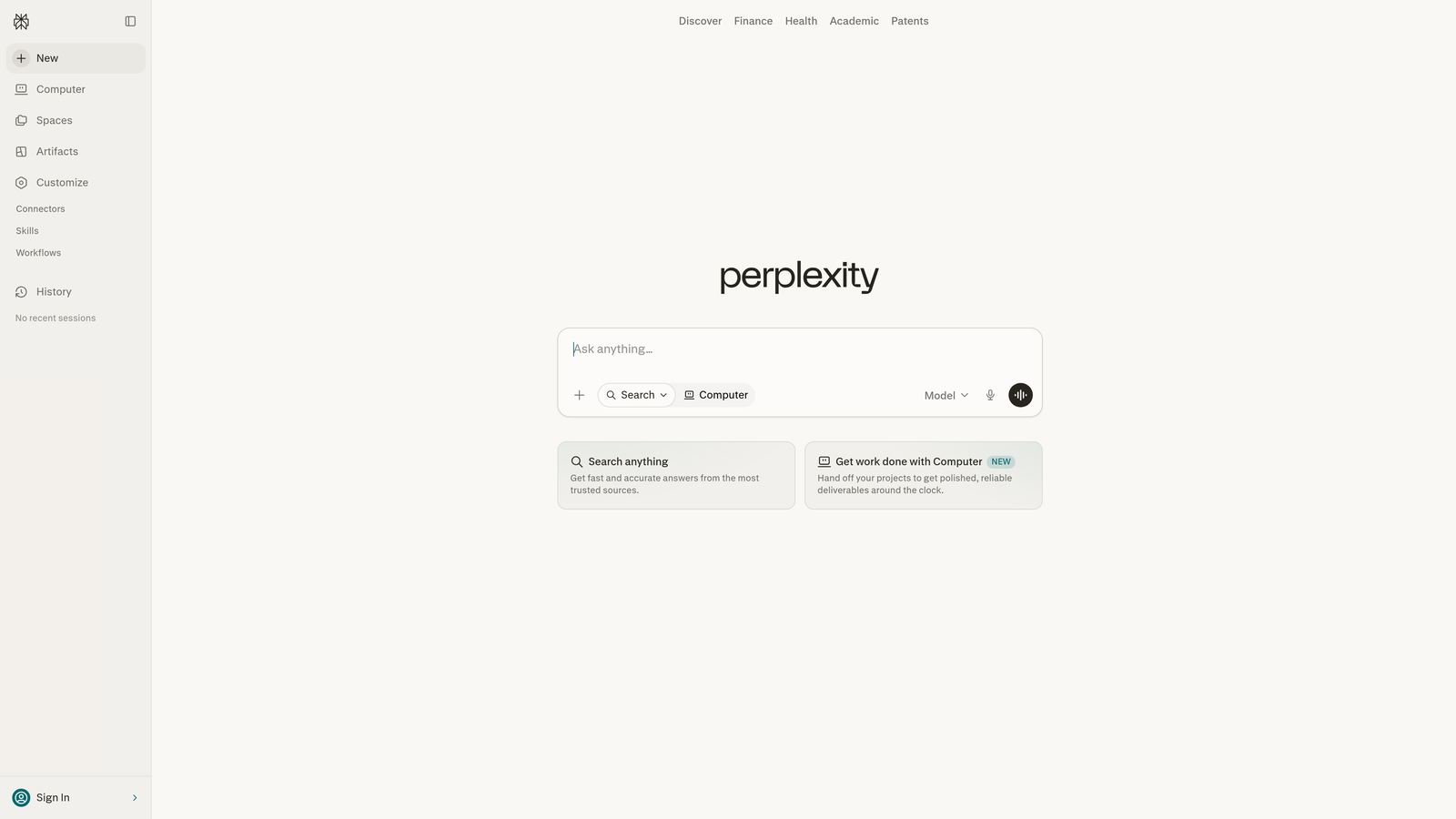
Perplexity AI is an AI-native answer engine that delivers conversational search results with real-time web citations, making it one of the fastest-growing discovery surfaces for brand visibility.
Where This Tool Shines
Perplexity isn't a tool for marketers in the traditional sense. It's a search engine, and that's exactly why it belongs on this list. It represents where a significant and growing portion of research and discovery is happening, especially among technically savvy users who want direct answers rather than a list of ten blue links.
For marketers, the key insight is this: Perplexity pulls from cited sources, which means the content you publish has a direct path to appearing in its answers. Understanding how Perplexity surfaces information is foundational to any modern GEO strategy.
Key Features
Conversational AI Search: Delivers synthesized answers to complex queries, drawing from real-time web sources with visible citations.
Pro Search Mode: Enables deeper, multi-step research queries with more thorough source analysis.
Source Transparency: Users can see exactly which websites and pages are cited in each answer, giving publishers a clear signal of what content earns placement.
API Access: Developers and product teams can integrate Perplexity's search capabilities directly into their own applications.
Spaces: Collaborative research environments for teams building shared knowledge bases.
Best For
Perplexity is worth using directly if you're a marketer or founder who wants to understand how AI answer engines respond to queries in your niche. It's also the search surface to optimize for if your audience skews toward researchers, professionals, and early adopters of AI tools.
Pricing
Free tier available with core search functionality. Perplexity Pro starts at approximately $20/month and unlocks Pro Search mode and higher usage limits.
3. Writesonic
Best for: Content teams that need to produce SEO-optimized articles and marketing copy at scale across traditional and AI search surfaces.
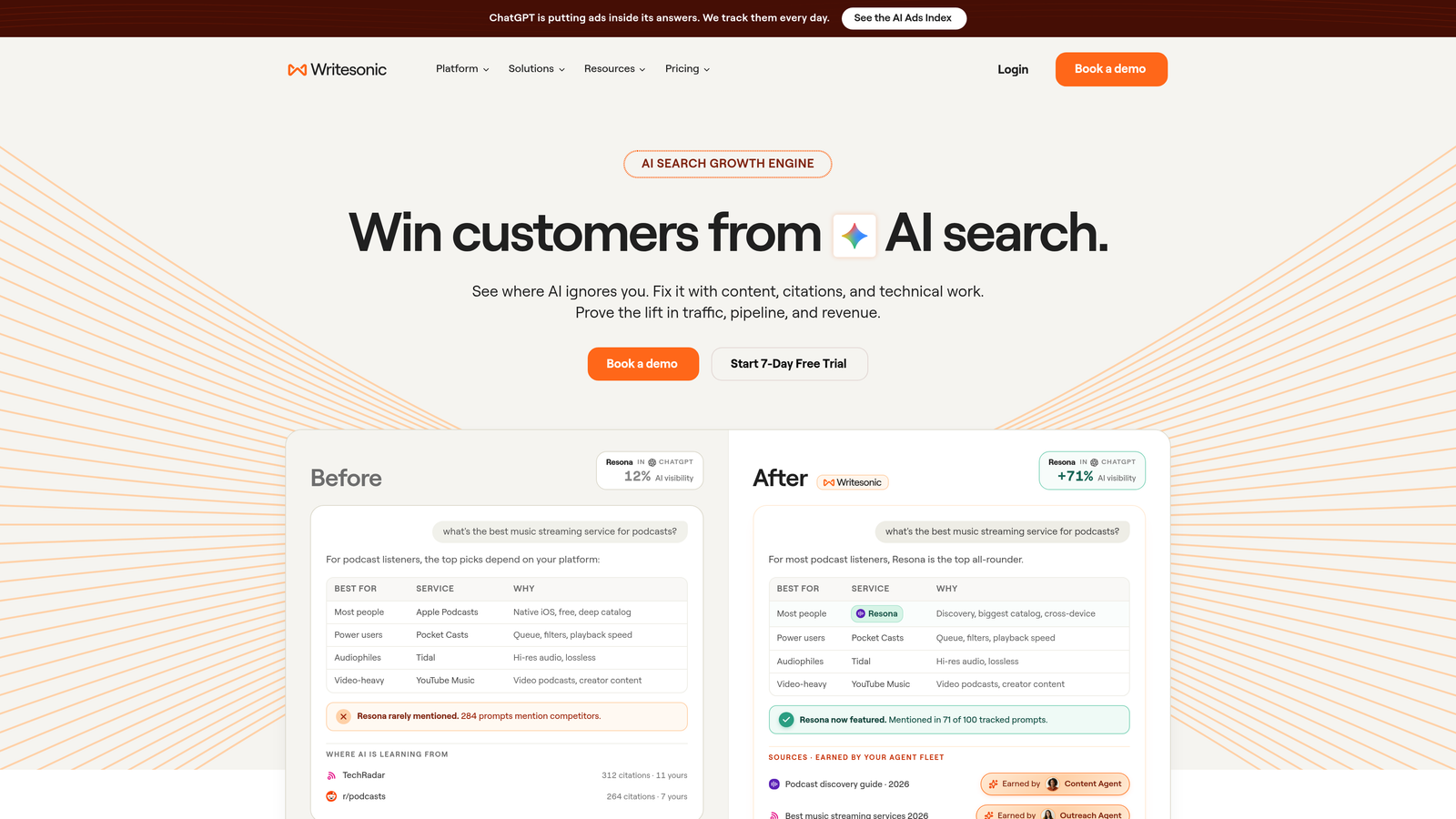
Writesonic is an AI-powered content platform designed to help teams generate blog posts, articles, and marketing copy with built-in SEO optimization features.
Where This Tool Shines
Writesonic has built a broad feature set around AI content generation, with a particular focus on helping teams produce content that performs in organic search. Its Chatsonic feature adds real-time web access to the writing workflow, which is useful when you need content grounded in current information rather than a static training dataset.
For teams producing high volumes of blog content or running programmatic publishing strategies, Writesonic's bulk generation capabilities reduce the time-per-piece significantly. It's a practical choice for content operations that need to move fast.
Key Features
AI Article and Blog Generation: Produces long-form content with SEO optimization baked into the workflow, including keyword targeting and structure guidance.
Chatsonic: A conversational AI assistant with real-time web access, useful for research-backed content creation.
Botsonic: Allows teams to build AI-powered chatbots trained on their own content, extending content utility beyond static pages.
Bulk Content Generation: Enables programmatic publishing at scale, useful for large content operations or agencies managing multiple clients.
CMS Integrations: Connects with popular content management platforms to streamline the publishing workflow.
Best For
Writesonic works well for content marketing teams, SEO agencies, and small businesses that need a reliable AI writing tool with enough SEO-specific features to keep output search-ready. It's a strong point solution for content production, though it doesn't extend into AI visibility monitoring.
Pricing
Free trial available. Paid plans start at approximately $16/month, with higher tiers unlocking more words, users, and advanced features.
4. AirOps
Best for: Growth teams and agencies building scalable, repeatable content pipelines powered by large language models.
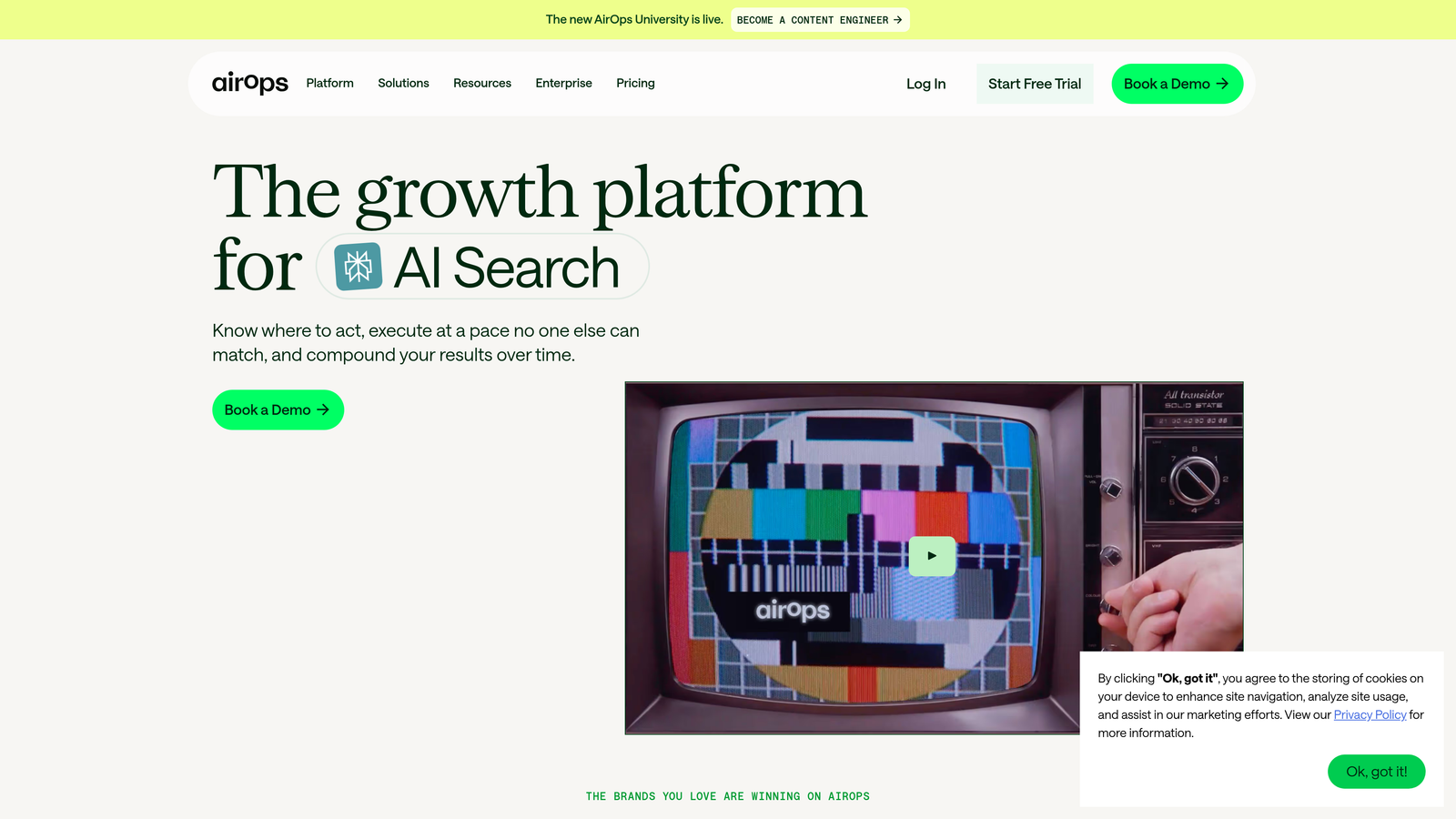
AirOps is an AI workflow automation platform that lets teams design and run LLM-powered content operations without writing custom code for every use case.
Where This Tool Shines
AirOps sits at the intersection of content and operations. Rather than being a writing tool you use one article at a time, it's a workflow builder that lets you define repeatable processes, like pulling data, running it through an AI model, and outputting structured content, and then run those processes at scale.
This makes it particularly well-suited for programmatic SEO strategies, where you need to generate large volumes of structured content efficiently. Teams that have already figured out what works can use AirOps to systematize and scale those processes without a heavy engineering lift.
Key Features
Visual Workflow Builder: Drag-and-drop interface for designing LLM-powered content workflows without requiring engineering resources.
Multi-Model Integrations: Connects with GPT-4, Claude, and other leading AI models, giving teams flexibility in which model powers each workflow.
Programmatic SEO Content Generation: Designed to support large-scale content production with consistent structure and quality across thousands of pages.
Data Enrichment Workflows: Pulls in external data to personalize and contextualize content at scale.
Team Collaboration and Versioning: Supports multiple contributors with workflow versioning to manage changes and iterations over time.
Best For
AirOps is a strong fit for growth-stage companies and agencies with established content strategies who need to operationalize and scale their production. It rewards teams that already have a clear process, because it's built to systematize, not discover, what works.
Pricing
Free tier available for getting started. Paid plans scale based on usage volume and number of seats, making it accessible for smaller teams before committing to enterprise-level pricing.
5. Profound
Best for: Enterprise marketing teams that need structured reporting on how AI models represent their brand in generated answers.
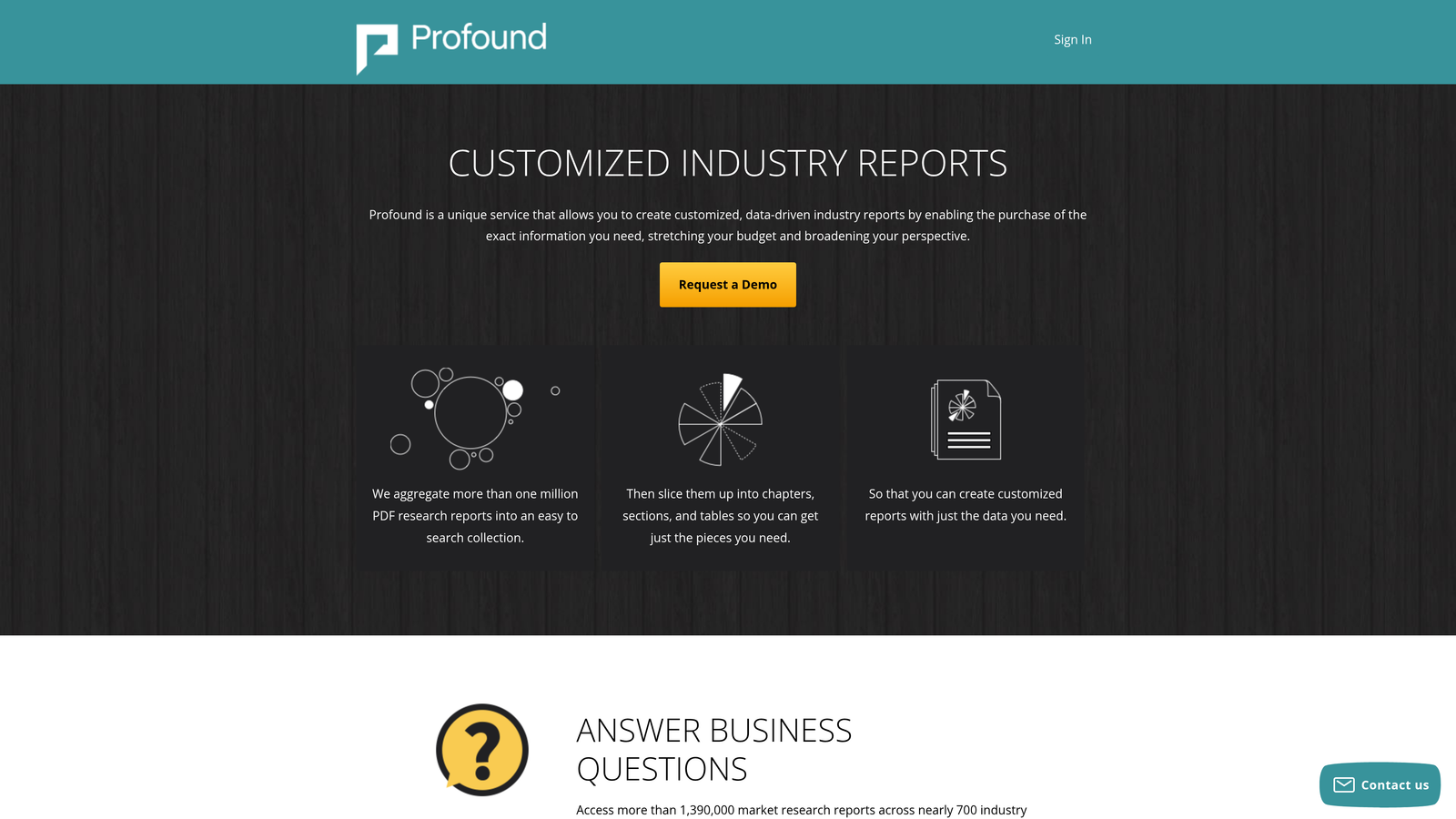
Profound is an enterprise-grade AI search monitoring platform focused on brand representation in AI-generated responses, built for large organizations with brand governance requirements.
Where This Tool Shines
Profound is built for organizations where brand accuracy in AI outputs is a compliance and governance concern, not just a marketing metric. If your brand operates in a regulated industry or has strict messaging guidelines, knowing exactly how AI models describe you, and being able to document that, is a real operational need.
The platform's competitive share-of-voice analysis is also notable. It goes beyond tracking your own brand to benchmarking how often and how favorably you appear relative to competitors in AI-generated answers, which is the kind of strategic intelligence enterprise marketing teams need.
Key Features
Brand Mention Tracking: Monitors how your brand appears across major AI answer engines, capturing both presence and context.
Competitive Share-of-Voice Analysis: Benchmarks your brand's AI visibility against competitors in the same category.
Structured Enterprise Reporting: Delivers organized reporting outputs suitable for marketing leadership and brand governance teams.
Answer Engine Optimization Insights: Provides recommendations for improving how AI models represent your brand in generated answers.
Brand Accuracy and Sentiment Monitoring: Flags instances where AI outputs contain inaccurate or off-message descriptions of your brand.
Best For
Profound is built for enterprise marketing teams, particularly those in competitive categories where AI-generated answers influence purchase decisions. It's less suited for small teams or early-stage companies that don't yet need the reporting depth or governance features it provides.
Pricing
Enterprise pricing model. Contact Profound directly for a quote, as pricing is customized based on team size and monitoring scope.
6. Peec
Best for: Small teams and early-stage companies entering AI visibility monitoring without enterprise complexity.
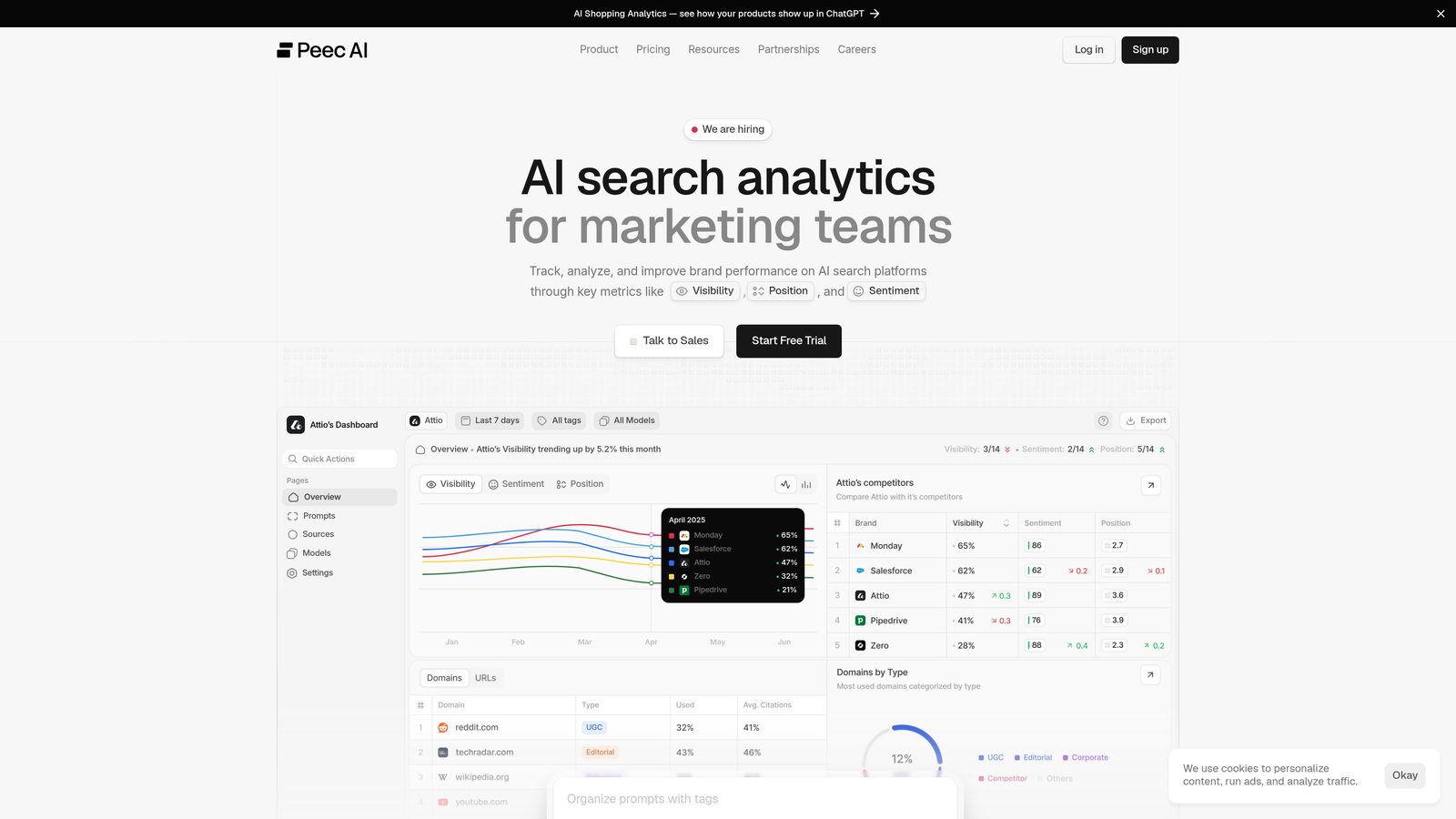
Peec is a lightweight AI visibility monitoring tool that helps smaller organizations start tracking their brand presence in AI-generated search results without a steep learning curve or heavy onboarding process.
Where This Tool Shines
Not every team needs an enterprise platform with governance workflows and competitive intelligence dashboards. Peec is designed for teams that are earlier in their AI visibility journey and need to get started quickly. The setup is prompt-based, meaning you define what queries you want to track and the tool handles the monitoring from there.
For founders and small marketing teams who are just beginning to understand how their brand appears in AI-generated answers, Peec offers a lower-friction entry point than more complex platforms. It's a practical first step before committing to a more comprehensive solution.
Key Features
Brand Mention Monitoring: Tracks how your brand appears in AI search outputs across key queries relevant to your category.
Accessible Dashboard: Clean, straightforward interface for monitoring AI visibility trends without a steep learning curve.
Prompt-Based Brand Tracking Setup: Lets you define the specific prompts and queries you want to monitor, making setup fast and intuitive.
Competitive Benchmarking: Compares your AI visibility against peer brands in your category, useful for understanding relative positioning.
Lightweight Onboarding: Designed for small teams that need to move quickly without dedicated implementation support.
Best For
Peec is a good fit for early-stage startups, solo marketers, and small teams that want to begin tracking AI visibility without the complexity or cost of an enterprise solution. As your needs grow, you'll likely outgrow it, but it's a solid starting point.
Pricing
Visit peec.ai for current pricing details. Positioning suggests accessibility for smaller teams and budgets.
Which Tool Is Right for Your Search Strategy?
The right choice depends on where you are in your AI visibility journey and what problem you're actually trying to solve. Here's a quick way to think about it.
If you're looking for a full-stack solution that combines AI visibility tracking, content generation, and automated indexing in one place, Sight AI is the most complete option on this list. It's built for the post-Google search landscape from the ground up, and it's the only platform here that connects monitoring to content creation to indexing in a single workflow. If you want to understand how to optimize content for SEO and GEO simultaneously, this is where to start.
If you want to understand AI search behavior firsthand, spend time using Perplexity as a research tool. It will show you exactly how AI answer engines synthesize information and which sources they cite, which is invaluable context for any GEO strategy.
For content production at scale, Writesonic and AirOps serve different needs. Writesonic is better for teams that want a writing-first tool with SEO features. AirOps is better for teams that want to build systematic, repeatable content workflows powered by multiple AI models.
For AI visibility monitoring specifically, the choice comes down to team size. Profound is built for enterprise organizations that need governance-level reporting and competitive intelligence. Peec is the lighter-weight entry point for smaller teams getting started with AI search monitoring.
The broader takeaway: Google rankings still matter, but they're no longer the complete picture. Your audience is discovering brands, products, and content through AI-generated answers, and that surface requires a different kind of optimization. Understanding how to track your SEO and AI visibility performance together is quickly becoming a baseline competency for any growth-focused marketing team.
Stop guessing how AI models like ChatGPT and Claude talk about your brand. Start tracking your AI visibility today and see exactly where your brand appears across top AI platforms, so you can publish the right content, earn the right citations, and grow your organic presence across every search surface that matters in 2026.