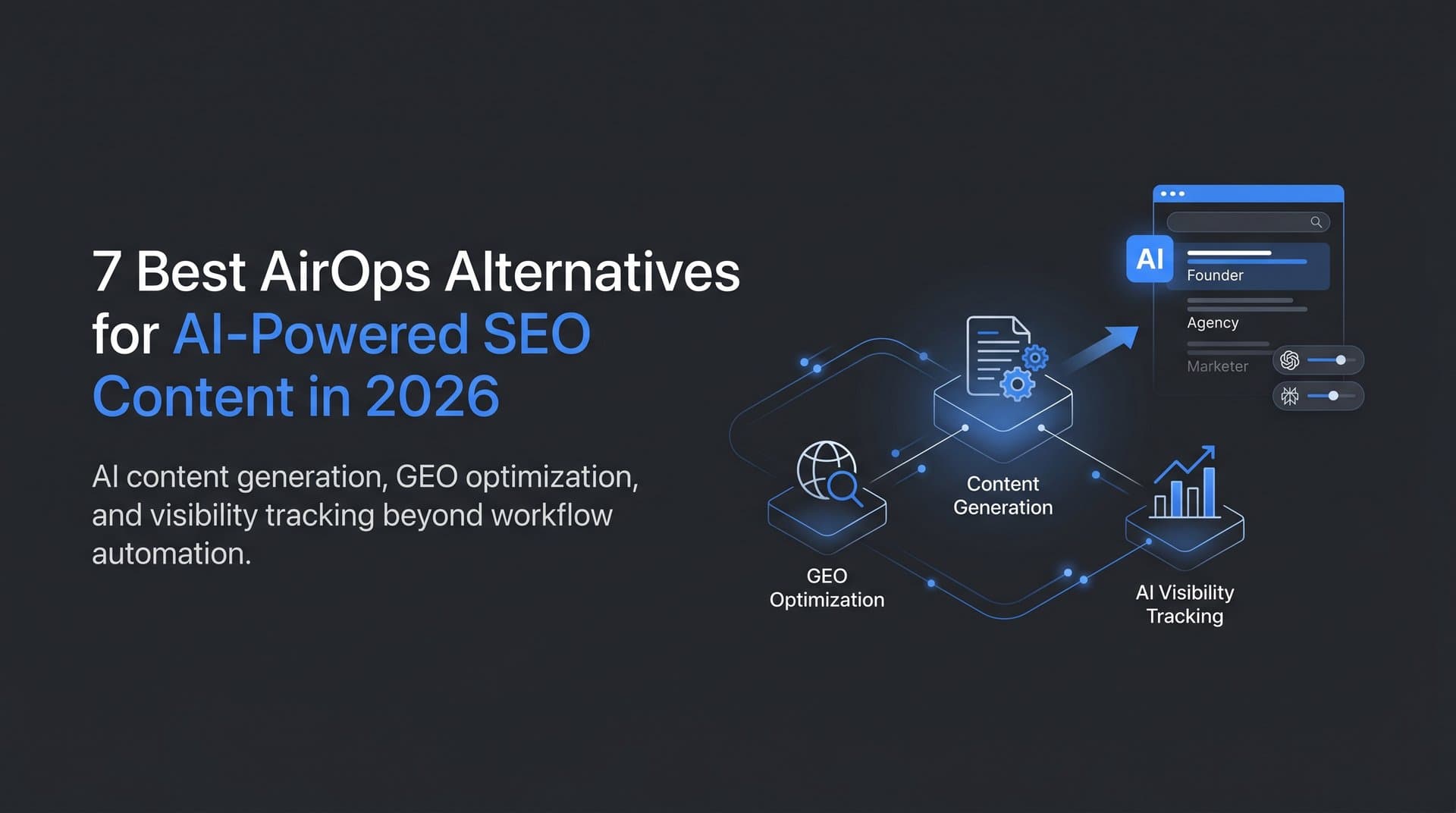
As AI-generated content becomes central to organic growth strategies, marketers and agencies are actively searching for AiOps content writer alternatives that go beyond basic text generation. AiOps has carved out a niche in AI-assisted content workflows, but it isn't the only option. For teams that need deeper SEO optimization, GEO (Generative Engine Optimization) capabilities, and AI visibility tracking, it may not be the best fit.
The landscape of AI content tools has matured significantly. Today's leading platforms don't just write articles. They optimize for how AI models like ChatGPT, Claude, and Perplexity surface brand mentions, automate indexing workflows, and integrate directly with CMS platforms for end-to-end publishing.
If you're evaluating your current stack, this guide covers the most effective strategies for finding and switching to an AiOps content writer alternative that aligns with your growth goals. Whether you're a founder scaling content output, an agency managing multiple client sites, or a marketer trying to rank in both traditional search and AI-powered answers, these strategies will help you evaluate, select, and implement the right tool with a focus on measurable results.
1. Prioritize GEO Optimization, Not Just SEO
The Challenge It Solves
Traditional SEO tools were built for a world where Google's ten blue links determined who got discovered. That world is changing. Consumers and B2B buyers increasingly turn to AI assistants like ChatGPT, Claude, and Perplexity as their first research stop. If your content isn't structured to appear in those AI-generated answers, you're leaving a growing discovery channel completely unaddressed.
The Strategy Explained
Generative Engine Optimization (GEO) is the practice of optimizing content specifically for how AI models retrieve, synthesize, and surface information in response to user queries. It's distinct from traditional SEO, though the two are complementary. GEO-optimized content tends to be structured around direct answers, authoritative sourcing, and clear entity relationships that AI models can parse and cite confidently.
When evaluating an AiOps content writer alternative, ask specifically whether the platform generates content with GEO principles built in. Does it structure articles to answer conversational queries? Does it help your brand get mentioned when someone asks an AI assistant about your category? These are the questions that separate forward-looking platforms from tools that simply automate yesterday's content playbook. You can explore more on how to optimize content for SEO in both traditional and AI-powered environments.
Implementation Steps
1. List the top ten questions your target audience asks AI assistants about your product category, and verify whether your current content answers them directly.
2. Evaluate each alternative platform by generating a sample article and checking whether it includes direct answers, structured headings, and entity-rich language that AI models can parse.
3. Set a baseline by monitoring how often your brand appears in AI-generated answers before switching tools, so you can measure improvement after.
Pro Tips
GEO and SEO share a foundation: authoritative, well-structured content. Don't treat them as competing priorities. The best AiOps alternatives will handle both simultaneously, generating articles that rank in traditional search while also being structured for AI retrieval. If a platform can only do one, it's already behind.
2. Audit Your Current Content Workflow Before Switching
The Challenge It Solves
Switching AI content tools without a clear picture of your existing workflow often leads to replicating the same inefficiencies in a new environment. Teams end up paying for a new platform while still managing the same bottlenecks manually. A workflow audit prevents this by making your actual requirements visible before you start evaluating alternatives.
The Strategy Explained
A content workflow audit maps every step from ideation to publication, identifying where time is lost, where quality breaks down, and where human effort is being spent on tasks that could be automated. This gives you a concrete checklist of capabilities your next platform must have, rather than relying on feature marketing to guide your decision.
Think of it like renovating a kitchen. You wouldn't order new appliances before measuring the space. Similarly, you need to understand your production pipeline before committing to a replacement tool. Review your blog content pipeline and document how each piece of content moves from brief to published article, noting every manual handoff along the way.
Implementation Steps
1. Document your current workflow end-to-end: keyword research, briefing, drafting, editing, internal linking, publishing, and indexing. Note which steps are manual and which are automated.
2. Identify your top three bottlenecks by asking your content team where they lose the most time each week.
3. Define measurable success criteria before evaluating any tool. For example: reduce time-to-publish by a specific number of hours, increase monthly content output by a target volume, or improve average article ranking within a set timeframe.
Pro Tips
Include your indexing and distribution steps in the audit, not just writing. Many teams discover that the biggest time sink isn't content creation but the manual work of submitting URLs, updating sitemaps, and tracking which articles have been crawled. An alternative that automates these steps can deliver more value than one that simply writes faster.
3. Evaluate Multi-Agent AI Writing Architectures
The Challenge It Solves
Most entry-level AI writing tools use a single language model to handle every task: research, outlining, drafting, SEO optimization, and editing. The result is generic content that lacks the depth and structure needed to compete in search or earn citations from AI models. A single-model approach is the AI equivalent of hiring one generalist to do the work of a specialized team.
The Strategy Explained
Multi-agent AI writing architectures assign different specialized agents to different stages of the content creation process. One agent handles competitive research, another structures the outline, a third optimizes for SEO signals, and a fourth reviews for readability and accuracy. The output reflects the combined expertise of each agent rather than the averaged capability of one.
When evaluating AiOps content writer alternatives, ask vendors to describe their underlying architecture. Platforms built on multi-agent content writing systems tend to produce more structured, accurate, and SEO-complete articles because each stage of production is handled by a model optimized for that specific task. This is particularly important if you're producing content at scale, where quality consistency matters as much as output volume. Learn more about how to automate content creation without sacrificing quality.
Implementation Steps
1. Ask each vendor directly: does your platform use a single model or multiple specialized agents? Request a breakdown of what each agent handles.
2. Generate a sample article on a topic you know well and evaluate whether the output reflects genuine research depth, logical structure, and accurate SEO optimization.
3. Compare the internal linking, heading hierarchy, and keyword placement across samples from different platforms to identify which architecture produces more publishable first drafts.
Pro Tips
Autopilot mode is a meaningful differentiator to look for. Platforms that can run multi-agent pipelines without manual prompting at each stage dramatically reduce the operational overhead of content production. If a tool requires you to hand-hold every agent transition, it's adding complexity rather than removing it.
4. Demand Built-In Indexing and Crawl Automation
The Challenge It Solves
Publishing content is only half the equation. If search engines don't discover and crawl your new articles quickly, even well-optimized content sits invisible for days or weeks. For teams publishing at volume, manual URL submission and sitemap management becomes a significant operational drag that compounds with every article published.
The Strategy Explained
IndexNow is a protocol supported by Microsoft Bing, Yandex, and other search engines that allows websites to instantly notify search engines when content is published or updated (Source: IndexNow.org). Rather than waiting for a search engine crawler to discover new pages on its own schedule, IndexNow-enabled platforms push notifications the moment content goes live, accelerating discovery and indexing.
When evaluating alternatives, verify whether the platform integrates IndexNow natively and whether it automates sitemap updates as part of the publishing workflow. This isn't a nice-to-have feature. For agencies managing multiple client sites or founders publishing frequently, it's a core operational requirement. Explore the practical details of why content isn't indexed quickly to understand what automated indexing replaces in your current workflow.
Implementation Steps
1. Confirm whether each platform under evaluation includes IndexNow integration as a native feature, not a third-party add-on requiring separate configuration.
2. Ask whether sitemap updates are triggered automatically upon publishing or whether they require manual action.
3. Test the indexing workflow by publishing a sample article through the platform and verifying how quickly it appears in search engine crawl logs.
Pro Tips
Don't overlook the compounding effect of faster indexing. For content-heavy strategies where you're publishing multiple articles per week, even a 48-hour reduction in average crawl time adds up to a meaningful advantage in how quickly new content begins generating organic traffic.
5. Look for AI Visibility Tracking as a Core Feature
The Challenge It Solves
Most content teams can tell you their Google rankings. Very few can tell you how ChatGPT describes their brand when a user asks about their product category, or whether Claude recommends them over a competitor. This blind spot is growing more costly as AI assistants become a primary discovery channel for both consumers and business buyers.
The Strategy Explained
AI visibility tracking monitors how AI models mention, describe, and position your brand across platforms like ChatGPT, Claude, Perplexity, and others. A platform with built-in AI visibility tracking gives you an AI Visibility Score, sentiment analysis on how your brand is characterized, and insight into which prompts trigger mentions of your brand versus a competitor's.
This data directly informs your content strategy. If you discover that AI models consistently recommend a competitor when users ask about a specific use case, you know exactly what content gap to address next. Without this visibility, you're optimizing blind. Understanding AI generated content SEO performance now needs to include AI mention frequency alongside traditional organic traffic signals.
Implementation Steps
1. Identify the ten most common prompts your target audience might use in AI assistants when researching your product category.
2. Test each platform under evaluation to confirm it monitors AI responses across multiple AI engines, not just one.
3. Establish a baseline AI Visibility Score before switching tools so you can track whether your new content strategy is improving how AI models talk about your brand over time.
Pro Tips
Sentiment analysis is as important as mention frequency. A brand that gets mentioned frequently but described negatively or inaccurately has a different problem than one that isn't mentioned at all. Look for platforms that surface both the volume and the quality of AI mentions so you can respond to both issues with targeted content.
6. Test Content Output Quality Across Real Use Cases
The Challenge It Solves
Feature lists and vendor demos are optimized to impress. The only reliable way to evaluate an AI content writer alternative is to generate articles on topics you actually cover and assess them against the standards your audience and search algorithms expect. Many teams skip this step and discover quality issues only after committing to a new platform.
The Strategy Explained
A structured quality test compares content output across four dimensions: factual accuracy, SEO structure, readability, and automated internal linking. Each dimension maps to a real business outcome. Factual accuracy protects your brand credibility. SEO structure determines ranking potential. Readability affects engagement and time-on-page. Automated internal linking improves site authority distribution without manual effort.
Run the same brief through each platform under evaluation and score the outputs against a consistent rubric. This removes the subjectivity from the decision and gives you defensible data to share with stakeholders. Review how AI content writer tools differ in output quality across architectures, and compare against your current benchmarks for publishable content. You can also explore a broader set of best AI content writing software to understand where each platform sits on the quality spectrum.
Implementation Steps
1. Select three to five real content briefs from your current pipeline and run them through each platform under evaluation using identical inputs.
2. Score each output on factual accuracy, heading structure, keyword placement, readability, and whether internal links were suggested or inserted automatically.
3. Have at least one subject matter expert review the outputs for accuracy, since AI-generated content can sound authoritative while containing subtle errors that damage credibility.
Pro Tips
Pay particular attention to how each platform handles automated internal linking. Platforms that suggest contextually relevant internal links based on your existing content library save significant editorial time and improve site architecture simultaneously. This feature is often underweighted in evaluations but delivers compounding SEO value over time.
7. Choose a Platform That Scales With Your Content Operations
The Challenge It Solves
A tool that works well for publishing ten articles per month may become a bottleneck at fifty. Agencies managing multiple client sites face additional complexity: different brand voices, separate content calendars, and clients with varying SEO requirements. Choosing a platform without evaluating its scalability means you'll likely be switching again within twelve months.
The Strategy Explained
Scalability in AI content platforms has three dimensions: volume capacity, multi-site management, and agency-specific features. Volume capacity refers to how many articles the platform can generate within your budget without quality degradation. Multi-site management covers whether you can manage separate content strategies, brand voices, and publishing workflows for different domains from a single dashboard. Agency features include white-label reporting, client access controls, and bulk content generation capabilities.
Content teams are increasingly relying on automation to scale output without proportionally increasing headcount. The right platform should make it possible to double or triple your publishing volume without doubling your operational complexity. For agencies, this is especially critical when managing multiple client sites simultaneously. Explore AI content writing for agencies that complement a scalable content platform, and consider how bulk content creation for blogs at scale requires both content volume and content quality working together.
Implementation Steps
1. Map your projected content volume for the next twelve months and verify that each platform's pricing model remains cost-effective at that scale, not just at your current volume.
2. If you manage multiple sites or clients, request a demo specifically focused on multi-site workflows and ask how brand voice differentiation is handled across accounts.
3. Evaluate the platform's CMS integration capabilities. Direct publishing to your CMS eliminates a manual handoff that compounds in cost as volume increases.
Pro Tips
Autopilot mode is the clearest indicator of true scalability. If a platform requires significant manual input to produce each article, its effective capacity is limited by your team's time, not the tool's technical capability. Platforms that can run full content pipelines autonomously, from keyword research through publishing, are the ones that actually deliver on the promise of scaled content operations.
Putting It All Together
Switching from AiOps to a more capable content writer doesn't have to be disruptive. By following a structured evaluation process, starting with your GEO and SEO requirements, auditing your workflow, testing real content output, and assessing scalability, you can identify an alternative that delivers measurably better results without the friction of a rushed transition.
The most important shift to make in 2026 is recognizing that content creation and AI visibility are inseparable. A platform that writes well but doesn't help you track how AI models talk about your brand is solving only half the problem. The brands that will win in both traditional and AI-powered search are those that treat content generation and AI visibility monitoring as a single, integrated workflow.
Here's a prioritized implementation roadmap to get started:
Week 1: Complete your workflow audit and define measurable success criteria before evaluating any platform.
Week 2: Run structured content quality tests using real briefs across platforms that include multi-agent architecture, GEO optimization, and built-in indexing.
Week 3: Establish your baseline AI Visibility Score so you can measure improvement after switching.
Week 4: Evaluate scalability and pricing models against your twelve-month content volume projections before making a final decision.
Sight AI is built specifically for this challenge, combining 13+ specialized AI agents for SEO and GEO-optimized content with AI visibility tracking across ChatGPT, Claude, Perplexity, and more, plus IndexNow-powered indexing automation. It's an all-in-one platform designed for the teams that understand content creation and AI visibility belong in the same workflow.
Stop guessing how AI models like ChatGPT and Claude talk about your brand. Start tracking your AI visibility today and see exactly where your brand appears across top AI platforms, so every piece of content you publish moves the needle in both traditional search and AI-generated answers.