Your potential customers aren't starting their search on Google anymore. They're asking ChatGPT for the best CRM for small teams. They're querying Claude about local marketing agencies worth hiring. They're turning to Perplexity to find recommended accounting software for freelancers. And here's the uncomfortable truth: if you've built your entire discovery strategy around SEO rankings, you might be completely invisible in these conversations.
This isn't a distant future scenario. It's happening right now, and the gap between businesses that appear in AI recommendations and those that don't is widening every week. The small business that dominated page one of Google for "best coffee roaster in Portland" might never get mentioned when someone asks an AI assistant the same question. Traditional search rankings and AI visibility are two different games with different rules.
But here's what makes this moment particularly interesting for small businesses: most of your competitors haven't figured this out yet. Large brands are still catching up, and the businesses that start tracking and optimizing their AI visibility now have a genuine first-mover advantage. AI visibility tracking gives you the intelligence you need—showing you exactly when, how, and whether AI models mention your brand when users ask relevant questions. Think of it as your early warning system and competitive intelligence platform rolled into one, designed for the new era of AI-powered discovery.
How AI Assistants Actually Recommend Businesses
When someone searches Google for "best project management tools," they get ten blue links and some ads. When they ask ChatGPT the same question, they get a curated answer with specific recommendations, reasoning, and use cases. No links to click through. No page two to explore. The AI either mentions your business or it doesn't.
This fundamental difference changes everything about how discovery works. AI models synthesize information from their training data and, increasingly, from real-time retrieval sources to construct direct answers. They're not ranking websites by backlink authority or keyword optimization—they're identifying entities, evaluating relevance, and constructing narratives about which solutions fit which needs.
The types of queries where businesses get mentioned follow predictable patterns. Recommendation queries are the most obvious: "What's the best email marketing platform for small businesses?" Comparison queries come next: "Should I use Mailchimp or ConvertKit?" Then there are problem-solution queries: "How do I automate my client onboarding process?" In each case, the AI constructs an answer that may or may not include your brand, depending on factors that have nothing to do with your Google ranking.
Here's where it gets interesting for small businesses. AI models often favor specificity and expertise over generic brand recognition. When someone asks for "the best bookkeeping service for Shopify stores in Austin," an AI might recommend a specialized local firm over a national brand—if that local firm has created content demonstrating their specific expertise. The AI isn't being influenced by advertising budgets or brand awareness campaigns. It's looking for signals of authority and relevance to the specific query.
Traditional SEO taught us to optimize for keywords and build backlinks. AI search visibility requires a different approach: establishing your business as a recognized entity with clear expertise signals that AI models can identify and cite. Your backlink profile matters less than whether authoritative sources have mentioned your business in contexts that demonstrate expertise. Your keyword density matters less than whether you've created comprehensive content that answers specific questions in your niche.
The shift is subtle but profound. Google shows you options and lets you choose. AI makes recommendations and explains why. In this new paradigm, being the recommended option is everything.
The Metrics That Actually Matter for AI Visibility
AI visibility tracking measures four core dimensions that determine whether your business shows up in AI-powered recommendations. Understanding these metrics gives you a clear picture of where you stand and what needs improvement.
Brand Mention Frequency: This is the foundational metric—how often AI models mention your brand when users ask relevant questions. If you're a CRM provider, how many CRM-related prompts result in your brand being mentioned? This isn't about vanity metrics. It's about market share in AI-powered discovery. A small business mentioned in 15% of relevant prompts is building real visibility, even if larger competitors appear more frequently.
Sentiment Analysis: Being mentioned isn't enough if the mention is negative or dismissive. Sentiment tracking categorizes mentions as positive, negative, or neutral based on the context and language used. When an AI says "While Company X is popular, many users find it overpriced for small teams," that's a very different visibility outcome than "Company X consistently ranks as the top choice for small teams seeking affordability." The sentiment of your mentions directly impacts whether users act on the recommendation.
Prompt Coverage: This metric tracks which types of queries trigger mentions of your brand. You might have strong visibility for "best email marketing for e-commerce" but zero visibility for "affordable email marketing for startups"—even though both audiences could be valuable to your business. Prompt coverage mapping reveals gaps in your visibility strategy and shows you which market segments see your brand versus which ones don't.
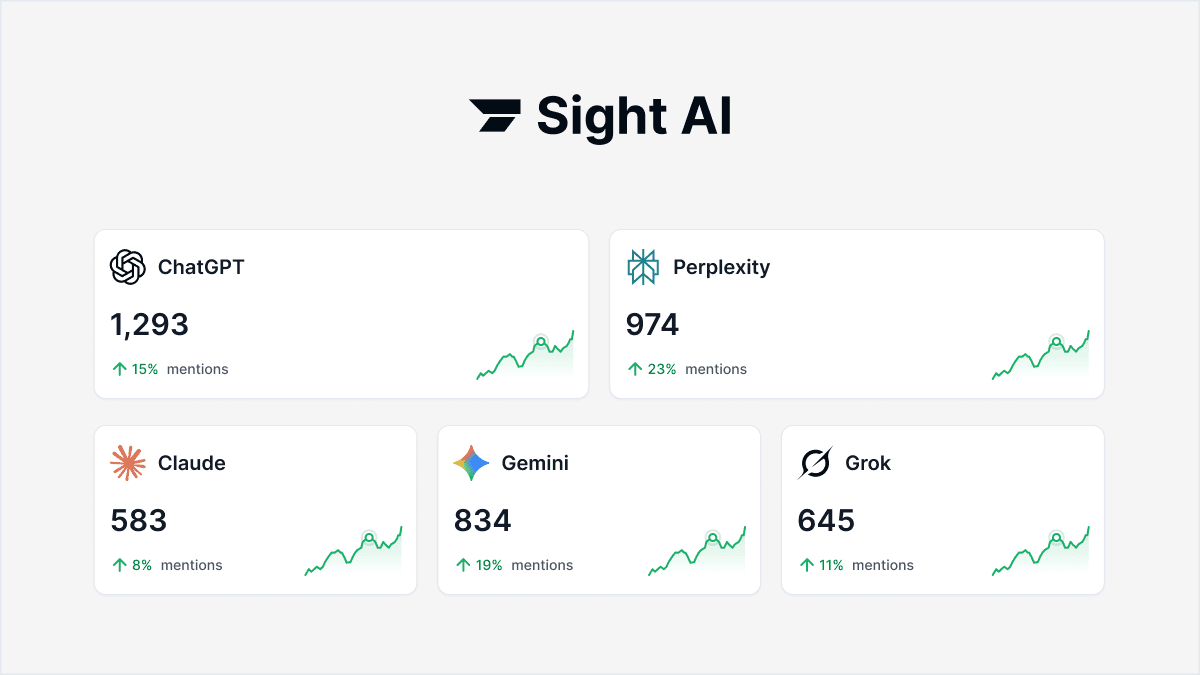
Platform-Specific Visibility: ChatGPT, Claude, Perplexity, Gemini, and other AI platforms each have different training data, retrieval methods, and recommendation algorithms. Your brand might appear frequently in ChatGPT responses but rarely in Claude. AI visibility metrics tracking across platforms reveals these discrepancies and helps you understand where to focus optimization efforts based on where your audience actually searches.
The difference between being mentioned positively, negatively, or not at all creates three distinct tiers of AI visibility. Positive mentions drive consideration and action. Negative mentions can actively harm your business by steering potential customers toward competitors. But perhaps most dangerous is the third category: complete invisibility. When AI models consistently recommend competitors without mentioning your business at all, you're losing market share to brands that have figured out how to signal their expertise in ways AI models recognize.
Tracking these metrics across multiple platforms simultaneously gives you the complete picture. A comprehensive AI visibility tracking system monitors how different models respond to the same prompts, revealing patterns in how your brand is perceived and recommended across the AI ecosystem.
The Small Business Advantage in AI Visibility
Large corporations are scrambling to understand AI visibility, but they're handicapped by their own scale. Enterprise content strategies, legal review processes, and brand guideline committees slow them down. Meanwhile, small businesses can move fast, experiment freely, and leverage their most powerful asset: deep, specific expertise in narrow domains.
Right now, in early 2026, we're in a unique window of opportunity. Most businesses—including your direct competitors—aren't tracking their AI visibility at all. They're still focused entirely on traditional SEO, unaware that a parallel discovery channel is growing rapidly without their participation. This creates an asymmetric advantage for the small businesses focused on AI visibility that recognize the shift and act on it.
Think about how AI models construct recommendations. They favor authoritative, specific answers over generic brand messaging. When someone asks "What's the best accounting software for wedding photographers," an AI is more likely to recommend a solution from a company that has published detailed content about accounting challenges specific to wedding photography businesses. The national accounting software brand with generic small business messaging loses to the smaller competitor with demonstrated niche expertise.
This dynamic inverts traditional competitive advantages. In SEO, small businesses often struggle to compete with enterprise budgets for link building and content production at scale. In AI visibility, niche authority and specific expertise can outperform generic content volume. A local marketing agency that has deeply documented their approach to serving dental practices may achieve better AI visibility in that niche than a global agency with broader but shallower content.
The barrier to entry is fundamentally lower than traditional SEO competition. You don't need thousands of backlinks or a massive content library. You need clear expertise signals, well-structured information about your business, and content that demonstrates authority in your specific domain. For small businesses with genuine expertise, this is achievable in weeks or months rather than years.
The businesses that establish strong AI visibility now will compound that advantage over time. As AI models continue learning and updating their knowledge bases, brands that consistently appear as authorities in their niches will reinforce their position. Starting early means your expertise signals get incorporated into the patterns AI models use to make future recommendations.
Building Your AI Visibility Tracking Foundation
Setting up effective AI visibility tracking starts with understanding which platforms matter most for your specific business and audience. Not every AI assistant is equally relevant to every industry, and spreading your efforts too thin dilutes impact.
Platform Prioritization: ChatGPT currently has the largest user base and is often the starting point for tracking. Perplexity has strong adoption among users seeking research and recommendations. Claude is growing rapidly, particularly among users who value detailed, nuanced responses. Gemini integrates with Google's ecosystem and matters for businesses whose customers use Google products. Start by tracking the two or three platforms where your target audience is most likely to search, then expand as you build systems and processes.
Establishing your baseline visibility requires systematic testing of prompts relevant to your business. If you run a social media management agency, you need to know how AI models respond to prompts like "best social media agency for B2B SaaS companies," "how to choose a social media management service," and "affordable social media help for startups." Manual testing means opening each AI platform and entering these prompts yourself to see what gets recommended. This gives you qualitative insights but becomes impractical at scale.
This is where AI visibility tracking tools become valuable. Rather than manually testing dozens of prompts across multiple platforms daily or weekly, automated tracking systems can monitor hundreds of prompt variations continuously, alerting you to changes in your visibility and competitor mentions. The time savings alone justify the investment for most small businesses serious about AI visibility.
What to Monitor: Your tracking system should cover three categories of prompts. First, direct brand queries—variations of your business name that users might search. Second, category and comparison queries where your business should appear but might not: "best [your category] for [your niche]" or "alternatives to [competitor name]." Third, problem-solution queries where your expertise could be relevant: "how to solve [problem your business addresses]."
Competitor mention tracking is equally important. When AI models don't recommend your business, which competitors do they mention instead? This reveals who you're actually competing against in AI-powered discovery—which may differ from your traditional competitive set. You might discover that AI models frequently recommend a competitor you hadn't been tracking, or that you're being positioned against businesses in adjacent categories rather than direct competitors.
Brand name variations matter more than you might expect. AI models might recognize your full legal business name but not your common abbreviation, or vice versa. If you're "Smith & Associates Marketing Agency" but clients call you "Smith Marketing," you need to track both variations to understand your complete visibility picture.
The goal of this foundation phase is creating a clear baseline: where do you appear today, with what frequency, with what sentiment, and compared to which competitors? This baseline becomes your benchmark for measuring improvement as you optimize your AI visibility strategy.
Translating Visibility Data Into Content Strategy
Tracking your AI visibility reveals gaps and opportunities, but the real value comes from using that intelligence to improve your position. The connection between visibility data and content strategy is direct: AI models cite and reference content that demonstrates expertise, uses clear entity relationships, and provides comprehensive answers to specific questions.
When your tracking shows that AI models never mention your business for a valuable prompt category, you have a content opportunity. If "best CRM for real estate teams" never triggers your brand but you serve that market, you need content that establishes your expertise in that specific niche. This isn't about keyword stuffing or gaming algorithms—it's about creating genuinely useful content that helps AI models understand your relevance and authority.
Structured Data and Entity Optimization: AI models understand the web through entities and relationships. Making your business information clear and structured helps AI models identify you correctly and understand your expertise areas. This means having consistent business information across your website, clear descriptions of what you do and who you serve, and explicit connections between your business and the problems you solve.
Authoritative content that AI models can cite typically shares common characteristics: it addresses specific questions comprehensively, demonstrates expertise through detailed explanations and examples, uses clear language and structure that makes information easy to extract, and includes relevant entity mentions that establish topical authority. A blog post titled "5 Quick Tips" is less likely to be cited than a comprehensive guide that thoroughly addresses a specific challenge your audience faces.
The feedback loop is where AI visibility optimization becomes truly powerful. You track your current visibility, identify gaps, create optimized content to address those gaps, measure whether your visibility improves in those areas, and iterate based on results. This cycle is faster and more direct than traditional SEO feedback loops because you can see changes in AI recommendations within weeks rather than months.
For example, imagine your tracking reveals that AI models frequently recommend competitors when users ask about marketing automation for e-commerce businesses, but never mention your agency. You create a detailed guide addressing common automation challenges specific to e-commerce brands, publish case studies showing your work in that space, and structure your service pages to clearly establish your e-commerce expertise. Within a few weeks, you re-test the same prompts and measure whether your mention frequency has increased.
This approach aligns with traditional SEO best practices but extends beyond them. You're not just optimizing for search engine crawlers—you're creating content that helps AI models understand your expertise and cite your business as a relevant solution. The content that performs well in AI visibility tracking tends to perform well in traditional search too, making this a complementary strategy rather than a replacement.
Integrating AI Visibility Into Your Marketing Workflow
The key to sustainable AI visibility tracking is making it a regular part of your marketing workflow without it becoming overwhelming. Small business owners don't have time for daily monitoring of dozens of metrics, but they can't afford to ignore AI visibility entirely.
A realistic time investment for most small businesses is a weekly check-in of 30-45 minutes. During this time, review your visibility reports to identify significant changes, note new competitor mentions, and spot emerging prompt categories where you should be visible but aren't. This weekly rhythm keeps you informed without becoming a time sink, and it's frequent enough to catch meaningful trends while they're still actionable.
Prioritizing which visibility gaps to address first requires connecting tracking data to business impact. Not all prompts are equally valuable. A prompt that triggers 100 searches per month with high purchase intent is worth optimizing for before a prompt with 1,000 searches but low commercial value. Look for the intersection of high visibility gaps and high business impact—these are your priority opportunities.
AI visibility tracking integrates naturally with existing SEO and content marketing efforts because the underlying principles align. Content that demonstrates expertise and authority performs well in both traditional search and AI recommendations. The main difference is that AI visibility tracking gives you faster, more specific feedback about which content is actually being cited and recommended. Using SEO tools for small business alongside AI tracking creates a comprehensive discovery strategy.
Consider building AI visibility checkpoints into your content creation process. Before publishing a new piece of content, ask: "What prompts should this help us rank for in AI recommendations?" After publishing, track whether your visibility for those prompts improves over the following weeks. This creates accountability and helps you learn which content approaches drive the best AI visibility results.
For small businesses with limited resources, focus beats breadth. It's better to deeply optimize your visibility for the 20 most valuable prompts in your niche than to spread efforts across 200 generic queries. Identify your core visibility targets—the prompts that, if you owned them in AI recommendations, would drive meaningful business growth—and concentrate your optimization efforts there.
Your Competitive Advantage Starts Now
AI visibility tracking isn't replacing SEO or traditional marketing—it's the next layer of discovery that small businesses need to master while the opportunity is still wide open. The businesses that start tracking and optimizing their AI visibility now will build compound advantages that become harder to overcome as this channel matures.
Think about where SEO was in 2010. The businesses that invested early in content marketing and search optimization built traffic assets that still drive results today. We're at a similar inflection point with AI-powered discovery. The difference is that you're reading this early enough to be among the first movers rather than playing catch-up years later.
The competitive advantage of starting now is real and measurable. While your competitors remain focused exclusively on traditional search rankings, you can establish authority signals that AI models recognize and cite. While they wonder why qualified leads have slowed down, you'll understand that those prospects are finding solutions through AI assistants—and you'll be the solution they're finding.
Small businesses have a unique window of opportunity here. Your ability to move quickly, your deep niche expertise, and your willingness to experiment give you advantages that larger competitors can't easily replicate. The question isn't whether AI-powered discovery will matter to your business—it already does. The question is whether you'll start tracking and optimizing your visibility now or wait until competitors have already claimed the territory.
Stop guessing how AI models like ChatGPT and Claude talk about your brand—get visibility into every mention, track content opportunities, and automate your path to organic traffic growth. Start tracking your AI visibility today and see exactly where your brand appears across top AI platforms.