You've spent months building your brand, publishing content, and establishing authority in your space. Then one day you casually ask ChatGPT about your industry—and your brand isn't mentioned anywhere. Meanwhile, three competitors show up in the response, positioned as the go-to solutions.
This is the new reality of AI search. When potential customers ask Claude, Perplexity, or ChatGPT for recommendations, these AI models deliver direct answers with specific brand mentions. No blue links. No chance to optimize your way onto page one. Just a curated list of brands the AI deems relevant.
The problem? Most marketers have zero visibility into this critical channel. You don't know if your brand gets mentioned, how it's positioned when it does appear, or what prompts trigger these mentions. Traditional SEO tools can't help—they're built for ranking URLs, not tracking brand mentions in conversational AI responses.
This guide walks you through building a complete AI search result tracking system from the ground up. You'll learn how to identify which AI platforms matter for your business, configure monitoring that captures every mention, establish baseline metrics that prove ROI, and create dashboards that surface actionable opportunities. By the end, you'll have a working system that tracks your brand's presence across major AI models and tells you exactly what content to create next.
Let's start with the foundation: figuring out where your audience is actually searching.
Step 1: Identify Your Priority AI Platforms and Tracking Scope
Not all AI search platforms matter equally for your business. Your first task is figuring out where your target audience actually goes when they need answers.
Start by auditing the major players: ChatGPT dominates general queries, Claude excels with technical and research-focused users, Perplexity attracts users who want cited sources, Google AI Overviews reach mainstream searchers, and Bing Copilot captures Microsoft ecosystem users. The platform mix that matters depends entirely on your audience.
Run a Quick Audience Survey: Ask 20-30 customers or prospects which AI tools they use regularly. You're looking for patterns. If you're targeting developers, Claude and ChatGPT likely dominate. If you're after mainstream consumers, Google AI Overviews and ChatGPT matter most.
Once you know your platforms, define your tracking scope. This goes beyond just your brand name. You need to track brand name variations (including common misspellings), product names, competitor brands, and broad category terms where your brand should appear.
For example, if you sell project management software, your tracking scope might include your brand name, your flagship product name, your top five competitors, and category terms like "project management tools" or "team collaboration software."
Build Your Prompt Library: This is where most people start too narrow. Create a master list of 20-50 prompts your ideal customers might actually ask. Think about different stages of awareness.
Early-stage prompts might be: "What are the main challenges with remote team collaboration?" Mid-stage prompts: "What project management tools work best for distributed teams?" Late-stage prompts: "Compare [Your Brand] vs [Competitor] for remote teams."
The key is capturing the full spectrum of how people ask about your category. Include comparison prompts, problem-solution prompts, recommendation prompts, and how-to prompts where your brand could naturally fit. Understanding search intent helps you build a more effective prompt library.
Verify Your Baseline: Before you set up any automation, test 5-10 of your most important prompts manually across your priority platforms. Take screenshots. Document which brands appear, how they're positioned, and whether your brand shows up at all.
This manual testing serves two purposes: it gives you an immediate reality check on your current AI visibility, and it helps you refine your prompt library before you scale up tracking. If a prompt consistently returns irrelevant results across platforms, cut it from your list.
Success indicator for this step: You have a documented list of 3-5 priority AI platforms, a tracking scope that covers your brand ecosystem, and a prompt library of 20-50 tested queries. You've also run manual tests that show your current mention status.
Step 2: Select and Configure Your AI Visibility Tracking Tool
Manual tracking works for validation, but it doesn't scale. You need a system that monitors AI responses automatically and alerts you to changes.
When evaluating tracking solutions, focus on three critical capabilities: platform coverage, update frequency, and sentiment analysis. Your tool needs to monitor all the AI platforms you identified in Step 1. It should check for updates at least weekly, ideally daily for high-priority prompts. And it must analyze sentiment—knowing your brand was mentioned isn't enough if the context is negative.
Platform Coverage Matters More Than You Think: Some tracking tools only monitor ChatGPT. That's fine if ChatGPT is your only priority platform, but most brands need multi-platform visibility. Verify that your chosen solution covers your full platform list before committing. Explore the best tools for AI search optimization to find the right fit.
Once you've selected your tool, the configuration process typically follows a similar pattern across platforms. You'll start by adding your brand entities—this includes your company name, product names, and any branded terms you want to track.
Next, add your competitor tracking list. Most tools let you monitor 5-10 competitors alongside your own brand. This competitive intelligence is crucial—you need to know not just when you're mentioned, but when competitors appear in contexts where you're absent.
Import Your Prompt Library: Upload the prompt list you created in Step 1. Most tracking platforms let you organize prompts into categories: informational, comparison, product-specific, and so on. This organization pays off later when you're analyzing results.
Configure your alert thresholds carefully. You want to be notified about significant changes without drowning in noise. Set alerts for mention volume drops of 20% or more, sentiment shifts from positive to neutral or negative, and new competitor mentions in your tracked prompts.
Some platforms offer prompt discovery features that suggest new queries to track based on your initial library. Enable this if available—it helps you expand coverage over time without manual research.
Set Your Tracking Frequency: For most brands, daily tracking of high-priority prompts and weekly tracking of your full library strikes the right balance. If you're in a fast-moving industry or running active campaigns, consider increasing frequency for specific prompt sets.
Success indicator: Within 24-48 hours of configuration, you should receive your first automated tracking report showing mention data across your platforms and prompts. If you're not seeing data by then, revisit your configuration—something's likely misconfigured.
Step 3: Establish Your AI Visibility Baseline Metrics
You can't improve what you don't measure. Before you start optimizing for AI visibility, you need to document exactly where you stand right now.
Your baseline measurement should capture three key dimensions: mention frequency, sentiment distribution, and competitive positioning. Start by recording how often your brand appears across each AI platform for your tracked prompts.
For example, you might discover that your brand appears in 15% of tracked prompts on ChatGPT, 8% on Claude, and 22% on Perplexity. These numbers become your baseline mention rates per platform.
Document Sentiment Distribution: When your brand does appear, what's the context? Most tracking tools categorize mentions as positive, neutral, or negative. Calculate the percentage breakdown across these categories.
A healthy baseline might show 60% positive mentions, 35% neutral, and 5% negative. If you're seeing high negative sentiment, that's a red flag requiring immediate attention—AI models might be surfacing outdated complaints or misconceptions about your brand. Learn more about brand mentions in AI search results to understand how sentiment impacts visibility.
Pay attention to the contexts where mentions appear. Are you showing up in comparison prompts? Recommendation prompts? Problem-solution prompts? The context mix tells you how AI models categorize your brand and where you have authority.
Calculate Your Competitive Share: For each tracked prompt where competitors appear, calculate your share of mentions. If a prompt generates five brand mentions and you're one of them, you have 20% share for that prompt.
Aggregate this across your prompt library to get your overall competitive share. This becomes one of your most important baseline metrics—it shows how you stack up against competitors in AI-generated recommendations.
Create Your AI Visibility Score: Many tracking platforms calculate a composite score that combines mention frequency, sentiment, and competitive positioning. If your tool provides this, record it as your baseline. If not, create a simple formula: (Mention Rate × Positive Sentiment Percentage × Competitive Share) × 100.
This single number gives you a trackable metric for overall AI visibility. A score of 50 means you're appearing in half your tracked prompts with mostly positive sentiment and moderate competitive share. A score of 80 indicates strong visibility. Below 30 signals serious gaps.
Common pitfall: Many marketers skip this baseline measurement and jump straight to optimization. Don't make this mistake. Without baseline metrics, you can't prove ROI when stakeholders ask if AI visibility efforts are working. Take the time to document where you stand today.
Step 4: Build Your Tracking Dashboard and Reporting Workflow
Raw tracking data is useless without a system that surfaces insights and drives action. Your dashboard needs to answer three questions instantly: What's changing? Where are the opportunities? What should we do next?
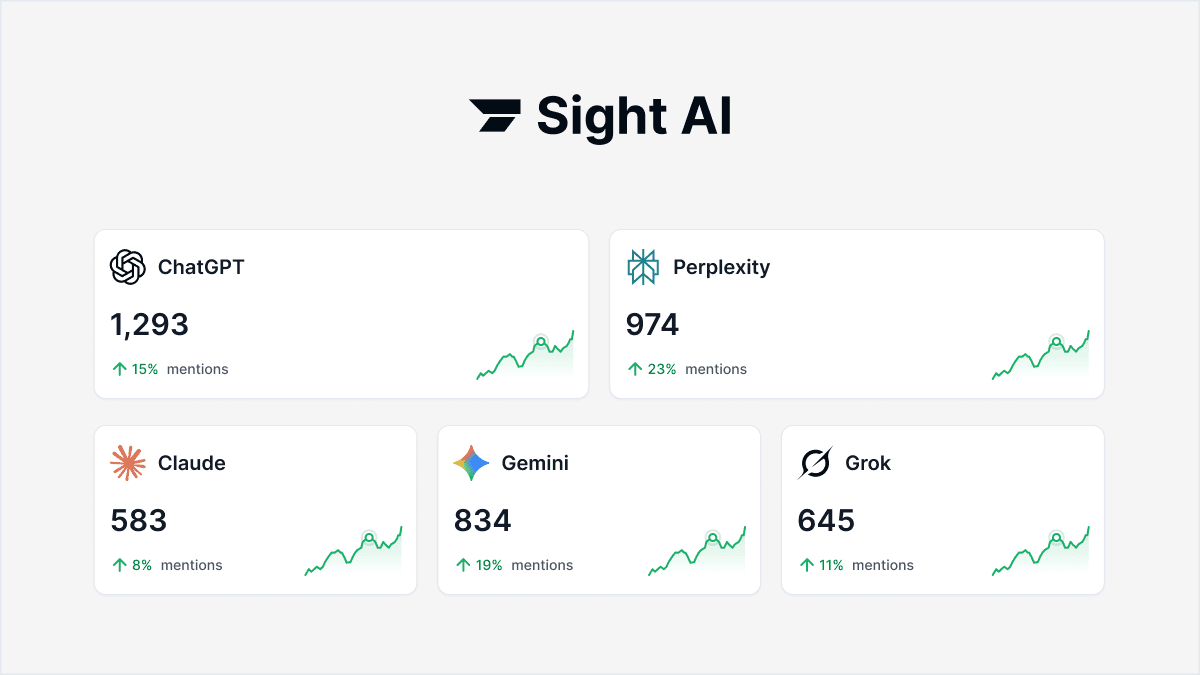
Start by creating a centralized view that shows mention trends over time. You want to see if your AI visibility is improving, declining, or staying flat. Most tracking platforms offer customizable dashboards—configure yours to show weekly mention counts by platform, sentiment trend lines, and competitive share evolution.
Platform-by-Platform Breakdown: Create separate dashboard sections for each AI platform you're tracking. ChatGPT performance might look completely different from Perplexity performance. You need visibility into these differences to allocate optimization efforts effectively.
For each platform section, display mention frequency, sentiment distribution, and your top-performing prompts. Highlight prompts where you consistently appear versus prompts where competitors dominate. This visual contrast makes opportunities obvious.
Add a competitive intelligence section that shows how your mention share compares to your top three competitors over time. Are you gaining ground or losing share? This competitive context matters more than absolute mention counts. Understanding competitor ranking in AI search results helps you benchmark your progress.
Set Up Automated Weekly Reports: Configure your tracking system to send a summary report every Monday morning. This report should highlight significant changes from the previous week: mention volume increases or decreases, new competitor appearances, sentiment shifts, and emerging prompt opportunities.
The key is actionability. Your weekly report shouldn't just dump data—it should flag items requiring attention. A 30% drop in mentions on Claude? That's a red flag. A competitor suddenly appearing in five prompts where you were previously alone? That's competitive intelligence worth investigating.
Define your key metrics for ongoing tracking. Most brands focus on four core metrics: overall AI Visibility Score, mention share versus competitors, positive sentiment percentage, and prompt coverage rate (percentage of tracked prompts where your brand appears).
Track these metrics weekly and plot them over time. You're looking for trends, not day-to-day fluctuations. AI responses can vary based on model updates and other factors outside your control, so focus on month-over-month directional movement.
Make It Stakeholder-Friendly: Your dashboard needs to communicate status to people who don't live in the data. Use visual indicators: green for improving metrics, yellow for flat performance, red for declining metrics. Add context annotations that explain why changes happened when you know the cause.
Success indicator: A stakeholder who's never seen your dashboard before should be able to understand your AI visibility status in under 60 seconds. If they need more than a minute to grasp the basics, your dashboard is too complex.
Step 5: Analyze Results and Identify Content Opportunities
Your tracking system is now generating data. This step is about turning that data into a prioritized content roadmap that improves your AI visibility.
Start by reviewing which prompts consistently generate brand mentions versus which ones return only competitor mentions. This gap analysis reveals your biggest opportunities. If competitors appear in 10 prompts where you're completely absent, those represent 10 potential content opportunities.
Map Content Gaps to Business Value: Not all prompt gaps are equally valuable. Prioritize based on two factors: how often people likely ask this question, and how close the question is to purchase intent.
A prompt like "What's the best project management tool for enterprise teams?" has high business value—it's asked frequently and indicates purchase intent. A prompt like "History of project management methodologies" might generate mentions but has lower commercial value.
Create a simple scoring system: High-value prompts (frequent + high intent) get priority one. Medium-value prompts (frequent OR high intent) get priority two. Low-value prompts (neither frequent nor high intent) get priority three.
Identify Content Types That Earn Mentions: Look at the prompts where you do appear and analyze what content earned those mentions. Is it comparison guides? How-to articles? Case studies? Product documentation?
This pattern recognition tells you what content formats AI models favor when answering questions in your category. If comparison content consistently earns mentions, that's a signal to create more comparison pieces. Understanding AI search ranking factors helps you create content that gets cited.
Pay attention to the depth and structure of content that gets cited. AI models tend to favor comprehensive, well-structured content with clear headings, specific examples, and authoritative information. Shallow content rarely gets mentioned even if it targets the right topics.
Build Your Content Opportunity Queue: Create a prioritized list of content pieces to create or improve. For each item, document the target prompt, the gap you're filling, the content format that works for similar prompts, and the expected impact on AI visibility.
For example: "Create comprehensive guide comparing top 10 project management tools for remote teams. Target prompt: 'Best project management software for distributed teams.' Current status: Competitors mentioned, we're absent. Format: Detailed comparison with feature tables. Expected impact: Capture 20% mention share in this high-value prompt."
Prioritize your queue by combining business value with competitive gap size. The biggest opportunities are high-value prompts where you're absent and competitors are strongly positioned—these represent both significant business potential and clear evidence that AI models will cite content on this topic.
Success indicator: You have a documented content queue with at least 10 prioritized opportunities, each mapped to specific prompts where you want to earn mentions. You understand what content format to create and why it will improve your AI visibility.
Step 6: Implement a Continuous Monitoring and Optimization Loop
AI visibility isn't a set-it-and-forget-it channel. AI models update regularly, competitors publish new content, and user behavior evolves. You need a systematic process for ongoing monitoring and optimization.
Schedule monthly deep-dive reviews where you assess progress against your baseline metrics. Compare your current AI Visibility Score to where you started. Look at mention share trends versus competitors. Evaluate whether your content efforts are moving the needle.
Set Up Immediate Action Triggers: Some changes require faster response than monthly reviews. Configure alerts for three scenarios that demand immediate attention.
First, sudden mention drops of 30% or more within a week. This could indicate a competitor published superior content, an AI model updated its training data, or negative news about your brand is circulating. Investigate the cause immediately. If you're experiencing this, review strategies for addressing losing visibility in AI search results.
Second, negative sentiment spikes. If your positive sentiment percentage drops below 50%, or negative mentions increase significantly, dig into what's driving the change. AI models might be surfacing complaints or controversies that need addressing.
Third, new competitor entries in your tracked prompts. When a competitor suddenly appears in multiple prompts where they were previously absent, they've likely published content that's earning AI citations. Analyze their content strategy and adapt accordingly. Learn how to track competitors in AI search results effectively.
Connect Tracking to Content Production: This is where many brands fail—they track AI visibility but never close the loop back to content creation. Your tracking insights should directly inform your content calendar.
When you identify a high-value prompt where competitors dominate, that becomes a content brief. When you notice your mention share declining in a category, that triggers a content refresh project. When sentiment trends negative, that sparks reputation management content.
Create a formal process where tracking insights feed into your content workflow. Weekly tracking reports should generate content tasks. Monthly reviews should update your content roadmap. This closed-loop system ensures you're always optimizing based on actual AI visibility data.
Expand Your Prompt Library Over Time: As you learn more about how your audience asks questions, add new prompts to your tracking. Monitor industry forums, customer support tickets, and social media to discover new ways people phrase queries about your category.
Your initial library of 20-50 prompts should grow to 100+ over time as you capture more variations and edge cases. This expansion improves your visibility into AI search performance and surfaces new content opportunities.
Success indicator: Within 90 days of implementing your tracking system, you should see measurable improvement in your AI Visibility Score. If you're not seeing progress, revisit your content strategy—you might be creating content that doesn't align with how AI models select information to cite.
Your AI Visibility Tracking System Is Live
You've built a complete system for monitoring and improving how AI search engines talk about your brand. Quick checklist: priority platforms identified, tracking tool configured, baseline metrics documented, dashboard providing weekly insights, content opportunities mapped to specific prompts, and ongoing monitoring scheduled.
The brands winning in AI search aren't just creating content and hoping for the best. They're systematically tracking how AI models position them, identifying gaps where competitors dominate, and optimizing their content strategy based on actual mention data.
This is the new frontier of search visibility. Traditional SEO focused on ranking URLs on page one. AI visibility focuses on earning mentions in direct answers that bypass traditional search results entirely. As more users turn to ChatGPT, Claude, and Perplexity for answers, your presence in these AI responses becomes increasingly critical.
Start with weekly reviews of your tracking data. Look for patterns in what's working and what's not. Notice which content formats consistently earn mentions and double down on those. Pay attention to sentiment trends and address negative patterns quickly.
Your prompt library will evolve as you learn more about how your audience asks questions. Add new prompts monthly based on customer conversations, support tickets, and industry discussions. The more comprehensive your tracking, the better your visibility into AI search performance.
Remember that AI models update regularly. What works today might need adjustment tomorrow as models retrain on new data. Your tracking system gives you early warning when changes happen so you can adapt quickly.
Stop guessing how AI models like ChatGPT and Claude talk about your brand—get visibility into every mention, track content opportunities, and automate your path to organic traffic growth. Start tracking your AI visibility today and see exactly where your brand appears across top AI platforms.
Your next action: Run your first full tracking cycle over the next seven days. Review the results and identify three content pieces you can create or improve within the next 30 days. Focus on high-value prompts where competitors currently dominate but you have the expertise to compete. That's your fastest path to measurable AI visibility improvement.