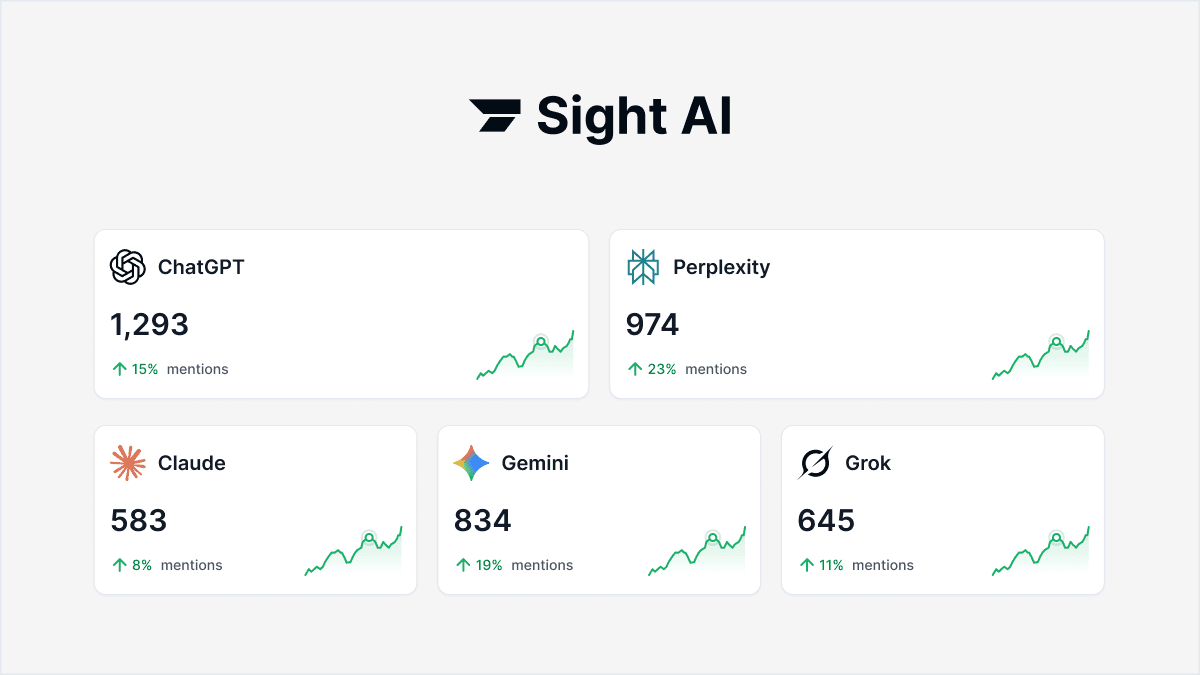
Your SaaS product might be getting mentioned by ChatGPT, Claude, and Perplexity right now—and you have no idea what they're saying. As AI-powered search becomes a primary discovery channel for software buyers, tracking how AI models discuss your brand has shifted from nice-to-have to essential.
Think about it: when a potential customer asks ChatGPT "What's the best project management tool for remote teams?" or queries Claude about "top CRM solutions for startups," your brand might appear in those responses. Or worse, it might not appear at all while your competitors dominate the conversation.
This guide walks you through implementing AI visibility tracking for your SaaS company, from initial setup to ongoing optimization. You'll learn how to monitor brand mentions across major AI platforms, measure sentiment, identify content gaps, and use these insights to improve how AI models represent your product.
Whether you're a founder trying to understand your AI presence or a marketer building a comprehensive visibility strategy, these steps will help you take control of your brand's AI narrative. Let's get started.
Step 1: Audit Your Current AI Presence Across Major Platforms
Before you can improve your AI visibility, you need to understand where you stand today. This baseline audit reveals exactly how AI models currently discuss your brand—or whether they mention you at all.
Start by identifying the prompts your target customers actually use. Put yourself in their shoes. If someone is searching for a solution like yours, what would they ask? For a project management SaaS, that might be "best tools for managing distributed teams" or "how to track project milestones effectively."
Query each major platform systematically: Open ChatGPT, Claude, Perplexity, and Gemini in separate tabs. Ask the same customer-focused questions across all four platforms. Don't just search for your brand name—that's not how real buyers discover solutions.
Document everything you find. Create a simple spreadsheet with columns for the platform, the prompt used, whether your brand was mentioned, the context of the mention, and the overall sentiment. Was the mention positive, neutral, or negative? Did the AI provide accurate information about your features and pricing?
Here's where it gets interesting: pay close attention to which competitors appear in responses where your brand should logically be included. If you're a legitimate player in the CRM space but Claude recommends three competitors without mentioning you, that's a critical visibility gap. Understanding brand tracking across AI platforms becomes essential for identifying these competitive blind spots.
Test at least 10-15 different prompts that cover your core use cases, target industries, and problem statements. This gives you enough data to identify patterns. You might discover that Perplexity mentions you frequently for enterprise queries but ignores you for small business searches.
Create your baseline scorecard: Rate each platform on a simple scale for mention frequency, accuracy, and sentiment. This becomes your benchmark for measuring improvement over the coming months.
The audit typically takes 2-3 hours but reveals insights you can't get any other way. You're seeing your brand through the lens that increasingly shapes buyer perception—before prospects ever visit your website.
Step 2: Define Your Tracking Metrics and Success Criteria
Raw data without context is just noise. Now that you've completed your baseline audit, it's time to establish the metrics that will actually drive your AI visibility strategy forward.
Mention frequency: How often does your brand appear in relevant AI responses? Track this as a percentage—if you test 20 prompts and appear in 6 responses, that's a 30% mention rate. This becomes your primary growth metric.
Sentiment score: Not all mentions are created equal. A mention that describes your product as "complicated and expensive" hurts more than it helps. Assign a simple positive/neutral/negative rating to each mention, then calculate your sentiment ratio.
Accuracy rate: AI models sometimes get facts wrong—outdated pricing, discontinued features, or confused product capabilities. Tracking AI visibility metrics helps you identify what percentage of mentions contain accurate, current information about your SaaS.
Competitor share of voice: In responses where your category is discussed, what percentage mention your brand versus competitors? If three competitors consistently appear while you don't, you're losing visibility battles that directly impact pipeline.
Set realistic benchmarks based on your current market position. If you're an established player with strong SEO, you might target a 60% mention rate within six months. If you're newer to market, 30% might be ambitious but achievable.
Determine which AI platforms matter most for your specific SaaS category. B2B enterprise software buyers increasingly use Claude and Perplexity for research, while consumer SaaS prospects might lean toward ChatGPT. Focus your efforts where your customers actually search.
Establish your tracking cadence: Weekly monitoring makes sense during active content campaigns or product launches when you're publishing frequently. Monthly tracking works well for baseline monitoring and long-term trend analysis.
The key is consistency. Tracking sporadically gives you snapshots, but consistent measurement reveals trends and validates what's actually working.
Step 3: Configure Automated Monitoring with Prompt Libraries
Manual checking across four platforms every week quickly becomes unsustainable. This is where automated AI visibility tracking transforms from a research project into a scalable system.
Start by building your prompt library—the collection of queries you'll monitor consistently. These should mirror real customer search behavior, not vanity searches for your brand name. Include category searches, problem-focused queries, comparison prompts, and use case scenarios.
For a marketing automation SaaS, your library might include prompts like "how to automate email campaigns for e-commerce," "best tools for lead scoring," and "marketing automation vs CRM differences." Aim for 15-25 core prompts that cover your primary value propositions and target use cases.
Set up systematic tracking using specialized tools: Platforms designed for AI visibility tracking software can query multiple AI models simultaneously, track mention frequency over time, and alert you to significant changes. This eliminates the manual work of checking each platform individually.
Configure alerts for meaningful shifts in your visibility. A sudden drop in mention frequency might indicate competitors have published strong new content. A sentiment change from positive to neutral could signal outdated information circulating about your product.
Include competitor brand names in your monitoring strategy. You're not just tracking your own mentions—you need to understand the competitive landscape within AI responses. When Perplexity recommends three competitors for a query where you should appear, that's actionable intelligence.
Build in prompt variation: AI models respond differently to subtle phrasing changes. "Best CRM for startups" might yield different results than "top CRM tools for early-stage companies." Exploring prompt tracking for brands helps you test variations of your core prompts to understand the full visibility landscape.
The goal is a system that runs automatically, surfaces important changes, and gives you consistent data without constant manual effort. This frees you to focus on strategy and content creation rather than data collection.
Step 4: Analyze Sentiment and Identify Content Gaps
Now that you're collecting consistent data, it's time to extract insights that drive action. This analysis phase separates companies that track AI visibility from those that actually improve it.
Start with sentiment patterns. Review how AI models describe your product across different contexts. Are they highlighting your strengths accurately? When Claude mentions your SaaS, does it emphasize the features you've invested in, or does it focus on outdated capabilities?
Look for sentiment inconsistencies across platforms. If ChatGPT consistently describes your product positively while Gemini sounds neutral or skeptical, that points to differences in their training data or the content they're indexing. You might need platform-specific content strategies, and understanding ChatGPT brand visibility tracking versus other platforms becomes crucial.
Identify topics where competitors get mentioned but you don't: This is where the real opportunities hide. If every AI model recommends three competitors when asked about "project management for agencies" but never mentions you, that's a content gap screaming for attention.
Create a gap analysis spreadsheet. List the prompts where you're absent, note which competitors appear instead, and identify the common themes. You might discover that competitors dominate conversations about specific industries, use cases, or integration capabilities.
Map the disconnect between how AI describes your product versus your actual value propositions. If your core differentiator is enterprise-grade security but AI models never mention it, your content isn't effectively communicating that strength to the systems that matter.
Prioritize content opportunities strategically: Not all gaps deserve equal attention. Focus first on high-intent topics where buyer interest is strong. A gap in "best tools for X" queries typically matters more than absence from broad educational content.
Consider competitive positioning when prioritizing. If you're the clear leader in a specific vertical but AI models don't reflect that, closing that gap should be top priority. Those are buyers you should be winning but might be losing to AI-driven misinformation.
The analysis phase should produce a clear action plan: specific topics to target, content types to create, and platforms that need the most attention. This transforms your tracking data into a strategic roadmap.
Step 5: Create GEO-Optimized Content to Improve AI Mentions
Understanding your gaps means nothing without action. This step is where you create content specifically structured for AI model consumption and citation—what's known as Generative Engine Optimization.
GEO-optimized content differs from traditional SEO content in important ways. AI models prefer authoritative, factual content with clear structure and verifiable information. They cite sources that directly answer questions without fluff or excessive marketing language. Learning about GEO optimization for SaaS companies helps you understand these critical differences.
Develop content targeting your identified gaps: If your analysis revealed that competitors dominate "CRM for real estate" queries, create comprehensive content addressing exactly that topic. But don't just write another blog post—structure it for AI consumption.
Use clear, descriptive headings that match natural language queries. Include specific features, use cases, and implementation details. AI models look for concrete information they can reference, not vague marketing claims.
Focus on the topics and questions where you identified visibility gaps. If AI models never mention your integration capabilities, publish detailed integration guides. If they're citing outdated pricing information, ensure current pricing pages are well-structured and easily indexable.
Ensure fast indexing using IndexNow integration: AI models can only cite content they can access. The faster your new content gets indexed, the sooner it can influence AI responses. Reviewing the best indexing tools for SaaS enables immediate notification to search engines and AI platforms when you publish new content.
This is critical for SaaS companies where product information changes frequently. If you launch a new feature but AI models are still describing your old capabilities three months later, you're losing competitive positioning in AI-driven research.
Structure your content with AI citation in mind. Include clear definitions, bullet-pointed feature lists, and specific use cases. When AI models scan your content for relevant information to include in responses, well-structured data makes citation easier.
Publish consistently across your priority topics: One article won't shift AI visibility. Build a content library that comprehensively covers the topics where you need stronger presence. AI models develop stronger associations with brands that have depth of authoritative content.
The goal isn't just to rank in traditional search—it's to become the source AI models cite when discussing your category, use cases, and solutions.
Step 6: Measure Results and Iterate Your Strategy
Content published, monitoring running—now comes the critical feedback loop that separates one-time efforts from sustained AI visibility growth.
Compare your current AI visibility scores against the baseline audit you completed in Step 1. Are mention rates improving? Has sentiment shifted more positive? Are you appearing in responses where you were previously absent?
Track which specific content improvements led to better AI mentions. If you published a comprehensive guide on "CRM for healthcare providers" and suddenly start appearing in related AI responses, that's validated success. Document what worked so you can replicate it.
Analyze the time lag between publishing and visibility improvement: Some AI platforms update their knowledge bases more frequently than others. Understanding these patterns helps you set realistic expectations and optimize your publishing calendar. Using an AI visibility tracking dashboard makes monitoring these changes significantly easier.
Look for unexpected wins. Sometimes content you create for one purpose improves visibility in adjacent topics you hadn't considered. These discoveries can open new content opportunities you hadn't identified in your initial gap analysis.
Adjust your prompt library based on emerging customer query patterns. The questions buyers ask evolve as your market matures and competitors shift positioning. Your monitoring should evolve with them.
Build a sustainable feedback loop: Monitor your visibility metrics, identify new gaps or opportunities, create targeted content, measure the impact, and repeat. This cycle compounds over time as your content library grows and AI models develop stronger associations with your brand.
Review competitor visibility trends alongside your own. If a competitor suddenly surges in mentions, investigate what changed. Did they launch a major content initiative? Announce new features? Understanding competitive movements helps you stay ahead.
Refine your success metrics as you learn what's actually achievable in your category. Initial benchmarks are educated guesses—real data over time reveals what's realistic and where you should push harder.
The companies seeing the strongest AI visibility growth treat this as an ongoing discipline, not a project with an end date. Each cycle of measurement and optimization builds on the previous one, creating compounding returns on your content investment.
Taking Control of Your AI Narrative
AI visibility tracking for SaaS isn't a one-time project—it's an ongoing practice that compounds over time. The brands that master this discipline now will have a significant advantage as AI-powered search continues to reshape how software buyers discover and evaluate solutions.
By following these six steps, you've established a foundation for understanding and improving how AI models discuss your brand. You've moved from complete uncertainty about your AI presence to systematic monitoring and strategic optimization.
Quick implementation checklist: Baseline audit completed across ChatGPT, Claude, Perplexity, and Gemini. Core metrics and realistic benchmarks defined. Automated monitoring configured with a comprehensive prompt library. Content gaps identified and prioritized. GEO-optimized content published targeting your biggest opportunities. Measurement cadence established with regular review cycles.
Start with your baseline audit this week. Block out three hours, query the major AI platforms with prompts your customers actually use, and document where you stand today. That single action provides the clarity you need to build everything else.
Then focus on getting your monitoring infrastructure in place. Manual tracking works for initial research, but automated systems are essential for sustainable visibility growth. The sooner you establish consistent measurement, the sooner you can identify what's working and double down on successful strategies.
Remember: every day you're not tracking AI visibility is a day you're flying blind while your competitors potentially dominate the conversations that drive buyer decisions. The gap between companies actively managing their AI presence and those ignoring it will only widen.
Stop guessing how AI models like ChatGPT and Claude talk about your brand—get visibility into every mention, track content opportunities, and automate your path to organic traffic growth. Start tracking your AI visibility today and see exactly where your brand appears across top AI platforms.