Picture this: Your ideal customer opens ChatGPT and types, "What are the best marketing automation platforms for B2B SaaS companies?" They're early in their research journey, gathering options before diving deeper. The AI responds with a thoughtful list of five platforms. Your competitor is mentioned. Another competitor gets a detailed explanation of their features. Your brand? Nowhere to be found.
This scenario is playing out thousands of times every day across B2B industries. Decision-makers are increasingly bypassing traditional search engines entirely, turning instead to AI assistants like ChatGPT, Claude, Perplexity, and Gemini to compile vendor shortlists, compare solutions, and understand market landscapes. These AI-powered research sessions happen in private, leaving no analytics trail for you to follow.
The critical question every B2B brand must answer in 2026 is deceptively simple: When prospects ask AI assistants about solutions in your category, does your brand appear in the response? AI visibility monitoring has emerged as the discipline that answers this question—and for B2B brands specifically, the stakes are uniquely high. Unlike consumer purchases, B2B buying decisions involve multiple stakeholders, longer evaluation cycles, and higher transaction values. Missing from AI recommendations doesn't just cost you a click. It costs you a seat at the table before the conversation even begins.
The Hidden Discovery Channel Your B2B Competitors Are Already Exploiting
Something fundamental has shifted in how B2B buyers discover and evaluate vendors. The traditional path—Google search, website visit, form fill—is being supplemented and sometimes replaced entirely by a new behavior: asking AI assistants for recommendations.
Think about how this works in practice. A VP of Sales needs a new sales intelligence platform. Rather than Googling "best sales intelligence tools" and sorting through SEO-optimized listicles, they open Claude and have a conversation: "I need a sales intelligence platform for a 50-person team focused on mid-market accounts in the healthcare sector. What are my best options?" The AI responds with specific recommendations, feature comparisons, and even pricing considerations—all synthesized from its training data and real-time information.
This interaction represents a fundamentally different discovery mechanism than traditional search. The buyer gets personalized recommendations without visiting a single website. They receive context-aware suggestions that consider their specific requirements. And they can ask follow-up questions to refine their understanding before ever engaging with a vendor.
Here's where it gets critical for B2B brands: AI visibility operates on completely different principles than search engine visibility. Your brand might rank on page one of Google for "sales intelligence platform" but be entirely absent from AI recommendations for the same category. Why? Because AI models don't simply regurgitate search rankings. They synthesize information from their training data, assess relevance based on the specific query context, and generate recommendations based on patterns they've learned about which solutions fit which use cases.
The implications for B2B sales cycles are profound. When AI models consistently recommend your competitors but omit your brand, you're losing opportunities before prospects even know you exist. You're not just missing out on website traffic—you're absent from the initial consideration set that shapes the entire buying journey. By the time a prospect reaches your website through other channels, they may have already developed preferences based on AI recommendations that excluded you. Understanding AI visibility for B2B companies has become essential for maintaining competitive positioning.
Some B2B brands have recognized this shift early and are actively working to improve their AI visibility. They're creating content specifically designed for AI comprehension, monitoring how AI platforms discuss their solutions, and adjusting their positioning to align with how AI models categorize and recommend tools in their space. These brands are building an advantage that compounds over time as AI-assisted research becomes more prevalent.
The competitive gap isn't just about being mentioned versus not being mentioned. It's about the quality and context of those mentions. Does the AI describe your solution accurately? Does it position you for the right use cases? Does it mention you alongside the competitors you want to be compared against, or does it place you in a different category entirely?
How AI Visibility Monitoring Actually Works
AI visibility monitoring is the systematic practice of tracking how your brand appears—or doesn't appear—when users query AI assistants about topics relevant to your business. Unlike traditional analytics that show you what's happening on your website, AI visibility monitoring reveals what's happening in the conversations prospects are having before they ever reach your site.
The mechanics start with identifying the AI platforms your target audience actually uses. For B2B buyers, this typically includes ChatGPT (the most widely adopted), Claude (popular among technical users), Perplexity (favored for research-focused queries), Gemini (integrated into Google Workspace), and increasingly, specialized AI assistants built for specific industries or functions. Each platform has different training data, different strengths, and different patterns in how it surfaces brand recommendations. A multi-AI platform monitoring tool can help track your presence across all these channels simultaneously.
Once you've identified relevant platforms, the monitoring process involves systematically querying these AI assistants with prompts that mirror how your prospects actually search for solutions. These aren't just brand name searches—those are too easy and not particularly revealing. The valuable insights come from category queries ("What are the best project management tools for remote teams?"), use case queries ("I need software to track customer health scores"), and comparison queries ("Compare Salesforce to HubSpot for mid-market companies").
The data you're collecting goes far beyond simple mention counts. Comprehensive AI visibility monitoring tracks several key dimensions that reveal the full picture of your AI presence.
Mention Frequency: How often does your brand appear in responses across different query types? A brand might appear frequently in direct comparison queries but rarely in broader category queries, revealing a positioning problem.
Sentiment and Accuracy: When your brand is mentioned, what's the context? Does the AI describe your features accurately? Is the sentiment positive, neutral, or negative? Are there persistent misconceptions about what your product does or who it's for?
Competitive Positioning: Which competitors are mentioned alongside your brand? Are you being compared to the market leaders you want to compete against, or are you grouped with smaller players? This reveals how AI models categorize your solution in the competitive landscape.
Prompt Patterns: Perhaps most valuable is understanding which specific queries trigger your brand mentions and which don't. You might discover that AI assistants recommend you for "enterprise marketing automation" but never for "email marketing platforms," even though your product does both. This gap reveals opportunities to strengthen your positioning for underrepresented use cases.
The tracking itself can be done manually—literally opening AI assistants and running queries—but this approach doesn't scale. Comprehensive monitoring requires systematically tracking dozens or hundreds of relevant prompts across multiple platforms over time. Specialized LLM visibility monitoring tools automate this process, running queries on a regular schedule and alerting you to changes in how AI platforms discuss your brand.
What makes this data actionable is the ability to establish trends over time. A single snapshot tells you where you stand today. Continuous monitoring reveals whether your visibility is improving, declining, or stagnating. It shows you which content initiatives are successfully improving your AI presence and which aren't moving the needle. This feedback loop transforms monitoring from a passive measurement exercise into an active optimization strategy.
Why B2B Brands Face Unique AI Visibility Challenges
B2B brands operate in a fundamentally different environment than B2C companies when it comes to AI visibility, and these differences create specific challenges that require specialized approaches.
The first challenge is the complexity of B2B buying committees. A consumer might ask an AI assistant one question and make a purchase decision. A B2B purchase involves multiple stakeholders asking different questions from different perspectives. The CFO asks about pricing and ROI. The end users ask about features and usability. The IT team asks about security and integrations. The executive sponsor asks about strategic fit and vendor stability.
This means your brand needs visibility across a much wider range of query types than a consumer brand would face. You're not optimizing for one perfect query—you're optimizing for the entire constellation of questions that different stakeholders ask throughout a complex buying journey. Missing visibility on queries relevant to just one stakeholder group can derail your chances of making the consideration set. Implementing LLM tracking for B2B brands helps ensure you're capturing insights across all these stakeholder perspectives.
The second challenge is niche terminology and industry-specific language. Many B2B solutions serve specific verticals or use cases that require specialized vocabulary. You might offer "revenue intelligence software" or "clinical trial management systems" or "supply chain visibility platforms." These aren't everyday terms that appear frequently in general training data. AI models may not have strong associations between your brand and these specialized terms, even if you're a category leader.
This creates what we might call the "explanation gap." When a prospect asks an AI assistant about a specific B2B category using industry terminology, the AI might not have sufficient training data to confidently recommend specific vendors. It might give generic advice instead of brand recommendations, or it might default to mentioning only the largest, most well-known players that appear frequently across its training data.
The third challenge is the long-tail problem. B2B solutions often serve highly specific niches—accounting software for dental practices, or CRM systems for commercial real estate brokers, or project management tools for construction companies. These long-tail categories have smaller search volumes and less content available for AI models to learn from. The more specialized your solution, the harder it becomes to establish strong AI visibility because there's simply less signal in the training data.
Consider how this plays out in practice. A horizontal solution like "project management software" has thousands of articles, reviews, comparisons, and discussions that AI models can learn from. A vertical solution like "project management software for architectural firms" has far fewer resources. The AI has less data to work with when determining which brands to recommend for that specific use case, making it harder for specialized vendors to break through.
These challenges compound each other. A specialized B2B solution serving a specific vertical with a complex buying committee faces the perfect storm of AI visibility obstacles. But understanding these challenges is the first step toward addressing them systematically through targeted content strategy and continuous monitoring.
Building Your AI Visibility Monitoring Framework
Effective AI visibility monitoring isn't about randomly checking whether AI assistants mention your brand. It requires a systematic framework that produces actionable insights and tracks progress over time. Here's how to build that framework from the ground up.
Start by identifying which AI platforms actually matter for your target buyers. This isn't about monitoring every AI assistant that exists—it's about focusing on the platforms your prospects use during their research process. For most B2B brands, this means prioritizing ChatGPT due to its widespread adoption, Claude for its strong reasoning capabilities that appeal to analytical buyers, and Perplexity for prospects who want cited sources alongside AI responses.
But don't assume—validate. Survey your customers about their research habits. Ask your sales team which tools prospects mention using. Check industry forums and communities to understand which AI platforms are popular in your specific sector. A cybersecurity company might find that their technical buyers heavily use Claude, while a marketing automation platform might discover their audience prefers ChatGPT's conversational interface.
Once you've identified your priority platforms, the next step is building your prompt library. This is the foundation of meaningful monitoring. Your prompt library should include three categories of queries that mirror how prospects actually search for solutions. A comprehensive prompt tracking for brands guide can help you develop this critical asset.
Category Queries: These are broad questions about your product category. "What are the best CRM platforms for small businesses?" or "Which marketing automation tools should I consider?" These queries reveal whether you're part of the general consideration set for your category.
Use Case Queries: These focus on specific problems or scenarios. "I need software to track customer health scores and predict churn" or "What tools can help me automate my outbound sales process?" These queries reveal whether AI associates your brand with the specific use cases you solve for.
Comparison Queries: These directly pit you against competitors. "Compare Salesforce to HubSpot" or "What's the difference between Asana and Monday.com?" These queries reveal how AI positions you relative to specific competitors and whether you're mentioned in head-to-head comparisons.
Build your prompt library by thinking through the actual questions your prospects ask during their buying journey. Review sales call recordings for the language prospects use. Analyze search query data from your website. Talk to your customer success team about how new customers describe their needs before finding your solution. The goal is to capture the authentic voice of your target buyers, not to create artificial queries optimized for your brand.
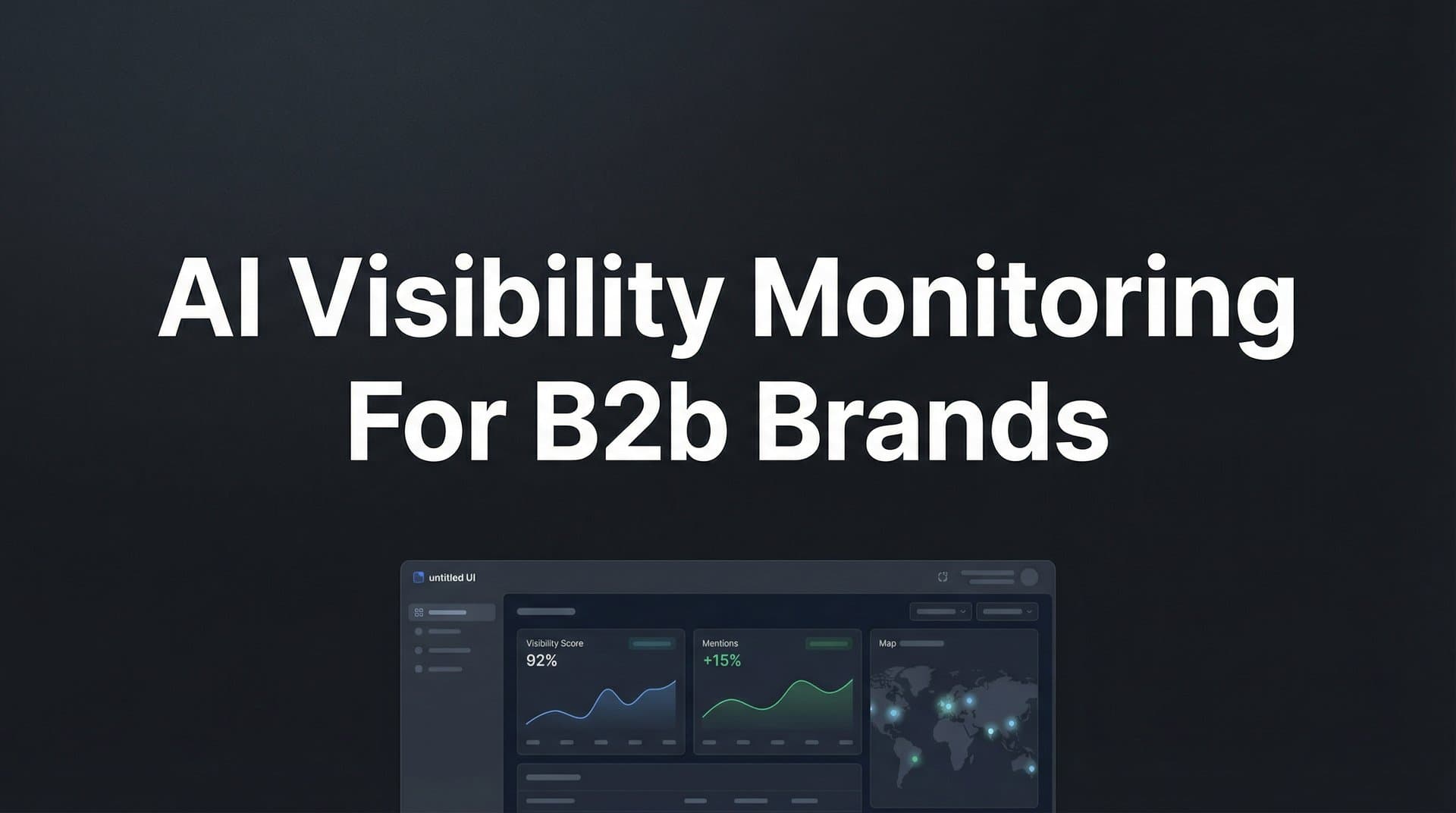
With your platforms and prompts identified, establish your baseline metrics. Run your complete prompt library across all priority platforms and document the current state of your AI visibility. Which queries trigger mentions of your brand? How frequently are you mentioned compared to competitors? What's the sentiment and accuracy of those mentions? This baseline becomes your benchmark for measuring improvement over time. An AI visibility monitoring dashboard can centralize all these metrics in one place.
The final piece of your framework is the monitoring cadence. AI models update regularly, and your visibility can shift as they ingest new training data or adjust their recommendation algorithms. Monthly monitoring provides a reasonable balance between staying informed and not drowning in data. For competitive categories or during active content campaigns, weekly monitoring might be warranted to catch changes quickly.
Document everything in a centralized tracking system. Create a dashboard that shows your visibility trends across platforms, tracks your performance on key prompts over time, and highlights significant changes that require attention. This transforms raw monitoring data into strategic intelligence that guides your optimization efforts.
From Monitoring to Action: Improving Your AI Presence
Monitoring reveals where you stand, but the real value comes from using those insights to systematically improve your AI visibility. The path from monitoring to optimization follows a clear pattern that compounds over time.
Start by analyzing your monitoring data to identify specific content gaps. Look for patterns in queries where competitors appear but you don't. These gaps reveal opportunities where creating targeted content could improve your visibility. If AI assistants consistently recommend competitors when prospects ask about "sales intelligence for healthcare companies" but never mention your brand, that's a signal that you need content explicitly connecting your solution to that use case.
The content you create needs to be optimized for AI comprehension—what's increasingly called Generative Engine Optimization or GEO. This is different from traditional SEO. You're not optimizing for keyword rankings or backlinks. You're creating content that helps AI models understand what your product does, who it's for, and why it's relevant for specific use cases. Understanding AI SEO for B2B marketing is essential for developing content that resonates with both human readers and AI systems.
Effective GEO content has several characteristics. It uses clear, straightforward language that AI models can easily parse. It explicitly states the problems you solve and the types of companies you serve. It includes specific examples and use cases that help AI understand the contexts where your solution is relevant. And it provides comprehensive information rather than marketing fluff—AI models favor substantive content that actually answers user questions.
This might mean creating detailed guides that explain how your solution addresses specific industry challenges. It might mean publishing case studies that clearly articulate the use cases where you excel. It might mean developing comparison content that positions you accurately against competitors. The specific content types matter less than ensuring AI models can extract clear, accurate information about your solution and its applications.
As you publish GEO-optimized content, your monitoring framework reveals whether it's working. This feedback loop is crucial. You might create comprehensive content about your solution for healthcare companies, then monitor whether AI assistants start mentioning you more frequently for healthcare-related queries. If visibility improves, you've validated the approach. If it doesn't, you need to adjust your content strategy or give it more time to be incorporated into AI training data. Comparing AI visibility tracking vs manual monitoring approaches can help you determine the most efficient method for your team.
The timeline for seeing results varies. Some AI platforms update their models more frequently than others. Some types of content get incorporated into training data faster than others. Generally, expect to see initial signals within a few months and more substantial improvements over six to twelve months of consistent effort. AI visibility optimization is a marathon, not a sprint.
Beyond creating new content, use your monitoring insights to refine your positioning and messaging across all channels. If AI consistently describes your product inaccurately or positions you for use cases you don't actually serve well, that's a signal that your public-facing messaging might be unclear. Clarifying your positioning on your website, in your product descriptions, and in your marketing materials helps ensure AI models develop accurate understanding of your solution.
The most sophisticated approach involves creating a continuous optimization cycle. Monitor your AI visibility, identify gaps, create targeted content, wait for AI models to incorporate that content, measure the impact, and repeat. Each cycle builds on the previous one, gradually strengthening your presence across the queries that matter most to your business.
Putting It All Together: Your AI Visibility Action Plan
The path from AI visibility blind spot to systematic monitoring and optimization doesn't have to be overwhelming. Break it down into concrete steps you can take this week to start understanding and improving your AI presence.
Your first action is assessment. Open ChatGPT, Claude, and Perplexity. Run five to ten queries that your prospects would actually ask when researching solutions in your category. Don't search for your brand name—that's too easy. Search for the problems you solve, the categories you compete in, and the use cases you serve. Document what you find. Are you mentioned? How are you described? Which competitors appear? This manual assessment gives you an immediate sense of your current AI visibility status.
Next, build your prompt library. Spend an hour brainstorming the questions your target buyers ask during their research journey. Include broad category queries, specific use case queries, and direct comparison queries. Aim for at least 20-30 prompts that cover the full range of how prospects might search for solutions like yours. This library becomes the foundation for ongoing monitoring.
Then, establish your baseline. Run your complete prompt library across your priority AI platforms and document the results. Create a simple spreadsheet tracking which queries mention your brand, which don't, and how you're positioned when you do appear. This baseline is your starting point for measuring improvement over time.
With your baseline established, identify your top three content gaps. Look for the highest-value queries where you're consistently absent but competitors appear. These represent your biggest opportunities for improvement. Prioritize creating comprehensive, AI-friendly content that addresses these gaps.
Finally, set up a monitoring cadence. Whether you track manually or use specialized tools, commit to checking your AI visibility regularly. Monthly monitoring is sufficient for most B2B brands to track trends and measure the impact of your optimization efforts.
Your Competitive Advantage Starts with Visibility
AI visibility monitoring isn't an optional nice-to-have for B2B brands competing in 2026—it's becoming as fundamental as SEO was when Google dominated discovery a decade ago. The difference is that AI-assisted research is growing faster than search ever did, and the window for establishing strong AI visibility before your market becomes saturated is narrower.
The brands that will win in this new landscape are those that recognize the shift early and act systematically. They're not guessing whether AI assistants recommend them—they're tracking it. They're not hoping their content helps AI understand their solutions—they're optimizing specifically for AI comprehension. They're not reacting to lost deals—they're proactively ensuring they're part of the conversation before prospects even begin their formal evaluation process.
The competitive advantage compounds over time. Every piece of content you create that improves your AI visibility makes it more likely that AI models will recommend you in the future. Every month you spend monitoring and optimizing builds a deeper understanding of how AI platforms perceive your brand. The brands that start this work today will have a visibility advantage that becomes harder for competitors to overcome as AI-assisted research becomes the default behavior for B2B buyers.
The question isn't whether you should care about AI visibility—it's whether you can afford to remain blind to how AI platforms currently discuss your brand and solutions. Stop guessing how AI models like ChatGPT and Claude talk about your brand—get visibility into every mention, track content opportunities, and automate your path to organic traffic growth. Start tracking your AI visibility today and see exactly where your brand appears across top AI platforms.