Right now, someone is asking ChatGPT which project management tool they should buy. Another person is consulting Claude about the best email marketing platform for their startup. A third is asking Perplexity to compare CRM solutions. These conversations are happening millions of times every single day—and if you're like most brand managers, you have absolutely no idea what these AI assistants are saying about your company.
Traditional brand monitoring tools track social media mentions, review sites, and news coverage. But they miss an entirely new category of brand conversations: the questions people ask AI systems and the answers those systems provide. When an AI assistant recommends your competitor instead of you, there's no notification. When it provides outdated or inaccurate information about your product, you won't know unless you're specifically looking for it.
This is where prompt tracking comes in. It's the practice of systematically monitoring the specific questions users ask AI systems and analyzing how those systems respond when your brand comes up. Think of it as the AI era's answer to search engine monitoring—except instead of tracking keyword rankings, you're tracking whether AI models mention, recommend, or accurately represent your brand when users ask relevant questions. For forward-thinking marketers, it's becoming as essential as SEO was a decade ago.
The Hidden Conversations Happening About Your Brand
Every time someone opens ChatGPT, Claude, or Perplexity, they're potentially having a conversation about brands in your category. These aren't passive searches—they're active consultations where users treat AI assistants as trusted advisors. The stakes are remarkably high.
When someone asks "What's the best accounting software for freelancers?" they're not just gathering information. They're at the consideration stage of their buying journey, and the AI's response directly influences their shortlist. If your brand doesn't appear in that response, you've lost a potential customer before they even knew you existed.
The types of prompts that trigger brand mentions fall into several categories. Comparison prompts are perhaps the most direct: "Compare Slack vs. Microsoft Teams" or "Asana or Monday.com for project management?" These queries explicitly invite AI systems to discuss specific brands and their relative strengths.
Recommendation prompts cast a wider net: "What CRM should I use for a real estate business?" or "Best email marketing tools for e-commerce." Here, the AI decides which brands to mention based on its training data and understanding of the space. Understanding AI recommendation tracking for businesses helps you monitor these critical decision points.
Then there are how-to and problem-solving prompts that can trigger brand mentions indirectly. When someone asks "How do I automate my social media posting?" AI assistants often recommend specific tools as part of their answer. Educational prompts like "Explain the difference between marketing automation platforms" create opportunities for brands to be featured as examples.
The business impact of these AI-mediated conversations is substantial. When AI consistently recommends competitors over your brand, you're losing market share in an increasingly important discovery channel. When it provides outdated information—mentioning a pricing tier you discontinued or a feature you've since launched—potential customers make decisions based on incorrect data.
Perhaps most concerning is when AI systems simply don't mention your brand at all in relevant contexts. This isn't active negative sentiment—it's invisibility. You're not part of the consideration set because the AI doesn't have sufficient quality information to confidently recommend you. In a world where more people start their research by asking an AI assistant, invisibility equals irrelevance.
How Prompt Tracking Actually Works
Prompt tracking might sound like magic, but the underlying process is methodical and increasingly automated. At its core, it involves three key steps: identifying relevant prompts, systematically querying AI models with those prompts, and analyzing the responses for brand mentions and positioning.
The first challenge is determining which prompts matter for your brand. You can't track every possible question users might ask—you need to focus on high-value queries that indicate purchase intent or influence brand perception. This starts with understanding your customer's journey and the questions they ask at each stage.
For a B2B SaaS company, relevant prompts might include feature comparisons, use-case recommendations, integration questions, and pricing inquiries. For a consumer brand, you might track product recommendations, troubleshooting questions, and brand comparison prompts. The goal is building a comprehensive library of prompts that represent real user queries in your space.
Once you've identified your target prompts, the next step is systematic querying across multiple AI platforms. This is where the technical complexity increases. You can't just ask each question once—AI models are probabilistic by nature, meaning they can provide different responses to identical prompts. To get accurate data, you need to query each prompt multiple times and analyze the pattern of responses.
Different AI platforms also behave differently. ChatGPT might emphasize certain brands based on its training data, while Claude might prioritize others. Perplexity pulls from current web sources, giving it different biases than models trained on historical data. Comprehensive prompt tracking requires monitoring across all major platforms your audience actually uses, which is why multi-model AI tracking software has become essential.
Here's where prompt tracking differs fundamentally from simple brand mention monitoring. Traditional tools might alert you when your brand name appears in an AI response. Prompt tracking goes deeper—it tracks the specific questions that trigger those mentions, the context in which you're discussed, and crucially, the prompts where you should appear but don't.
The metrics that matter in prompt tracking extend beyond simple mention counts. Mention frequency tells you how often your brand appears across your prompt library. Sentiment analysis reveals whether mentions are positive, neutral, or negative. Recommendation rate measures how often AI systems actively suggest your brand versus merely mentioning it.
Competitive positioning might be the most valuable metric of all. When AI systems compare brands, where does yours rank? Are you presented as a premium option or a budget alternative? Do AI models emphasize your strengths or focus on your limitations? This positioning directly influences how potential customers perceive your brand before they ever visit your website.
Context analysis adds another layer of insight. It's not enough to know your brand was mentioned—you need to understand why and how. Was your brand recommended as the best solution for a specific use case? Were you mentioned alongside premium competitors or budget alternatives? Did the AI provide accurate information about your features and pricing?
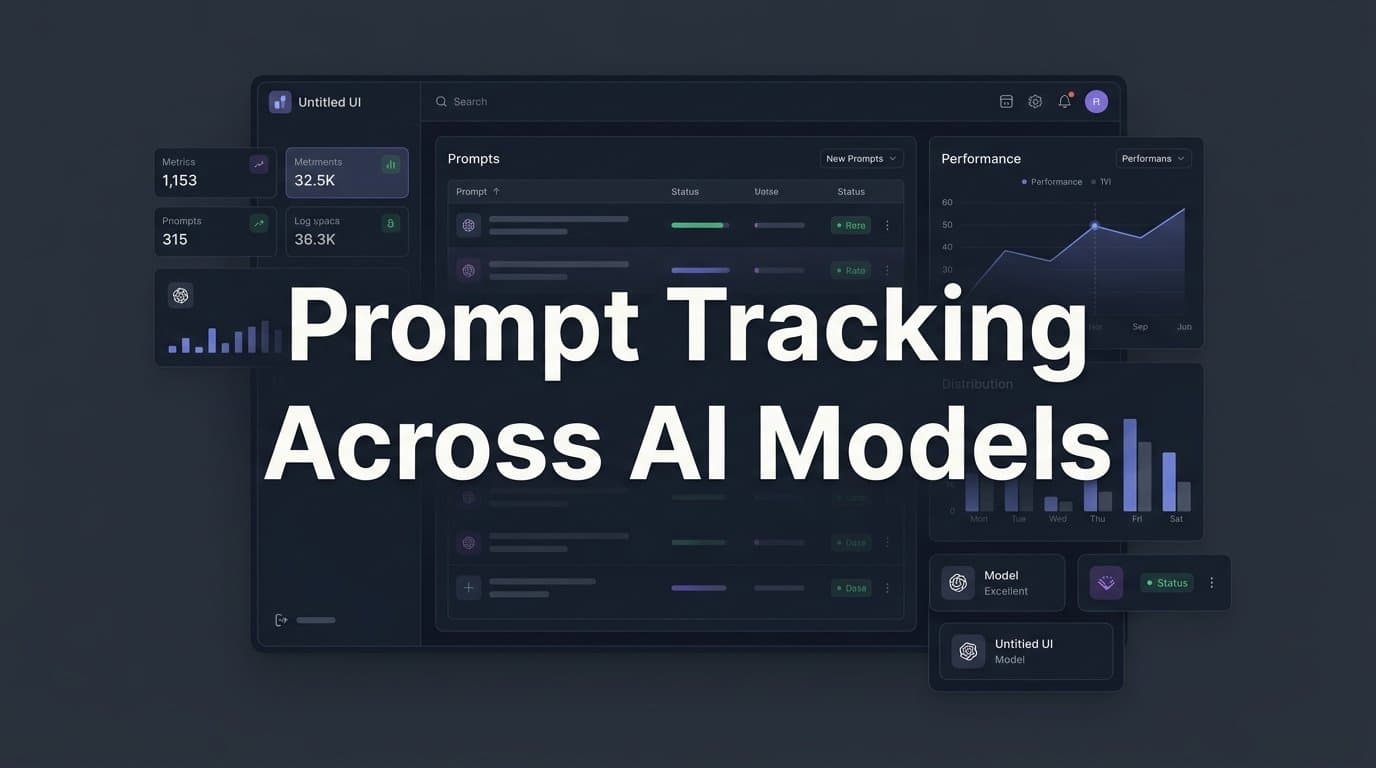
Advanced prompt tracking also measures share of voice across your prompt library. If there are 50 high-value prompts in your category and your brand appears in responses to 30 of them, you have 60% share of voice. Tracking this metric over time reveals whether your AI visibility is improving or declining. An AI visibility tracking dashboard makes monitoring these metrics straightforward.
Building Your Prompt Tracking Strategy
Starting prompt tracking without a clear strategy is like launching an SEO program without keyword research—you'll generate data but lack actionable insights. The foundation of effective prompt tracking is identifying the right prompts to monitor for your specific business.
Begin by mapping your customer journey and identifying the questions prospects ask at each stage. Someone just discovering they have a problem asks different questions than someone ready to make a purchase. Early-stage prompts might be educational: "What is marketing automation?" or "How does project management software work?" These broad queries establish category awareness.
Mid-funnel prompts show active consideration: "Best marketing automation platforms for small businesses" or "Compare project management tools for remote teams." These queries indicate the user is evaluating options and building a shortlist. Late-stage prompts get specific: "Mailchimp vs. HubSpot pricing" or "Does Asana integrate with Slack?" These questions come from buyers close to a decision.
Industry-specific prompts matter enormously. A generic query like "best CRM software" is valuable, but "best CRM for insurance agents" or "CRM with built-in calling for sales teams" represents a more qualified prospect. Build your prompt library around the specific use cases, industries, and requirements that define your ideal customers.
Prioritizing which AI platforms to monitor depends on where your audience actually goes for answers. For B2B software buyers, ChatGPT and Claude currently dominate. For consumer products, Perplexity's integration with shopping and reviews makes it critical. Dedicated Perplexity AI tracking tools help you monitor this increasingly important platform. Google's Gemini matters for users already in the Google ecosystem. Rather than spreading resources thin, focus deeply on the two or three platforms your target buyers actually use.
Establishing baselines is essential before you can measure improvement. Run your complete prompt library across your priority platforms and document current performance. How often does your brand appear? What's the sentiment? How do you compare to competitors? This baseline becomes your benchmark for measuring the impact of optimization efforts.
Ongoing monitoring cadence depends on your market dynamics and resources. Fast-moving consumer categories might require weekly tracking to catch shifts in AI recommendations. B2B companies with longer sales cycles might track monthly or quarterly. The key is consistency—tracking sporadically makes it impossible to identify trends or measure the impact of your content initiatives.
Don't try to track everything at once. Start with 20-30 high-priority prompts that represent your most valuable customer queries. Master the process of monitoring, analyzing, and acting on this core set before expanding. It's better to deeply understand a focused prompt set than to superficially track hundreds of queries.
Turning Prompt Insights Into Content Opportunities
Prompt tracking data becomes valuable when it drives content strategy. The patterns you discover reveal exactly what content you need to create to improve your AI visibility and capture more qualified traffic.
When you identify prompts where competitors appear but your brand doesn't, you've found a content gap. If AI systems consistently recommend rival products when users ask about specific use cases, it's because those competitors have published authoritative content on those topics. Your absence isn't personal—it's informational. The AI simply doesn't have enough quality content from your brand to confidently recommend you.
The connection between published content and AI responses is direct but not instant. AI models train on vast amounts of web content, and more recently published material influences their responses. When you create comprehensive, authoritative content on topics related to your products, you increase the likelihood that AI systems will reference and recommend your brand when users ask relevant questions.
This is where the concept of Generative Engine Optimization comes in. Just as SEO optimized content for search engines, GEO optimizes content for AI-generated responses. The principles overlap but aren't identical. AI models value depth, accuracy, and comprehensiveness. Exploring GEO optimization for brands reveals strategies specifically designed for this new landscape.
Let's say your prompt tracking reveals that when users ask "What's the best project management tool for creative agencies?" your brand never appears, but three competitors consistently do. Your content opportunity is clear: create definitive content about project management for creative teams. This might include detailed guides, use case examples, feature breakdowns specific to creative workflows, and integration information for tools creative teams use.
The framework for creating AI-optimized content starts with comprehensiveness. AI models favor detailed, thorough content that fully addresses a topic. A 500-word blog post might rank in traditional search, but a 2,500-word comprehensive guide is more likely to influence AI recommendations. Cover the topic from multiple angles, address common questions, and provide specific, actionable information.
Accuracy and currentness matter enormously. AI systems are increasingly fact-checking their responses against multiple sources. Outdated information, even if well-written, reduces your credibility. Keep your content updated with current features, pricing, and capabilities. When you launch new functionality, publish detailed content about it immediately.
Structure your content for AI comprehension. Use clear headings that directly answer questions. Include specific examples and use cases. Define technical terms. Provide context about how your product compares to alternatives. AI models parse structured content more effectively than stream-of-consciousness writing.
Track the impact of your content initiatives on AI visibility. After publishing new content, monitor whether your brand starts appearing in responses to related prompts. This feedback loop helps you understand which content strategies actually improve your AI positioning versus which are just generating content without strategic value.
Common Prompt Tracking Challenges and Solutions
Even with a solid strategy, prompt tracking presents unique challenges that can frustrate teams new to the practice. Understanding these obstacles and their solutions helps you avoid common pitfalls.
Response variability is perhaps the most immediate challenge. Ask ChatGPT the same question three times and you might get three different answers. This isn't a bug—it's how probabilistic AI models work. They're designed to provide varied responses rather than identical outputs. For prompt tracking, this means a single query doesn't give you reliable data.
The solution is statistical sampling. Query each prompt multiple times across different sessions and analyze the pattern of responses. If your brand appears in 7 out of 10 responses to a specific prompt, that 70% appearance rate is your meaningful metric. Track how this percentage changes over time rather than fixating on individual responses.
Scaling prompt tracking across multiple products, markets, or brand names multiplies complexity. A company with five product lines in three geographic markets might need to track hundreds of prompt variations. Manual tracking becomes impossible at this scale.
Automation is essential for scaled prompt tracking. Purpose-built tools can systematically query multiple AI platforms, parse responses for brand mentions, and aggregate data into actionable dashboards. What would take a human hours per day becomes automated background monitoring. This is where AI visibility tracking software becomes a valuable investment.
Integration with existing marketing analytics creates another challenge. Prompt tracking data lives in isolation unless you connect it to your broader marketing metrics. You need to understand how AI visibility correlates with website traffic, lead generation, and ultimately revenue.
Build bridges between your prompt tracking data and your marketing stack. Track whether improvements in AI visibility correspond with increases in branded search volume. Monitor whether prompts where you gain visibility drive more traffic to related landing pages. Connect AI mention sentiment to brand health metrics you already track.
Attribution gets murky when AI assistants influence buying decisions. Someone might discover your brand through an AI recommendation, research on your website, and convert days later through a different channel. Traditional attribution models don't capture the AI assistant's role in that journey. Understanding AI attribution tracking methods helps you measure this hidden influence.
While perfect attribution may be impossible, directional insights matter. Survey new customers about how they discovered your brand. Track branded search trends alongside AI visibility improvements. Monitor whether content optimized for AI visibility drives measurable traffic increases. The goal isn't perfect measurement—it's understanding whether your prompt tracking initiatives drive business results.
Getting Started: Your First 30 Days of Prompt Tracking
The prospect of launching a prompt tracking program can feel overwhelming, but breaking it into manageable phases makes it achievable. Your first month should focus on establishing foundations rather than comprehensive coverage.
Week one is about research and setup. Identify your 10-15 highest-priority prompts—the questions your best customers ask when evaluating solutions in your category. Choose two AI platforms to start with, likely ChatGPT and one other based on your audience. Document your current baseline by manually querying these prompts and recording the results.
This initial baseline doesn't need to be perfect. You're establishing a starting point for comparison. Note which prompts mention your brand, which mention competitors, and which don't mention any specific brands. Pay attention to how your brand is positioned when it does appear.
Week two focuses on competitive analysis. Query your prompt list specifically asking about competitors. How do AI systems describe their strengths? What use cases do they recommend them for? This reveals the content and positioning strategies that are working in your space.
Identify the 2-3 most significant content gaps this analysis reveals. These are topics where competitors have strong AI visibility and you have none. These gaps become your immediate content priorities.
Week three is execution time. Create one piece of comprehensive, AI-optimized content targeting your highest-priority gap. Make it thorough, accurate, and structured for AI comprehension. Publish it and ensure it's properly indexed by search engines.
Simultaneously, audit your existing content for opportunities to improve AI visibility. Often you already have content on relevant topics—it just needs updating, expanding, or restructuring to better serve AI models.
Week four introduces ongoing monitoring. Re-query your priority prompts and compare results to your week-one baseline. While one month is too soon to expect dramatic shifts, you're establishing the monitoring rhythm that will reveal trends over time.
Set expectations appropriately with stakeholders. Prompt tracking is a long game, not a quick win. Meaningful improvements in AI visibility typically take 60-90 days of consistent content optimization. The value of prompt tracking isn't instant results—it's the strategic intelligence that guides your content investments toward maximum impact.
Quick wins that demonstrate value include documenting specific instances where competitors appear and you don't, quantifying your current share of voice across priority prompts, and identifying the content themes that most consistently generate AI mentions. These insights prove the value of systematic tracking even before you've improved your positioning.
The New Reality of Brand Visibility
Prompt tracking represents more than a new marketing tactic—it's a fundamental shift in how brands must think about visibility and discovery. For decades, brand managers focused on controlling their message through advertising and PR, then adapted to monitoring social media conversations. Now the frontier has moved to AI-mediated conversations where brands have even less direct control but potentially more influence through strategic content.
The brands that understand and act on prompt data today are building significant advantages. They're shaping how AI systems describe them, ensuring accurate information reaches potential customers, and claiming visibility in the prompts that drive purchase decisions. Implementing brand reputation tracking in AI ensures you maintain control of your narrative across these platforms.
This isn't about gaming AI systems or trying to manipulate their responses. It's about ensuring that when AI assistants discuss your category, they have access to comprehensive, accurate information about your brand. It's about understanding which questions your potential customers are asking and making sure you're part of the answer.
The trajectory is clear. As more people turn to AI assistants for research and recommendations, prompt tracking will evolve from an experimental practice to a standard component of brand management. The question isn't whether you'll eventually need to track your AI visibility—it's whether you'll start now while there's still opportunity to establish strong positioning, or wait until competitors have already claimed the high ground.
Stop guessing how AI models like ChatGPT and Claude talk about your brand—get visibility into every mention, track content opportunities, and automate your path to organic traffic growth. Start tracking your AI visibility today and see exactly where your brand appears across top AI platforms.