Most AI visibility software is billed monthly by tracked prompts, AI engines covered and how often prompts are re-run. Entry plans for a single brand start around $30–$100 per month. Mid-market plans for B2B marketing teams typically run $200–$1,000 per month. Enterprise platforms such as Profound or Brandwatch use custom annual contracts. Below are nine tools compared on pricing model, who each fits best and what you actually pay for.
Traditional SEO tools can't tell you whether ChatGPT, Claude or Perplexity mention your brand or how you're positioned against competitors. Because pricing varies so widely, it pays to understand the cost drivers before committing. For a broader look at the category, see our guide to AI visibility software pricing plans.
How AI visibility software is priced
Almost every vendor builds its price from the same four levers. Knowing them lets you compare plans that look very different on the surface.
- Tracked prompts: The number of questions (for example, "best CRM for small agencies") the tool sends to AI models on your behalf. This is the main unit of cost.
- Engines covered: ChatGPT, Claude, Perplexity, Gemini, Google AI Overviews / AI Mode, Copilot and others. Some vendors include all engines in one flat price. Others charge per engine or reserve some engines for higher tiers.
- Run frequency: Daily runs cost roughly 7× more compute than weekly runs for the same prompt set. "Real-time" usually means daily or more frequent runs plus alerting.
- Seats, brands and competitors: Agency and multi-brand plans are priced by the number of projects, brands or competitors benchmarked.
A useful normalization is cost per prompt-run, calculated as:
monthly price ÷ (prompts × engines × runs per month)
Here is a worked example. Suppose a $300/month plan tracks 100 prompts across 4 engines, run weekly (about 4.3 runs per month). That works out to roughly $0.17 per prompt-run, or $3 per tracked prompt per month.
As a rule of thumb, $1–$5 per tracked prompt per month with multi-engine coverage is a fair price for most teams. Much above that, you should be getting content tooling, deep historical data or enterprise support in return.
Typical price bands
| Tier | Typical monthly cost | What you usually get | Typical buyer |
|---|---|---|---|
| Entry | $30–$150 | 25–100 prompts, 2–4 engines, weekly runs, 1 brand | Startups, SMBs, consultants |
| Mid-market | $200–$1,000 | 100–500 prompts, most major engines, daily runs, competitor benchmarking, several seats | Mid-sized B2B marketing teams, agencies |
| Enterprise | Custom, often $1,500+/month billed annually | Thousands of prompts, multiple brands and regions, SSO, API, dedicated support | Large brands, regulated industries |
These bands reflect publicly listed plans in the category and change often. Always confirm current rates on each vendor's pricing page.
1. Sight AI
Best for: Teams needing all-in-one AI visibility tracking, content generation and automated indexing.
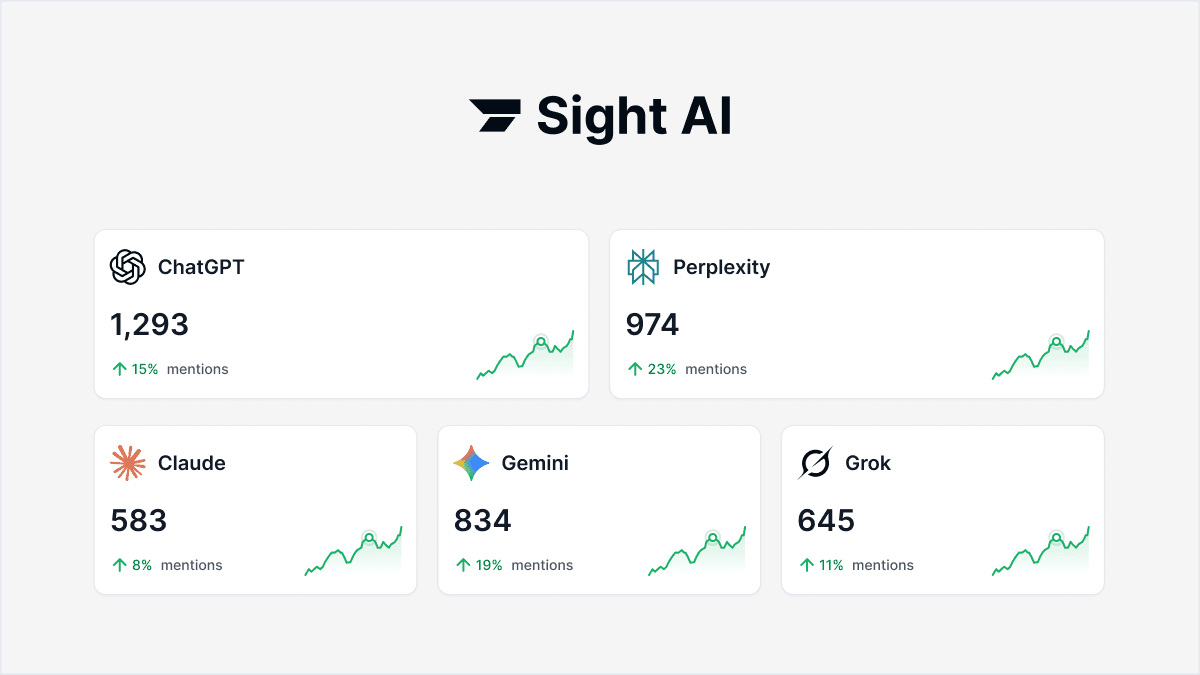
Sight AI combines AI visibility monitoring across six platforms with integrated content creation and website indexing tools.

Where This Tool Shines
Sight AI stands out by offering transparent, published pricing. You don't need a demo request or sales call to see what you'll pay.
The platform tracks how ChatGPT, Claude, Perplexity and other AI models mention your brand. It then helps you act on those insights with 13 specialized AI agents that generate SEO- and GEO-optimized content.
The integrated approach means you're not juggling separate tools for monitoring, content creation and indexing. When you spot a content gap where competitors appear but you don't, you can generate an optimized article directly in the platform. You can then publish it with automatic IndexNow integration for faster discovery.
Key Features
AI Visibility Score: Quantifies your brand presence across AI platforms, with sentiment analysis and prompt tracking.
Multi-Platform Monitoring: Tracks mentions across ChatGPT, Claude, Perplexity and three additional AI models.
Content Generation Suite: 13+ AI agents create listicles, guides and explainers optimized for AI visibility.
Autopilot Mode: Automates content research, generation and publishing workflows.
IndexNow Integration: Automatically notifies search engines when new content is published, for faster indexing.
Best For
Marketers and founders who want visibility tracking plus the tools to improve it. It is particularly valuable for teams tired of switching between monitoring platforms, content tools and indexing solutions. It also works well for agencies managing multiple client brands.
Pricing
Sight AI publishes transparent, monthly-billed pricing tiers on its website. Visit trysight.ai/pricing to see current rates and feature breakdowns for each plan.
2. Profound
Best for: Enterprise teams requiring deep analytics and comprehensive historical AI search data.
Profound positions itself as the enterprise-grade solution for brands treating AI visibility as a strategic priority.

Where This Tool Shines
Profound delivers depth over breadth. Its analytics help enterprise teams understand more than whether they're mentioned. They show how sentiment shifts over time, which prompts trigger mentions and how competitive positioning evolves across AI models.
The reporting dashboards are built for executive-level presentations, and custom alert configurations let teams monitor specific scenarios. Historical trend analysis goes deeper than most competitors, which makes Profound valuable for brands tracking long-term AI visibility strategies.
Key Features
Deep Analytics Engine: Analyzes mention patterns, sentiment trajectories and competitive dynamics across AI platforms.
Enterprise Dashboards: Customizable reporting interfaces designed for C-suite presentations.
Advanced Alert System: Configure complex monitoring rules based on sentiment changes, competitor mentions or specific keywords.
Historical Data Access: Extended retention periods for tracking how AI visibility evolves over months or years.
White-Glove Onboarding: Dedicated implementation support for enterprise deployments.
Best For
Large organizations with established brand monitoring programs that want to add AI visibility to their stack. It is best suited to teams with budget flexibility who prioritize data depth and enterprise-grade security over cost optimization.
Pricing
Custom enterprise pricing based on monitoring volume, team size and feature requirements. Contact Profound directly for a quote, and expect pricing in line with enterprise software standards and annual contracts.
3. Otterly.AI
Best for: Competitive intelligence teams tracking share of voice across AI-powered search experiences.
Otterly.AI specializes in competitive benchmarking, showing exactly how your brand compares to competitors in AI-generated responses.

Where This Tool Shines
Otterly.AI excels at answering "how do we stack up?" You see more than your own mentions: you see your share of voice relative to up to ten competitors at once. That makes it particularly valuable for brands in crowded markets, where AI visibility is becoming a differentiator.
Its share-of-voice tracking goes beyond simple mention counts. Otterly.AI analyzes your position within responses, compares sentiment and shows which prompts favor your brand versus competitors. Its AI search ranking reports help teams see which topics they own and where competitors dominate.
Key Features
Multi-Competitor Monitoring: Track your brand against up to ten competitors across AI platforms simultaneously.
Share-of-Voice Metrics: Quantify your mention frequency relative to competitors in the same category.
Positioning Analysis: See where your brand appears in AI responses: first mention, supporting mention or not mentioned.
Topic Ownership Reports: Identify which subjects your brand dominates and where competitors lead.
Sentiment Benchmarking: Compare how AI models describe your brand versus competitor brands.
Best For
Marketing teams in competitive industries, where relative AI visibility matters as much as absolute visibility. It is particularly useful for brands launching competitive campaigns or tracking shifts in market positioning.
Pricing
Tiered, self-serve pricing from startup to enterprise levels. Pricing typically scales with the number of prompts, competitors monitored and query frequency. Check Otterly.AI's website for current plan details.
4. Peec AI
Best for: Brand managers and PR teams needing fast alerts on AI-generated brand mentions.
Peec AI prioritizes speed, notifying you quickly when AI models mention your brand.

Where This Tool Shines
Peec AI treats AI visibility like a newswire: you get alerts soon after mentions appear, not days later. This approach makes it particularly valuable for crisis monitoring and reputation management. If an AI model starts generating negative responses about your brand, you find out quickly rather than in a weekly report.
The PR-focused dashboard organizes mentions by urgency and sentiment, which helps communications teams prioritize responses. Threshold alerts trigger when mention volume spikes or sentiment drops below acceptable levels.
Key Features
Fast Alerts: Notifications when AI platforms mention your brand in generated responses.
PR Dashboard: Interface designed for communications teams managing brand reputation across channels.
Sentiment Detection: Automatic classification of mentions as positive, neutral or negative.
Crisis Thresholds: Configure alerts for unusual mention spikes or sentiment drops.
Mobile Notifications: Push alerts keep PR teams informed outside office hours.
Best For
Communications professionals who need to respond quickly to AI-generated brand mentions. It is ideal for brands with active PR programs or those in reputation-sensitive industries where rapid response matters.
Pricing
Usage-based pricing that scales with monitoring volume (prompts and engines) and alert frequency. Contact Peec AI or check its pricing page for rates based on your expected volume and team size.
5. Knowatoa
Best for: Startups and small businesses beginning their AI visibility journey with limited budgets.
Knowatoa offers accessible entry points for brands just starting to track AI mentions.

Where This Tool Shines
Knowatoa removes the barriers that keep smaller brands from monitoring AI visibility. Its onboarding requires minimal technical knowledge, and the basic analytics dashboard focuses on essential metrics without overwhelming new users. Multi-model coverage means you still track mentions across major AI platforms despite the lower price.
The prompt tracking feature shows smaller teams which questions or topics trigger brand mentions, making it easier to find content opportunities with limited resources. The interface favors simplicity over breadth, which is an advantage for teams that don't need enterprise complexity.
Key Features
Multi-Model Coverage: Monitors mentions across ChatGPT, Claude and Perplexity at entry-level pricing.
Simplified Onboarding: Get started in minutes without technical expertise or lengthy setup.
Basic Analytics: Dashboard showing mention frequency, sentiment and trending topics.
Prompt Tracking: See which questions or searches trigger mentions of your brand.
Weekly Reports: Automated email summaries for quick visibility updates.
Best For
Founders and small marketing teams who recognize that AI visibility matters but can't justify enterprise software costs. It works well for bootstrapped startups and SMBs testing AI monitoring before committing to a more comprehensive solution.
Pricing
Entry-level pricing designed for startups and small businesses, typically among the most affordable options in the category. Check Knowatoa's website for current plan rates.
6. Brandwatch AI Insights
Best for: Enterprises already using Brandwatch for social listening who want unified brand monitoring.
Brandwatch AI Insights adds AI visibility tracking to the established Brandwatch consumer intelligence platform.

Where This Tool Shines
The integration advantage is significant for existing Brandwatch customers. Teams work in one interface for social listening, consumer intelligence and AI visibility instead of managing separate dashboards. You can correlate social conversation trends with AI mention patterns and spot when online discussion starts influencing how AI models describe your brand.
The consumer intelligence overlay provides context that standalone AI visibility tools lack. You see that mentions increased and, from broader consumer sentiment data, why. Enterprise-grade security and compliance features meet the requirements of regulated industries.
Key Features
Unified Platform: AI visibility data integrated with social listening and consumer intelligence in one dashboard.
Cross-Channel Correlation: Identify connections between social conversations and AI mention patterns.
Enterprise Security: Meets compliance requirements for regulated industries, including finance and healthcare.
Consumer Intelligence Context: Understand AI mentions within broader consumer sentiment trends.
Multi-Brand Management: Monitor AI visibility across multiple brands or product lines from one account.
Best For
Large organizations already invested in the Brandwatch ecosystem that want to extend monitoring to AI platforms. It is most valuable when you need unified reporting across social, web and AI channels.
Pricing
Bundled enterprise pricing, typically added to an existing Brandwatch subscription. Contact Brandwatch for a custom quote. Pricing depends on your current plan and the scope of AI monitoring you need.
7. Semrush AI Overview Tracking
Best for: SEO teams already using Semrush who want AI visibility alongside traditional rankings.
Semrush AI Overview Tracking extends the familiar Semrush toolkit to AI-powered search monitoring.

Where This Tool Shines
Semrush makes AI visibility feel like a natural extension of SEO work. It tracks AI Overview appearances alongside traditional search rankings, so teams can see how AI-powered results affect their overall visibility. This matters because AI Overviews increasingly appear above traditional results and change click-through patterns.
Keyword-AI correlation features show which search terms trigger AI Overviews versus standard results, which informs content strategy. Position monitoring shows where your brand appears within AI-generated responses, not just whether you're mentioned. For teams already fluent in Semrush, the learning curve is minimal.
Key Features
Integrated SEO Workflow: AI visibility data appears alongside traditional ranking metrics in familiar Semrush reports.
AI Overview Tracking: Monitor when and where AI-generated overviews appear for your target keywords.
Position Monitoring: Track your placement within AI responses: first mention, supporting mention or not mentioned.
Keyword-AI Correlation: Identify which search terms trigger AI Overviews versus traditional results.
Competitive Analysis: See which competitors appear in AI Overviews for your target keywords.
Best For
SEO professionals and content teams who already use Semrush for keyword research and rank tracking. It is particularly valuable for teams treating AI visibility as an extension of their existing SEO strategy rather than a separate initiative.
Pricing
Available as an add-on to existing Semrush plans. Costs vary with your base subscription level and the scope of AI monitoring, so check current tier pricing on Semrush's website. Remember that the effective price is the base plan plus the add-on.
8. Scrunch AI
Best for: Marketing agencies managing multiple client brands with combined influencer and AI tracking needs.
Scrunch AI combines influencer marketing tracking with AI brand mention monitoring in one platform.
Where This Tool Shines
Scrunch AI solves a specific agency problem. Clients increasingly ask about both influencer impact and AI visibility, but most tools handle only one. With the combined approach, agencies can show clients how influencer campaigns affect brand mentions across social platforms and AI models at the same time.
Agency collaboration tools support multi-client management with separate dashboards, white-label reporting and campaign attribution. This makes it easier to demonstrate ROI when influencer partnerships lead to increased AI visibility, and it streamlines work for agencies tracking dozens of brands.
Key Features
Dual Tracking: Monitor influencer mentions and AI brand visibility from one platform.
Agency Collaboration: Multi-user access with permission controls and client-specific dashboards.
Campaign Attribution: Connect influencer campaigns to changes in AI mention frequency or sentiment.
Multi-Client Management: Separate tracking and reporting for each client brand.
White-Label Reports: Generate branded reports for client presentations.
Best For
Marketing agencies running influencer campaigns that need to track the downstream effects on AI visibility. It is particularly useful for agencies positioning themselves as full-service brand visibility experts rather than single-channel specialists.
Pricing
Agency pricing tiers based on the number of client brands monitored. Check Scrunch's website for current rates.
9. AIMonitor Pro
Best for: Development teams building custom monitoring dashboards with API-first access to AI visibility data.
AIMonitor Pro provides developer-oriented AI visibility monitoring through API access.
Where This Tool Shines
AIMonitor Pro treats AI visibility data as raw material for custom applications. With its API-first architecture, development teams can build monitoring into existing dashboards, create automated workflows or feed visibility data into internal analytics platforms. This flexibility matters for companies whose technical requirements off-the-shelf solutions can't meet.
Raw data access provides granular detail that pre-built dashboards often abstract away. Developer documentation includes code examples, webhook configurations and integration guides.
Key Features
API-First Design: Platform functionality accessible through RESTful API endpoints.
Custom Integration Support: Build AI visibility monitoring into existing tools and workflows.
Raw Data Access: Retrieve unprocessed mention data for custom analysis and visualization.
Developer Documentation: Guides, code examples and integration tutorials.
Webhook Configuration: Set up automated notifications and data pipelines triggered by mention events.
Best For
Development teams at tech companies that want to embed AI visibility monitoring into custom dashboards or internal tools.
Pricing
Pay-per-query model in which costs scale with API usage. Pricing depends on query volume, data retention and webhook configuration. Contact AIMonitor Pro for rate cards based on your projected usage.
Pricing models compared at a glance
| Tool | Pricing model | Published pricing | Best fit |
|---|---|---|---|
| Sight AI | Monthly tiers, tracking + content + indexing | Yes | SMB to mid-market, agencies |
| Profound | Custom enterprise contract | No | Enterprise |
| Otterly.AI | Self-serve tiers by prompts | Yes | SMB to mid-market |
| Peec AI | Usage-based tiers | Partly | Brand/PR teams |
| Knowatoa | Low-cost entry tiers | Yes | Startups |
| Brandwatch AI Insights | Bundled enterprise add-on | No | Existing Brandwatch customers |
| Semrush | Add-on to base SEO plan | Yes | Existing Semrush users |
| Scrunch AI | Agency tiers | Varies | Agencies |
| AIMonitor Pro | Pay-per-query API | On request | Developers |
Making the Right Choice
AI visibility software pricing ranges from low-cost entry plans to enterprise solutions that require custom quotes. The market falls into three tiers:
- Entry: Bootstrap-friendly options like Knowatoa for startups testing the waters.
- Mid-market: Solutions like Sight AI and Otterly.AI that offer comprehensive features at transparent prices.
- Enterprise: Platforms like Profound and Brandwatch AI Insights for organizations that need deep analytics and custom implementations.
Your budget tier matters less than matching features to your actual needs. A startup tracking one brand across three AI platforms doesn't need enterprise analytics; Knowatoa or Sight AI's entry tier handles that scenario efficiently. A Fortune 500 company monitoring twenty brands with complex competitive intelligence requirements, on the other hand, will find mid-market tools limiting despite their affordability.
Consider these selection factors beyond price:
- Do you need real-time alerts, or are weekly reports sufficient?
- Will you act on the data with content generation, or just monitor passively?
- Do you need API access for custom integrations?
- How many team members need access?
These questions often matter more than the monthly cost when judging value. To define the metrics you'll report on before you buy, use our 6-step framework for measuring AI visibility performance.
Pricing transparency varies significantly across vendors. Tools like Sight AI publish their rates openly, so you can budget accurately before contacting sales. Others require demo requests and custom quotes, which adds friction but sometimes results in better pricing for specific use cases. When comparing several options, start with vendors that publish their pricing.
AI visibility investment pays off as AI-powered search takes over more traditional queries. Brands that appear consistently in ChatGPT, Claude and Perplexity responses gain compounding advantages as more users rely on AI for research and recommendations. The cost of monitoring is small compared with the opportunity cost of being invisible while your competitors appear.
Frequently asked questions
What does a typical AI visibility tool cost each month for a mid-sized B2B company?
Most mid-sized B2B teams spend roughly $200–$1,000 per month. That budget typically covers 100–500 tracked prompts across ChatGPT, Perplexity, Claude, Gemini and Google AI Overviews, run daily or weekly, plus competitor benchmarking and several seats. Costs rise with more brands, regions or daily runs. Tools that bundle content creation, such as Sight AI, can replace separate content subscriptions, which changes the effective comparison. See the price band table above for tier details.
What is a fair price per tracked prompt for AI visibility?
A fair benchmark is about $1–$5 per tracked prompt per month with multi-engine coverage and at least weekly runs. To compare plans fairly, divide the monthly price by prompts × engines × runs per month to get a cost per prompt-run. A plan that looks cheap per prompt may cover only one engine or run monthly. Higher per-prompt prices are justified by daily runs, long data history, content tooling or enterprise support.
Are there AI visibility tools that charge one flat price instead of per engine?
Yes. Many self-serve tools, including Sight AI and Otterly.AI, include several engines in each tier rather than charging per engine, so your price is driven mainly by prompt volume. Others gate certain engines, such as Gemini or Google AI Mode, behind higher plans, or sell them as add-ons. Always check which engines are included at your tier before comparing headline prices.
What's the lowest-cost way for a brand to start on AI visibility?
Start with 25–50 high-intent prompts your buyers actually ask, tracked weekly on an entry plan from a tool like Knowatoa or a lower Sight AI tier. You can also test manually by asking ChatGPT and Perplexity those prompts and logging results in a spreadsheet, though this doesn't scale. Upgrade once you know which prompts and engines matter. If you also need traditional rank tracking, our roundup of rank checking software for keyword and AI search positions covers combined options.
Are real-time AI visibility dashboards worth the subscription cost?
For most brands, no. AI answers shift gradually, so weekly or daily runs capture the trends you'll act on, at a fraction of the cost. Real-time or high-frequency monitoring is worth paying for mainly in reputation-sensitive industries, during launches or crises, or when PR teams must respond quickly to negative or inaccurate AI answers. Otherwise, put the budget toward more prompts and engines.
Stop guessing how AI models like ChatGPT and Claude talk about your brand. Get visibility into every mention, track content opportunities and automate your path to organic traffic growth. Start tracking your AI visibility today and see exactly where your brand appears across top AI platforms.