AI search engines like ChatGPT, Claude, and Perplexity have quietly become a primary discovery channel for buyers and decision-makers. The problem? You can't check a traditional rankings report to know if your brand is showing up in those conversations. You need tools built specifically for this new reality: platforms that track how AI models talk about you, surface the content gaps costing you visibility, and help you publish the right material to get mentioned more often.
This list covers the best AI search presence tools available in 2026, evaluated on visibility tracking depth, content optimization capabilities, indexing support, and overall value for marketers, founders, and agencies. Whether you're just starting to think about AI visibility or looking to consolidate a fragmented stack into something unified, there's an option here for you.
1. Sight AI
Best for: Teams that need AI visibility tracking, content generation, and indexing in one platform.
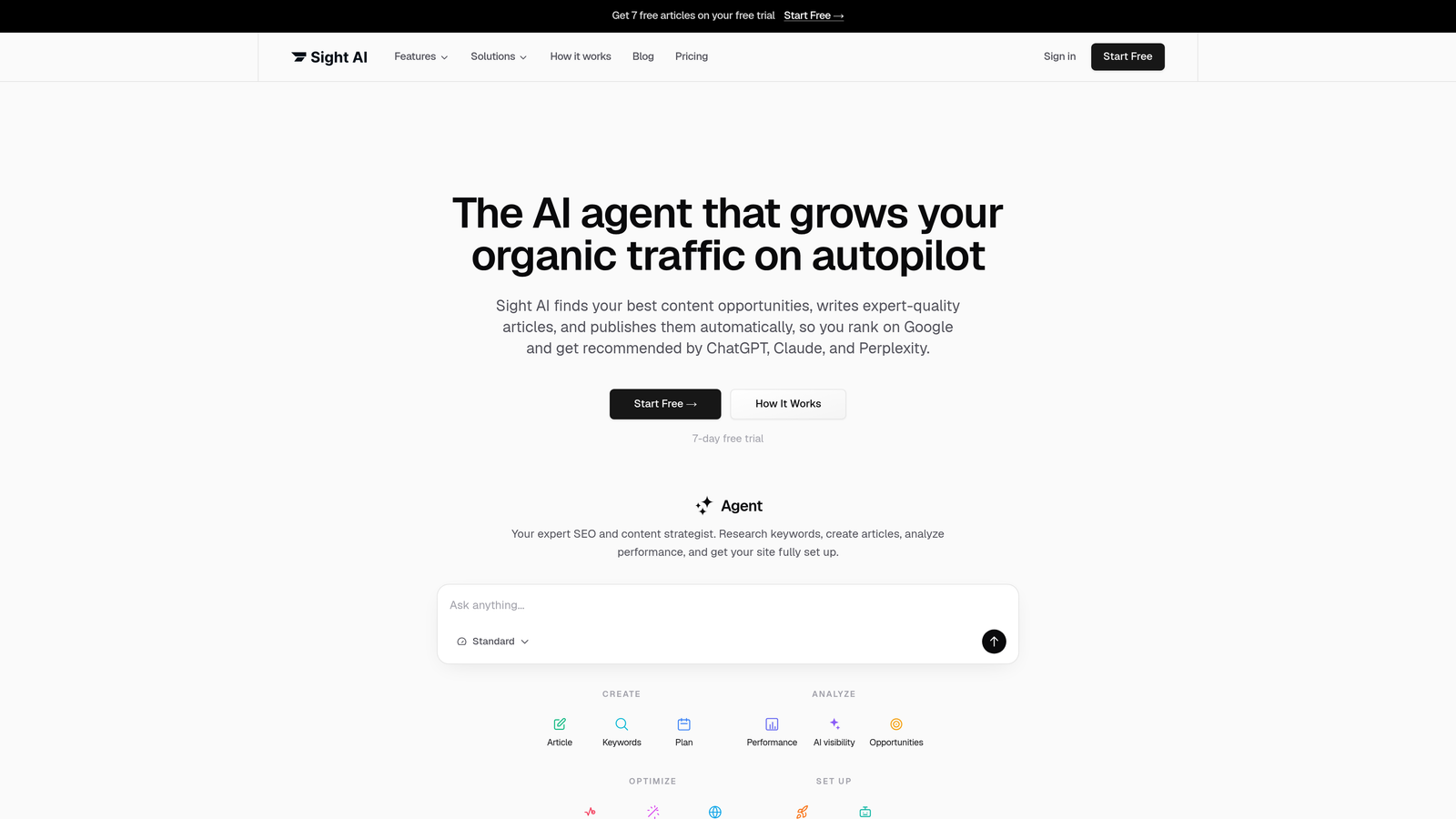
Sight AI is an all-in-one AI search presence platform that combines brand mention monitoring across 6+ AI models, GEO-optimized content generation with 13+ specialized AI agents, and automated content indexing via IndexNow integration.
Where This Tool Shines
Most tools in this category handle one piece of the puzzle: they either monitor your brand or help you create content. Sight AI is built around the idea that these workflows belong together. You track where your brand appears (and where it doesn't), identify the content gaps driving those absences, generate optimized content to fill them, and push that content live with automatic indexing. That closed loop is what separates it from point solutions.
The AI Visibility Score gives you a single, trackable metric for your brand's presence across platforms like ChatGPT, Claude, and Perplexity, with sentiment analysis layered in so you're not just counting mentions but understanding their quality. Prompt tracking goes a level deeper, showing you exactly which queries trigger your brand in AI responses and which ones your competitors are winning instead.
Key Features
AI Visibility Score: A unified metric tracking brand mention frequency and sentiment across 6+ AI platforms including ChatGPT, Claude, and Perplexity.
Prompt Tracking: See exactly which user queries surface your brand in AI-generated answers and identify the gaps where competitors appear instead.
13+ Specialized AI Agents: Purpose-built agents for generating listicles, guides, explainers, and other formats structured for GEO (Generative Engine Optimization) retrieval.
Autopilot Mode: Hands-off content publishing that keeps your content pipeline moving without manual intervention at every step.
IndexNow Integration: Automated sitemap updates and IndexNow submission ensure new content is discovered by search engines faster after publishing.
CMS Auto-Publishing: Direct publishing to your CMS reduces the time between content creation and live indexing, accelerating your visibility growth cycle.
Best For
Sight AI is the strongest fit for marketers, founders, and agencies who want a single platform covering the full AI visibility workflow. If you're currently stitching together separate tools for monitoring, content creation, and indexing, this is built to replace that stack. It's especially valuable for teams actively trying to grow their presence in AI-generated answers, not just passively monitor it.
Pricing
Plans are available at trysight.ai. Check the site directly for current pricing, as plans are updated regularly.
2. Promptwatch
Best for: Teams focused specifically on prompt-level brand mention monitoring across AI search engines.
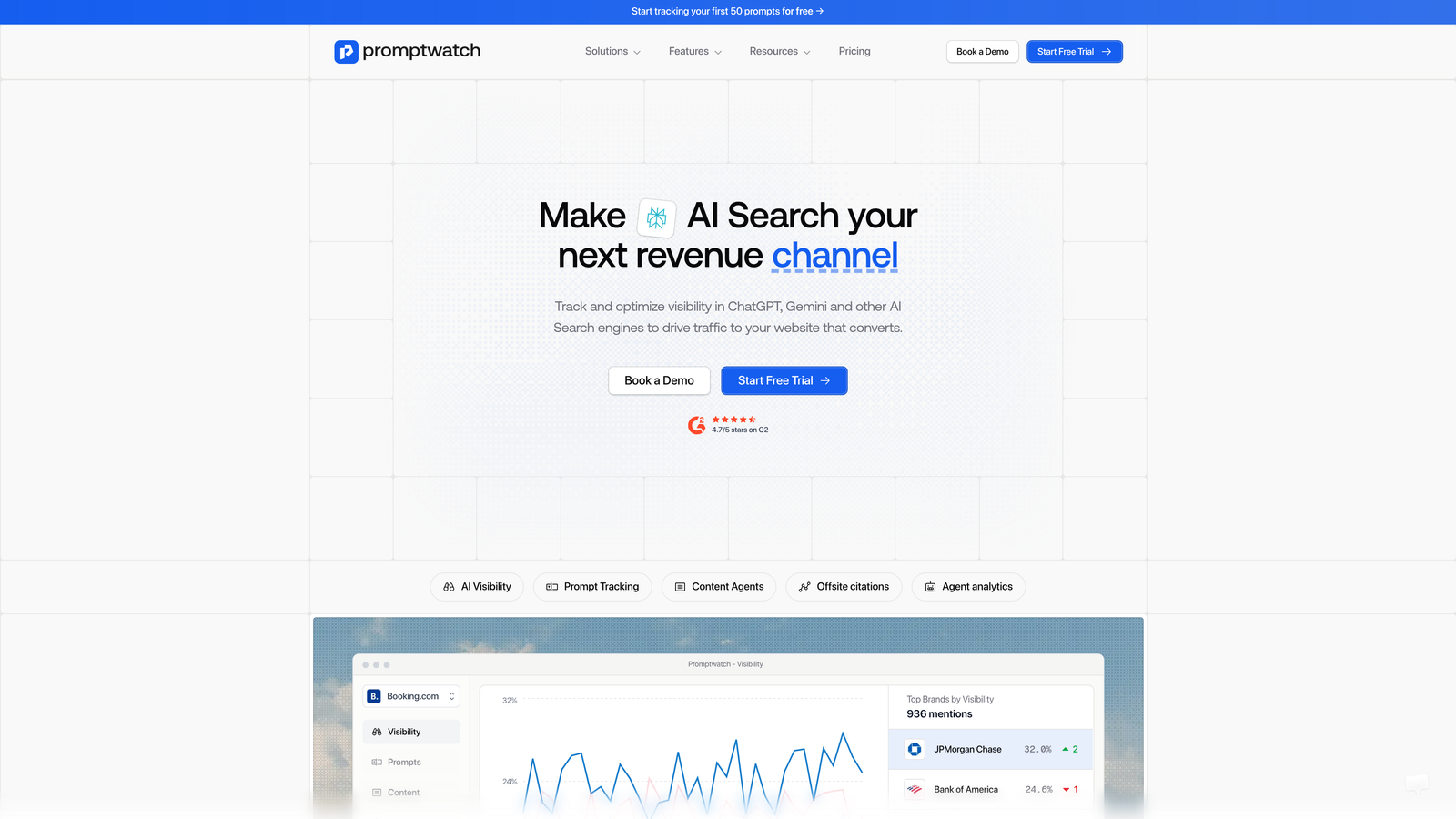
Promptwatch is a focused AI search monitoring tool that tracks brand mentions at the prompt level, helping teams understand which specific queries surface their brand and which don't.
Where This Tool Shines
Promptwatch's core strength is granularity. Rather than giving you a broad sense of AI visibility, it drills down to the individual query level: which exact prompts are returning your brand, which are returning competitors, and where the gaps are. This makes it particularly useful for teams running competitive analysis or trying to build a systematic list of content opportunities based on real AI query behavior.
The alerting system adds a practical operational layer. When your brand's mention status changes in AI responses, you're notified, which matters in a channel where model updates can shift brand visibility without warning. It's a narrower tool than Sight AI but does its focused job well.
Key Features
Prompt-Level Tracking: Monitor which specific queries trigger your brand in AI-generated responses across major AI search engines.
Gap Identification: Surface queries where competitors appear in AI answers but your brand does not, creating a clear content opportunity list.
Mention Change Alerts: Receive notifications when your brand's visibility in AI responses shifts, keeping you informed of model-driven changes.
Reporting Dashboard: Track mention trends over time to measure the impact of content and optimization efforts.
Best For
Promptwatch suits teams whose primary need is monitoring and competitive intelligence at the prompt level. It doesn't include content generation or indexing capabilities, so it works best as a dedicated monitoring layer, either standalone for smaller teams or alongside content tools for larger ones.
Pricing
Check promptwatch.io for current pricing and plan details.
3. Profound
Best for: Enterprise teams and agencies needing share-of-voice analytics and brand positioning data across AI search channels.
Profound is an enterprise-focused AI search analytics platform that provides share-of-voice measurement and brand positioning insights across AI-generated answers.
Where This Tool Shines
Profound approaches AI search presence from an analytics-first perspective. The emphasis is on quantifying brand positioning relative to competitors over time, which is the kind of reporting that resonates with enterprise stakeholders who need to justify investment in AI visibility programs. Share-of-voice metrics give you a comparative lens rather than just an absolute count of mentions.
The multi-brand and multi-market support makes it a practical choice for agencies managing several clients or enterprise teams operating across different product lines or geographies. The reporting layer is built for presentations and executive dashboards, not just internal team monitoring.
Key Features
Share-of-Voice Analytics: Measure how your brand's presence in AI-generated answers compares to competitors across key query categories.
Brand Positioning Tracking: Monitor how your brand's representation in AI answers evolves over time as you publish new content or competitors adjust their strategies.
Enterprise Reporting: Dashboard and reporting infrastructure designed for stakeholder-ready outputs and executive visibility.
Multi-Brand Support: Manage tracking across multiple brands or clients from a single platform, making it practical for agency use cases.
Best For
Profound is strongest for enterprise marketing teams and agencies with a formal AI visibility reporting mandate. If your primary need is analytics and competitive benchmarking with polished reporting, it's a solid fit. Teams that also need content generation or indexing will need to pair it with other tools.
Pricing
Check helloprofound.com for current enterprise pricing and plan options.
4. Peec
Best for: Competitive intelligence teams tracking brand vs. competitor representation in AI-generated search answers.
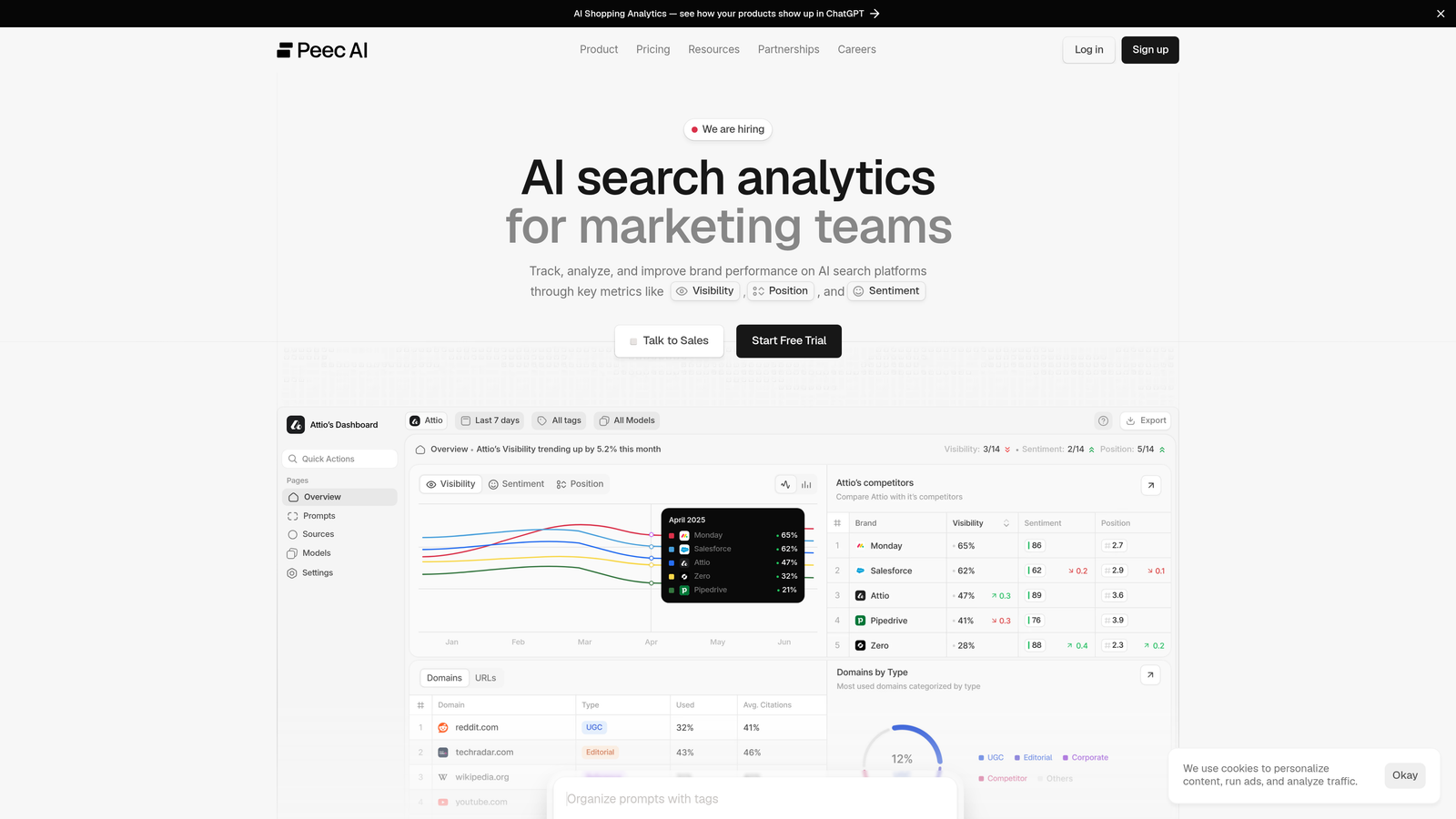
Peec is a competitive benchmarking tool that shows how your brand and rivals are represented in AI-generated search answers across different query categories.
Where This Tool Shines
Where some tools focus on your own brand's visibility in isolation, Peec is built around the competitive comparison. The side-by-side view of how your brand and competitors are represented in AI answers across different query categories gives you an immediate sense of where you're winning and where you're being outpaced. That framing is useful for teams that treat AI search presence as a competitive battleground rather than just a brand health metric.
Query category analysis adds strategic depth. Rather than looking at individual prompts, you can assess your competitive position across broader topic clusters, which helps prioritize where to invest content efforts for the highest competitive impact.
Key Features
Side-by-Side Competitive Visibility: Compare your brand's representation in AI-generated answers directly against named competitors across the same queries.
Query Category Analysis: Identify topic areas where you lead competitors in AI visibility and areas where you're underrepresented.
Competitive Intelligence Reporting: Export and present competitive benchmarking data in a format suitable for strategic planning.
Trend Tracking: Monitor how competitive brand representation shifts over time as both you and competitors publish new content.
Best For
Peec is well suited for teams with a strong competitive intelligence function, particularly those in markets with clearly defined rivals. It doesn't include content generation capabilities, so it functions best as a monitoring and benchmarking layer within a broader tool stack.
Pricing
Check peec.ai for current pricing details.
5. AirOps
Best for: Content and growth teams building automated, GEO-structured content workflows at scale.
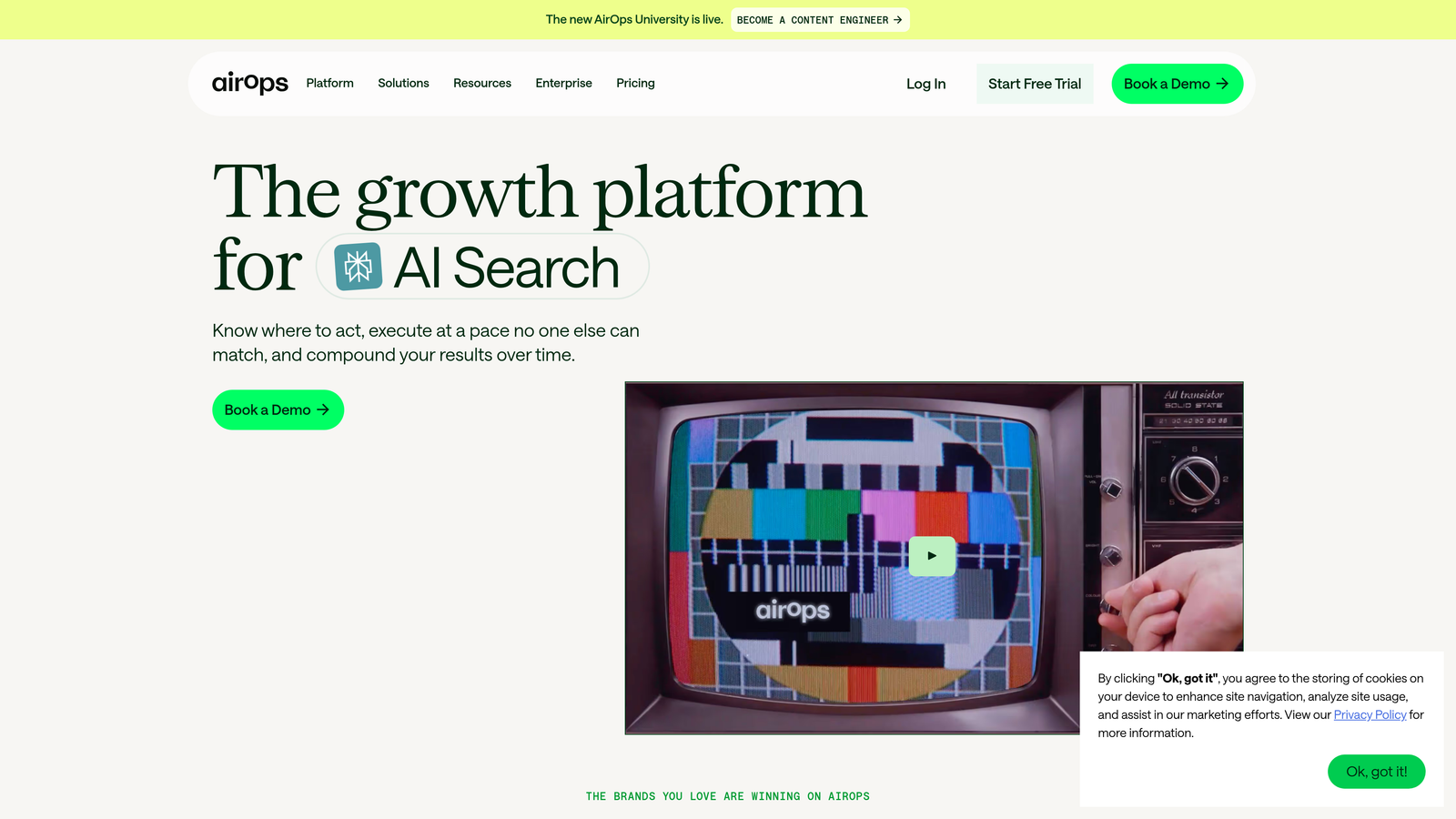
AirOps is a workflow automation platform built for AI-assisted content production, with strong support for GEO content workflows designed to improve AI search retrieval.
Where This Tool Shines
AirOps approaches AI search presence from the content production side rather than the monitoring side. Its workflow automation capabilities let teams build repeatable pipelines for generating content structured for AI retrieval, including the entity definitions, FAQ formats, and authoritative sourcing patterns that make content more likely to be cited by AI models.
The CMS and data source integrations make it practical for teams producing content at scale. You can connect your existing data sources, define content templates optimized for GEO, and automate production workflows that would otherwise require significant manual coordination. It's a strong operational tool for content teams with established processes who want to systematize GEO-oriented production.
Key Features
AI Content Workflow Automation: Build and run automated content production pipelines with CMS integrations for direct publishing.
GEO Content Templates: Structured templates designed for AI retrieval, incorporating the formatting patterns that improve citation likelihood in AI-generated answers.
Data Source Integrations: Connect existing data sources to enable personalized or data-driven content production at scale.
Team Collaboration Tools: Workflow management and collaboration features for coordinating content production across teams.
Best For
AirOps fits content teams and agencies that need to systematize GEO content production at volume. It's less focused on AI mention monitoring, so teams that need both visibility tracking and content production will want to pair it with a monitoring tool or consider a more unified platform.
Pricing
Check airops.com for current pricing and plan details.
6. Writesonic
Best for: Teams needing high-volume AI content production with SEO signals built into the output.
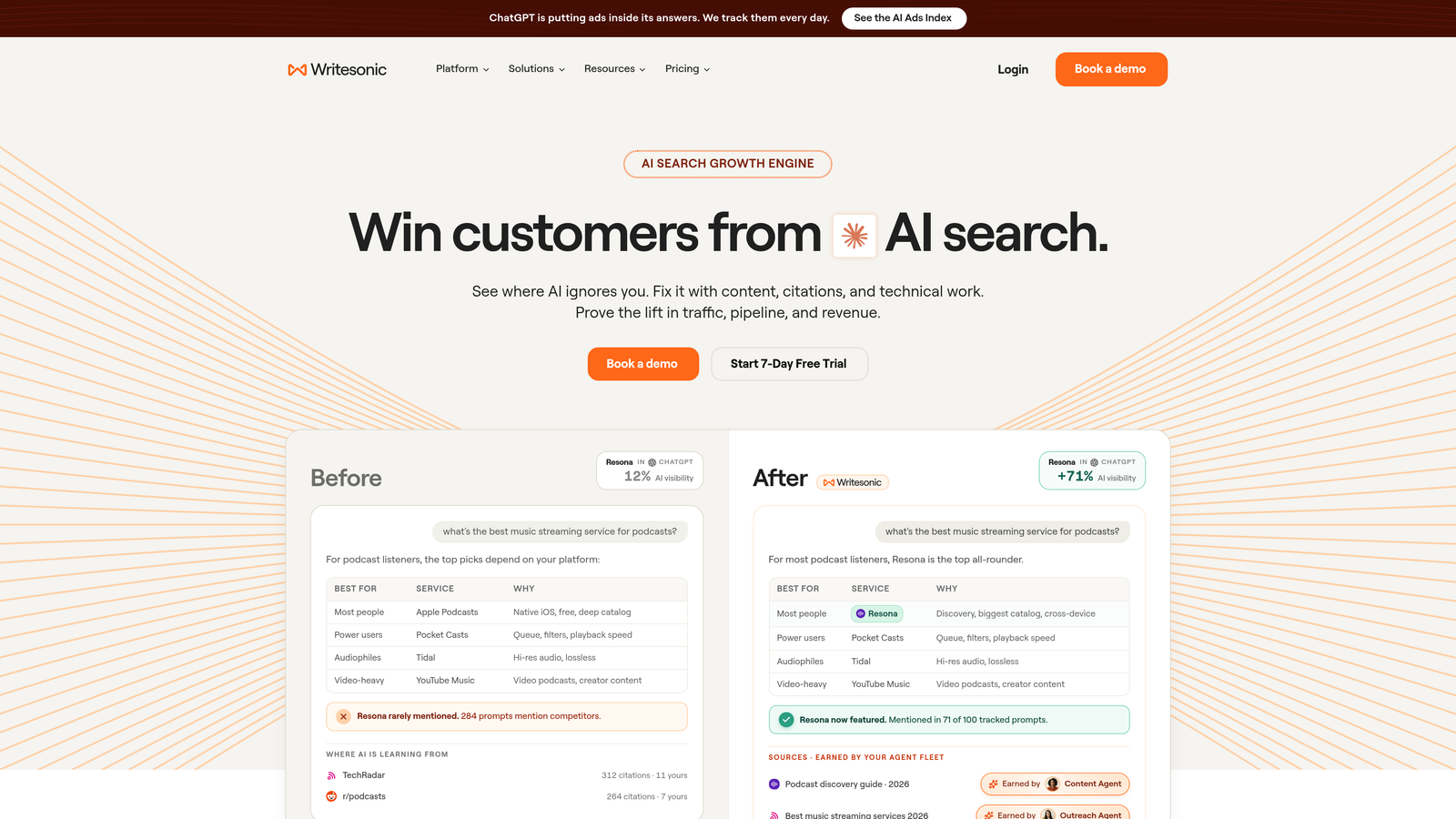
Writesonic is a broad AI content generation suite with built-in SEO signals, useful for teams that need high-volume content production with keyword and topic optimization baked in.
Where This Tool Shines
Writesonic's strength is breadth and accessibility. It covers a wide range of content formats, from long-form blog articles to landing pages and ad copy, with keyword research and content brief generation built into the workflow. For teams that need to maintain content velocity across multiple formats, having those capabilities in one interface reduces tool-switching friction.
The SEO-aware output is a practical feature for teams where traditional search and AI search optimization overlap. While Writesonic isn't purpose-built for GEO or AI mention optimization specifically, the SEO-structured content it produces can contribute to the kind of authoritative, well-organized content that AI models tend to cite. It's a general-purpose content engine with solid SEO fundamentals rather than a dedicated AI visibility platform.
Key Features
AI Article Writer: Long-form content generation with SEO-aware structuring, including keyword integration and readability optimization.
Keyword Research and Briefs: Built-in keyword research and content brief generation to inform content strategy before writing begins.
Multi-Format Support: Generate blog posts, landing pages, ad copy, and other content formats from a single platform.
Brand Voice Customization: Configure the tool to match your brand's tone and style for consistent output across content types.
Best For
Writesonic is a good fit for content teams and solo marketers who need reliable, high-volume content production with SEO fundamentals built in. It doesn't offer AI visibility monitoring or GEO-specific optimization, so teams prioritizing AI search presence specifically will likely need it as part of a broader stack rather than a standalone solution.
Pricing
Check writesonic.com for current pricing and plan details.
Which Tool Is Right for You
The right choice depends on where you are in your AI visibility journey and what your team actually needs to do with the data.
Solo founders and small teams: If you want a single platform that handles monitoring, content creation, and indexing without managing multiple subscriptions, Sight AI is the most complete option at this scale. The Autopilot Mode and CMS auto-publishing are particularly useful when you don't have a dedicated content team.
Content teams focused on production volume: AirOps is worth evaluating if you already have visibility monitoring in place and need to systematize GEO content workflows at scale. Writesonic fits teams that need broad content volume with SEO signals and aren't yet prioritizing AI-specific optimization.
Agencies managing multiple clients: Profound's multi-brand support and enterprise reporting make it a practical monitoring layer for client-facing deliverables. Pairing it with a content generation tool gives you a more complete stack. Sight AI's unified platform is also a strong agency option if you want to reduce the number of tools you're managing per client.
Enterprise teams with competitive intelligence mandates: Peec and Profound both address competitive benchmarking in AI search, with Peec offering more granular side-by-side comparisons and Profound providing the share-of-voice analytics that resonate in executive reporting contexts. Promptwatch adds prompt-level monitoring if query-specific gap analysis is a priority.
If you're still figuring out where your brand stands in AI-generated answers before committing to a full stack, starting with visibility tracking is the logical first step. Stop guessing how AI models like ChatGPT and Claude talk about your brand. Start tracking your AI visibility today and see exactly where your brand appears across top AI platforms, which queries you're winning, and where your biggest content opportunities are hiding.